In January 2026, the PRAGATI (Pro-Active Governance and Timely Implementation) platform completed a decade of operation, Prime Minister Modi has chaired its 50th meeting milestone. Since its launch in 2015, the platform has fundamentally shifted India's governance from a culture of delays to one of time-bound delivery and accountability.The platform has also enabled over 3300 projects worth INR 85 lakh crore to be accelerated, which is a form of cooperative and result-driven governance.
|
Key highlights
- 10 Years of PRAGATI
- What PRAGATI is?
- Why PRAGATI was necessary?
- PRAGATI in Governance
- Impacts of PRAGATI on Cooperative Federalism
- Institutional Significance of PRAGATI
- Multi-Faceted Impacts of PRAGATI
|
The Platform for Pro-Active Governance and Timely Implementation (PRAGATI) was introduced in 2015, and this is a major innovation in the Indian administration framework. PRAGATI, as a digital platform between the Prime Minister and Union ministries and state governments, reflects the concept of cooperative federalism and government, aiming to be results-oriented. It has allowed the real-time tracking of projects, improved the decision-making process, and ensured that the citizen grievance was met in the past 10 years, through the use of technology based on transparency. Combinations of satellite imagery, data analytics, and two-way communication channels have made PRAGATI faster in infrastructure development, more accountable, and thus offer a perspective of a model of participatory governance in modern India.Recently, the Pro-Active Governance and Timely Implementation (PRAGATI) initiative of the government of India has completed 10 years, and in the course of the meetings, Prime Minister Modi has chaired its 50th meeting.
What is PRAGATI and Why it was Necessary
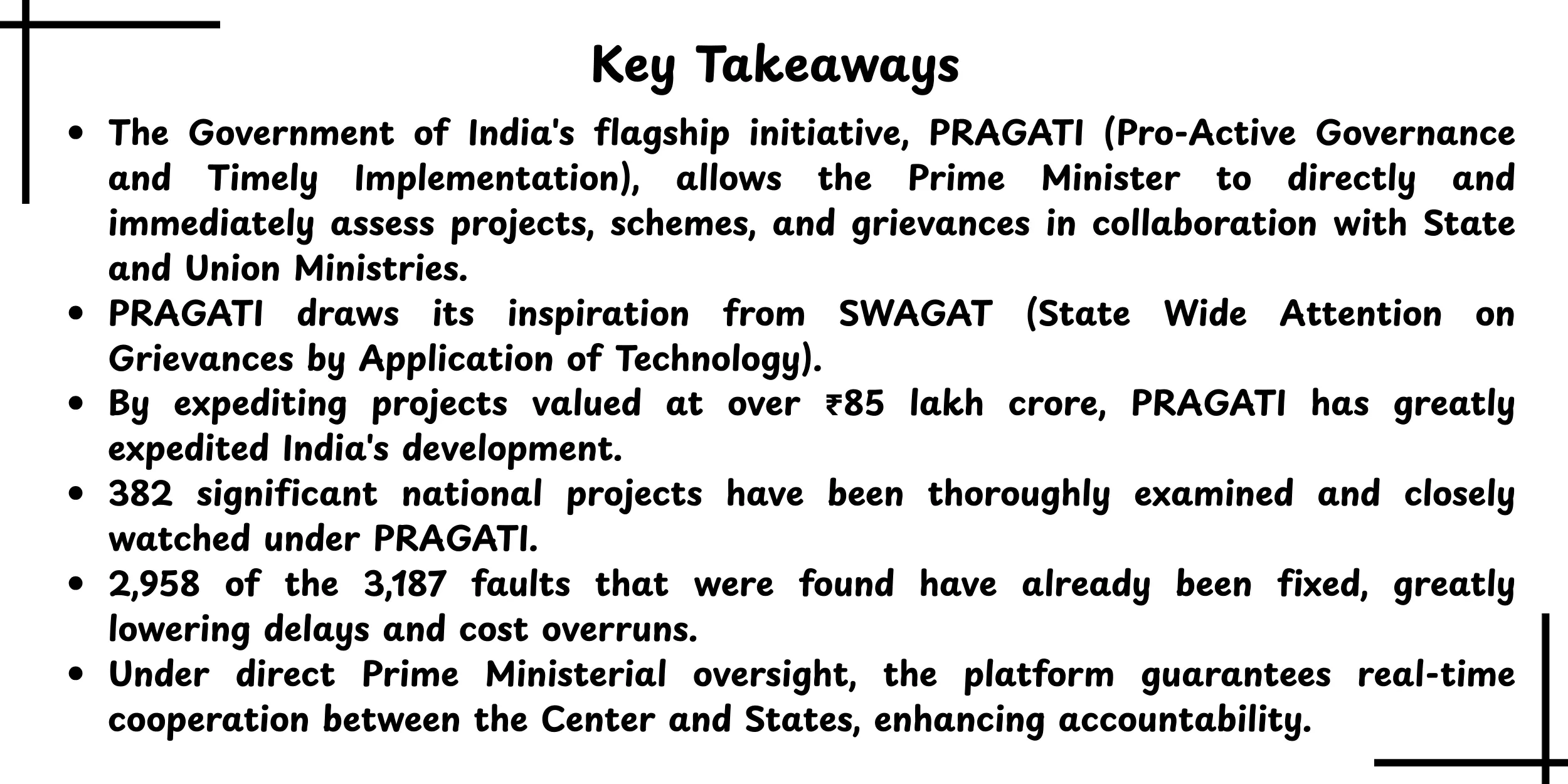
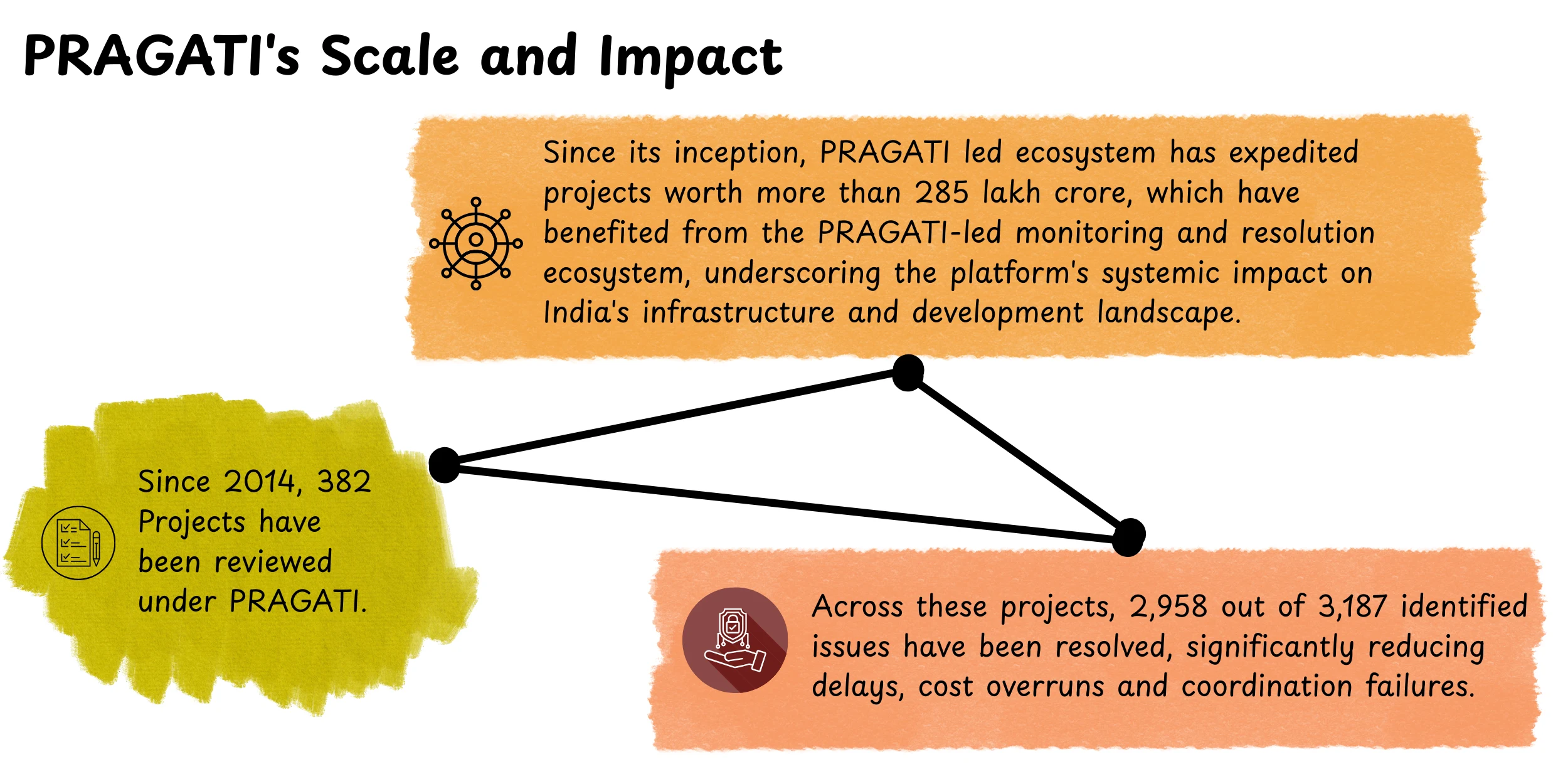
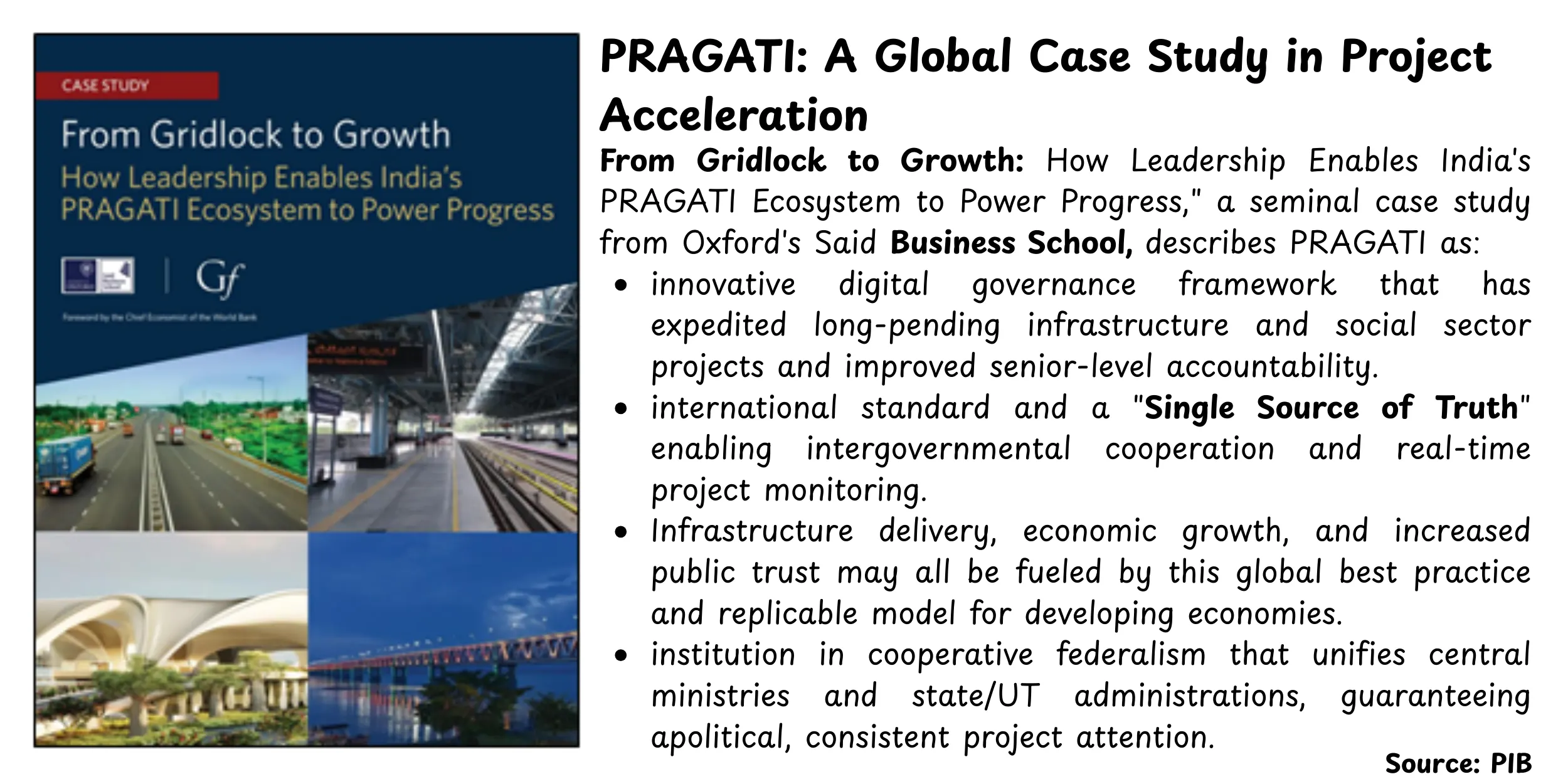
PRAGATI (Pro-Active Governance and Timely Implementation) is India's flagship digital platform, launched in 2015, that uses video conferencing and data management for the Prime Minister to review, monitor, and fast-track major government projects, schemes, and public grievances in real-time with Central and State officials, ensuring accountability and quicker completion.PRAGATI (Pro Active Governance and Timely Implementation) is a digital platform, launched in 2015 and aiming at the institutionalisation of real-time monitoring and cooperative federalism. It had to conquer chronic delays, cost overruns and inadequate coordination of infrastructure and social projects in India. According to research by the Oxford Business School, PRAGATI has sped up over 340 projects with values of USD 205 billion, and official statistics show that 2,958 of 3,187 raised issues were resolved, and thus the bottlenecks were lessened substantially. Therefore, PRAGATI is an example of technology-based, result-oriented governance.
The Beginning and Development of PRAGATI
PRAGATI was introduced in March 2015 and was developed as a digital government initiative to connect the Prime Minister's office, Union ministries and the state governments so that real-time monitoring of projects can be done. With the passage of time, it has become a strong system by settling more than 3,300 projects worth INR 85 lakh crore, therefore increasing transparency and cooperative federalism.A Decade of Cooperative, Outcome-Driven Governance. PRAGATI has significantly accelerated India's development by fast-tracking projects worth more than ₹85 lakh crore. Under PRAGATI, 382 major national projects have been systematically reviewed and closely monitored.
Process of Review and Follow-up in PRAGATI
The PRAGATI institutionalises a structured review method by means of monthly meetings that are led by the Prime Minister and incorporate both central ministries and state governments on a digital platform. Using geo-spatial instruments and video conferencing, 382 mega-projects have been managed systematically;about 2958 issues out of 3,187 issues raised were resolved, hence reducing significant delays and cost overruns.
Project and Issue Escalation Mechanism of PRAGATI
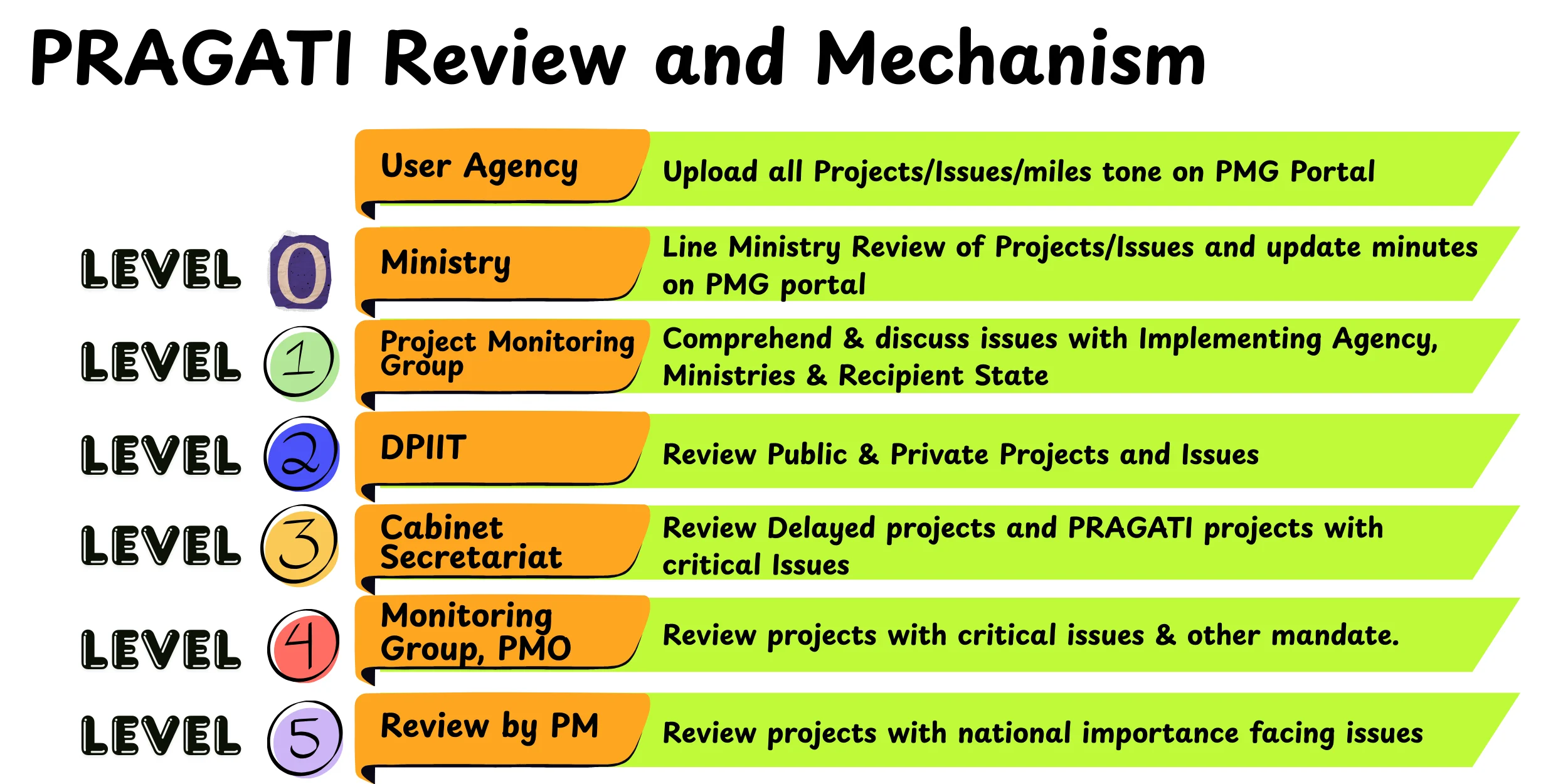
Within PRAGATI,the issues are addressed at the level of the ministry and then advanced to a higher point in the hierarchy when the issues are not resolved, with the final point being Prime Ministerled reviews. This system secures accountability and the effective resolution of any complex issues at the right time, thus promoting cooperative federalism. It has facilitated surveillance of projects with a valuation worth above INR 85 lakh crore, which has strengthened transparency and efficiency in governance.
Impact of PRAGATI on the Major Infrastructure Sectors
PRAGATI has boosted infrastructural growth within the past 10 years through alleviating transport, energy and urban development bottlenecks. Formal reports attest to the clearance of projects worth above 85 lakh crore rupees, and studies highlight how the platform has been instrumental in accelerating 340 initiatives at an estimated cumulative value of USD 205billion, thus making sure that projects are completed in asignificant time and how it has empowered cooperative federalism in key areas.PRAGATI will continue to be a vital governance platform in realizing the National Vision of Viksit Bharat 2047, Prime Minister Modi said, emphasizing the need for better coordination, faster implementation, and continuous monitoring as the national development agenda accelerates, while ensuring timely and high-quality execution of projects.
How PRAGATI has Empowered Cooperative Federalism and Governance
PRAGATI is now a central organisational platform in the reforms of governance in India; it reflects the best example of cooperative federalism, which is the adoption of technology-enabled coordination and result-oriented oversight. The scheme has over a decade-long history of portraying increased transparency, accountability and a timely project execution.
Contribution of PRAGATI to Cooperative Federalism
Under the concept of cooperative federalism, PRAGATI integrates the Prime Minister's office, Union ministries, and state government to one integrated digital platform, with the po10tial to allow real-time communication and quick clearing of administration bottlenecks. The framework, therefore, allows state structures to take an active role in the priorities of national development without ceding authority in the implementation.
PRAGATI’s Achievements of Governance Outcomes
According to official statistics, 2958 out of 3,178 issues highlighted were resolved, and projects counted over 85 lakh crores rupees in value listed across ministries and states. A study by the Business School, Oxford, also strengthens the platform by stating that it has facilitated 340 projects that have added up to the USD 205 billion, which has had a transformative effect on the world.
Institutional Significance of PRAGATI
PRAGATI has strengthened accountability and reduced delays through the introduction of systematic reviews and citizen grievance redressal, and the use of GIS for downstream activities, offering an enhanced decision-making tool. The project is therefore a paradigm of how cooperative federalism, augmented with digital governance structures, can bring about quantifiable development results.
Long-Pending Projects Unlocked with the Help of PRAGATI
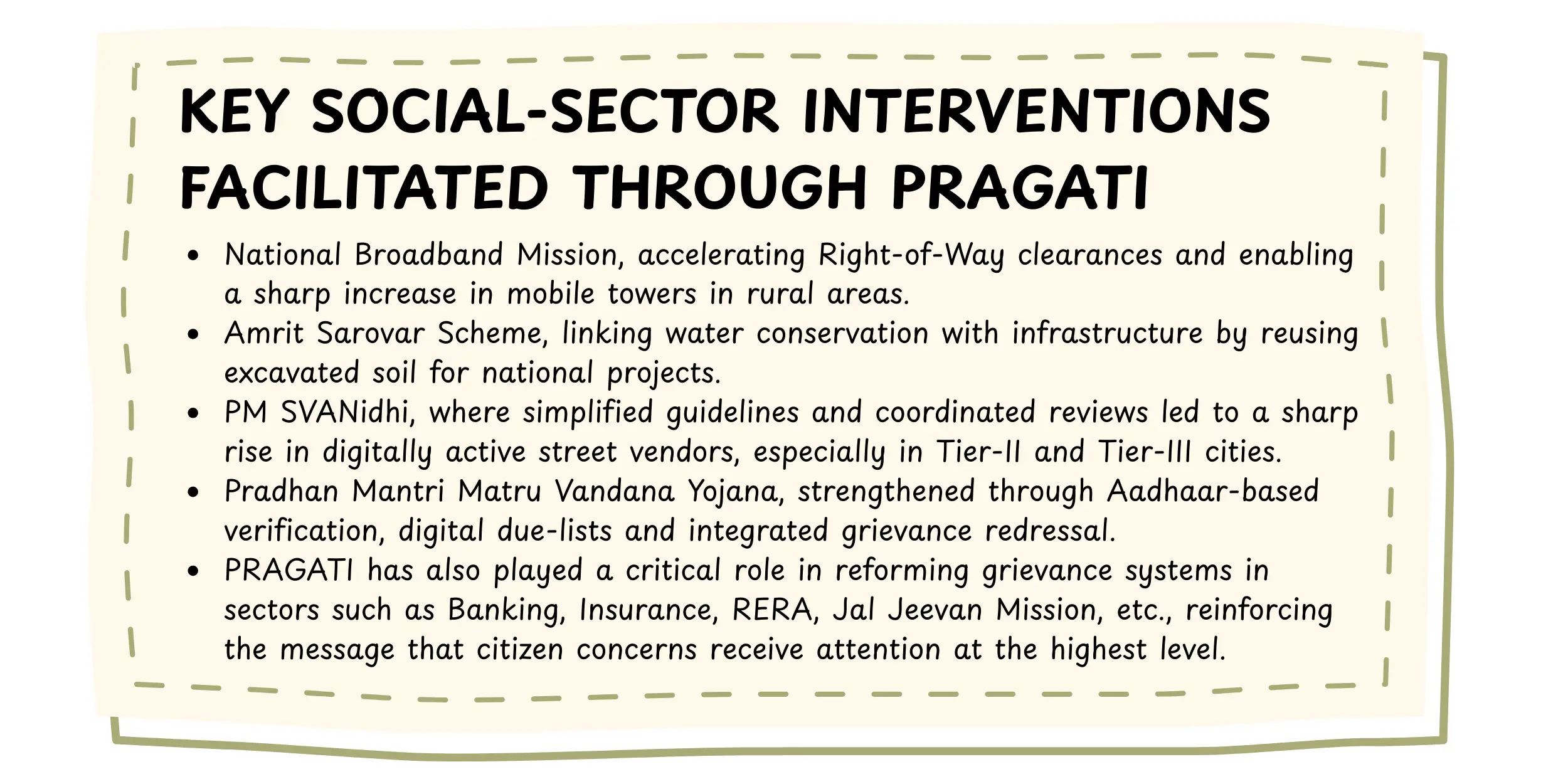
PRAGATI has portrayed transformative ability in organising long-term projects within the country. Through the incorporation of technology, regulated review processes, and principles of cooperative federalism, it has solved the deep-rooted bottlenecks that had held development over a long period of time.
PRAGATI in Connection and Transportation Projects
One vivid contribution witnessed by PRAGATI is in the transport sector. The direct monitoring has increased the speed of the expansion efforts towards highways and the modernisation of railways in the country. To take an example, the Eastern and Western Dedicated Freight Corridors, which were previously plagued with delays, have had faster developments in their exis10ce through PRAGATI.
PRAGATI in the Energy and Power Sector
PRAGATI has also addressed the bottlenecks in the energy sector, especially the stalled thermal and hydroelectric power projects. The platform also helped in solving the land acquisition and environmental clearance matters so as to commission power plants more quickly. The analysis of Oxford Business School has shown that PRAGATI has accelerated 340 USD 205 billion worth of projects, and a large part of these projects were related to energy.
PRAGATI in City and Social Infrastructure
The projects of urban development, like the ex10sion of metro rail networks in cities like Delhi and Bengaluru, have also been enhanced by the PRAGATI-coordinated review mechanisms. Old housing and sanitation initiatives have also been has10ed, thus having an impact on improved provision of social infrastructure. According to official reports, 2,958 issues out of 3,187 detected have been addressed by PRAGATI, which highlights its contribution to the promotion of the emergence of citizen-centric governance.
Multi‑Faceted Impact of PRAGATI
PRAGATI has proven to have a multi-dimensional effect on governance involving the use of technology, cooperative federalism, and outcomes that are citizen-centric. Its 10-year trend is also representative of more efficiency, increased transparency, and accelerated implementation of projects within a range of industries.
Economic and Infrastructure
PRAGATI has significantly cut down the implementation process by fast-tracking long-time led projects in transport, energy and cities. Documented projects have been cleared in the value of about 85 lakh crore, and a recent study of Oxford University Business School shows that 340 projects worth USD 205 billion are being accelerated, hence showing the economic importance of the initiative.
The Governance and Accountability Gains by PRAGATI
PRAGATI has strengthened the accountability mechanisms through the use of satellite images, video conferencing, and systematic reviews. Throughout the programme, 2,958 out of 3187 issues were addressed, bringing about a high amount of bureaucratic speed and entrenching more transparency into decision-making regimes.
Citizen‑Centric Outcomes of PRAGATI
In addition to the infrastructural success, PRAGATI has resolved grievances at hand so as to provide responsive governance. The digital interface of PRAGATIempowers the citizens, as it also connects global issues with domestic leadership, which supports participatory democracy and the spirit of cooperative federalism.
Conclusion
PRAGATI is one such innovative technology-driven transformative governance technology that has institutionalised cooperative federalism with monitoring and structured accountability in the last 10 years. The programme has proven the effectiveness of result-oriented governance because it has accelerated over 85 lakh crore worth of projects and fixed thousands of problems. Participatory democracy is also emphasised by the citizen-centred grievance redressing. With more and more convoluted developmental pressures facing India, PRAGATI can be used as a model of how online platforms can perpetuate transparency, efficiency and collaborative federalism and thus define the direction in which governance will take place over the next 10 years.