|
Key highlights
- Significance of Critical Minerals
- India’s Mineral Mission
- Refining Gaps in India
- Import dependency
- Major Challenges Faced by India
- Way forward for India
|
The mineral mission in India has advanced on the issues of reforms involving mine laws and exploration; however, the critical weakness lies in the areas of processing and refining. India still remains reliant on imported refining facilities, in the lack of which it depends on imported essential minerals that are key to renewable energy, defense, and technology industries. In turn, the resilience of supply chains and the attainment of strategic autonomy cannot be possible without strengthening midstream industries, cultivating research and development, and developing international collaboration.
India is heavily investing in its midstream oil and gas sector, moving "beyond extraction" to build robust infrastructure through significant government initiatives and policy reforms.
|
Tips for Aspirants
The current article is an invaluable asset to the Union Public Service Commission (UPSC) Civil Services Examination (CSE) and State Public Service Commission (PSC) examinations because it is a blend of the reasoning on governance, economics, energy security, and strategic autonomy, and thus it expounds on policy gaps and emphasises the need to maintain sustainable development.
|
|
Relevant Suggestions for UPSC and State PCS Exam
- Critical Minerals Significance: The energy transition, military equipment, semiconductor production, and sophisticated manufacturing cannot do without critical minerals.
- Mineral Mission in India: The mission focuses on exploring and regulating the mining industry of India, but has not gone further to include the development of the midstream refining division.
- Gap in Refining: The country at present is exporting raw ores yet importing processed ores, creating economic inefficiency and strategic weaknesses.
- Reliance on China: The country has a high level of dependence on China and other countries for refined lithium, cobalt, as well as extracted rare-earth elements.
Challenges:
- Barriers to capital and technology.
- Red tape and environmental issues in administration.
- Week R&D and Human Resource.
- Poor political environment and delays in the supply chain.
Way Forward:
- Use policy incentives and industry-based programs.
- Encourage public-private and international cooperation.
- Invest in research and development, professional training, and green-refining technologies.
|
The mineral mission of India has emerged as the pillar of its broad economic and strategic infrastructure, particularly under the changed environment of the energy transition in the world and the growing need to use key minerals. Lithium, cobalt, nickel, and rare earth elements are resources that cannot be replaced by renewable energy technologies, advanced manufacturing, and national defense. Despite major reforms in India in mining laws, triggered exploration, and guaranteeing international supply chains, the discussion has been largely biased against upstream operations. The middle ground, i.e., processing and refining, has also been the gap that is still missing in the Indian strategy of minerals. With no well-established capacity to refine its oil, India is in danger of continuing to depend on its overseas partners, and hence, to compromise its long-term goals of technological independence and strategic sovereignty. Furthermore, the lack of advanced refining facilities constrains value addition, reduces industrial competitiveness, and creates geopolitical susceptibility to the economy. To resolve this gap requires a systematic policy re-orientation where refining is institutionalised as part of the overall mineral mission, which is supported by research and transfer of technology as well as sustainable operations. It is the upliftment of this neglected section of the value chain alone that can enable India to convert its mineral endowment into a solid foundation of industrial growth and energy security.
India’s Critical Mineral Imperative
The Indian mineral mission has been noted to be a building block to the Indian industrial and strategic future. The renewable energy sources, improved manufacturing, and defence technologies are all based on critical minerals, but the policy discourse in India has frequently focused on exploration and mining, and neglected midstream operations like refining and processing. This disproportion proves to be a threat to economic stability and technological independence.
India's Critical Mineral Imperative is a national strategy, spearheaded by the National Critical Mineral Mission (NCMM) (launched 2025), to secure essential minerals (like Lithium, Cobalt, REEs) for its clean energy, defense, and tech goals, reducing import dependence through aggressive domestic exploration (GSI), overseas asset acquisition, recycling, R&D, and strategic stockpiling, aiming for self-reliance by boosting mining, processing, and innovation in the entire value chain.
Critical minerals & strategic importance
Lithium, cobalt, nickel, and rare earth elements are vital critical minerals that are essential to clean energy, electric mobility, and aerospace. They are the foundation of batteries, wind turbines, and semiconductors, and hence the focus of the effort to make India energy transition-oriented and competitive in industry. These resources are directly recognised by the National Critical Mineral Mission (NCMM), which was initiated in 2025 and claims to use them as the new currency of progress, with the emphasis on ensuring the security of the supply chain and reducing the impact of dependence on imports.
Current policy landscape
India has also implemented some reforms to its Acts concerning Mines and Minerals (Development and Regulation) by increasing the number of exploration licenses, simplifying the procedure of auctions, and motivating the involvement of a private party. Nevertheless, these interventions are mostly upstream-based. Although exploration and mining are a must, they do not ensure strategic independence unless they are coupled with home refining capacity. This is because of the lack of strong midstream infrastructure that continues to serve as a dependency on external suppliers, especially China, which controls most of the rare earths and battery metals refining in the world.
The gap in refining and implications
The most value-adding processes in the mineral value chain are processing and refining. India stands to lose the other extreme and export raw ores to bring imported finished products at an increased cost without domestic refining. This not only diminishes the competitiveness of the industries in India but also places India at a geopolitical risk. As an example, the collapse of global supply chains during the COVID-19 pandemic highlighted the weakness of excessive reliance on external refining centres.
Overall mineral policy
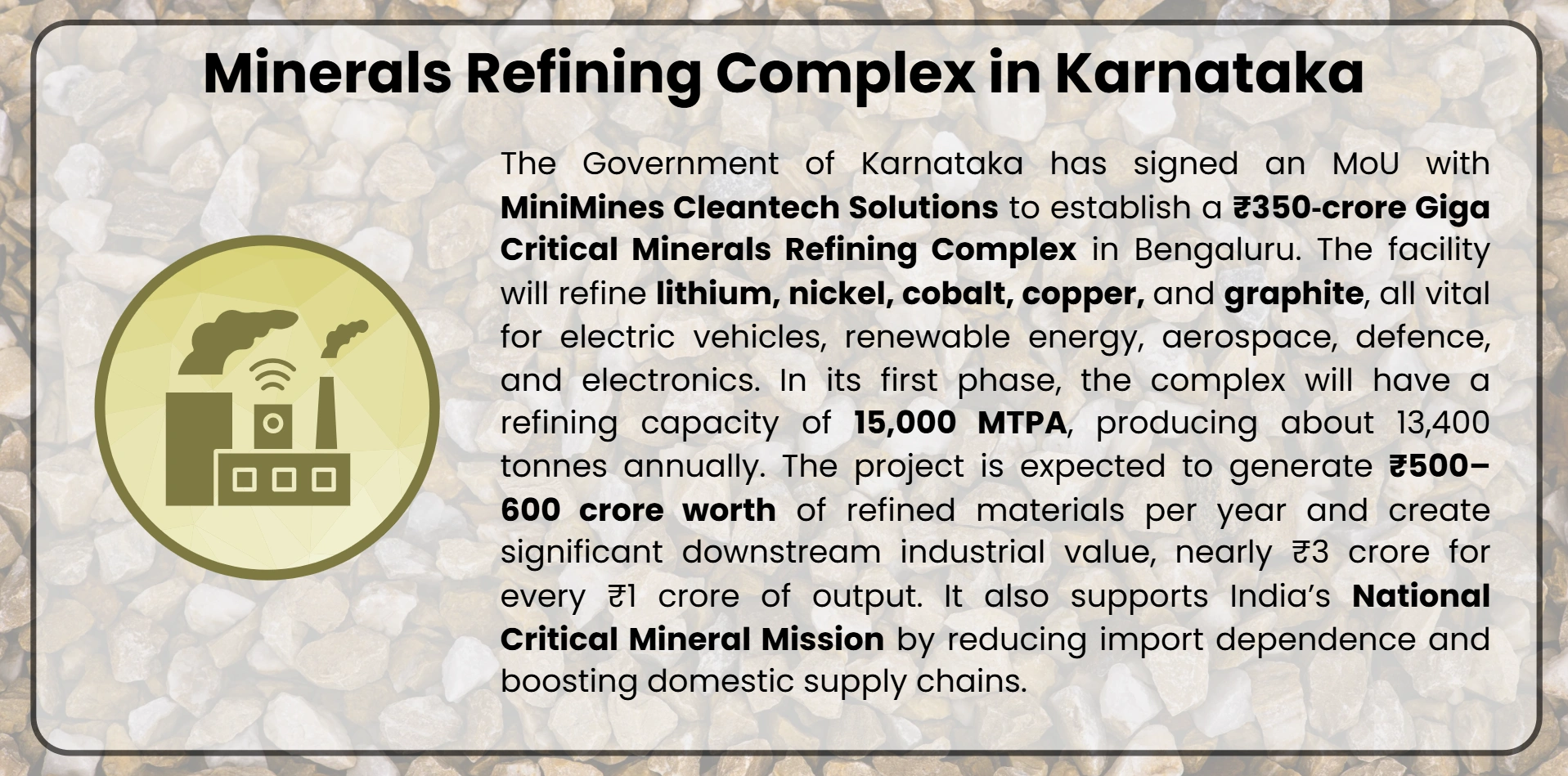
The gap can only be bridged through policy interventions. It needs to invest in refining technologies, public-private cooperation, and research on sustainable processing approaches. Efforts like the 350 crore complex of refining the critical minerals in Karnataka are some of the early attempts at creating domestic capacity. Such projects should be integrated into national industrial and climate strategies to ensure that India not only mines but also finds its path to mineral independence.
The Unrecognized Segment: Processing and Refining
The mineral agenda in India has achieved considerable development in the sphere of exploration and minerals regulation; nevertheless, the midstream industry involving processing and refining is significantly disordered. This neglected area is central to the change of primary ores into industrially competitive input, which, in turn, fundamentally defines the ability of the country to achieve mineral self-sufficiency and other strategic independence.
The phrase "The Unrecognized Segment: Processing and Refining" serves as a conceptual title applicable across several technical and professional fields. It refers to the identification and subsequent analysis or correction of an anomaly, error, or untapped area that falls outside of established parameters or current understanding.
Strategic Role of Refining
Refining and processing is the highest value-added stage of the mineral supply chain. Mining may provide access to raw material, but through refining, the raw material is converted into the form of a component to be used in batteries, semiconductors, and renewable energy technologies. States such as China dominate this stage and refine more than 80 percent of the world's rare-earth throughput. The fact that India continues to depend on imported refined lithium, cobalt, and rare earths in terms of industrial competitiveness therefore undermines the industrial competitiveness of the country and exposes the country to geopolitical instability.
The existing gaps in the Indian ecosystem
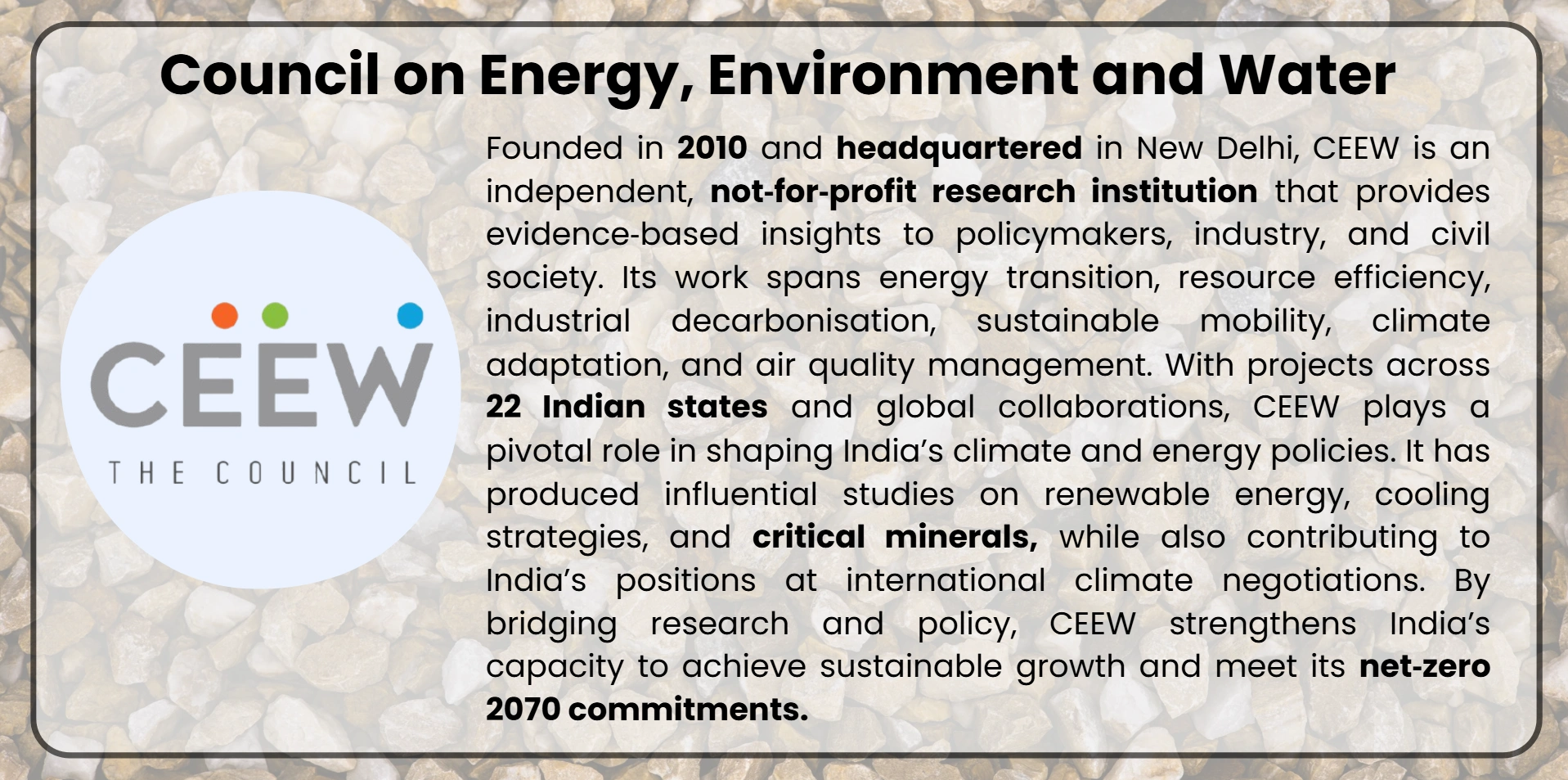
However, the refining infrastructure in India is mostly ineffective in spite of a series of policy changes. Most of the ores mined in the country are bought out at very low prices, with a large portion of them later being re-imported as refined products at very high prices. This inefficiency cycle continues to make the economy ineffective and threatens supply-chain resiliency. Articles published by the Council on Energy, Environment and Water (CEEW) highlight the disunity of the refining ecosystem in India, which has a low level of participation by the private sector and aspects of technology innovation.
Obstacles that hinder Development
Granting of a refining capacity requires a lot of capital expenditure, high technological solutions, and a highly qualified workforce. Environmental issues, including waste disposal and emissions, also make the introduction of new refining plants even more complicated. Furthermore, the reliance on technologies of other countries to process minerals adds to the vulnerability in the supply chain during the worldwide disruptions in the scope of the supply-chain. Without the intentional policy incentives, the existing refining gap is bound to remain in place to hamper the mineral mission in India.
Strengthening Refining
In order to overcome such obstacles, India needs to incorporate refining as an extension of its overall mineral policy agenda with an accurate policy intervention. Capacity building can be triggered with the help of public-private partnerships, international collaborations, and technology-transfer agreements. Specific investments in research and development of sustainable refining techniques, e.g., low-emission hydrometallurgical processes, will be used to make sure that they comply with environmental guidelines. Also, refining efforts should be linked to the national goals of India in terms of industry and climate to encourage synergies that help strengthen the economy and energy security at the same time.
Obstacles to Processing Capacity
It is noted that the mineral strategy in India has made progress in terms of exploration and mining reform, though the mid-stream steps in mineral processing and refining were significantly limited. The architectural, technological, and environmental challenges preserve the formation of a strong refining capacity, and therefore, restrict the ambitious self-sufficiency of this country on essential minerals.
Obstacles to processing capacity involve issues like poor visibility, inaccurate forecasting, resource shortages (skills, people), process bottlenecks, and variability (demand, quality), leading to constant crisis management; in cognitive contexts, mental health (anxiety, depression), neurological factors, lack of sleep, and multitasking overload hinder efficient information processing.
High Capital and High Technological Barriers
The development of mineral refining plants requires huge capital investments and advanced technological skills. Unlike mining, which is reasonably labor-intensive, refining requires sophisticated equipment and intricate chemical operations, and precision engineering. The Indian industrial ecosystem is yet to develop large-scale refineries that could tackle major mineral resources like lithium, cobalt, and rare earths, so that it does not have to depend on overseas refining centres, especially China, which controls the mainstream.
Environmental and Regulatory restrictions
Refining processes produce a large amount of waste, emissions, and chemical by-products, and therefore bring environmental issues. Nevertheless, strict regulation systems are necessary, but they tend to slow down the approval of projects and discourage individual investment. The absence of evident principles on sustainable refining operations also makes it difficult to build new plants. Devoid of the incorporation of green technologies, including the low-emission hydrometallurgical procedures, India would be exposed to ecological outrage and worldwide investigations concerning ecological adherence.
Poor Research and Manpower
Indian mineral processing is a research ecosystem that is underdeveloped. Although universities and research institutes took steps in the mining sciences, there are few refining technologies and R&D efforts. Moreover, the lack of skilled personnel to work in the industry who have been trained in the more sophisticated chemical engineering and metallurgical processes limits the expansion of the industries. India will run out of workers capable of maintaining a local refining sector without a specific investment in education and training.
Way Forward
The mineral mission of India cannot achieve strategic autonomy on the basis of mining, but mid-stream level processing and refining should be reinforced. To create resilience in the mineral supply of China, it is necessary to have a holistic approach that incorporates policy, technology, and sustainability.
Policymaking and Institutional Support
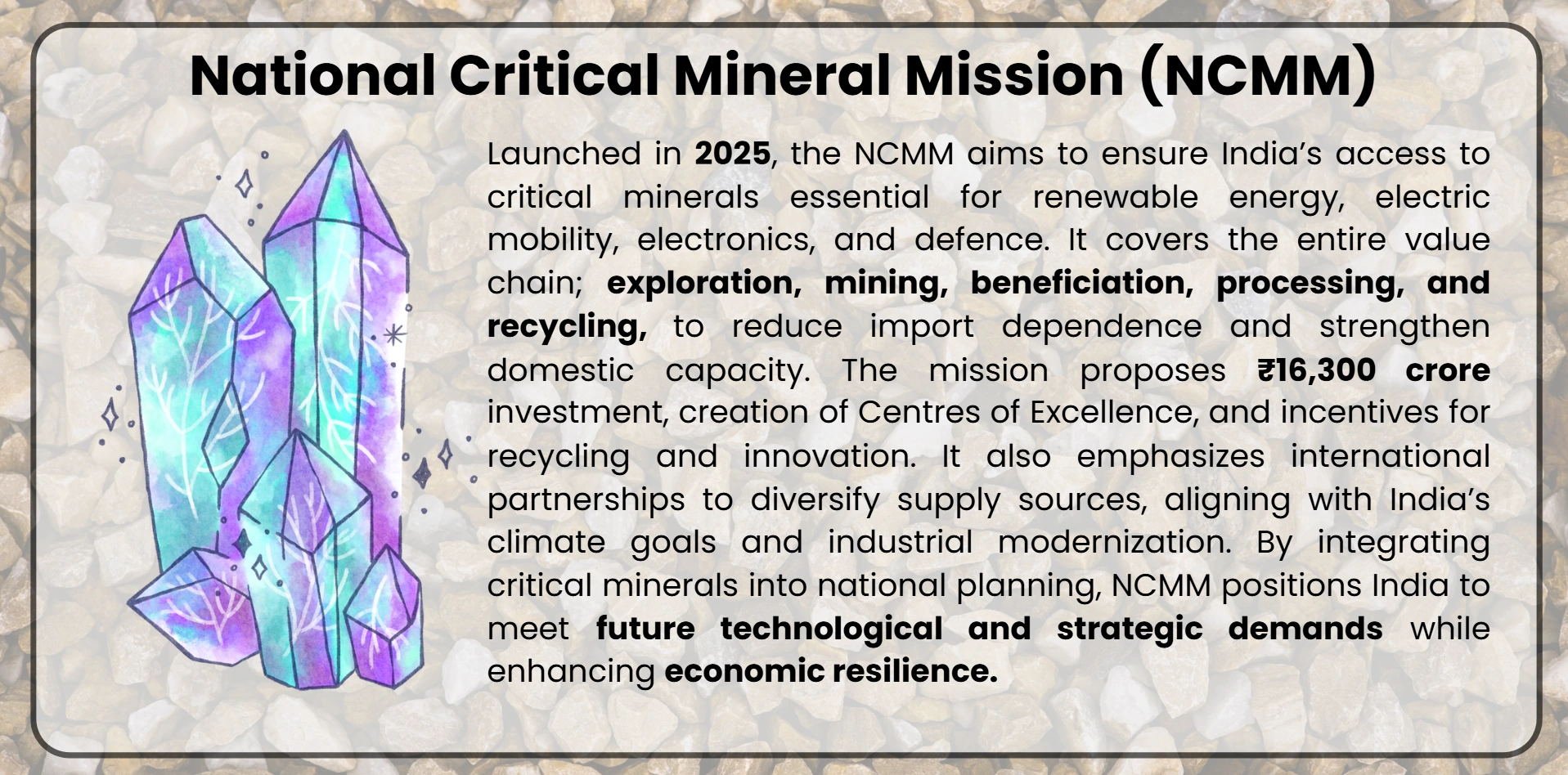
There should be a deliberate policy set up that encourages investment in refining capacity. In 2025, the National Critical Mineral Mission (NCMM) already announced plans to introduce a scheme entitled INR 1,500 Crore to stimulate recycling and midstream industries. The increased financial incentives, coupled with tax incentives and standards of dispensation, should be extended in the case of the private sector in the form of production-related plans and expedited approvals. Innovation and capacity building may also be institutionalised through the formation of Centres of Excellence that are listed to refine technologies.
Global Cooperation and Partnerships
The existence of public-private partnerships (PPPs) may gather funds and skills, whereas international cooperation guarantees the availability of sophisticated technologies. India has also signed Memoranda of Understanding with resource-abundant countries like Australia, Argentina, and the Democratic Republic of Congo in order to establish cooperation in the areas of exploration and processing. Through such collaborations in the transfer of technology and joint ventures, a refining ecosystem will be established quickly.
Research and Development
To empower refining capacity, there is a need to invest long-term in R&D to advance low-emission hydrometallurgical and pyro-metallurgical processes in universities and research institutes. Training in metallurgical engineering and chemical science is also important to develop an employee who will be able to maintain the sophisticated state of the refining industries. These initiatives should be tied to the overall industrial and climatic program of India in order to attain economic competitiveness and environmental compliance.
Green practices in Refining
Sustainability of the environment has to be integrated into the refinement strategies. The green technologies to be adopted, including closed-loop recycling, low-carbon refining, will reduce the ecological footprint. The priority of the NCMM on recycling of critical minerals is one such step. Incorporation of circular economy concepts into refining projects will not only help minimize waste, but it will also help India to be credible in the global climate negotiations.
Conclusion
The mineral mission of India, however broadly focused, is still incomplete without the concerted focus on the processing and refining processes. Creating strategic independence or industrial competitiveness cannot be achieved through the extraction of minerals, but rather as a result of the midstream sector that converts raw ores into a key factor in producing energy, defense production, and high-tech manufacturing products. The defeat in capital, technological, and sustainability issues requires productive policy incentives, healthy cooperation between the state and business, and consistent investment in research and development of human capital. The introduction of greener refining operations even brings the national mineral strategy closer to the general climate aims. As a result, it means that a refining ecosystem is unavoidable in making India turn its mineral resources into a sustained economic and geopolitical strength.