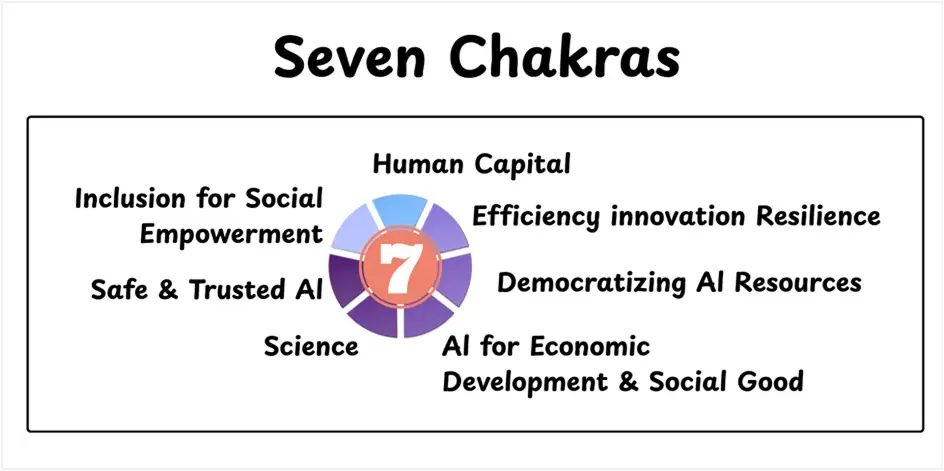
The Seven Chakras translate the guiding Sutras into clear and practical areas for multilateral action. The Seven Chakras of AI represent a broad framework introduced by India to guide global artificial intelligence policy, development, and application, with a strong focus on responsible, inclusive, and sustainable growth.The India-AI Impact Summit 2026 is receiving Global attention as the first global AI conference to be held in the Global South, and it will be held in New Delhi, between 16 and 20 February.
|
Key highlights
- India-AI Impact Summit 2026
- Global Leader in AI: India
- The Seven Chakras
- India’s AI Initiatives and Flagship Programs
- India’s AI FutureSkills Initiative
- India’s BHASHINI platform
- India AI Safety Institute
|
The Seven Chakras of AI form the strategic framework for the India–AI Impact Summit 2026. India-AI Impact Summit 2026 uses Seven Chakras to translate AI principles into real-world policy and applications for global cooperation. The India-AI Impact Summit 2026, which will take place in New Delhi, will be a ground-breaking conference of technology regulation in the world, as it will be the first significant AI summit in the Global South. The summit is anchored on the principles guiding the work, that is, People, Planet and Progress, and it attempts to convert the vision into measurable impact. India places itself at the centre of the process of enabling inclusive, responsible and sustainable AI by making use of its Seven Chakras. Through domestic efforts (including BHASHINI, Bharat-VISTAAR, and the IndiaAI Safety Institute) and foreign collaboration, the summit puts India in the context of increasing its influence on the creation of fair access, responsible implementation, and development based on innovation. This move is a decisive shift in the transition from dialogue to implementation with AI cooperation in the world. What is important about it is that it brought together more than 100 countries in order to build responsible, inclusive AI based on the Seven Chakras and Three Sutras and align innovation, equity, and global collaboration.
AI Summit 2026: 7 Chakras for Global AI Policy
The "Seven Chakras" represent the seven interconnected thematic working groups, or pillars, of the India–AI Impact Summit 2026, which aim to position India as a global leader in artificial intelligence by transitioning from dialogue to implementation. The role of India as a global leader in the field of artificial intelligence is gaining recognition in the global market, and the India-AI Impact Summit 2026 is another milestone in regulating technologies.
India as a Global Convenor
India is going to host the global AI summit, thus it becomes a facilitator of dialogue in the Global South. The summit, planned in New Delhi, shows the vision of India, that is, Welfare of All, Happiness of All and its rules and efforts to make artificial intelligence work in coordination with human-related values.
Strategic Frameworks of India AI Summit
The summit is rooted in the Three Sutras of people, planet and progress, in which rights, sustainability and fair development are envisioned. The operationalization of these principles are given in the form of his Seven Chakras, which are the thematic working groups that work the vision into attainable results in human capital, inclusion, safety, science, resilience, democratisation of resources, and social good.
The Indian Leadership in AI
India is among the top three in the world when it comes to acquiring AI talent, with 33 percent growth in hiring reported in the Stanford AI Index Report 2025. Indian initiatives, including FutureSkills (serving 500 PhD students and 5 000 postgraduates) through India AI Future Skills and BHASHINI (giving universal access to AI in 36 text languages and 22 voice languages) shows the ability of India to be an inclusive innovation country.
Global Importance of India AI Summit
Through the connection between the national agenda and the global partnership, India will become a trustworthy player in the development of responsible AI standards. The summit thus represents the shift of a conversation to action, playing a reinforced role in empowering AI, equitable and sustainable trends globally in India.
The Seven Chakras: Global Cooperation Structural Framework
The Seven Chakras of AI Impact in India is an elaborate model of translating normative principles to policy action. Every Chakra has its thematic area of collaboration, which in turn helps to establish inclusive, responsible, and sustainable development of artificial intelligence in many situations of society around the world.
Chakra One: Human Capital
India focuses on fair skills development and workforce transition approaches to ensure a future-ready situation using AI. According to the Stanford AI Index Report 2025, India leads in the search for AI talent around the world, with an average hiring rate of 33% per year. Such initiatives to open up the possibilities of expansion include the implementation of IndiaAI FutureSkills that promotes 500 doctoral students and 5,000 postgraduate scholars with monetary resources.
Chakra Two: Inclusion for Social Empowerment
The inclusion Chakra encourages AI frameworks that are implicitly suitable for different user communities. BHASHINI — providing service to 36 textual and 22 vocalised languages, and Kisan e-Mitra, a program that handles inquiries made by over 9.5 million farmers, represent good examples of how AI can address linguistic and other regional disparities. These programmes empower the marginalised communities by enabling them to get the most out of accessible digital infrastructure.
Chakra Three: Safe and Trusted AI
India emphasises transparency, accountability, and bias mitigation in AI implementation. Its focus is on safety regulation and governance frameworks, as is the case with the IndiaAI Safety Institute, as well as 13 responsible-AI efforts. At the same time, as NITI Aayog, Mission Digital Shram Setu will ensure the accessibility of AI to informal-sector workers, which will help strengthen the trust of people and the national needs of inclusion and digital sovereignty.
Chakra Four: Science
Artificial intelligence accelerates frontier research and interdisciplinary work. The influence of the sector can be seen by the fact that India is the sixth in the world in terms of patents registered, and the fact that the country has moved 81 to position 38 in the Global Innovation Index. Programs like STELLAR, climate-prediction, and MausamGPT demonstrate the potential of AI to formulate scientific breakthroughs into technological development that, in the most reasonable manner, serve as an equal benefit to the whole world.
Chakra Five: Resilience, Innovation, and Efficiency
Sustainability is built into technological progress through the Resilience, Innovation, and Efficiency Chakra. By 2030, it is estimated that the capacity of data infrastructure will rise from 960 MW to 9.2 GW in India. The presence of public-private investments (primarily Microsoft, Amazon, and Google) in AI hubs strengthens climate-aware innovation and thus will present India as a model of resilient and efficient AI systems in the world.
Chakra Six: Democratizing AI Resources
India encourages a fair process of access to computational resources as well as access to data provenance. On the platform India AI Kosh, 7400 datasets and 273 machine-learning models are curated, whereas the AIRAWAT supercomputer, with 38000 GPUs, supports the development of AI on a scale. Affordable compute rates, averaging less than INR 100 per hour, make them cheaper than international rates, making inclusive innovation practised in academia and startup systems.
Chakra Seven: AI for Economic Development and Social Good
Artificial intelligence can produce quantifiable interventions in the fields of agriculture, healthcare, education, and justice. It has been documented that productivity in the states of Andhra Pradesh and Maharashtra has grown by 30-50 percent due to AI-magnified agrarian tools. It has been projected that the AI market in India will continue to increase in revenue of about USD 280 billion, thus depicting the potential of the sector in terms of transforming the economy.
India’s AI Initiatives and Flagship Programs
The artificial intelligence path in India is marked with flagship projects combining national interests in international cooperation. The domestic capacity building of these programmes positions India as an ideal partner in responsible innovation.
India’s AI FutureSkills Initiative
Under the initiative, the government supported 500 PhD scholars, 5,000 postgraduates, and 8,000 undergraduates in the training and research of AI. In the 2025 Stanford AI Index Report, India recorded an annual growth of 33 percent in AI talent recruitment, and the country is one of the three countries with the highest capability acquisition rate in the world.
India’s BHASHINI platform
The BHASHINI platform is an extension of digital inclusion in which 36 textual languages, 22 voice languages, along with over 350 AI language models, are present. Complementing this, the Kisan e-Mitra voice chatbot has answered more than 95 lakh farmer queries, thereby providing easy services to its stakeholders in 11 regional languages.
India AI Safety Institute
India is setting up the India AI Safety Institute to curb the challenges of AI, and it is also launching 13 projects to reduce the challenges of bias, transparency, and accountability. The Mission Digital ShramSetu by the NITI Aayog also helps to make AI accessible to informal employees, ensuring their trust in AI systems.
India AI in Agriculture and Infrastructure
The Bharat VISTAAR platform is based on Agri Stack and the AI systems to provide location-specified advice. Parallel proposals include the AIRAWAT supercomputer and IndiaAI Kosh that will be used to democratise computational resources and datasets as part of the vision of equal innovation in India.
Conclusion
The India-AI Impact Summit 2026 is a game-changer in international technology governance, as India would be at the forefront to develop responsible and inclusive artificial intelligence. The summit, based on Three Sutras, People, Planet, and Progress and the framework of Seven Chakras, bridges the national and international cooperation. India shows the ability to bring diverse stakeholders together and change the dialogue into results by introducing equal accessibility, ethical implementation, and development based on innovation. This will be a turning point for sustainable and human-centred AI directions in international collaboration.