|
Key highlights
- India-Oman Trade Agreement
- Second major Gulf trade agreement
- Enhances energy security
- Mutual Economic Growth
- Counters west dependency
- Strengthens India’s Position in West Asia
|
The trade agreement of India with Oman, which is the second bilateral agreement that has been established after the earlier one between the country and the United Arab Emirates in West Asia, strengthens the economic presence of the country against the Western trading bloc, such as the United States tariffs, and the carbon tax scheme of the European Union. The agreement expands the market to Indian exporters, ensures strategic interests in the energy markets, and provides additional diversification of trade routes, which further increases the strength of the India strategy in the Gulf and its tenacity in the ever-changing global order.
|
Tips for Aspirants
The article is relevant to the UPSC Civil Services Examination and State Public Service Commission examinations because it integrates trade diplomacy, energy security, and geopolitics in West Asia with the global economic changes, hence facilitating analytical preparation.
|
|
Relevant Suggestions for UPSC and State PCS Exam
- The second major Gulf trade agreement that India has signed is the India-Oman CEPA (2025) after the United Arab Emirates trade agreement of 2022.
- It is signed in the background of western trade restrictions (U.S. tariffs, carbon border tax at the EU), which allows India to have diversified export markets.
- The agreement gives 99% access to Indian exports, which include textiles, engineering, and agriculture professionals.
- It also enhances energy security due to the promotion of hydrocarbon and petrochemical partnerships, which are critical to the Indian industrial foundation.
- The agreement takes into account 127 services, thus promoting the mobility of professionals in information technology, healthcare, architecture, and traditional medicine in India.
- The access to the maritime and energy corridor in India is enhanced by Oman due to its close proximity to the Strait of Hormuz.
- The agreement furthered the leadership of India in the India-Middle East-Europe Corridor (IMEC), thus negating the Belt and Road Initiative of China.
- It is indicative of the Indian multi-polar vision of trade over the long term, entrenching the connectivity with the GCC economies and reducing the reliance on the Western markets.
|
The change in trade policy of India in West Asia reflects not only economic expediency but also the political vision. The latest agreement signed with Oman, which replaces the ground-breaking Comprehensive Economic Partnership Agreement with the United Arab Emirates, forms a major step in the direction that New Delhi takes in consolidating its position in the Gulf region. This trend seems to gain certain sharpness in the context of mounting trade restrictions in the Western market, such as the increase of tariffs within the United States and the carbon border adjustment tool of the European Union. Diversification of the trading partners and stronger integration of economic capacities with the strategically located states of the Gulf can help India to reduce the weaknesses associated with the external shocks and the propensity towards protectionism.
This Muscat pact mirrors the India-UAE deal, strengthening economic ties with the Gulf Cooperation Council (GCC) and cementing India's strategic presence in the region. The geographical closeness of Oman to the Strait of Hormuz, as well as the access to the bigger Gulf Cooperation Council market, improves India's chances of energy security, maritime connectedness, and growth in the petrochemicals, pharmaceuticals, and information technology sectors. Therefore, the deal is not just a bilateral economic project, but a calculated strategy in the larger scheme of India's view of resilient, multi-polar trade involvement.
Strategic Background of the Oman Deal
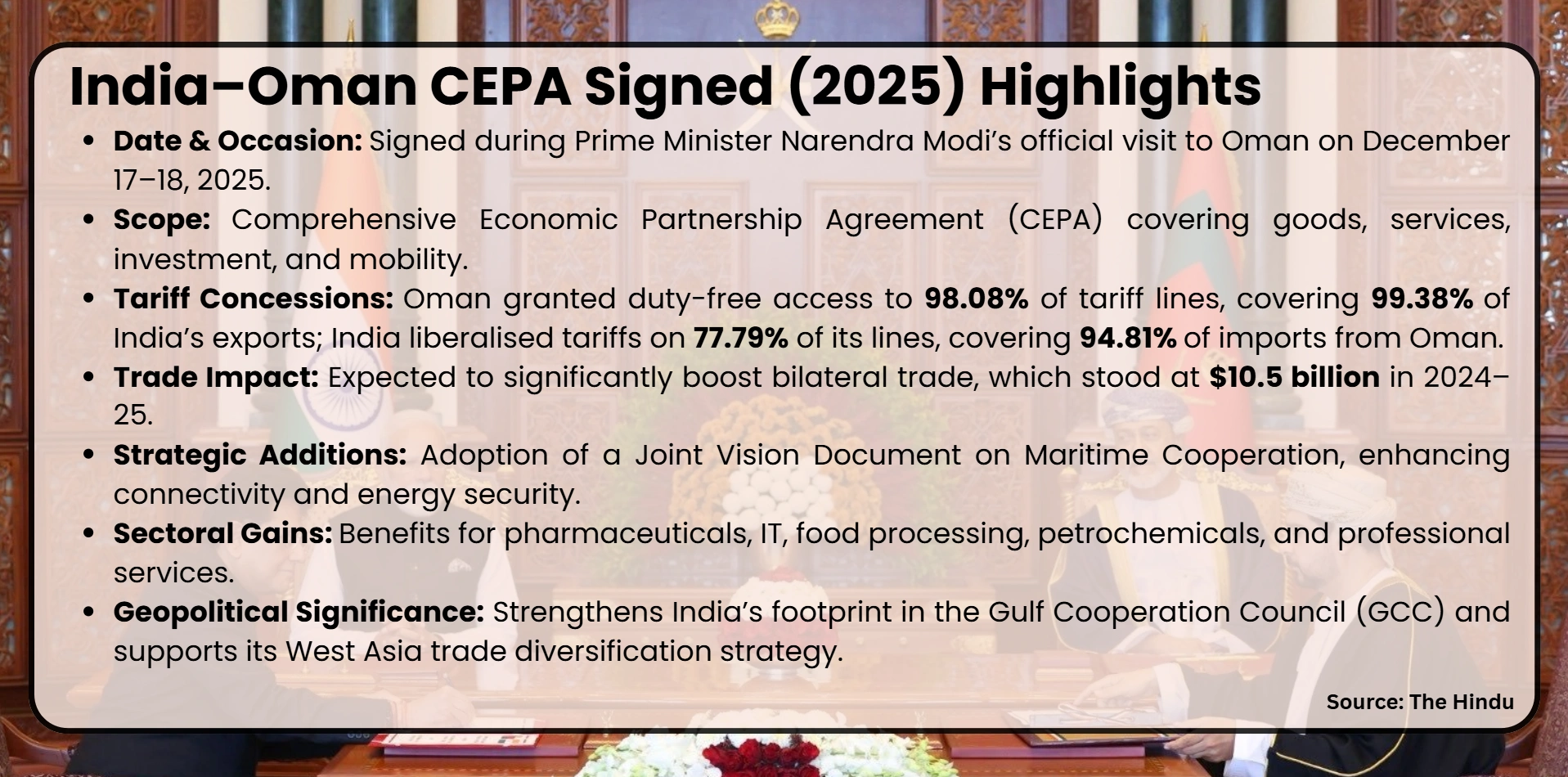
The trade agreement between India and Oman, which was signed in December 2025, is a significant milestone in the economic diplomacy that is sought by the government of India. Although the tariff cuts are part of the agreement, it represents the overall Indian plan to integrate its economic presence in West Asia despite the global trade disruptors. Oman is a crucial pillar of India's West Asia Policy and its oldest regional strategic partner. The political engagement between the two countries has increasingly taken on a more strategic shape. The historical India-Oman bilateral ties were transformed into a strategic partnership in November 2008.
Beyond the Western Markets Diversification
The pact is based on strategic orientation to reduce exposure with the current constraints in the Western economies, which are tightening trade regimes with escalating tariffs and other measures like the carbon border adjustment mechanism, as implemented by the European Union. By this, therefore, the interaction between India and Oman is not so based on opportunistic interests but is an initiative to de-risk its export base through diversification out of the conservative Western markets. This kind of diversification will increase the ability of India to resist external shocks and make West Asia a potential alternative location for trade growth.
The UAE Precedent
The Oman accord is the second large-scale trade agreement of India in the Gulf region after the Comprehensive Economic Partnership Agreement (CEPA) with the United Arab Emirates in 2022. All these agreements are indicators that India has a calculated plan to establish its economic presence in the Gulf Cooperation Council. India stands to gain not just bilateral trade by acquiring favouritism in the markets of Oman, which cover more than 99 percent of the Indian exports with no duties, but also the foundation of a possible GCC-wide framework.
Geopolitical Advantage
The fact that Oman is geographically close to the Strait of Hormuz, which is among the most important energy chokepoints in the world, brings in another element of strategy to the agreement. The improvement in economic relations with Muscat grants India increased bargaining power in achieving energy sources and maritime transportation. This is a goal that would see the country of India achieve the India-Middle East-Europe Corridor (IMEC), in the course of which Oman would play the central role of South Asia to Europe through West Asia.
Long-Term Strategic Vision
The Oman agreement is not a stand-alone project; but it is part and parcel of India's long-term trade architecture, one that aims at entrenching the country deep in the multipolar supply chains. In strengthening its relationships with Oman, India demonstrates its desire to become a reliable partner in the Gulf, striking a balance between cooperation in the economic sphere and geopolitical stability. This strategy represents a wider conception of South-South collaboration where India uses common developmental interests to offset Western protectionism.
Economic and Sectoral Gains
The India-Oman Comprehensive Economic Partnership Agreement (CEPA), which was signed in December 2025, is not just a tariff-cutting system; it is a sophisticated system that will radically change bilateral economic relations and sectoral cooperation.
Improvement of Market Access
India has also received zero-duty access on over 99 percent of its exports to Oman under the CEPA, and this includes all the categories of tariff. This liberalisation allows Indian products such as textiles and engineering goods, as well as agricultural products, to enter Omani markets in a competitive manner. To exporters, the result is a decrease in the cost of transactions and an increase in their profits, whereas to Omani consumers, their mutual impact is the availability of products that are more diverse, and the import price will be lower.
Energy and Petrochemical Synergies
Oman has an abundant resource-based economy, particularly in the field of hydrocarbons and petrochemicals, which gives India an upper hand. The agreement allows strengthening the long-term energy security because it enhances access to crude oil, natural gas, and downstream petrochemical products that are a vital supply in its energy-consuming industrial economy. Moreover, the combined projects in refining and petrochemical businesses are likely to trigger the co-investment and consequently combine the supply chains across the Gulf and South Asian regions.
Services and Professional Mobility
In addition to the mobility of goods, the CEPA entails 127 service sectors, including information technology, healthcare, architecture, and traditional medicine. Liberalised mobility entitlement allows Indian engineers, accountants, and doctors to explore Omani markets with fewer restrictions. This setup will boost the export of skilled labour and other knowledge-driven services in India and Oman will be dealing with the need to have professionals. Accordingly, these provisions make the partnership less of a trade-based structure but engage it in a more socio-economic manner.
Industrial and Technological Cooperation
The accord also promotes cooperation in the pharmaceutical, food processing, and information technology sectors. The Indian pharmaceutical companies, already experienced in the production of generics, gain easy access to the healthcare sector of Oman. Similarly, food-processing companies have the advantage of the popular demand of Oman in diversified importation, and information technology companies can tap the growing digital infrastructure of Muscat. These sectoral advantages not only boost business levels between the two countries but also promote industrial diversification and innovations.
Geopolitical and Dimensions of Connectivity
The Comprehensive Economic Partnership Agreement (CEPA) of India and Oman, which is set to be signed in December 2025, is more than a typical trade liberalisation agreement but a strategic tool to enhance India's geopolitical weight and connectivity in West Asia.
Strategic Seaport Position
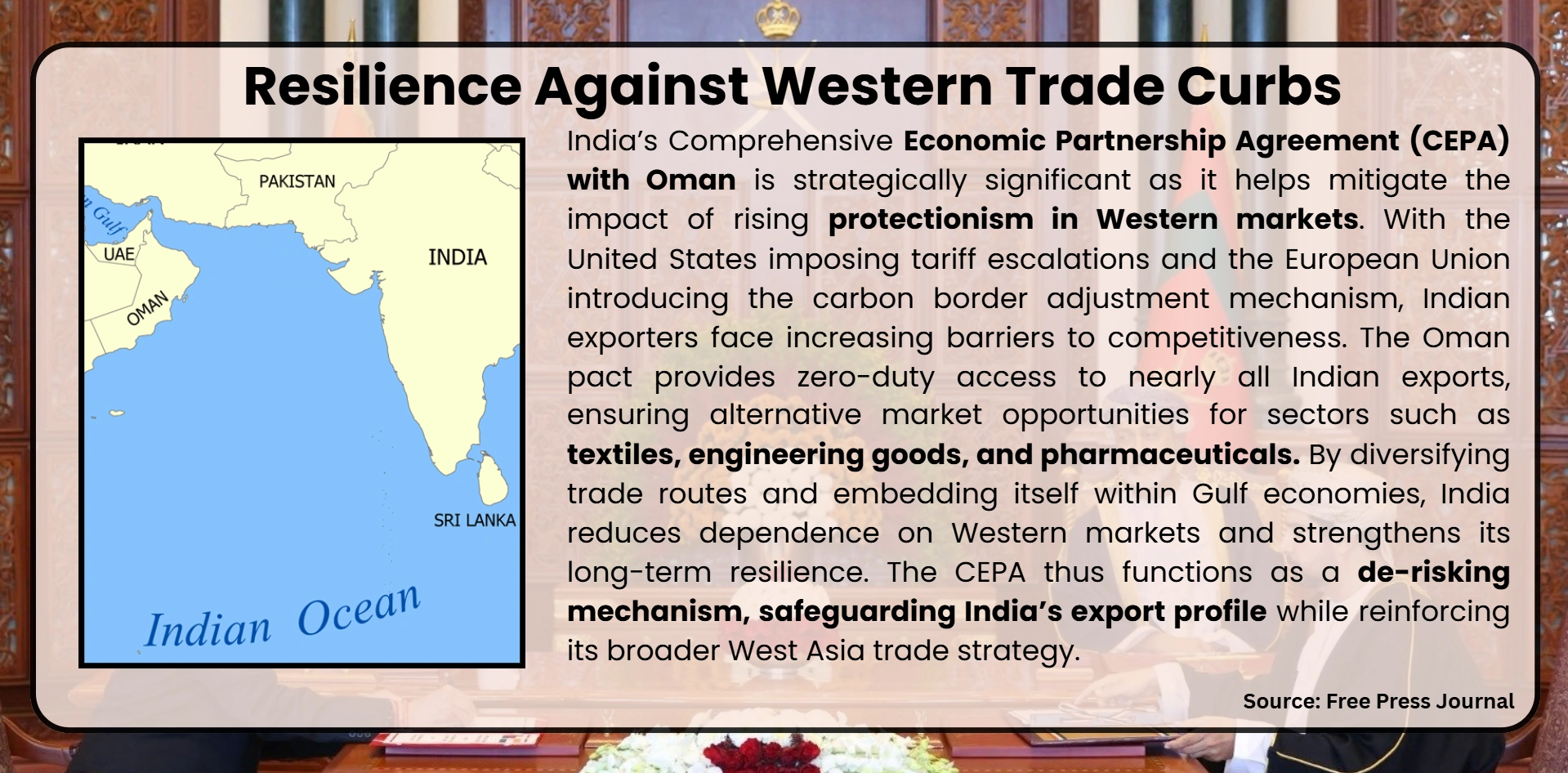
The unique geopolitical advantage of India is shaped by the vital location of Oman at the entrance to the Strait of Hormuz, which is one of the most important energy paths in the world. Enhanced diplomatic relations with Muscat help New Delhi ensure maritime routes that are vital in imports of energy as well as commercial traffic, which will increase the ability of India to protect its supply chain, as well as project influence across the Gulf region, which is a center of energy security of the globe.
Connection to the Regional Corridors
CEPA supplements the goals of India as part of the India-Middle East-Europe Corridor (IMEC) that was announced in 2023. The key hub can be the Oman ports, especially Duqm, connecting South Asia and Europe via West Asia. Through its entry into the Oman logistics and infrastructure networks, India will be facilitated to gain a presence in the regional connectivity projects that balance the Belt and Road Initiative by China, thereby strengthening multipolar trade networks.
Increasing Strategic Footprint
The accord further makes India a realist in the Gulf Cooperation Council (GCC). Following the UAE pact of 2022, the Oman accord represents the signals that India aims at ensuring its presence in the economies of the Gulf. This growth is not just in terms of trade, but also investment, logistics, and professional mobility, and therefore, it will make India closer to the social-economic fabric of the region. This kind of integration will augment the influence that India has in the region as a closing power in the face of changing alliances in West Asia.
Energy and Security Diplomacy
In addition to economic factors, CEPA gives impetus to the energy diplomacy of India. The hydrocarbons and petrochemicals in Oman play a crucial role in the industrial foundation of India, and the joint logistics and supply chain programs enhance resistance to the impact of disruption on the world. In addition, a stronger relationship with Muscat provides India with diplomatic power in regional security discussions, especially since Oman has positive ties with Iran and Saudi Arabia and can see the geopolitical field of the Gulf.
Long term Trade Strategy
The case of the shift in India trade architecture is the Comprehensive Economic Partnership Agreement (CEPA) between India and Oman, signed in December 2025. It represents a strategic recalibration of economic diplomacy based on the growing global trade restrictions and resetting the geopolitical balance.
Resilience against Western Protectionism
The implementation of the CEPA occurred against a backdrop of tightening of the trade regimes by the Western economies, in particular the tariff increases by the United States and the introduction of the carbon border adjustment mechanism by the European Union. This can directly affect the competitiveness of exports in India as a result of such policy changes. Establishing stronger economic relationships with Oman, in turn, can reduce the vulnerability of the country to these limitations, keeping the favour of its exporters. Therefore, trade partner diversification will be one of the core strategies of the long-term resilience plan in India.
Gulf Economic Networks
The Oman deal follows the preceding 2022 agreement with the United Arab Emirates, indicating that India is planning to entrench itself in the member economies of the Gulf Cooperation Council. This networked approach will help India to utilize regional synergies, expand investment flows, and acquire energy alliances. As time passes, these bilateral agreements can be transformed into a GCC-wide framework, and India will emerge as a reliable partner in the economic changes in West Asia.
Supply Chains and Strategic Connections
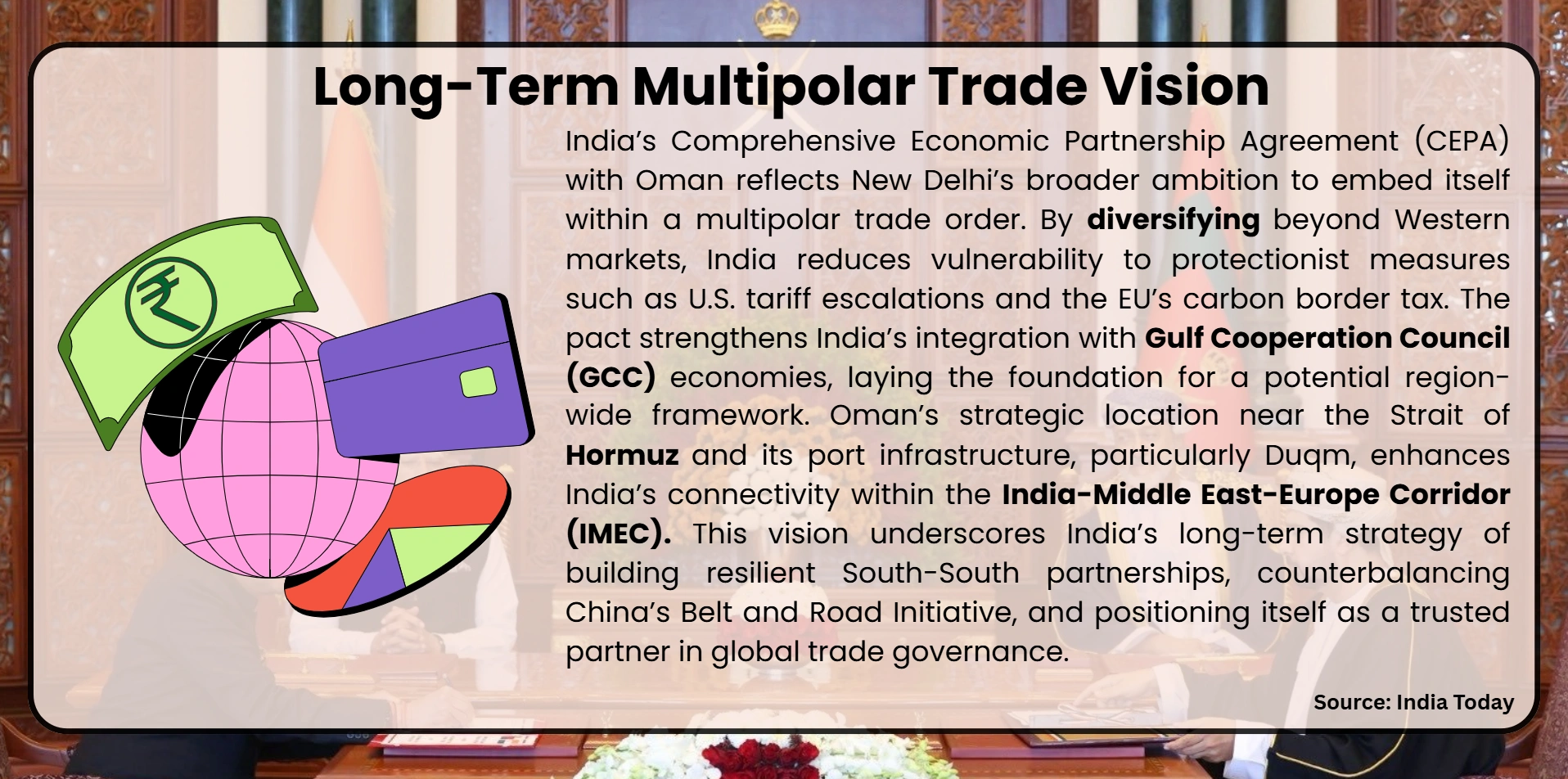
Multinational supply chains are taking over contemporary global trade. The strategic position of Oman, near the Strait of Hormuz and its developed port infrastructure, especially the deep-water Duqm facility, can be of great connectivity benefit to India. Increasing its logistical presence in Oman by making it a part of inter-continental projects like the India – Middle East -Europe Corridor (IMEC), India will be able not only to offset the Belt and Road Initiative by China but also guarantee permanent access to diversified trade routes.
Multipolar Trade Order Vision
The CEPA also captures the larger vision of India of the multipolar nature of the trade order. Focusing on South-South cooperation and creating long-term alliances in West Asia, India indicates that the country is ready to move beyond Western economies. This strategy orientation is in line with India's desires of being a rule-shaper in the world, which improves the growth of the country in an inclusive way, whereby systemic changes in global trade governance are managed.
Conclusion
The India-Oman Comprehensive Economic Partnership Agreement (CEPA) is more than a treaty on bilateral trade; it is a strategy that India realigns itself in the world, in which it remains increasingly fluid. India not only increases resilience and influence by expanding its presence beyond the deep-rooted Western markets and incorporating itself into the Gulf economic networks, as well as leveraging on the Oman geographic position and energy reserves. The agreement has integrated the goods, services, and connectivity gains, hence strengthening the long-term approach of the multipolar trade architecture of India. In such a context, the Oman agreement can be characterized as an asset of the West-Asian policy adopted by New Delhi to maintain the right balance between short-term economic needs and long-term geopolitical and developmental goals.