|
Key Highlights
- President Putin’s Visit to India
- USD 100 Billion Trade by 2030
- President Putin promised an Uninterrupted supply of fuel
- Cooperation in Energy Security
- Kudankulam Nuclear Power Plant
- Multipolar Global Vision of India
|
In December 2025, President Vladimir paid a visit to India, the twenty-third summit between the two leaders, during which the leaders renewed the Special and Privileged Strategic Partnership mentioned. The officials renewed a goal of one hundred billion dollars in bilateral trade by the year 2030 and guaranteed Russian fuel supplies to India. The sectors covered by agreements included energy, healthcare, and fertilizers, whereas Prime Minister Narendra Modi outlined the balanced geopolitical position and the strengthening of bilateral cooperation in the conditions of existing tensions in the Global sphere.
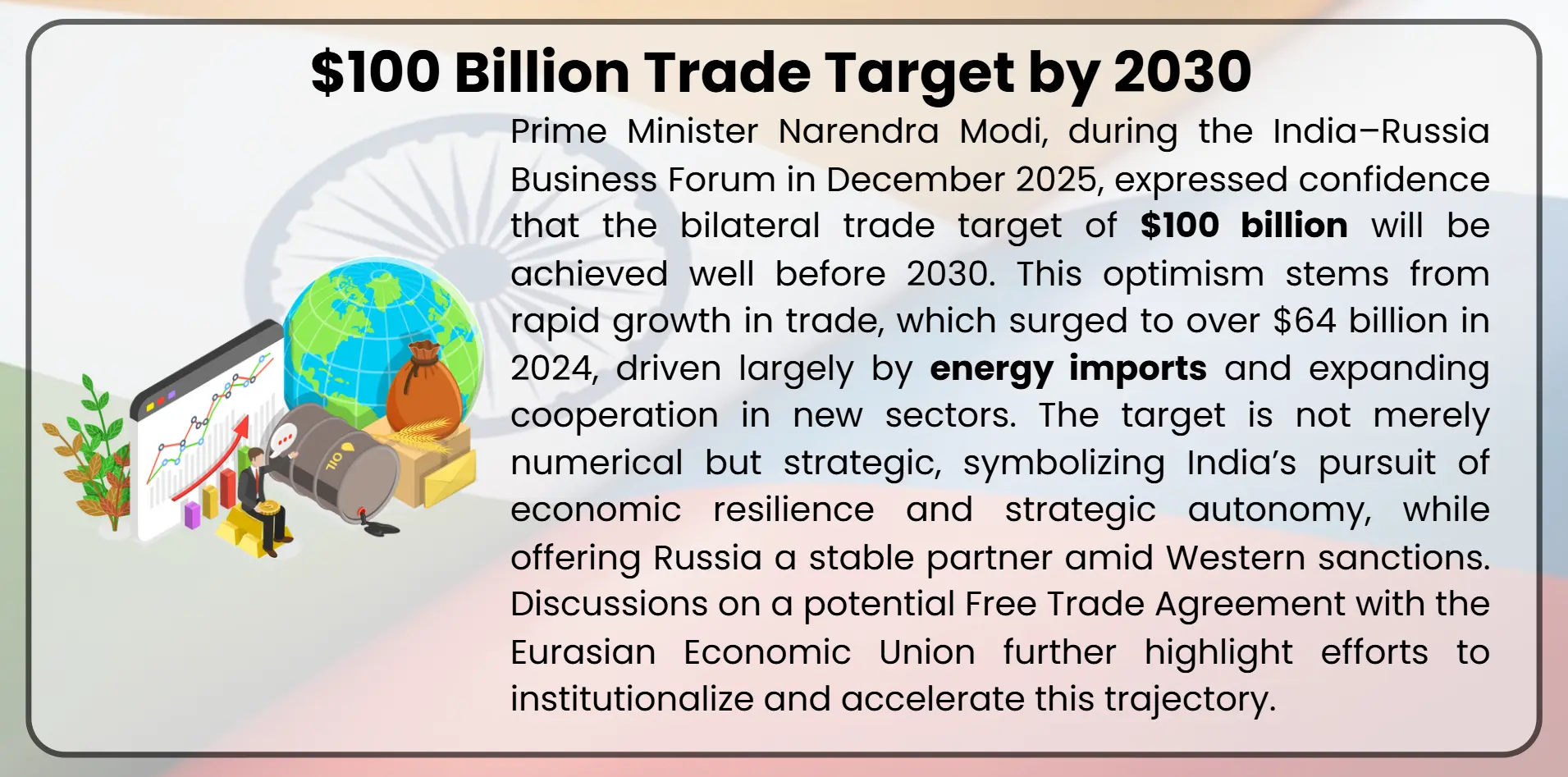
Indiaand Russiahave set an ambitious target of reaching $100 billion in annual bilateral trade by 2030, a goal both nations' leaders believe can be achieved even sooner. The current trade volume has already surpassed previous milestones, driven largely by significant energy imports to India
|
Tips for Aspirants
The article will be significant in the case of the UPSC CSE and State PSC because it brings to the fore India-Russia trade, energy security, and balancing geopolitics, which are major themes in international relations, economy, and strategic autonomy.
|
|
Relevant Suggestions for UPSC and State PCS Exam
<
- There is an objective of bilateral trade between India and Russia to reach up to 100 billion by 2030 due to the growing economic relationship.
- Indianeeds diversification and mustinvest in pharmaceuticals, agriculture, information technology, infrastructure, and the transfer of technologies.
- Russia promises to supply fuel (oil, coal, LNG) on an uninterrupted basis, which makes India more secure in terms of energy.
- Nuclear cooperation: the growth of the Kudankulam Nuclear Power Plant shows the cooperation in the long-term of sustainable energy.
- India is balancing between Russia and the West, demonstrating the independence of the country in foreign policy.
- Cooperation by BRICS, SCO, and G20 accentuates the mutual desire for multi-polarity.
- Difficulties: imbalance in trade and means of payment (rupee-ruble), as well as logistic congestion.
- Opportunities: free-trade agreements with the Eurasian Economic Union, renewable energy, and collaboration in digital technology.
- Cooperation is one of the pillars of the multi-polar global vision of India.
|
Recent strengthening of India-Russia relationships, as indicated by the announcement of Prime Minister Modi in attaining the aforementioned trade target before 2030 and the assurance made by President Putin on continuous commercialization of the fuel provided to India, is a manifestation of the longstanding strategic breadth of this alliance. Since the day of the Cold War cooperation, the ties have extended to a multisided interaction involving the defense, energy, technology, and financial sectors. It became very clear in the modern geopolitical environment marked by the fact that global supply chains are becoming more permeable and that the sanction regimes introduce a pragmatic aspect of the foreign policies in India, with the emphasis put on its own reliance on energy. At the same time, the shift of Russia towards the Asia markets and India in particular, demonstrates the desire to have economic allies that will remain stable in the situation of Western isolation. Not only does this bilateral pathway enhance the energy security of India, but it has also been associated with its interest in achieving strategic sovereignty and a multipolar framework of world governance. The trade and energy commitments that both leaders demonstrated are a foundation of further collaboration, but at the same time, the statements also pose pertinent questions in terms of sustainability, diversification, and resilience. As a result, the India-Russia relationship is in a vantage position that tries to maintain a balance between traditional relationships and new opportunities and threats in the international system.
Strategic Trade Ambitions
The renewed determination between India and Russia to complete $100 billion in the volume of bilateral trades before 2030 is one of the examples demonstrating a clear vision of broadening their economic cooperation to other sectors besides the traditional routes to install confidence and strength in their union.
The Horizon of Economic Expansion
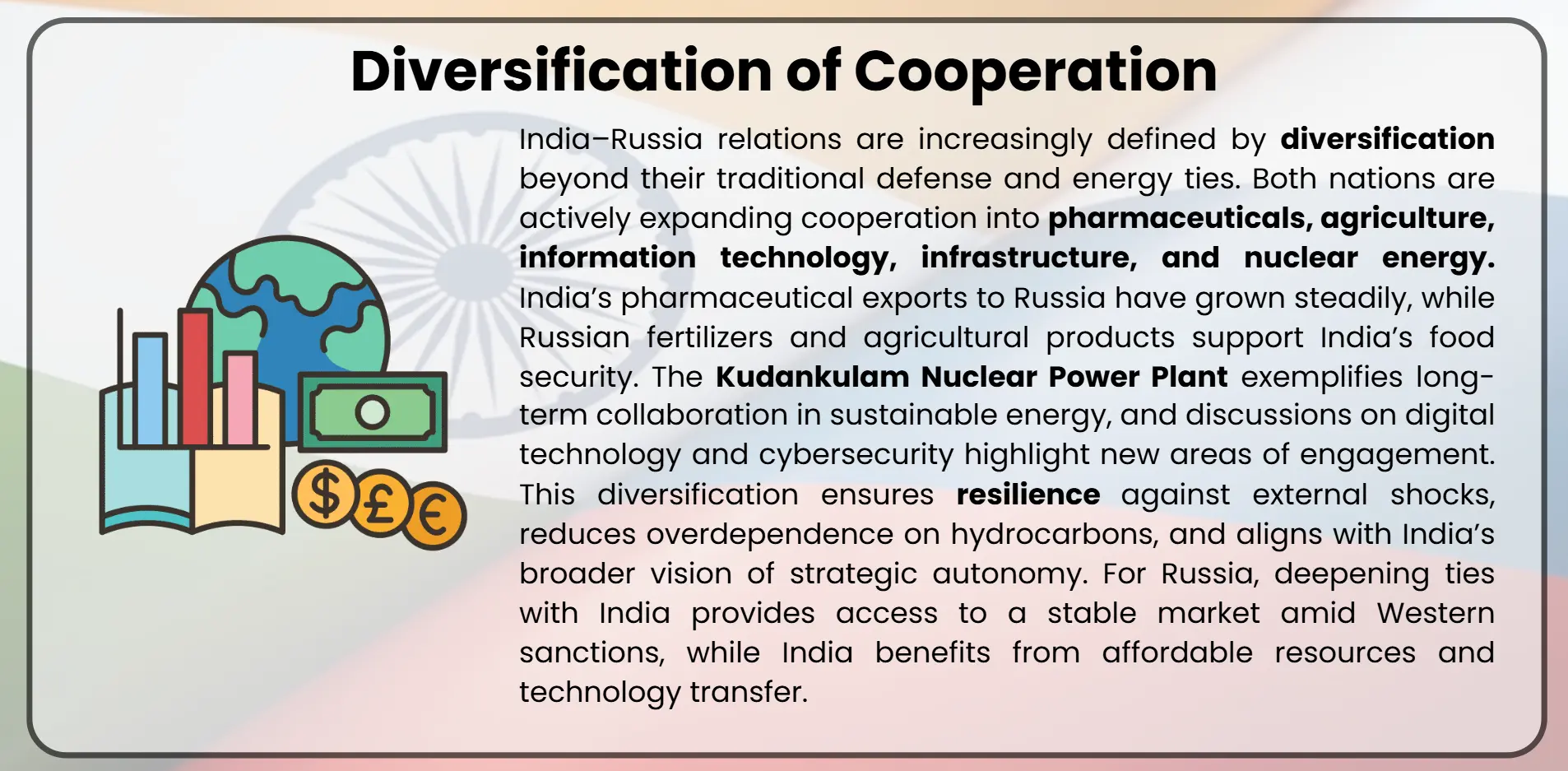
The mentioned trade target is a deliberate integration of bilateral trade. Previously focused on the defense and energy industry, the partnership now aims to add pharmaceuticals, agriculture, information technology, and infrastructure. This growth is much more than transactional but is more strategic in nature, and this is aligned with the overall economic transformation in India that is being done by reforms that aim at making the country simpler to do business. Since Russia is facing Western sanctions, it is looking at India as a stable place where it can export its goods and have similar market potential.
Energy as a Cornerstone
The trade ambitions of India are still energy-focused, and the promise of supply of fuel supply by Russia makes India stronger in terms of energy security. The importation of oil, coal, and liquid natural gas is essential to support the growth trend in India. With energy cooperation being embedded into the bigger trade system, the two countries are also able to ensure that the economic goals are not susceptible to the threat of failures in the global supply chains. Such an energy-trade partnership then prevails to reinforce the stability of the bilateral relationships.
Geopolitical Balancing
India is also practicing diplomatic balancing in its quest for ambitious trade objectives. As it strengthens its bonds with the West, India still preserves a good relationship with its ancient friend, Russia. The 100 billion target is symbolic in the Indian part of strategic independence, in terms of which India will not be too tied to one of its economic paths. On its part, Russia looks at this alliance simply to have a presence in Asia and to diversify its international economic activities.
Challenges and Prospects
Even though there are positive expectations, difficulties remain. The payment systems, logistical outposts, and commercial asymmetric should be managed. The imports of India, especially the energy sector, have far surpassed its exports, and therefore, corrective action is required to make sure this sector is sustainable. The debates on the issue of the possible free trade agreement with the Eurasian Economic Union emphasize the attempts to establish cooperation on the institutional level. Provided that they are realized, these frameworks have the potential to speed up the process of achieving the $100 billion mark and instil long-term resiliency into bilateral trade.
Fuel Shipments and Energy Security
The Republic of India and the Russian Federation have been developing the energy security of India as the key element of their strategic relationship. The sustainability and persistence of this collaborative deal can be stressed by the recent promise by President Vladimir Putin to ensure that uninterrupted shipments of fuel will be supplied.
Russia as a Viable Energy Ally
The Russian Federation has always established itself as a reliable provider of crude oil, natural gas, and coal to India. In 2025, upon the visit of President Putin, he once again stated that Moscow is ready to continue unbroken supplies to meet the growing energy needs of India. This reliability is crucial to a nation whose consumption is increasing owing to the rocketing industrial growth and urbanisation.
Energy Cooperation Diversification
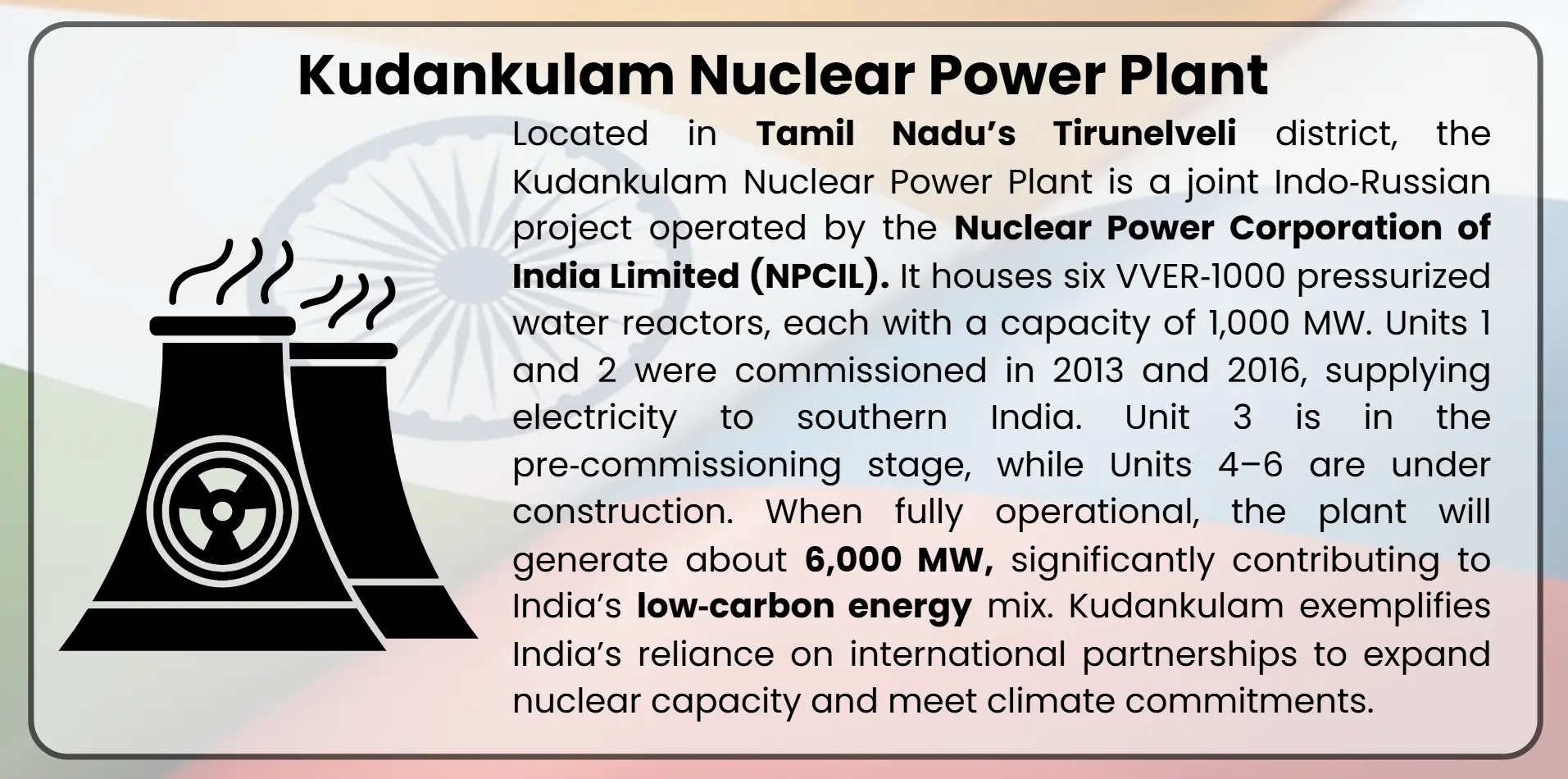
In addition to hydrocarbon resources, the bilateral alliance has reached in the nuclear sphere. The Kudankulam Nuclear Power Plant in Tamil Nadu, which is a flagship joint Indo-Russian venture, has already commissioned two operational reactors, and its fourth reactor is expected to be commissioned. The given undertaking represents an example of a diversification policy that will make the energy mix in India rely on long-term, sustainable sources, as well as traditional fossil fuels.
Tactical Freedom and International Barriers
The long-time participation of India in the energy field with the Russian Federation is an indication of an aggressive strategy of autonomy. Although the Western governments are pushing India to limit imports from Moscow, India has still considered being genuine to their national interests by ensuring the availability of cheap power. It is this form of balance that supports a pragmatic foreign-policy calculus where energy security is something that cannot and must not be diverted away in the pursuit of long-term economic prosperity.
Hurdles and Future Opportunities
Although the guarantee of a continuous supply of fuel creates confidence, there are considerable challenges with reality. Financial disruptions must be discouraged by ensuring payment mechanisms, especially those used to carry out rupee-ruble transactions. Additionally, India will have to deal with the issue of logistical chokepoints in the surface transport and storage facilities. In the future, the partnership can be expanded into renewable-energy cooperation, which would bring the bilateral energy relationship in line with the changing global sustainability requirements.
Geopolitical, and Diplomatic Aspects
The relations between India and Russia are deeply rooted in the changing international system, and the recent redefinition of a strategic partnership depicts how bilateral collaboration is informed by the ambitions of a multipolar system, as well as by relevant diplomatic balancing.
Continuity and Trust in Strategies
India and Russia have a longstanding relationship that can be traced to the Cold War period, and it was during these years that Moscow became an important defense partner. The trust that was built in this timeframe remains the cornerstone of the modern-day diplomatic activities, and both countries predict their Special and Privileged Strategic Partnership. This continuity was reinforced by the 23rd Annual Summit in December 2025 to indicate a sign that, in spite of the turbulence in the world, the bilateral relationship remains resilient.
Balancing Global Pressures
The efforts of India towards gaining strategic independence can be seen in its ability to strike a balance between its relationships with Russia and, alternately, one can also see its engagement with Western powers. New Delhi has put national interest firstdespite the demand of the United States and the European Union to reduce energy imports from Moscow. Facing sanctions and isolation in the world, Russia sees India as a very important ally to keep it assertive in the world. This is a balancing measure of the Indian pragmatic diplomacy in which economic and energy security are greater than the external forces.
Globalisation and Common Grounds
In addition to bilateral trade and energy relations between India and Russia, the two countries also cooperate in multilateral relations, including BRICS, the Shanghai Cooperation Organisation (SCO), and the G20. All of these platforms allow both countries to sell their idea of a multipolar global regime that way opposing hegemonic expansion. Their mutual desire to institutionalise collaboration in key areas is indicated by the implementation of a programme referred to as Programme 2030 at the summit.
The New Threats and Prospects
In spite of a strong diplomatic orientation, there are hurdles. Tradeimbalances, payment modalities and varied strategic perspectives, especially towards the West and China, are some of the challenges. However, there are possibilities of strengthening ties in terms of technological transfer, defence co-manufacturing, as well as renewable energy collaboration. As such, the alliance is not fixed or static, but it adjusts and recalibrates itself according to the requirements of a changing geopolitical environment.
Future Prospects & Challenges
The relations between India and Russia, which are based on cooperation in trade and energy areas, are going to develop significantly. However, the road to a 100 billion target trade by 2030 is both exciting and stifling.
Building Institutional Strengths
Future development perspectives are based on the institutionalization of cooperation, especially in the case of the Free Trade Agreement suggested with the Eurasian Economic Union. This system would soften tariff barriers, streamline logistics, and encourage investment in other areas, including the pharmaceutical, agricultural, and technological sectors. Institutional cooperation would be augmented through predictability and resilience, which would eliminate the derailment of the bilateral trade ambitions by external shocks.
Increasing Technological and Energy Partnership
In addition to hydrocarbons, India and Russia can intensify common operations in nuclear energy, renewable energy, and the transfer of technology. The Kudankulam Nuclear Power Plant is a case of long-term cooperation, and the joint venture in solar and wind technologies might suit the goals of sustainability in India. In a similar vein, collaboration in digital technologies and cybersecurity offers the opportunities of diversification and less reliance on the traditional sectors, and greater depth of strategy.
Trade Imbalances and System of Payments
One obstacle that has existed is the trade imbalance, in which India has been exporting much less compared to receiving much as imports from Russia. This should be corrected by encouraging Indian pharmaceuticals, textiles, and IT services in Russian markets. The system of payment should also be perfected; the system of rupee-ruble payments has technical problems, and they should be corrected to make transactions run smoothly. Unless these issues are addressed, the ambitious trade target may not be sustainable.
Operating in the Geopolitical Uncertainties
There are risks and opportunities within the global geopolitical tension. Western sanctions on Russia provide an opportunity for India to make beneficial energy agreements, but require financial and logistical solutions. India has to maintain autonomy in its strategies through maintaining relations with Russia, even as it further develops relationships with the West. This is a sensitive game of diplomacy that will result in the success or failure of potential benefits becoming real.
Conclusion
The changing pattern of India-Russia relations highlights the strength of a friendship that was based on historical faith but is being affected by the current challenges. The pragmatic compatibility between the economic and strategic interests is evidenced in the ambitious goal of trade of 100 billion by 2030 and the guarantee by Russia that it would deliver fuel shipments without interruption. Although issues such as trade imbalance, money transfer, and geopolitics complicate trade relations, the two countries still focus on collaboration in energy, technology, and other multilateral platforms. Finally, the relationship indicates an example of India seeking a strategy of autonomy and Russia seeking stable allies, which puts bilateral cooperation into a central place in the system of multipolar world regulation.