Constitutional morality in the sanctum signifies that the core values of the Constitution justice, liberty, equality, and dignity prevail over traditional, religious, or social norms governing places of worship and religious practices. The recent decision by the Supreme Court of India to support restrictions against certain religious practices at the Thiruparankundram Hills, in the state of Tamil Nadu, has been in the news allowing the judiciary to balance religious freedom with fundamental rights.
|
Key highlights
- Increasing role of the Judiciary
- Constitutional Framework and Religious Freedom
- Case Studies related to Religion v. Rights
- Thiruparankundram Deepathoon case
- Thenkalai Sect and Hymn Recitation case
- General Implications of Religion v. Rights and Future Directions
|
The article “Constitutional Morality in the Sanctum” highlights the intersection of religion and constitutional law that has taken a steadily growing role in modern India as the courts are increasingly being called upon to resolve disputes that define the boundary between faith and the precepts of the foundations of the state. Since the accessibility to temples and the question of gender equality, as well as the rules of conversion and the desires of the government order are disputed, the judiciary has to work out the conflicts between the traditions that have been held long and the values that are presented by the Constitution. The Court also sent notices to twelve states on anti-conversion laws. These trends highlight the judiciary's role in playing a leading role in reconciling religious freedoms in the context of constitutional morality and thus protecting equality, civil order, and fundamental rights. This increased judicial activism highlights the permanence of constitutional courts as the guardians of secularism, equality, and liberty. Through the constitutional restrictions on the practice of religion, the state establishes precedence, so that worship does not jeopardize democracy.
Increasing role of the Judiciary in Religion v. Rights
The increasing number of religious cases brought to the courts of constitutional documents indicates a strengthening confrontation between religious traditions and constitutional ethics, and judicial intervention to safeguard equality and secularism.
Courts' Intervention in Religious Activities
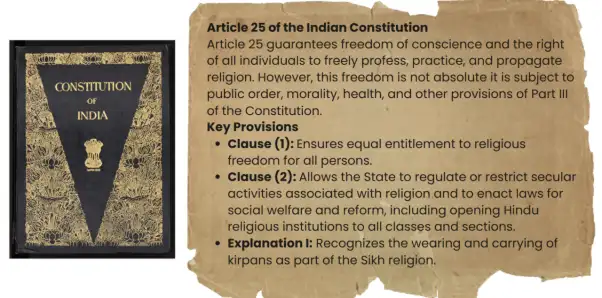
The Supreme Court of India, in February 2026, upheld some limitations set on some religious practices on the Thiruparankundram Hills by the Madras High Court. The Court once again restated that in Article 25, the freedom of religion is affirmed, which is required to be obtained and adhered to within the provisions of public order, as well as morality and health, in order to bolster constitutional supremacy over the grace of rituals.
Increasing the Scope of Constitutional Morality
Recently guided petitions have also demanded the instruction to oversee police exclusionary talk by state officials, thus specifying the judicial court in granting that religion is not a means of discrimination. The scholars have noted that the constitutional morality based on liberty, equality, and human dignity has played out as a guiding principle in order to judge such disputes.
Increasing cases related to religion and rights
As of reports, almost 15 percent of the constitutional litigations that were resolved during the 2024-25 involved religious liberty and religious minority rights issues, suggesting a steady increase in the number of litigations about faith and secularism. This ceiling highlights another already long-standing responsibility of the judiciary to reconcile the various traditions of India with the principles of its constitution.
Constitutional Framework and Religious Freedom
The Preamble of Indian Constitution provides a subtle balance in terms of preserving religious freedom and respecting secular democratic values, and so there is a need for judicial oversight whenever customary practices conflict with the basic rights.
Foundational Principles in the Indian Constitution
Articles 25 to 28 enshrine the freedom of religion, fostering the right to profess and practice, as well as propagate his or her religion. However, this freedom does not exist; it is bounded by limitations to public order, morality, and health. The conceptualization of secularism by the constitutional makers was not about denying religion but rather established the need to award all faith communities equal respect and, in this way, ensured that they would not allow the practices of the various communities to discredit fundamental constitutional requirements of equality and human dignity.
Judicial Mandate on Religion v. Rights
These interpretations have been consistent across several years to prevent discriminatory or exclusionary behaviour by the Supreme Court. As an instance, in Indian Young Lawyers Association vs. The State of Kerala, the Court gave a new ruling that the right of women to visit the Sabarimala temple is not subject to violation, thus reaffirming that the moral norms existing in religious practices are not superior to the constitutional norms.
Case Studies related to Religion v. Rights
The Madras High Court rulings in recent times are representative of a constitutional court balancing the interests of the religious traditions and the constitutional principles, in such a way that religious practices do not conflict with the secular and democratic standards associated with the constitution.
Case Study 1: Thiruparankundram Deepathoon
In December 2025, the Madurai Bench of Madras High Court reaffirmed that Karthigai Deepam should be lit every year on the ancient stone pillar, named Deepathoon, at Thiruparankundram hill. The Court overturned state objections and has made clear that the pillar lies in the temple precincts, not the neighboring dargah, thereby providing police protection to enforce its order. The ruling indicated the judiciary as the body that put the interests of the community and the conservation of customary traditions into context.
Case Study 2: Thenkalai Sect and Hymn Recitation
In a similar case, the Court defended the right of the thenkalai sect to recite hymns in the temple of Varadaraja Perumal in Kanchipuram. The decision underscored the idea that Article 26 rights of denominations ought to be honored, as long as the same does not go against the larger constitutional rights of equality and order in the community.
General Implications of Religion v. Rights and Future Directions
The involvement of judicial intervention in religious controversies has considerable consequences regarding the continuing dominance of democratic systems acting as well as highlighting how courts have changed in defending secularism.
Strengthening Democratic Resilience in India
By their ruling on the clash between the new morality expressed in the constitution and the old way of doing things, the courts reinforce the idea that no good, however sacred, can supersede the basic rights. This strengthening of belief in institutions ensures secularism remains a living, dynamic value, not a static doctrine.
Making Indian Jurisprudence Inclusive
The judicial interventions also expand the inclusivity in the religious spaces. To a case in point, the case law concerning the right of entry in terms of the temple, and right of denomination can demonstrate that constitutional courts mediate between the majority and the protection of minority, hence bringing harmony to the society because of diversity existing in the society.
Future Challenges in Religion v. Rights
Emerging disputes in religion, like the manipulation of digital platforms, interfaith marriages, and conversion laws, signify that constitutional courts will keep on facing complicated issues. According to statistics, close to 15% of constitutional cases in the 2024-2025 period involved religion, and this is expected to rise with globalisation and technological achievement.
Way Forward for Religion v. Rights
The courts have to continue practicing constitutional morality and mainstreaming cultural differences. Enhancing a conversation between the communities, legislature, and the courts can also make sure that the faith practices are changed in a way that they do not affect the principles of democracy, but rather balance devotion and constitutional sanctity.
Conclusion
The rising level of religious cases before the constitutional courts highlights the importance of the judiciary in protecting the sanctity of the constitutional values. Through striking a balance between tradition and modernity, the courts make sure that devotion does not erode equality, liberty, and secularism. Constitutional morality is reasserted against plural societies by these interventions as the key to faith and democratic considerations, since plural societies cannot exist without one another. Finally, the constitutional order of India is enhanced through the vigilance of the judiciary in order to balance various practices of religions with the eternal principles of fairness and inclusivity.
Frequently asked questionsFrequently asked questions
Increasing role of the Judiciary in Religion v. Rights?
The increasing number of religious cases brought to the courts of constitutional documents indicates a strengthening confrontation between religious traditions and constitutional ethics, and judicial intervention to safeguard equality and secularism.
Constitutional Framework and Religious Freedom?
The Preamble of Indian Constitution provides a subtle balance in terms of preserving religious freedom and respecting secular democratic values, and so there is a need for judicial oversight whenever customary practices conflict with the basic rights.
Case Studies related to Religion v. Rights?
The Madras High Court rulings in recent times are representative of a constitutional court balancing the interests of the religious traditions and the constitutional principles, in such a way that religious practices do not conflict with the secular and democratic standards associated with the constitution.
General Implications of Religion v. Rights and Future Directions?
The involvement of judicial intervention in religious controversies has considerable consequences regarding the continuing dominance of democratic systems acting as well as highlighting how courts have changed in defending secularism.