CERT-In has been elevated in academic and policy realms to deal with 29.44 lakh cyber incidents in 2025, expand audit operations, educate up to thousands of professionals, and gain international recognition from the World Economic Forum, the University of Oxford, and ANSSI, for its threat edge through AI-enhanced threat detection and resilience efforts to secure the cyber system in India.
|
Key highlights
- CERT-In enhancing Digital Security
- India’s Rising Cyber Security Challenges
- Core Operations and Framework of CERT-In
- Key Achievements of CERT-In in 2025
- Global Recognition of CERT-In
|
This quick technological shift in India has reorganised the systems of governance, trade, and citizen service and also increased their vulnerability to cyber-attacks. In such an environment, the Indian Computer Emergency Response Team (CERT-In), which functions under the umbrella of the Ministry of Electronics and Information Technology, has become a pillar of national cybersecurity. Mandated by the Information Technology Act of 2000, CERT -In provides institutional depth in response to incidents of datathreats and system resilience. The fact that it has multidisciplinary initiatives such as audits, awareness programmes, and AI-driven threat detection can be used to validate that India is committed to nurturing a secure, trusted and responsible cyberspace, which is why it is able to strengthen the trust that people have in the fast-growing digital ecosystem in the country.
CERT-In enhancing Digital Transformation and Cyber Security
The fast process of digitalisation in India has expanded governance, business, and services to citizens; but it has also exposed the country to increased risks of cyber threats, thus shifting the concept of cybersecurity to the level of a national strategic priority.
Expanding Indian Digital Eco-system
The digital presence of India has grown by leaps and bounds, and now, broadband connections are more than 100 crores in 2025, an extensive rise over the 25.15 crores, which was registered in 2014. The consumption of data per subscriber in the wireless network increased about 399 times, with the consumption of 61.66MB in 2014 and 24.01GB in 2025, which makes India one of the highest consuming countries in the world. This wave has enabled e-governance, e-commerce, and financial inclusion, especially the Unified Payments Interface,which processed 21billion transactions valued at 27 lakh crore in December 2025.
India’s Rising Cyber Security Challenges
Further expansion of digital services has provided more pathways and avenues, which expose citizens and institutions to phishing scams, ransomware, and AI-enhanced fraud. In line with the State of Cybersecurity Resilience 2025 developed by Accenture, 89 percent of Indian organisations have to grapple with alignment of cyber-risk strategies with transformation goals, whereas 85 percent of the organisations have problems in enforcing the Zero Trust principles. Such a finding shows structural weaknesses in the protection of Indian digital infrastructure.
Indian National Cybersecurity Imperative
The recognition of these risks has led to the allocation of INR782 crore on cybersecurity in the Union Budget 2025-26 that reflects the interest of the government in resiliency. At the core of this framework is CERT-In, mandated under the IT Act 2000 and which organises incident response, auditing and awareness programmes. Its mandate ensures the digital growth in India is secure, trustworthy and sustainable, balancing its national security and innovation.
Core Operations and Framework of CERT-In
CERT-In plays a pivotal role in securing the digital ecosystem in India through the dimensional convergence of operational preparedness and institutional platforms, hence making it resilient to existing cyber threats. It still aims at the national security needs even as it keeps in focus citizen-focused goals.
Core Functions of CERT‑In
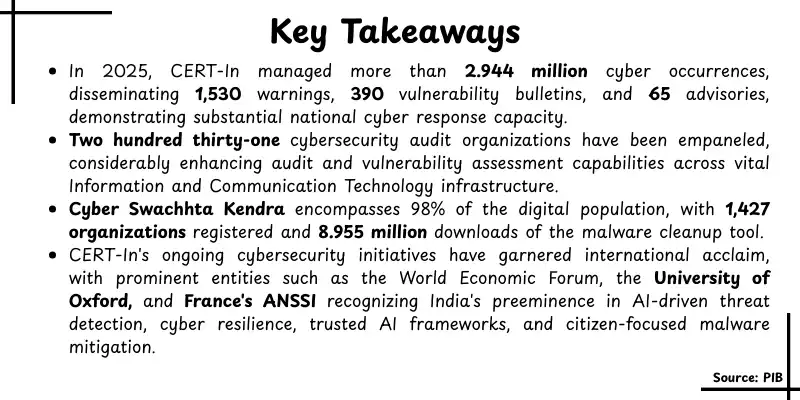
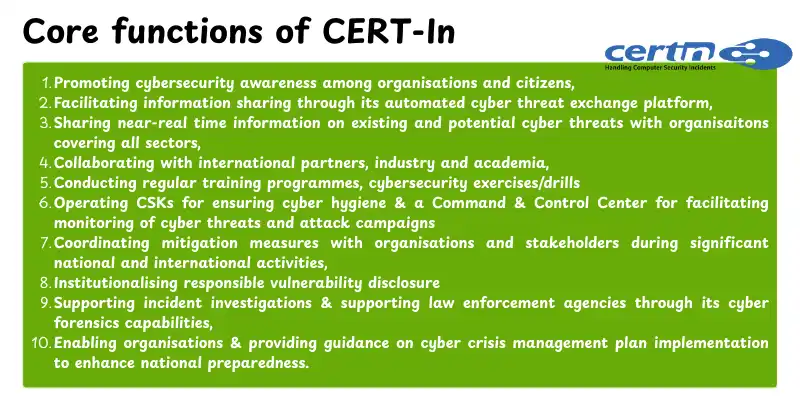
In Section 70B of the Information Technology Act, 2000, CERT-In will be the national agency in responding to cyber-incidents. Its statutory duties include the issue of alerts, advisories, and vulnerability messages, coordination of response efforts involving the incident, and information sharing between sectors. CERT-In alone responded to 29.44akh cyber incidents and issued 1,530 alerts and 390 cyber vulnerability notes in 2025 alone. Moreover, the agency enhances cyber-awareness, offers training courses and supports the law-enforcement authorities via forensic examinations, thus delivering strength to systemic resilience.
Institutional Frameworks under CERT-In
The CERT-In operationalizes the policy of cybersecurity in a multi-tiered institutional architecture.
- Being utilised by 98 percent of the digital population of India, the Cyber Swachhta Kendra (CSK) provides malware-removal tools and citizen-focused advice.
- NCCC provides real-time situational awareness to the national situation, and CSIRTs in the sector (finance, power, and telecommunications) and at the state level are maintained in a decentralised manner.
- The plan of Cyber Crisis Management (CCMP) provides the governmental organisations with the guidelines to be followed in the case of a large-scale cyber-attack.
- Together, these structures allow viewing the government-society relationship in a comprehensive manner, strengthening preparedness and recovery through important infrastructures and social services.
Key Achievements of CERT-In in 2025
The activity of the CERT-In in 2025 is a definitive fortification of Indian cybersecurity infrastructure, both in terms of scope of operation and the level of institutionalization in order to protect critical infrastructure and government services.
CERT-In’s Threat Intelligence
CERT-In administered 29.44 lakh cyber incidents, 1,530 alerts, 390 vulnerability notes and 65 advisories in 2025. Furthermore, it revealed and published 29 Common Vulnerabilities and Exposures (CVEs), which highlight its proactive nature in deterring threats and national cyber defence.
Cybersecurity Audits through CERT-In
As a measure to increase systemic resilience, CERT-In empanelled 231 certified audit organisations (with a focus on banking, power and transport industries). Meanwhile, 32 specialised training programmes and 95 awareness programmes were held, as a result of which 20,799 officers and professionals in the government and industry participated in the training activities. Such initiatives enhanced readiness at the institutional and individual levels.
Awareness Campaigns under CERT-In
CERT-In coordinated 122 cybersecurity exercises with 1,570 organisations, which included the defence, energy and telecommunication sectors. These have reached 91,065 participants in the month of National Cybersecurity Awareness (October 2025). The reports that were published encompassed the India Ransomware Report 2025, Cybersecurity Guidelines to Smart Cities and technical frameworks such as the AI Bill of Materials (AIBOM) and therefore improved policy and practice.
Strategic Impact of CERT-In
All these successes highlight that the primary role of CERT-In is to strengthen the cyber resilience of India. It combined audits, training, drills, and prospective guidelines to make sure that the digital development of the nation was safe, trusted, and recognised on the international level.
Global Recognition of CERT-In
Gradually, India, as far as cybersecurity initiatives are concerned, has become more visible internationally, so that CERT-In is a trusted global partner in cyber resilience and the use of AI to govern threats.
Recognition of CERT-In by Global Institutions
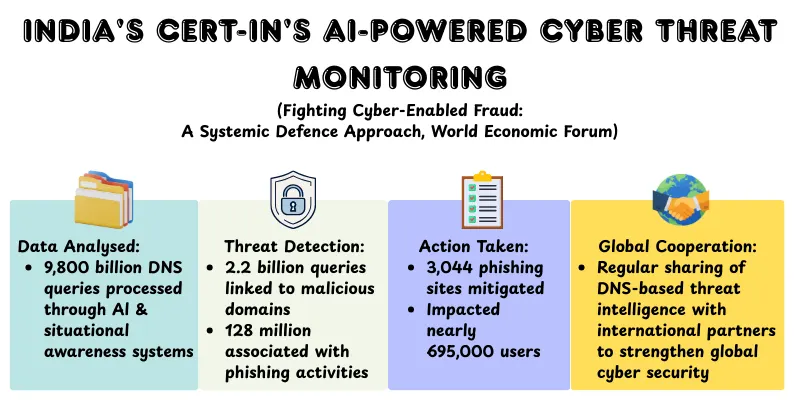
In a study on Global Cybersecurity Outlook 2025 conducted by the World Economic Forum, CERT‑In was reported to have deployed AI-based situational awareness to handle up to 9,800 billion DNS queries, detect 2.2 billion malicious domains, and eliminate 3,044 phishing sites targeting close to 695,000 users. This recognition highlights the fact that India is the foremost state in providing real-time threat intelligence on the international front.
Collaborative Research Contributions by CERT-In
CERT-In was one of the contributors of Cyber Resilience Compass, published by the WEF together with the University of Oxford in April 2025, which defines seven important areas of resilience. Similarly, also in February 2025, the National Cybersecurity Agency (ANSSI) of France credited CERT -In as a co-author of the report Building Trust in AI through a Cyber-Risk-Based Approach that promotes the idea of secure AI value chains and risk-based governance.
Global Impact of CERT-In
These awards prove that CERT-In is not only a national incident response organization but also an international practitioner in the area of cybersecurity. The operation of influencing AI risk management and resilience models and scales has made India a reliable collaborator in strengthening cross-global cyber collaboration.
Conclusion
Conclusively, CERT-In has firmly established itself as the foundation of cybersecurity infrastructure in India through its components, integration of incident response, institutional setups, and international partnerships. Its 2025 successes, through audits, awareness, technical guidelines, and threat detection with AI, are examples of a holistic resilience policy. The global recognition is another boost to the fact that India is becoming a reliable partner in international cyber-governance. All these initiatives once again reinstate the government's determination to protect digital infrastructure, build trust in people, and ensure sustainable growth by making sure that the fast-growing digital ecosystem is secure in India.
Frequently asked questionsFrequently asked questions
CERT-In enhancing Digital Transformation and Cyber Security?
The fast process of digitalisation in India has expanded governance, business, and services to citizens; but it has also exposed the country to increased risks of cyber threats, thus shifting the concept of cybersecurity to the level of a national strategic priority.
Core Operations and Framework of CERT-In?
CERT-In plays a pivotal role in securing the digital ecosystem in India through the dimensional convergence of operational preparedness and institutional platforms, hence making it resilient to existing cyber threats. It still aims at the national security needs even as it keeps in focus citizen-focused goals.
Key Achievements of CERT-In in 2025?
The activity of the CERT-In in 2025 is a definitive fortification of Indian cybersecurity infrastructure, both in terms of scope of operation and the level of institutionalization in order to protect critical infrastructure and government services.
Global Recognition of CERT-In?
Gradually, India, as far as cybersecurity initiatives are concerned, has become more visible internationally, so that CERT-In is a trusted global partner in cyber resilience and the use of AI to govern threats.