India’s energy future 2026 and its engagement with the IEA, focusing on energy politics, institutional barriers, and policy challenges shaping the transition. India is further strengthening its engagement with the International Energy Agency (IEA) while managing a complex and evolving domestic energy landscape.
|
Key Highlights
- IEA Partnership and Strategic Cooperation
- The Energy Landscape of India and the Global Order
- India’s Renewable Energy Leadership
- Membership Requirements and Structural Problems of IEA
- Structural Barriers for India
- Geopolitical and Economic Consequences of India’s Request
- Possibilities and opportunities for India
|
India’s Energy Future In 2026 reflects a dynamic and complex transition pairing ambitious renewable energy expansion with the pragmatic, continued use of conventional fuels to sustain rapidly growing demand. The Indian application seeking to become a full-fledged member of the International Energy Agency (IEA) has gained momentum after the application was formally submitted in October of 2023. The state of India's insistence on joining the International Energy Agency (IEA) as a full member state highlights its growing energy sources in the global arena, as well as the changing face of world governance. India, being the third-largest energy consumer in the world, is in a strategic place to formulate any policies regarding energy security, sustainability, and climate change. Its official filing of a membership application in October 2023 will be a key step in its foreign policy arena at international energy organizations. Membership of the IEA is limited by its founding charter to the membership of Organisation for Economic Cooperation and Development (OECD) states; thus limiting membership to non-members such as India in spite of its desired strategic significance.
India is the third-largest energy consumer in the world adding it would simply transform the nature of global energy policy governance. However, joining would require adaptation to the OECD based charter of the IEA, which would bring about a lot of procedural complexity. This strain highlights more general questions about inclusive or institutional change, and the ability of global systems to change to meet new economies. Thus, the bid of India speaks to the need to balance classic design with modern energy facts and makes the debate one not only about membership but also about the viability of IEA itself into the future.
IEA Partnership and Strategic Cooperation (2026)
Following the 2021 Strategic Partnership Agreement, India and the International Energy Agency have significantly deepened their collaboration, with 2026 emerging as a pivotal moment in India’s potential pathway toward full IEA membership.
Data and Analysis
The IEA is assisting India in integrating data across coal, oil, gas, and power sectors, enabling a shift from reactive policymaking to anticipatory, systems-based energy planning aligned with India’s 2047 development vision.
Technology & Innovation
The partnership advances India’s priorities in green hydrogen (including green ammonia), Battery Energy Storage Systems (BESS), and Carbon Capture, Utilization, and Storage (CCUS), strengthening clean energy deployment and industrial decarbonization.
Bioenergy Expansion
Both sides are accelerating the scale-up of bioenergy, with India’s modern bioenergy consumption having tripled since 2020, reinforcing energy security and rural economic development.
AI Integration
The IEA is also collaborating with India on AI-driven energy systems, focusing on grid optimization, demand forecasting, and managing the rising electricity requirements of data centers.
The Energy Landscape of India and the Global Order
India stands as a global energy powerhouse ranking third in energy and oil consumption and fourth worldwide in renewable energy capacity (226.79 GW as of June 2025). As energy demand keeps growing steadily, the country is balancing rapid economic growth with its visionary net zero emissions for 2070. With nearly 49% of its installed capacity coming from non-fossil sources, India is steadily transforming its energy mix, even as coal remains central to ensuring grid stability and energy security.
The energy trajectory in India is one that encompasses both the fast rate of domestic demand and the rising role in energy management on the international platform. The increasing consumption, the energy source diversification, and climate pledges put India at the center stage of the future energy transition.
Increasing Domestic Energy Capacity in India
As of June 2025, India had an installed power capacity of 476GW, and almost 49 percent of that power was non-fossil fuelled, with almost 14 percent of that non-fossil generation consisting of renewables and nuclear power. Generation by thermal means remains around 240GW, but renewable energy has grown to be the fastest-growing.
Rising Global Consumption and Oil Demand
India is the third-largest consumer of energy in the world and imports the second-largest amount of crude oil on a net basis. The IEA World Energy Outlook 2024 says that India will grow to be the largest contributor to the global oil demand between 2023 and 2030, including almost 1.2 million barrels of oil per day. It is projected to increase its portion of primary energy consumption in the world to about 10 percent in 2050, as compared to 7 percent in 2023.
India’s Renewable Energy Leadership
The renewable energy installed capacity in India in 2014 was 81,593 MW and 198,213 MW in 2024, which indicates a compound annual growth rate of 10.36 %. In 2025, a record 7.8 GW of solar open-access was added in India alone, with Karnataka, Maharashtra, and Rajasthan at the top in installations. The growth highlights the contribution of India to world clean-energy investment with 83 percent of power sector investment being channelled in clean energy projects in 2024.
Strategic Global Role of India
India is developing its energy not only on a domestic but also on a geopolitical basis. Its oil consumption patterns affect the oil markets, trade flows, and the climate negotiations. The rise in the share of the new economies in the world's electricity demand is expected to reach 85 percent in the coming three years, so the future trajectory of India would play a significant role in influencing the global discussion on energy security and sustainability.
Membership Requirements and Structural Problems of IEA
The Indian bid to be a full-fledged member of the International Energy Agency (IEA) has had its share of scholarly interest as it both highlights the institutional inflexibility of the agency and the need to change the agency in the context of global energy management.
Basic Requirements to be a Member of IEA
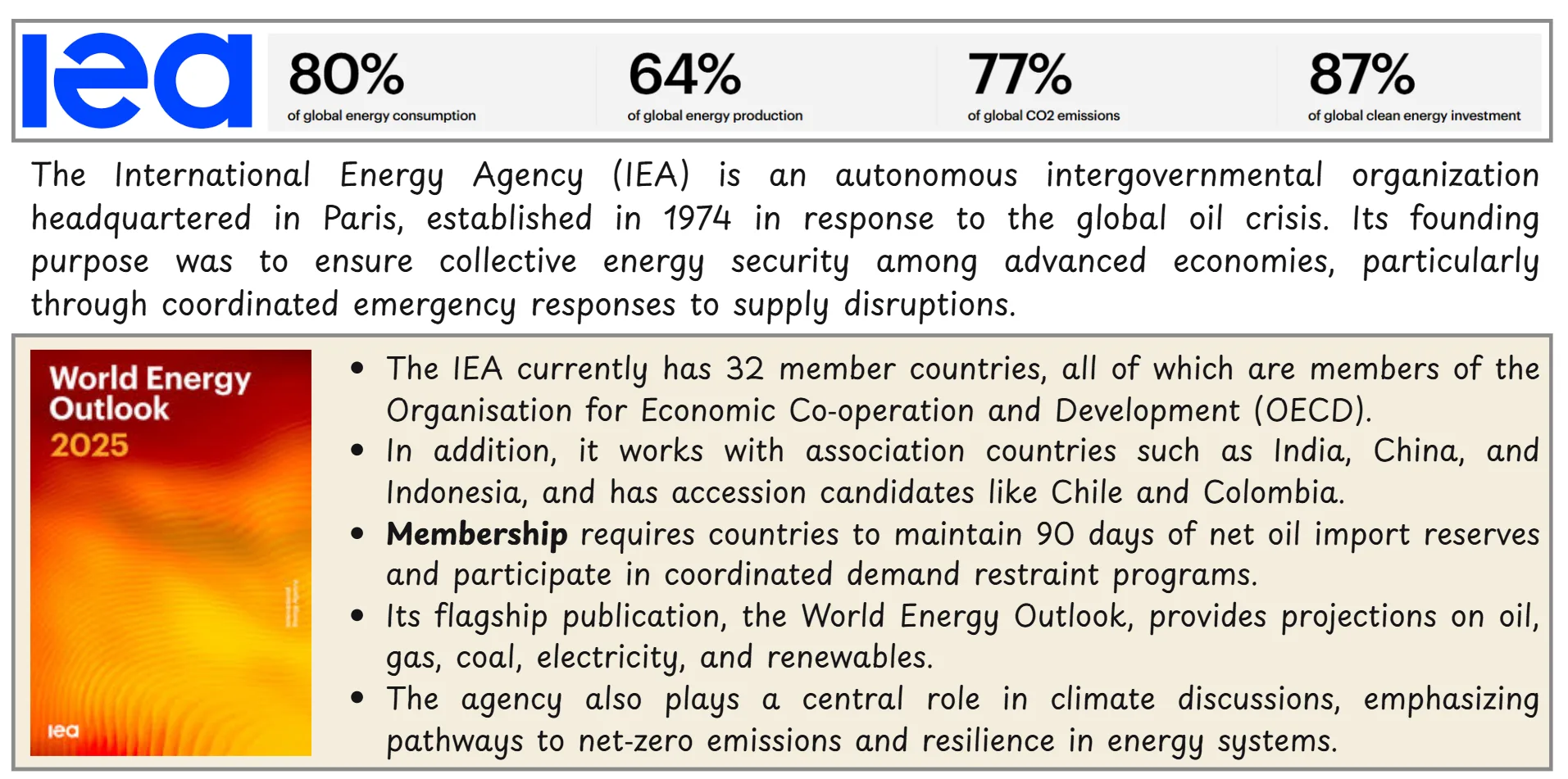
Currently, the members of the IEA are 32 countries, all of which are members of the Organization for Economic Co-operation and Development (OECD) as well. Membership is based on adherence to a number of explicit requirements: preservation of at least one hundred ninety days of net oil import reserves, implementation of a demand-restraining programme that is capable of stemming down oil consumption by ten percent, and establishing legislation that allows it to join up coordinated emergency responses. These were developed during the period of the oil crises of the 1970s and show a certain bias to the developed economies.
Structural Barriers for India
The non-OECD status of India is its main hindrance to joining the IEA. Even though India meets some of the technical requirements, like the presence of strategic petroleum reserves, the country cannot ignore the OECD exception, unless there is an official amendment of the founding charter of IEA. Therefore, the process of accession is more complicated for India, unlike in countries like Chile or Colombia that are members of OECD and are undergoing the accession process.
IEA Institutional Reform Debate
The case of India has rekindled scholarly discussions regarding the need for the IEA to go beyond its OECD-focused model. Researchers claim that omitting key up-and-coming economies subverts the validity of the agency, especially because it is indicated that India is due to confront the biggest rise in oil demand in the world by 2030. India would have to be admitted upon the consensus of the existing members and the redefinition of the mandate of the IEA.
Geopolitical and Economic Consequences of India’s Request
The Indian request to be fully a member of the IEA bears deeper geopolitical and economic implications and is both a source of domestic energy development and a possible contribution to the restructuring of the global system of governance.
Geopolitical Strategic Aspects
This would change the balance between the advanced and the emerging economies in the IEA due to the inclusion of India. Being an associate member since 2017, India already managed to influence discussions related to the processes of energy security and climate change. If India is offered full membership, it will grant India the right to influence the formulation of the emergency responses and also long-term energy policies. Analysts have opined that this change would make South-South collaboration more powerful and give some more voice to the emerging economies in institutions which have been dominated by the OECD states.
Implications on the Economy and the Market
By 2030, India is expected to create the biggest growth in global oil demand, nearly 1.2 million barrels per day. As a consequence, its membership would directly affect the oil markets, the flow of trade and investors. Besides, the fast development of renewable energy in India, with almost 200 GW of installed capacity by 2024, makes the country a key participant in the clean-energy transformation. Economically, Indian involvement may encourage additional investment in energy infrastructure and create more cooperation in the technology transfer, whereas, at the same time, it will be a challenge to the current subsidy and price structures.
Possibilities and opportunities for India
India's goal to join full membership and become a part of the International Energy Agency (IEA) is complicated; however, there are multiple avenues and solutions that may strengthen its participation in the world energy system.
India has to Strengthen Associate Membership
India was made an associate member of the IEA in 2017, thus gaining access to critical dialogues and technical cooperation. This has allowed India to participate in energy security and renewable projects without having to go through the legal hurdles of full membership. Further broadening of the associate membership would give India more leverage without the need to amend its charters.
Diplomatic Negotiations for Reforms in IEA
The accession request by India has revived the debate on the reformation of the OECD-centric structure of IEA. According to the IEA World Energy Outlook 2024, the emerging economies are expected to contribute 85 percent to the overall electricity demand in the world by 2030. One way India can use this projection is by forging coalitions with nations like Brazil and Indonesia, and in the process, plead with them to make structural reforms that mirror the reality in the energy world.
Strategic Petroleum Cooperation
The increasing strategic petroleum reserves (SPR) of India are currently approximately 5.33 million tonnes, which align with the IEA emergency response requirements. The increase of SPR capacity, as well as merging it with the system of collective stockholding of the IEA, can become a first step, which will show that India is willing to become a full member.
Conclusion
The formal request of India to become a full member of the International Energy Agency is also an indicator of its growing energy relevance and the institutional constraints of the current global frameworks. Although India meets a number of technical requirements, its non-OECD status reveals the inflexibility of the charter of IEA. As a result, the discussion of the Indian accession is not just a procedural issue but is rather an indicator of more general concerns with regard to inclusiveness, reform, and the institution-wide flexibility. Finally, India's bid raises concerns about the need to direct the process of global energy governance in accordance with the realities of the modern world of demands, sustainability, and equity.