|
Key Highlights
- Operation Thunder
- Scale of Seizers
- New trafficking trends
- Impact on humans and Ecology
- Environmental Challenges
- Need for Public Awareness
|
In Operation Thunder 2025, Interpol was able to seize close to 30,000 live animals in 134 countries, thus revealing vast trafficking networks. Officials caught ivory, scales of pangolin, bushmeat, insects, reptiles, and wood. The raid signifies that there is a growing smuggling business of smaller creatures like butterflies and plants that can be associated with organized crime and pose a threat to biodiversity, besides creating an added conservation alarm in the world.
|
Tips for Aspirants
This article is relevant in the context of UPSC CSE and State PSC examinations because it relates to the field of global governance, biodiversity protection, criminal networks, and policy enforcement, which are central themes in the curriculum of environmental, security, and international relations courses.
|
|
Relevant Suggestions for UPSC and State PCS Exam
- Operation Thunder 2025: The operation conducted under the umbrella of the Interpol and the World Customs Organization involved 134 countries.
- Scale of seizures: This seizure saved about 30,000 live animals, 10,500 insects and arachnids, ivory, pangolin scales, bushmeat, and timber products.
- New trafficking: Adaptive market forces also show an apparent change in the size of taxa, with iconic mega-fauna (i.e., elephants and tigers) being replaced by smaller taxa (i.e., reptiles, butterflies, spiders, and medicinal plants).
- Drivers of trade: Major driving forces are exotic pet markets, traditional medicinal constituents’ demands, and further use of illegally sourced timber.
- Ecological impacts: The illegal trade increases the rate of species deterioration, breaks trophic relationships, leads to the transmission of zoonotic diseases, and increases the possibility of invasions.
- Human dimension: Displacement of the livelihoods associated with biodiversity, cultural erosion, and the resilience of a community are all important socio-economic consequences.
- Policy frameworks: CITES and national laws, and the need to have a harmonization across borders, have a pivotal role to play in governance.
- Enforcement challenges: Limitations of resources, the expansion of cyber-based approaches to trafficking, and the complexity of criminal networks contribute to the complexity of enforcement challenges.
- Public awareness: The reduction in demand needs to be done over a long period through education, encouraging the use of alternatives that are sustainable, and empowering the community-based conservation process.
|
Wildlife crime has become one of the biggest demands of transnational concern on the global governance system, the conservation, and security systems. The recent Operation Thunder2025, organized by Interpol under the participation of customs and environmental agencies of 134 countries, is a historic intervention in this area. Approximately 30,000 animals had been seized, and large amounts of ivory, pangolin scales, bushmeat, reptiles, insects, and rare plants were found. Such a crackdown has never been bigger or more diverse, due to both the size and the growing variety of wildlife trafficking that is now focusing on smaller and less regulated species like butterflies, reptiles, and medicinal plants. These new patterns also expose how organized criminal networks take advantage of weaknesses in regulation and enforcement in order to meet their requirements, unlike the traditional trafficking that concentrated on iconic mega-fauna. Operation Thunder 2025's key lesson is that sophisticated global criminal networks drive the illegal wildlife trade, which is deeply linked with other serious crimes like drug trafficking and human exploitation. The operation, led by Interpol and the World Customs Organization (WCO), achieved record seizures, demonstrating the critical need for coordinated, international law enforcement action.
The effects are not limited to the reduction of biodiversity but include the threat of transmission of zoonotic diseases, ecological disproportions, and economic inconvenience to the communities depending on sustainable ecosystems.Placing Operation Thunder into the framework of wider discussion on the topic of conservation, policing, and multilateral cooperation, this article attempts to explore the changing outlines of the wildlife trafficking issue, its environmental and social-political implications, as well as the necessity of comprehensive policy measures to include enforcement, community outreach, and international legal frameworks.
Operation Thunder 2025: Scale and Scope
Operation Thunder 2025 is an especially large-scale global venture with the aim of preventing wildlife crime, given the fact that it is organized under Interpol. The program brings out the magnitude of trafficking networks and the ultimately significant importance of cross-border cooperation.Operation Thunder 2025 was a global, month-long anti-wildlife and forestry trafficking operation led by INTERPOL and the World Customs Organization (WCO), involving 134 countries.
Global Investment and Inclusion
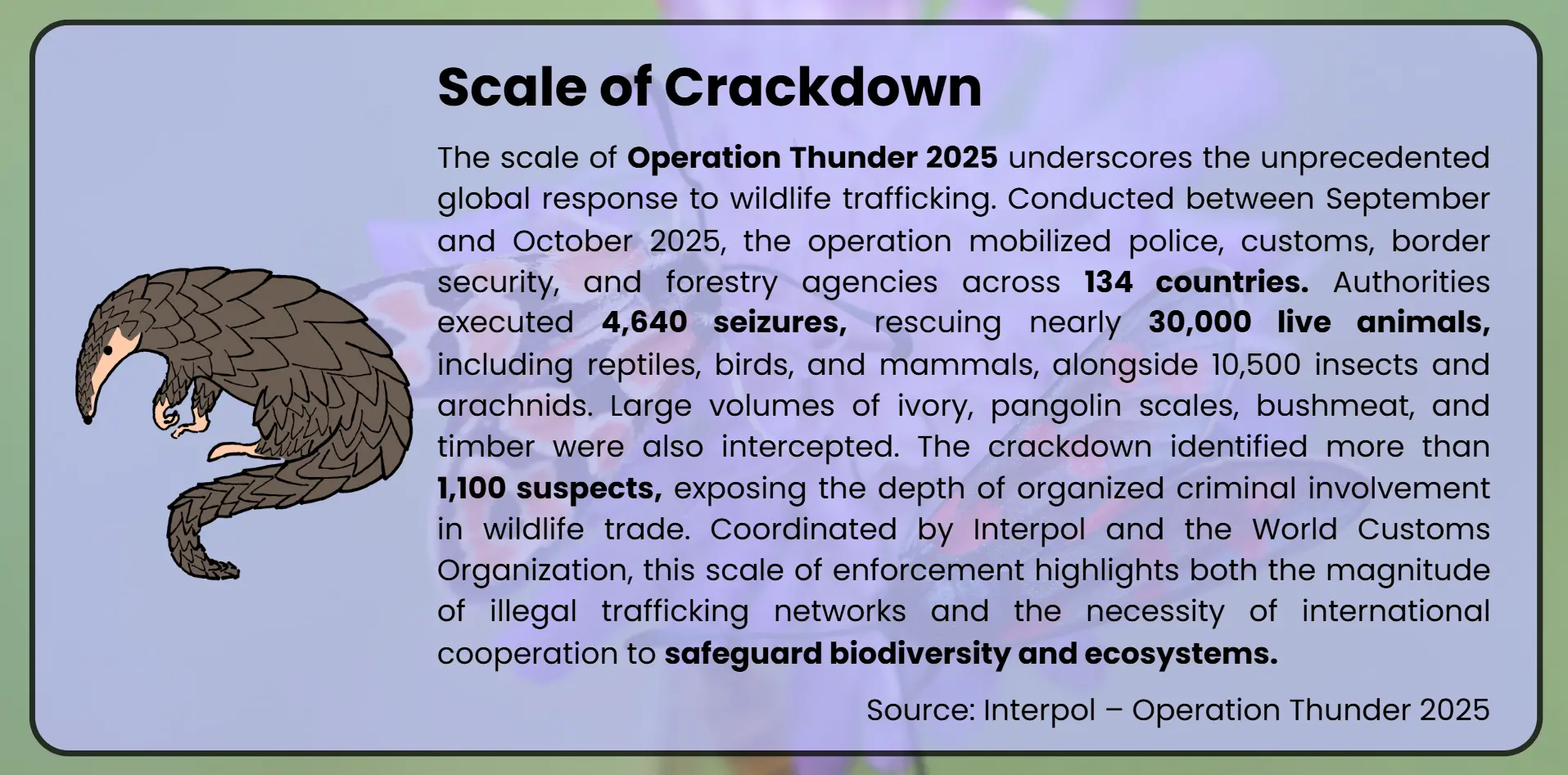
There were 134 sovereign states involved in the operation, and these comprised the police, customs, border security, and forestry agencies. During the period between September and October 2025, the law enforcement agencies had 4,640 seizures and over 1,100 suspects. The massive presence of multinational enterprises highlights the idea of wildlife crime as transnational, with a need to collaborate in dealing with the problem.
Magnitude of Seizures
The raid resulted in close to 30,000 live animals, including reptiles, birds, and mammals, being rescued. Over 10,500 insects and arachnids, ivory, pangolin scales, bushmeat, and tens of thousands of cubic meters of timber were also intercepted by authorities. These statistics demonstrate the unparalleled operation and the spread of illegal trade to non-classical mega-fauna.
Trafficking
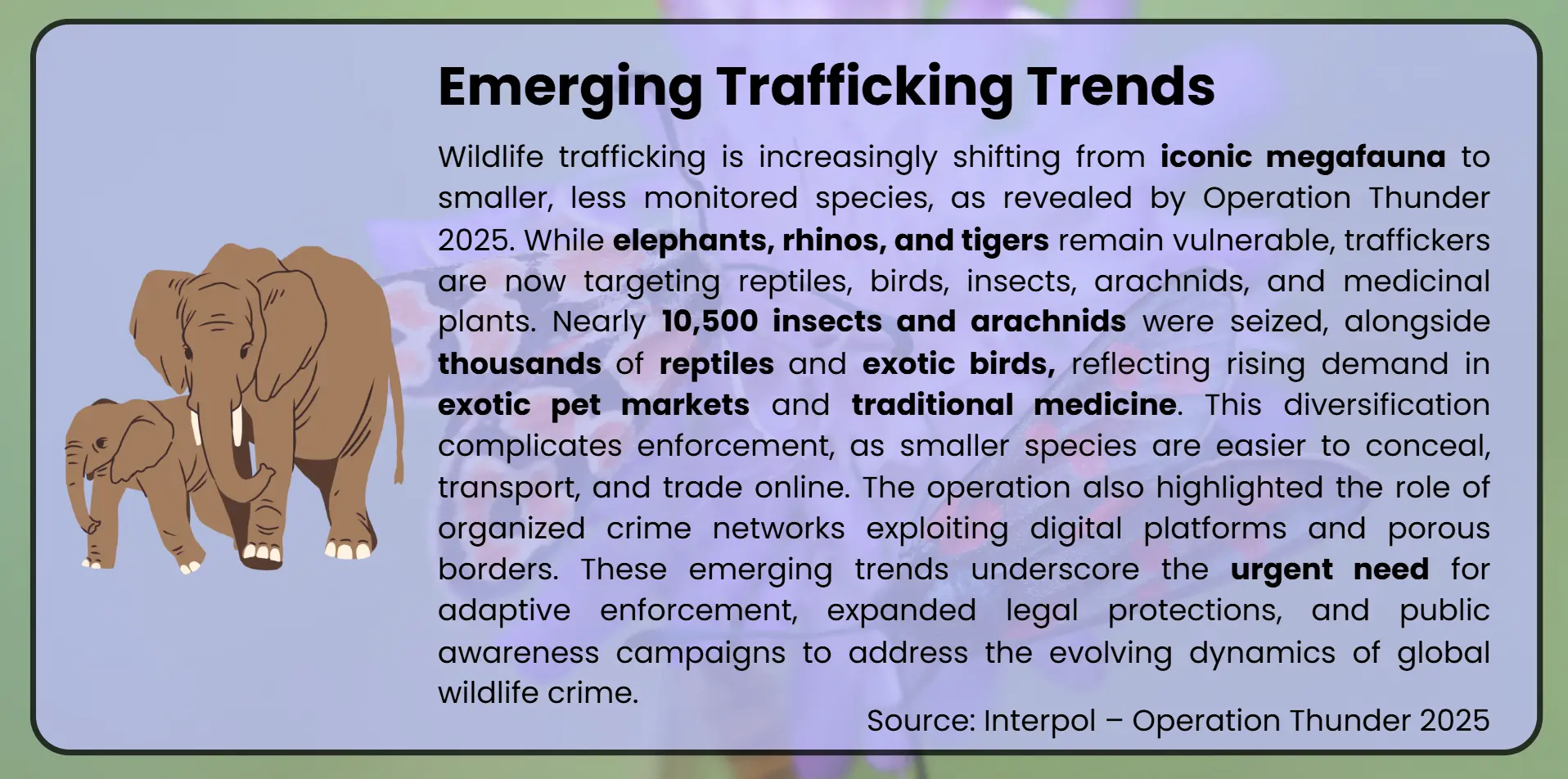
One salient characteristic of Operation Thunder 2025 was the change in favour of smaller species. The focus changed to butterflies, spiders, reptiles, and medicinal plants as the demand in the exotic pet markets and traditional medicine was growing. The compliance is not helped because smaller species tend to avoid the regulatory scrutiny and are transported in large numbers, consequently making it more challenging to detect.
Driving Enforcement and Policy
The scale of the operation shows not only the flexibility of criminal groups but also the survival of the criminal enforcement agencies. It shows the importance of better intelligence cooperation, technology-based surveillance, and tightening of legal regulations within such conventions as CITES. In addition, the project focuses on the need to educate society to reduce demand and support conservation.
A New Direction in Wildlife Trafficking
The recent changes in wildlife trafficking have been displayed quite distinctly, reflecting both the changes in the market demand and the adaptability of the criminal networks. Objective information on these nascent patterns is derived from the Interpol organization's centred operation Thunder 2025. A New Direction in Wildlife Trafficking" refers to emerging trends and modern approaches to combat illegal wildlife trade. The trade has become a highly organized, global network, utilizing technology and complex supply chains that require innovative responses from law enforcement, private sector partnerships, and the public.
Change in favour of smaller species
One of the current trends is the increased attention to such small taxa as butterflies, spiders, reptiles, and medicinal plants. They cannot be regulated effectively and are often expensive to monitor, unlike such larger mega-fauna as the elephant or tiger. Their secrecy and the high demand among the exotic pet markets make them a special attraction to traffickers.
Exotic Pet Market Expansion
The trade of exotic pets or animals has now become a major driver of wildlife crime around the globe. Live animals in 2025 showed that bird species, turtles, tortoises, and primates were a large percentage of the animals captured. This is a characteristic of consumer preference for unique and unusual pets, in most cases acquired via the black market. The multiplication of live-animal seizures, the size of which in one raid approaches 30,000, speaks of the extent of this demand.
Traditional Medicine and Traditional Food
In addition to the pet trade, poached animal components and derivatives, which find use in traditional medicine and specialty food, are also becoming subjects of wildlife trafficking. Pangolin scales, ivory, and bushmeat remain some of the leading products; however, traffickers are turning to less high-profile species whose medical or culinary importance has never been sufficiently controlled. This decentralization makes the process of enforcement harder and extends the reach of illegal business.
Transnational Organized Crime and Networks
Wildlife trafficking has long ago left the description as a disjointed phenomenon and is now thoroughly integrated with previously existing organized crime structures. These organizations take advantage of weak law-enforcement systems, unguarded frontiers, and e-commerce platforms. In the results of Operation Thunder 2025, it was possible to identify linked trafficking patterns across 134 countries, highlighting the transnational nature of the offense and the necessity of international joint efforts in counteractions.
Policymaking and Enforcement
The above trends highlight the need to heighten surveillance systems, improve intelligence dissemination, as well as tighten social-awareness campaigns. Enforcing agencies should change to the diversification of the species being trafficked illegally, and policymakers would need to extend the law to cover the previously neglected areas. Education of the population is also critical in reducing consumer demand and creating conservation.
Consequences to Biodiversity and Ecosystems
Wildlife trafficking is not just a crime; rather, it is an institutionalized hazard to diversity and environmental equilibrium. Losing biodiversity severely undermines ecosystem health, weakening their capacity to supply clean water, food, and climate stability. This leads to rising economic losses, higher risks of zoonotic diseases, collapsing livelihoods for dependent communities, and irreversible species extinctions. Ultimately, the disruption of pollination, nutrient cycles, and natural resources poses a direct threat to human well-being.
The fact that there were 226 seizures in the process of Operation Thunder 2025 highlights how big the exploitation problem is, as well as its massive ramifications.
Risks of Decline and Extinction
Smuggling products destroy enormous amounts of fauna and flora out of their natural sites. The seizure of almost 30,000 living animals and tens of thousands of safeguarded specimens of plants depicts how trafficking facilitates the violation of species. A significant number of them are already endangered, and when they are deprived of their habitats, it goes faster until they even reach extinction.
Alteration in the Ecological Balance
The ecological interactions are destabilised by the trafficking of wildlife. The loss of pollinators like butterflies and other insects or predators like reptiles and birds changes the trophic structure and leads to the loss of ecosystem resilience. These disruptions are capable of generating cascading consequences, such as population outbursts of some species and degradation of the ecological processes.
Zoonotic Diseases and Invasive Species
Animals that are being transported are often taken on the road in unhealthy conditions, which increases the risk of the spread of zoonotic diseases. Moreover, the composition of the non-native species in a new setting makes them invasive, hence, competing with the local fauna and undermining the integrity of the ecosystems. Both biodiversity and the health of people are threatened by this dual threat.
Social and Environmental Implications
Trafficking is particularly destructive to communities whose livelihoods are solely reliant on biodiversity to serve as a source of food, medicine, and sustainable income. Cultural practices and financial security are at stake because of the abuse of timber, medicinal plants, and bushmeat. The fight to conserve is no exception, and enforcement agencies struggleto enforce it.
Implications
The environmental effects of trafficking impose strong international regulations. Such tools as CITES have to be strengthened and further complemented by intelligence-sharing and capacity-building efforts among enforcement agencies. Demand must also be reduced by public socialization programs to encourage environmentally friendly substitutes.
International Policy, Implementation, and Education
The problem of wildlife trafficking is being recognized as an increasingly common phenomenon of global security, ecological, and governance concerns. Operation Thunder 2025 provides a vivid example of the need to have a unified international policy, extensive enforcement tools, and end-to-end campaigns aimed at sensitizing the population to deal an ultimate blow to this transnational vice of illicit trade.
International Laws
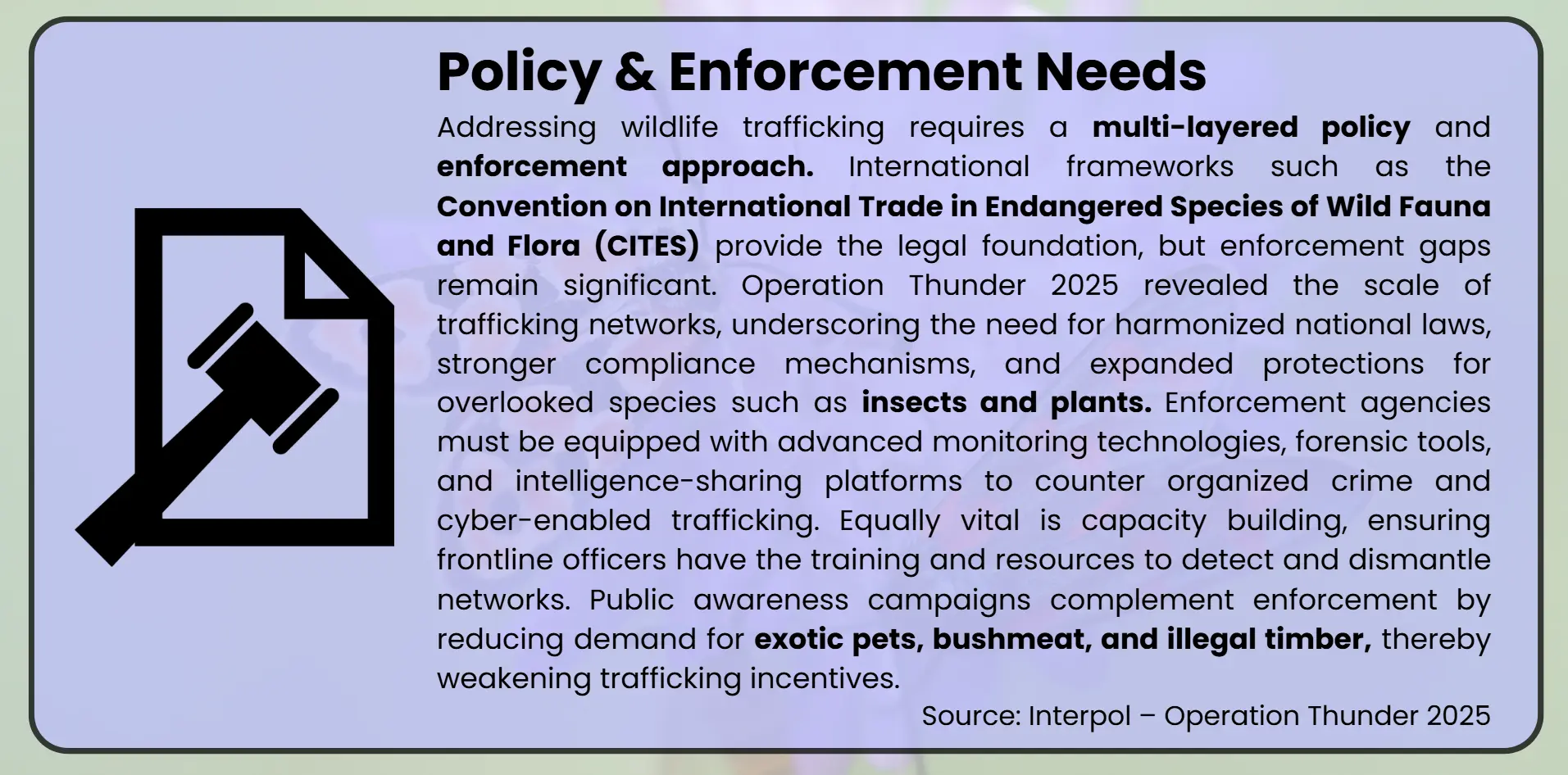
The Convention on International Trade in Endangered Species of Wild Fauna and Flora (CITES) is one of the tools that lie behind global policy responses to wildlife trafficking. These structures govern the trade of endangered species, but a lack of enforcement is still in place. The need to further strengthen compliance efforts through Operation Thunder 2025 brought home the need to align national laws and extend protection to other species, like insects and plants.
Implementation and Strengthening
Effective implementation requires international cooperation between the customs, police, and environmental officials. There are 134 countries that participated in the operation Thunder 2025, which highlights the extent of cooperation that should exist. However, in many cases, enforcement agencies face resource constraints, a lack of proper training, and other technology issues. Capacity-building projects like advanced surveillance systems and intelligence-sharing policies, and computer-forensic equipment cannot be done without tracking down and breaking down the trafficking networks.
Technology and Intelligence Sharing
platforms and leveraging anonymity and global connectivity. Therefore, enforcement will have to integrate cybercrime surveillance, data analytics, and a network of intelligence sharing. The coordination of the operation Thunder 2025 by Interpol depicts how enforcement through technology can interfere with organized crime without creating accountability where accountability is necessary across jurisdictions.
Publicity Awareness and Demand Reduction
There is no need for policy and enforcement without consumer demand. Awareness campaigns within the population become important in informing about the ecological and moral consequences of wildlife trafficking. Societies can cripple trafficking networks by reducing the demand for exotic pets and traditional medicines, and illegal timber. Education programs, the involvement of the media, and the conservation programs at the community level play a central role in influencing standard consumption trends.
International Relations
Organized crime, corruption, and poor governance structures are closely related to the issue of wildlife trafficking. It is necessary to enhance the collaboration in global institutions, local agreements, and the engagement of civil society. Operation Thunder 2025 shows that, to fight wildlife crime, protection of species is not the only battle, but also protection of the ecosystems, economies, and human security.
Conclusion
Operation Thunder 2025 captures the scale of global wildlife trafficking that has never been witnessed before and highlights the dire need to make global responses. This is evidenced by modifications of the illicit trade to smaller, less monitored species, which may underpin the seizure of almost 30,000 live animals and the induction of thousands of plant specimens in 134 jurisdictions. Such shifts prove to be devastating pressures on biodiversity, ecological stability, and human security, and at the same time exhibit the survival tactics of organized crime networks. The solution to this crisis requires strengthening international laws, increasing enforcement capacity, and developing long-term public awareness so as to reduce demand. Finally, the dominance to protect the wildlife is directly associated with the conservation of ecological balance, world health, and the quality of environmental authorities.