The statistical reforms in India are now on the agenda of public attention because the government has changed the base years of GDP, CPI, and IIP, redefined the labour and informal sector surveys, and increased the statistical accessibility of information to the public. The changes are necessary to effectively represent the actual economy, to have global comparability and evidence-based policymaking, transparency, and decentralised economic planning in a fast-changing world economy.
|
Key highlights
- Statistical System Odyssey in India
- GDP Base Year Revision
- CPI Base Year Update
- IIP Base Year Alignment
- Enhancing Indian Informal Sector, Services, and Labour Statistics
- Indian Statistical Modernisation
|
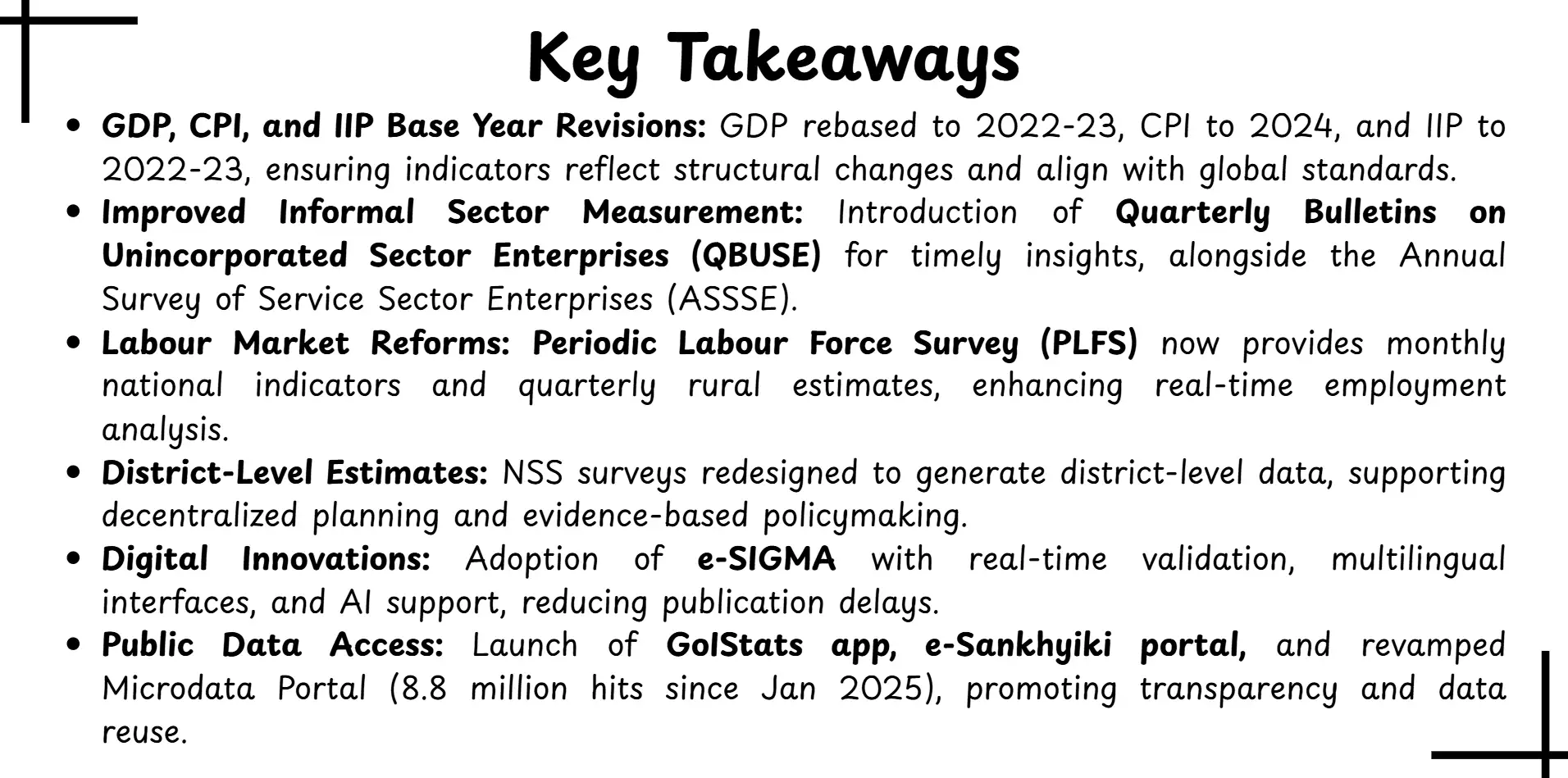
The statistical system of India is undergoing a major change in a bid to keep pace with the fast-changing dynamics of its economy and that of the world. The re-definition of the base years of GDP, CPI, and IIP, which go hand in hand with adjustments in the surveys of the labour and informal sector, is a conscious attempt to enhance accuracy, promptness, and credibility of official information. These measures are supported by the digital innovations and increased accessibility platforms aiming to support evidence-based policymaking and decentralised planning. The reforms will be the decisive move in making sure that the national accounts and the core economic statistics in India are relevant and internationally comparable by refining methodologies and using new sources of data.
Statistical System Odyssey in India
The statistical framework of India is going through a watershed change in response to the situation of an accelerating economy. Accuracy, timeliness, and transparency are emphasised in the modernisation drive, thus harmonising national accounts with the standards in the world.
Revising Core Indian Indicators
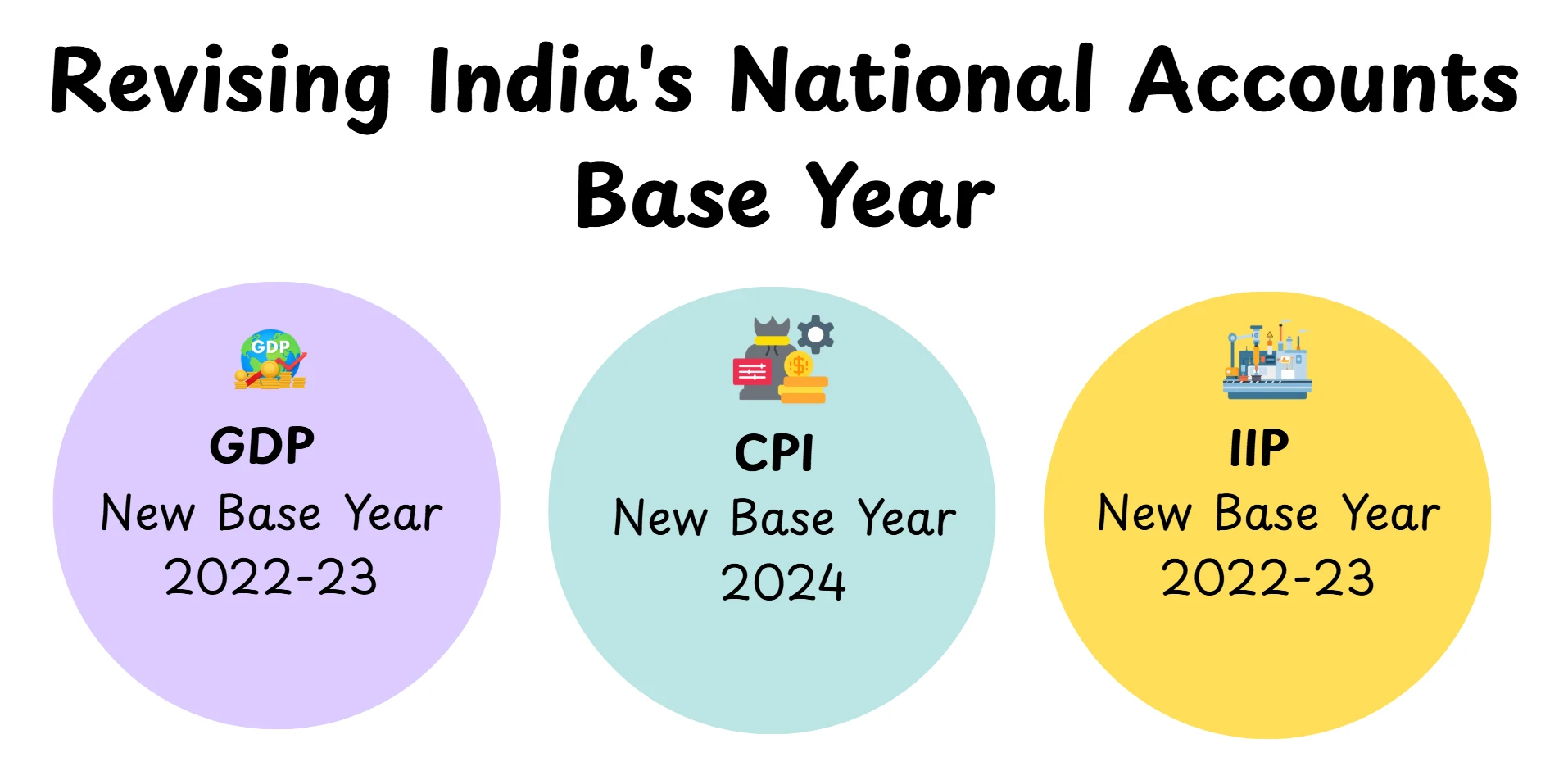
The Government of India has revised the base years of major indices, namely values of GDP (2022-23), CPI (2024), and IIP (2022-23). These changes bring new sources of data, including GST records, the PFMS system, and e-Vahan, to uphold the economic indicators to reflect structural changes in consumption, industry, and services. The new GDP series will be presented on 27 February 2026, CPI on 12 February 2026, and IIP on 28 May 2026, per the Ministry of Statistics and Programme Implementation (MoSPI).
Strengthening Indian Informal and Services Sector Data
Realising the role that the informal economy plays in the labour market and output, surveys are now also conducted on Quarterly Bulletins on Unincorporated Sector Enterprises (QBUSE) and the Annual Survey of Service Sector Enterprises (ASSSE). These programs provide granular information on enterprise functioning, labour use, and capital formation, thus filling in the long-standing data gaps.
Indian Labour Market Statistics
The Periodic Labour Force Survey (PLFS) currently generates monthly indicators and rural estimates, which complement the analysis of the real labour market in real-time. Also, decentralized planning is aided by the district-level sampling in the National Sample Survey (NSS) surveys to facilitate evidence-based intervention at the sub-state level.
Openness in Indian Digital Systems
The use of technological solutions, e.g., e-SIGMA to validate surveys in real-time, online platforms (e.g., GoIStats and e-Sankhyiki) has increased access by the general population. The updated Microdata Portal that achieved 8.8 million hits since January 2025, indicates the increased demands on the avenues of transparent and reusable data sets.
Revisions of Core Indian indicators (GDP, CPI, IIP) on an Annualbasis
The statistical system of India is also experiencing a massive recalibration by revising GDP, CPI, and IIP base years. It is this modernization that makes sure that the indicators are much closer to the realities of modern day economy and also that they match the global standards.
GDP Base Year Revision
This was done to update the base year of gross domestic product (GDP) to 2022-23. The transition also involves structural adjustments that apply in terms of the emergence of renewable energy, the growth and expansion of digital services, and the formalisation of economic activity by means of reinforcing the Goods and Services Tax (GST).The new data sources, such as e-vehicle registration data, GST repository, and Public Financial Management System (PFMS), have been added to increase accuracy. The rebased GDP series will be announced on 27 February 2026.
CPI Base Year Update
Consumer price index (CPI) has adopted 2024 as its base year based on the updated consumption patterns as per the Household Consumption Expenditure Survey (HCES) 2023-24. This amendment would mean that the rural and urban weights would be in line with the current realities, thus enhancing the measurement of inflation and its policy considerability. Theupdated CPI series is scheduled to be released on 12 February 2026.
IIP Base Year Alignment
The Index of Industrial Production (IIP) base year was changed to 2022-23,ensuring consistency in methodology with GDP estimates. New products, sectoral weights, and a better representation of the factories are added in this update. The revised IIP series will be released on 28 May 2026, improving the measurement of the output of the industry and informing policy-making.
Enhancing Indian Informal Sector, Services, and Labour Statistics
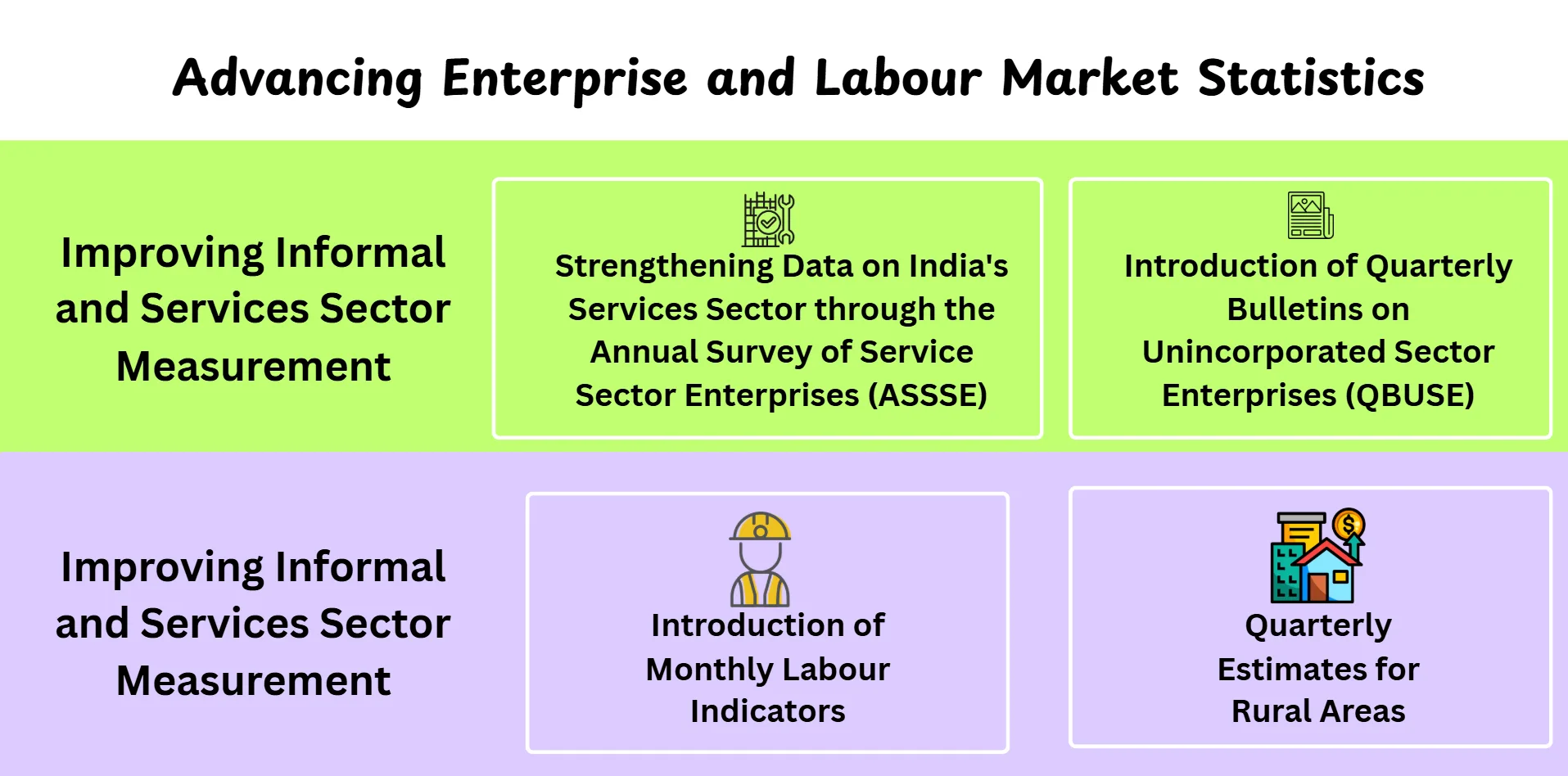
The informal sector and services are a major influence in the economy of India, which makes a significant contribution to employment and output. The recent reforms are supposed to enhance statistical coverage, raise frequency, and make the policies more relevant.
Measurement of the Indian Informal Sector
In 2025, it was extended by the addition of Quarterly Bulletins on Unincorporated Sector Enterprises (QBUSE) to the Annual Survey of Unincorporated Sector Enterprises (ASUSE). The quarterly releases can give up-to-date information on the scale of the enterprise, make-up and employment trends, and therefore minimise its reliance on the yearly data. As per MoSPI, QBUSE has currently provided short-term indicators that have become extremely important in tracking one of the most dynamic economic segments in India.
Indian Services Sector Statistics
The National Statistical Office (NSO) piloted the Annual Survey of Service Sector Enterprises (ASSSE) to deal with the limited granular data existing on incorporated service enterprises. This survey measures indicators, like Gross Value Added (GVA), fixed capital, and employment. This, in turn, seals a very big gap in the measurement of the service-sector. The ASSSE Framework, designed for the Technical Advisory Group on Enterprise Surveys, is methodologically rigorous.
Indian Labour Market Reforms
Labour statistics have been updated by the Periodic Labour Force Survey (PLFS). The monthly labour indicators have been available at the national level since January 2025 and now have quarter estimates that are also available to rural areas. These developments would allow close real-time tracking of the trends in employment and unemployment, thereby contributing to inclusive growth strategies.
Indian Statistical Modernisation
Systemic innovations that increase granularity, efficiency of operations, and transparency characterize the path that India is taking towards statistical modernization. These reforms are embedding high-tech solutions and also opening up to the masses, thus maintaining the credibility of official statistics and its policy topicality.
India’s Basic Statistical Block
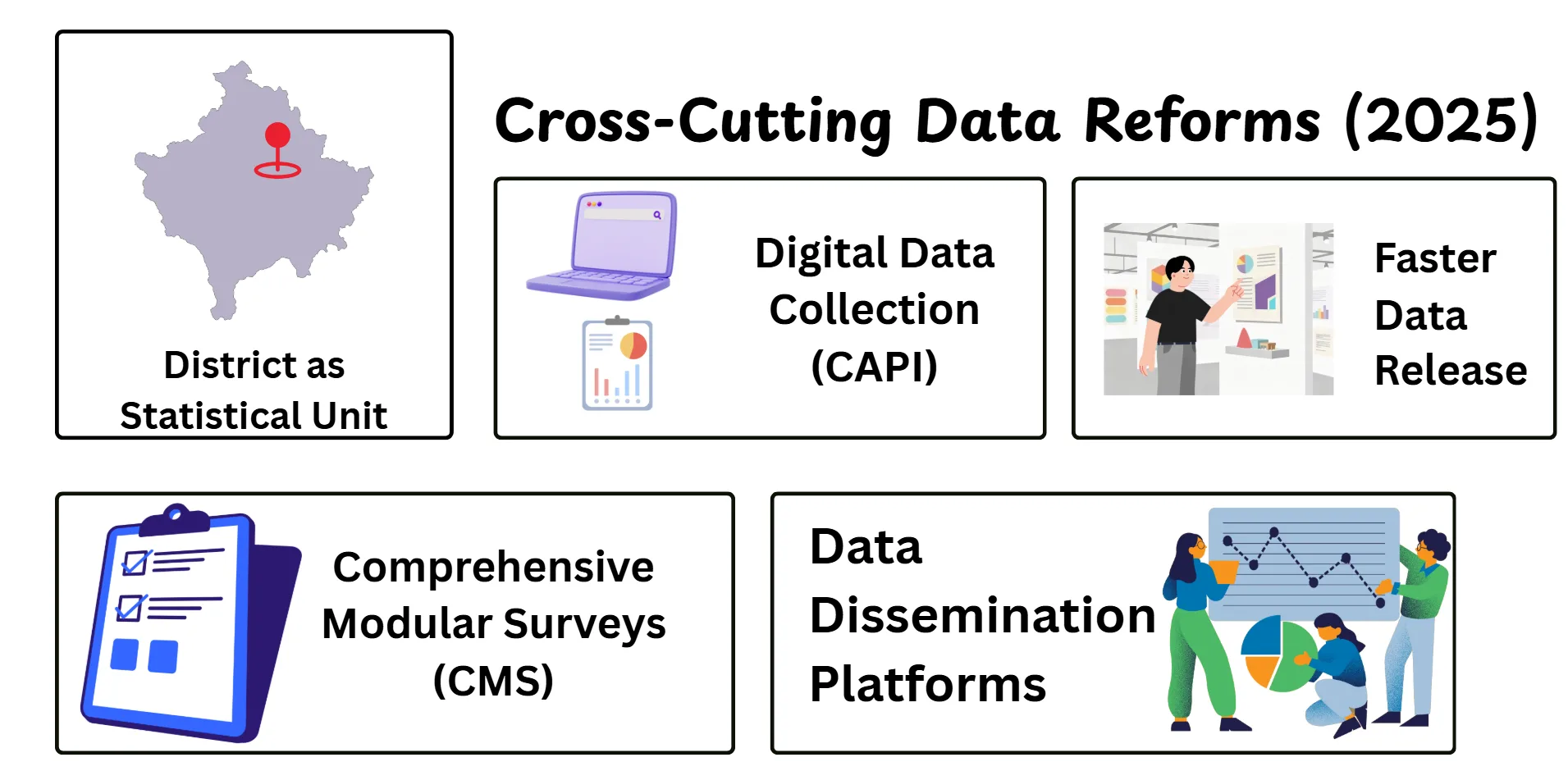
From January of 2025, the National Sample Survey (NSS) adopted districts as the basic statistical building block. This strategic change allows making quarterly estimates on a district and sub-district level, which will strengthen decentralized planning. Twenty-seven states have agreed to be part of flagship surveys using this design, which signifies a high level of institutional support.
Digital Data Collection in India
The e-SIGMA system presented Computer-Assisted Personal Interviewing (CAPI), which had real-time validation, multilingual interfaces, and a chatbot supported by AI. These advancements have significantly reduced the time taken to publish the yearly results, and monthly resultsare released in a period of 90 to 120 days and 15 to 30 days, respectively, which has improved the timeliness of the socio-economic indicators.
Comprehensive Modular Surveys (CMS)
Surveys issued by MoSPI under the short-cycle theme list include CMS on Telecom (January -March 2025) and CMS Education (April-June 2025). The surveys also provide a fast answer on the ICT competencies, school spending, and private coaching, and the CAPEX survey involved corporate firms through the digital platform to evaluate investment plans.
Public Data Access Platforms
The dissemination has been strengthened by GoIStats (mobile application), e-Sankhyiki (portal hosting 136⁻ million records), and the refined Micro-data Portal that has registered 8.8 billion hits ever since January 2025. The platforms are developed based on international best practices to guarantee transparency and allow the reuse of data.
Conclusion
To conclude, the current statistical reforms represent a decisive breakthrough in the Indian data ecosystem and have brought increased accuracy, timeliness, and transparency to leading economic indicators. The government has made national accounts more consistent with realities in the informal and service sector by recalibrating base years of GDP, CPI, and IIP; consolidated measurement of the informal and services sector, and developed labour statistics to conform national accounts to contemporary realities and global standards. Together with the digital innovations and the increased accessibility of the population, such actions provide a high-quality base of evidence-based policymaking and decentralized planning in the fast-changing economy.
Frequently asked questionsFrequently asked questions
Statistical System Odyssey in India?
The statistical framework of India is going through a watershed change in response to the situation of an accelerating economy. Accuracy, timeliness, and transparency are emphasised in the modernisation drive, thus harmonising national accounts with the standards in the world.
Revisions of Core Indian indicators (GDP, CPI, IIP) on an Annualbasis?
The statistical system of India is also experiencing a massive recalibration by revising GDP, CPI, and IIP base years. It is this modernization that makes sure that the indicators are much closer to the realities of modern day economy and also that they match the global standards.
Enhancing Indian Informal Sector, Services, and Labour Statistics?
The informal sector and services are a major influence in the economy of India, which makes a significant contribution to employment and output. The recent reforms are supposed to enhance statistical coverage, raise frequency, and make the policies more relevant.
Indian Statistical Modernisation?
Systemic innovations that increase granularity, efficiency of operations, and transparency characterize the path that India is taking towards statistical modernization. These reforms are embedding high-tech solutions and also opening up to the masses, thus maintaining the credibility of official statistics and its policy topicality.