|
Key Highlights
- FAQ SOLAW 2025, Report
- Agricultural Expansion
- Its impacts on the Environment
- Emerging Challenges
- Need for Alternatives
- Policy Integration and Future Pathways
|
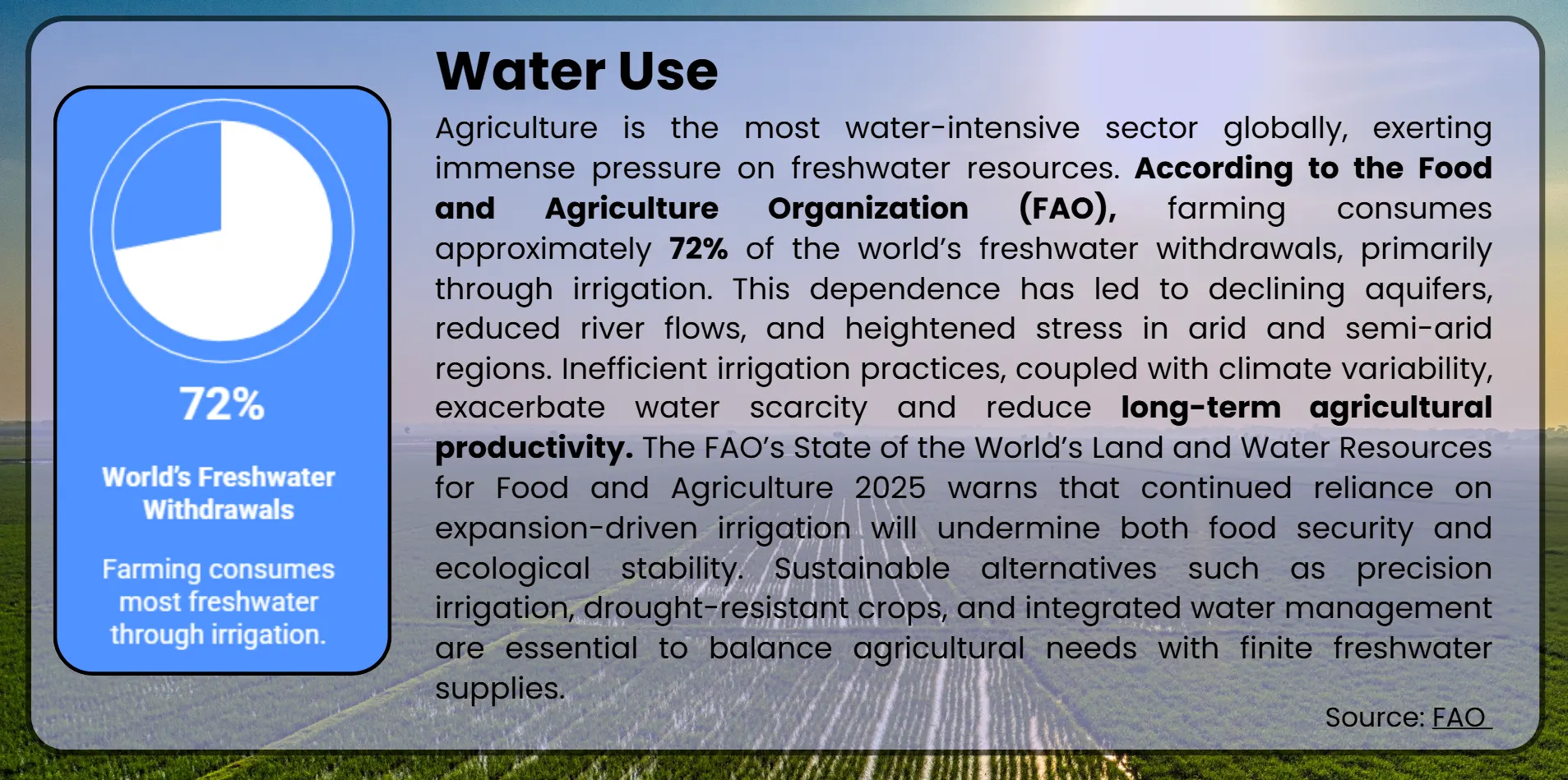
An abrupt warning has been sounded in the State of the World Land and Water Resources report by the Food and Agriculture Organization (FAO), which shows that the ongoing increase in farmland is no longer a viable solution. The existing state of agricultural affairs uses 72 percent of all freshwater resources all over the world and contributes more than 60 percent to land degradation. Having estimated that the world will require an increase in food production by 50 percent by the year 2050, the FAO has emphasized the implementation of resource-efficient production systems, resistant crop species, and integrated systems to ensure sustainable food security.
|
Tips for Aspirants
The article is essential to all candidates taking the Union Public Service Commission (UPSC) Civil Services Examination (CSE) and State Public Service Commission (PSC) examinations, as this article studies the relationships between agriculture, sustainability, and policy reforms- some of the main thematic areas of the environment, economy and governance section of the syllabus.
|
|
Relevant Suggestions for UPSC and State PCS Exam
- FAO Report (2025): The growth of agricultural areas can no longer be considered viable because of environmental limitations.
- Agricultural Footprint: take about fifty percent of the habitable land on the earth; agriculture has caused 60 percent of land degradation and seventy-two per cent of global fresh water.
- Environmental Impact: causes deforestation, biodiversity destruction, soil erosion, and water scarcity, leading to a high ecological imbalance.
- Limits of Expansion: According to population projections, the world will reach a new population of ten billion by the year 2050, and at this rate, the demand for food will rise by half a century. Further growth would increase the severity of climate change and increase land-use tensions.
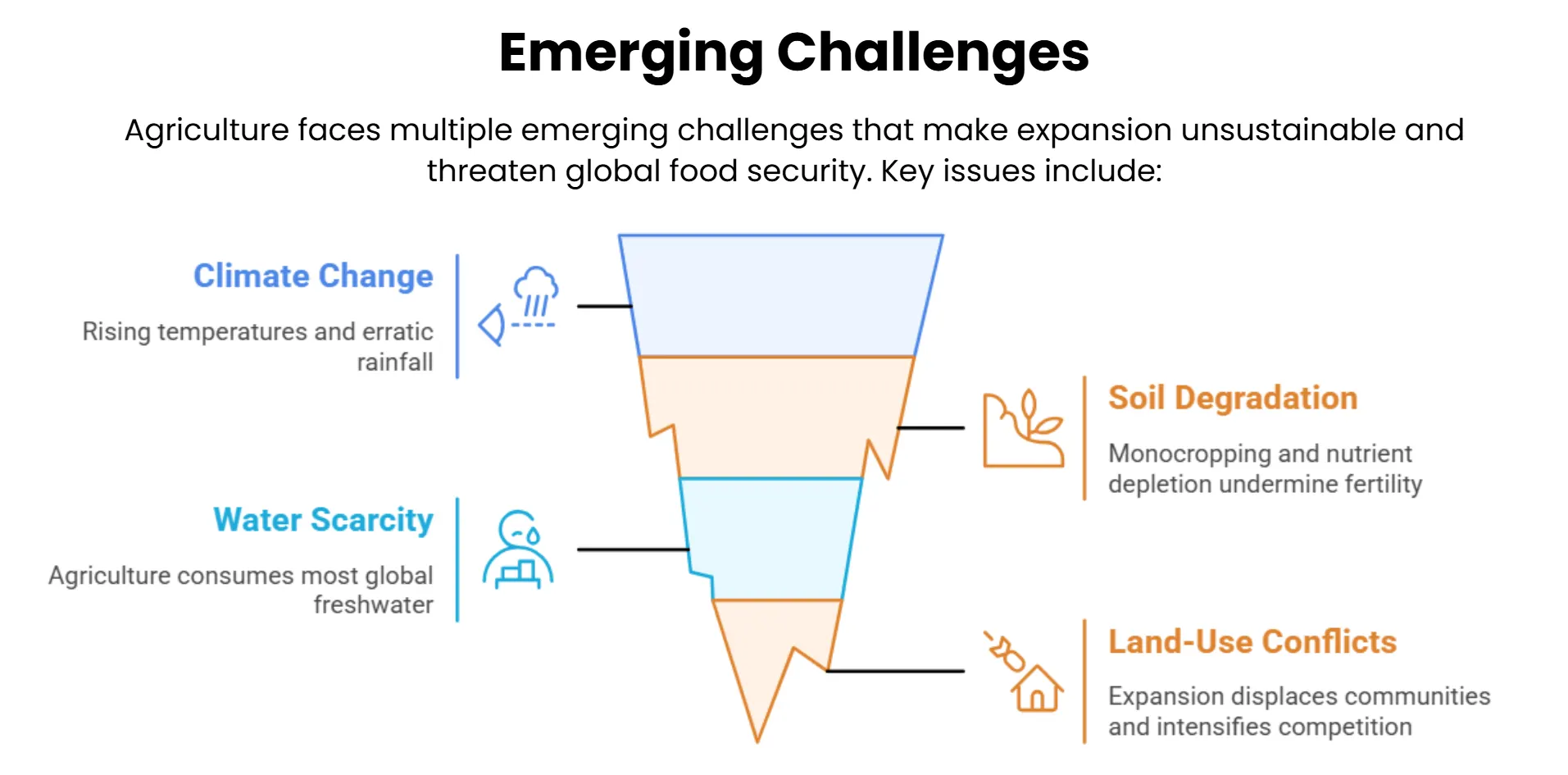
- Emerging Challenges: The frontiers of present-day agrarian threats are climate variability, declining soil productivity, degradation of the aquifer and socio-economic displacement.
- Sustainable Alternatives: Such approaches include resource-effective farming methods, regenerative farming, agroforestry and technological innovation, which have potential in reducing some of the negative effects.
- Policy Directions: A significant change in land-use planning, conservation provision and global collaboration is necessary in a bid to support sustainable agricultural growth.
|
Agriculture has always been recognized as the very backbone of human civilization, as it has an impact on economic growth, social organization, and landscape shaping. However, recent findings expressed by FAO scientific studies show that the traditional orthodox paradigm, including increasing agricultural acres to satisfy growing food demand, is no longer sustainable. The sector most influencedby the land resources, leading to rampant deforestation, soil erosion, loss of biodiversity, and disappearance of freshwater. Since the world population is expected to grow to 10billion by 2050, the projected growth in food demand will crash on already crossed ecological boundaries of land and water systems. Additional colonization of forests, wetlands, and marginal areas would amplify climate change, increase resource tensions, as well as compromise long-term food security. FAO thus proposes the concept of sustainable intensification, technological innovation, and regenerative practices to replace expansionist practices.This specific change requires a concerted policy reform, more investment into more resilient agro-ecological systems, and a shift in the consumption practices.
The universal dilemma changes to not only increasing the amount of food produced but also accomplishing this at the limited resources of the ecosystems of Earth, effectively reconciling the aims of development in agriculture with the demands of sustainability and intergenerational fairness.The land resources crisis is heavily driven by agriculture, which uses a third of the world's land, causing major deforestation (88% of it), soil degradation (over 60% of global degradation), biodiversity loss, and water depletion, creating a vicious cycle where degraded land reduces food security and further strains resources, impacting nearly half the world's population and threatening future food supply.
Context and FAO's Warning
The Food and Agriculture Organisation (FAO) has continued to highlight the increasing stresses confronting land and water systems in the world. It’s most recent publication, the State of the World Land and Water Resources for Food and Agriculture (SOLAW 2025), warns that an ever-growing food demand can no longer be covered by expanding agriculture. Despite being invaluable to the existence of human beings, agricultural practices have led to an ecological threshold where farming and sustainability have been threatened, as well as food security.
The Growing Imprint of Agriculture
The world continues to be primarily practising agriculture that consumes both land and water resources. FAO indicates that of the arable land in the world, over 60 percent of degraded agricultural land is under agricultural production, with 72 percent of the fresh water consumption being under cultivation. Encroachment of agricultural activities into the forest, wetlands and marginal lands has increased loss of biodiversity, erosion and exposure to extreme climatic conditions. The agricultural domain has a massive spatial footprint and, unlike the relatively small-scale footprint of the industrial or urban sectors, shapes landscapes and ecosystems at the planetary level.
Limits of Expansion
In the FAO report, it is reiterated that further growth would be unsustainable ecologically. It is projected that by 2050, the world population will grow to about 10billion, meaning it will be almost 50percent of the population in 2012. But land and water systems have already been overtaken by the absorptive capacity. Expansion-based growth exposes the lost opportunity to aggravate deforestation, lack of water and land-use disputes, hence undercutting the future productivity. This situation is placed within the context of a critical choice, in which agriculture needs to move beyond expansion into efficiency.
Warnings and Policy Implications of FAO
FAO promotes efficient use of resources, sustainable crop facilities, and the combined land-water management as possible solutions to further growth. Sustainable intensification, regenerative agriculture, and agroforestry are pointed out as avenues that can bring about food security and ecological integrity. The reforms of the policy should focus on conservation, technological development, and equal distribution of resources. This is a clear red flag as it states that the process of acquiring more farmland will not soften the world crisis but make it worse without creating changes in the global system.
Imposing Agriculture on the Land Resources
The roots of human survival and economic growth have always been based on agriculture. However, it has gained absolute dominion over land resources to such unimaginable heights that it has caused ecological strains that cannot be equalled by other sectors of the economy. Food and Agriculture Organization State of the World Land and Water Resources for Food and Agriculture (SOLAW 2025) indicates that agriculture has become the primary cause of land degradation and freshwater depletion in the entire world. Imposing agriculture on land resources is a primary driver of the land resources crisis, leading to widespread soil degradation, water scarcity, biodiversity loss, and climate change.
Agricultural Land Use
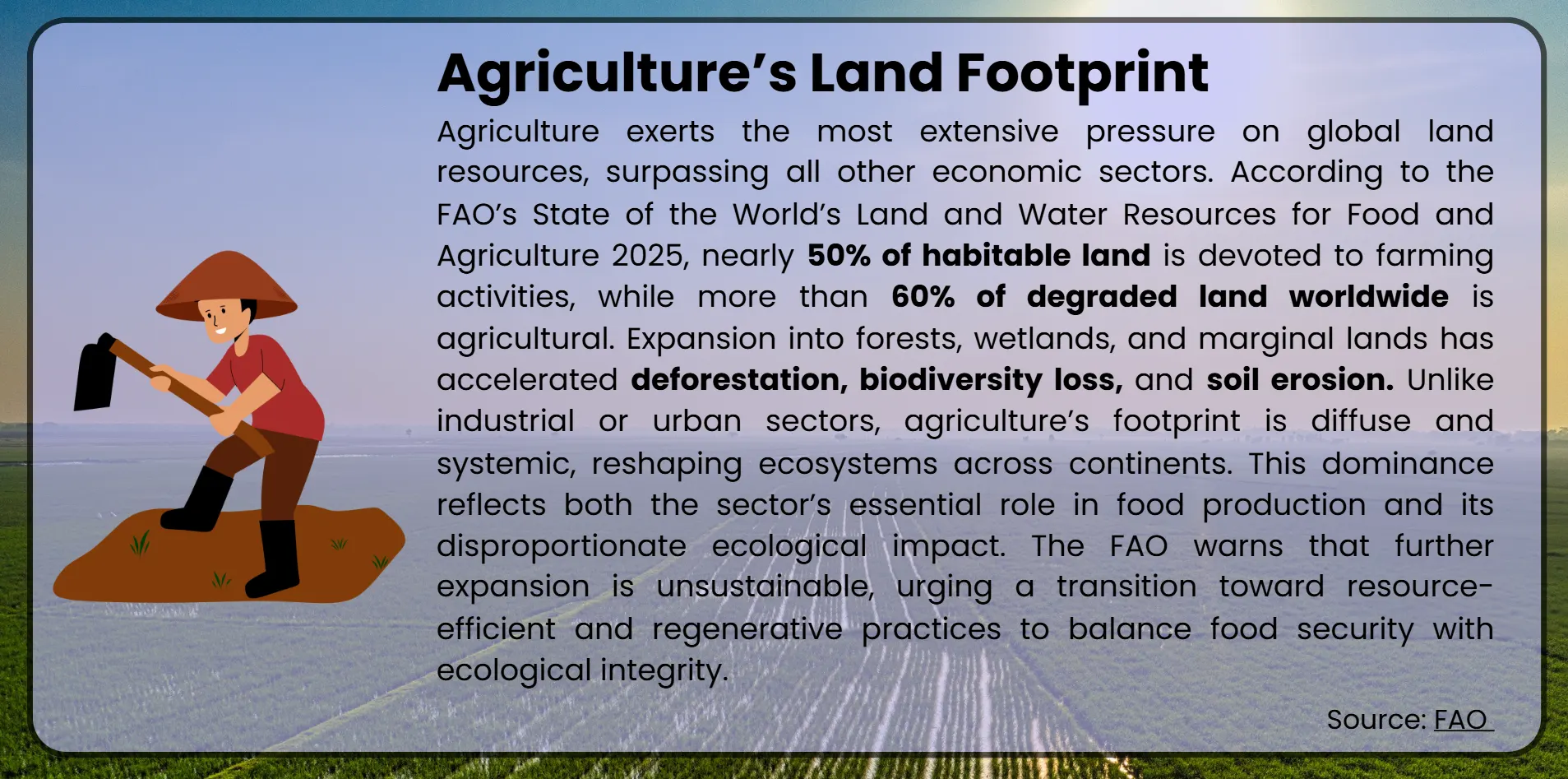
Agricultural production takes up almost half of habitable land worldwide, which surpasses the spatial footprint of industrial and urban developments. Agriculture is responsible for more than 60% of the degradation of land in the world, which is unsustainable due to overgrazing, mono-cropping, and deforestation, among others. This hegemony is not only quantitative but also remodels ecosystems, changes the composition of the soil, and reduces biodiversity. With the agricultural sectors, agricultural growth is diffuse, penetrating different landscapes and ecosystems, and thus making a more pronounced ecological effect than with the industrial sectors.
Sectoral Impact
Whereas local environmental complications are caused by industrial activities and urbanization, the agricultural impact is global. It can be industrial pollution and defile a particular location, but agriculture changes the whole scenery. Deforestation to produce cropland, the transformation of wetlands, and an increase in pastures combine to produce a loss in biodiversity on an unprecedented scale compared to the other sectors. As a result, the dominance of agriculture not only has the largest portion of land use, but it is also the most significant restructuring of ecological systems.
Constraints of Growth and New Dilemmas
As the Food and Agriculture Organization (FAO) has indicated, this is not possible anymore in the traditional approach of increasing cropland to satisfy the world's food demand. Ecological limits have been hit, and any additional growth is threatening to worsen land degradation, climatic pressures, and overuse of resources. The land resources crisis refers to the increasing gap between the finite supply of productive land and the escalating human demands for it, driven by population growth, economic development, and climate change.
Ecological Frontiers to Farmland Development
Today, Agriculture occupies about half of all habitable lands; thus, there is very little remaining room for invasion without harsh ecological consequences. According to FAO, over 60 percent of the impaired land on the Earth is under agriculture, and the conversion of forests and wetlands hastens the destruction of biodiversity and carbon release. These environmental limitations prove that the benefits of new farmland are not marginal compared to environmental activities that are long-term in nature.
Resource Scarcity and Climate Change
The change in climate complicates land expansion issues. Warmer temperatures, unpredictable rainfall, and severe weather conditions reduce the effectiveness of new land farming. Agricultural practices that are dependent on irrigation use approximately 72 percent of the world's freshwater and thus burden aquifers and river systems. Development of marginal areas could require an increase in the level of input, which further reduces the fertility of the soil and water. Such a feedback loop compromises and increases susceptibility to climate shocks.
Land-Use and Socio-Economic Conflicts
Outside of ecological boundaries, growth causes socio-economic strains. The conversion of land often evicts the locals, increases the competition between agricultural and urban development, and catalyses the struggle to distribute resources. The FAO emphasizes that growth through expansions is not economically efficient because the degraded soils require the use of expensive practices to restore them. The emerging issues, therefore, involve the balancing of food security and the equitable allocation of land and avoiding the unsustainable use of weak ecosystems.
Sustainability
The FAO proposes the shift of the expansion paradigm to the efficiency paradigm. These are sustainable intensification, regenerative agriculture, and integrated land-water management. The goal of these strategies is to maximize the yield without the need to expand the cropland and conserving biodiversity at the same time. To resolve the arising issues and ensure food security within the environmental boundaries, policy reforms, technological innovation, and international cooperation are necessary.
Alternatives and Policy Direction
The Food and Agriculture Organisation (FAO) argues that the future agricultural trend cannot be predicted based on the simple increase of arable land. Instead, ecological and viable solutions with coherent policy frameworks are needed to put global food systems on the path of resilience, efficiency, and ecological integrity by adopting sustainable alternatives.The land resources crisis, driven by human activities like unsustainable agriculture, deforestation, and urbanization, requires a multi-faceted approach involving sustainable management practices, policy reform, and international cooperation.
Resilient Production and Regenerative Agriculture
The concept of sustainable intensification gives importance to increasing food output in the already available farmland, which will not result in depletion of the natural resources. Precision farming, crop diversification, and built-in pest management strategy methodologies reduce the waste in the process of input, but the yield is maintained. The regenerative type of agriculture, including agroforestry and conservation tillage, allows restoring the health of the soil, enhancing carbon capture, and reinforcing biodiversity. Such methods combine productivity with environmental regeneration and, as a result, provide a sustainable alternative to growth through expansion.
Technological Innovation and Resource Efficiency
As a part of technological innovation, there is a crucial aspect of addressing the modern agricultural issues of today. Intelligent irrigation, breeding of a drought-resistant cultivar and the development of digital monitoring technology can increase the efficiency of water and soil usage. The FAO stresses that resource-efficient technologies can reduce Agriculture’s 72 percent of freshwater footprint in the world, and in parallel halt land degradation. By blending science and technology, agricultural systems can be able to cope with changes in climate and reduce their ecological footprints.
Policy Changes and International Collaboration
There is an assumption of policy directives playing a central role in enabling sustainable alternatives. The governments have the responsibility of ensuring land-use planning becomes the priority, conservation practices are promoted, and unsustainable growth is controlled. International cooperation is also required as the prolonged food security and environmental sustainability have no national boundaries. The FAO promotes integrative structures to combine agriculture, climate and biodiversity policies, thus guaranteeing equal access to resources and resilience in the vulnerable areas.
Sustainable Consumption and Equity
In addition to factors of production, consumption needs to realign itself to sustainability. The pressure on land and water systems can be softened through the mitigation of food waste, consumer behaviour advocacy in favour of plant-based diets, and advocacy of responsible consumer behaviour. The policies should also address the issue of equity, which will ensure that smallholder farmers who operate most of the agricultural lands in the world are provided with proper assistance when adopting sustainable farming. This two-fold focus on consumption and equity has been strengthening the social aspect of sustainability.
Conclusion
The conclusions drawn by the Food and Agriculture Organisation (FAO) are categorical, which means that the era, where the agricultural expansion has been epitomised as a panacea for food insecurity, is over. The existing burdens of agriculture across the world's land and water have already put the greatest strain on the terrestrial and water ecosystems of the world, and any further encroachment would increase ecological degradation, biodiversity loss and climate-related risks. This now calls on the urgent requirement of sustainable intensification, regenerative agro practices, and consistent policy changes in an attempt to frame the future direction of food production. Societies can secure food supply to the growing population and protect the dwindling natural resources by ensuring that they focus on operational efficiency, distributive equity, as well as ecological integrity. The main problem will be to balance the human needs and the planetary resources, hence being resilient and sustainable for future generations.