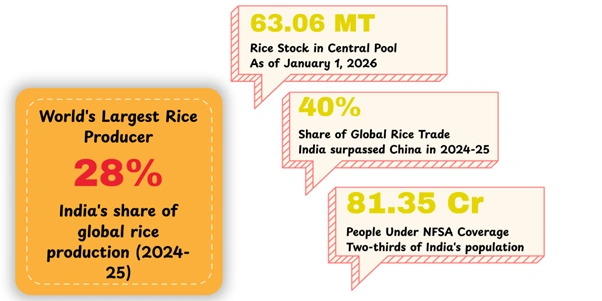
India has set its position as the world's largest rice producer (150–152 million tonnes) and exporter, controlling roughly 40% of the global trade, driven by high minimum support prices (MSP), subsidized power and burst international demand, with exports reaching over 21 million tonnes in 2025. India has officially surpassed China to become the world's largest rice producer, with a record output of 150.18 million tonnes in 2025.
|
Key highlights
- India’s Rice Boom
- India's Rice Paradox
- Challenges with Rice Cultivation
- Government Interventions & Policy Measures for Rice Production
- Way Forward for India
|
The incredible development in the production of rice has propelled India to the highest stage in the staple food market worldwide; however, highlighting the achievement hides relevant structural issues. An increase in paddy plantations has increased groundwater extraction, environmental degradation and limited diversification of crops, which has compounded the fears about sustainable food security and nutritional sufficiency. In addition, uneven productivity between regions predetermines the existence of systemic inefficiencies, leading to loss of resilience when confronted with climate change. The article provides a critical analysis of the contradiction between the increasing rice production and sustainability risks, and looks at the government actions implemented to promote ecological balance, food security, and agricultural diversification.
The increased production of rice in India has raised concerns due to high levels of harvests amidst the increasing fears of groundwater depletion, climatic stressors, and nutritional deficiencies. Increasing exports and food supply, the growth raises serious questions of sustainability and future food security.
India's Rice Paradox- Paradox of Rice Seed System in India
India’s rice paradox stems from being the world’s largest rice producer (150 million tonnes in 2024–25) and exporter, while at the same time depleting its valuable water resources. Although rice cultivation strengthens food security and farmers’ incomes, it is highly water-intensive—requiring about 3,000–4,000 litres per kilogram—and has led to serious groundwater depletion, especially in Punjab and Haryana. The production of rice in India has been boosted to levels it has never reached before, but the realisation of this feat hides several deep structural problems. The contradiction lies in the global leadership of rice production and sustainability, nutrition, and ecological stability.
Increasing Rice Production in India
During the years 2024-2025, India overtook China, becoming the largest rice producer in the world with 28 percent of the entire global production and almost 40 percent of global trade. This growth has strengthened the food supply and export earnings of India, making it a critical player in world food security. However, the scale of production makes issues of exploitation of resources as well as their sustainability hidden.
Environmental Costs for India
Rice is a crop that consumes a lot of water, requiring 3,000-4000 litres of water per kilogram. Extensive extraction of groundwater in Punjab and Haryana and various other states has led to an alarming reduction of aquifers, creating what scholars term a ‘virtual water export crisis, where limited water resources are exported in terms of rice shipments.
Productivity Concern for India
Even though the aggregate output is eye-raising, productivity levels are very uneven among various regions, with eastern states left behind. Failure to diversify in the production of foods has also been caused by overreliance on rice, thereby reducing their diets, hence leading to nutritional imbalances due to a lack of food diversification. These gaps are sought to be countered by government programmes such as rice fortification through the Public Distribution System.
Policy Interventions by India
Some of the steps that have been taken include soil-health cards, micro-irrigation projects and the selling of millets with the view of reducing reliance on rice. However, the rice paradox in India depicts the importance of integrating water management, sustainable agricultural skills, and diversification to ensure food security and avoid the destruction of an ecological balance.
Challenges with Rice Farming - Five Major Challenges Faced by Rice Farmers
Rice farmers around the world are facing serious, interconnected challenges that threaten stable production. These pressures are largely driven by climate change, resource depletion, and rising economic costs, with key issues including unpredictable weather, water shortages, labor constraints, high input expenses, and soil degradation. Despite the international popularity of rice production in India, the concept is still facing structural issues. These issues include ecological, economic, and nutritional aspects, thus posing a threat to the sustainability and food security in the long-term.
Groundwater Depletion in Indian States
Rice is also a very water-demanding crop as it consumes 3,000 to 4,000 litres of water per kilogram. Extensive use of groundwater in Punjab, Haryana and western Uttar Pradesh has resulted in extensive aquifer depletion. According to research by the Indian Council of Agricultural Research ICAR, a phenomenon of the so-called “virtual water export” has emerged due to unsustainable irrigation methods in the country, in which India exports rice that has been grown with limited groundwater reserves.
Productivity Disparities in India
Despite India becoming the largest producer of rice in the world in 2024-25, with 28 percent of the total world production, the productivity is uneven. The eastern states like Bihar and Odisha lag since they are characterized by fragmented landholdings, poor mechanization and access to better seed varieties. Studies in the article by Cereal Research Communications note that yield gaps in the Indo-Gangetic plains remain a critical barrier to resilience.
Insufficiency of Crop Diversification in India
Overreliance on rice has limited the diversification process towards pulses, millets and oilseeds. A 2026 study in the journal, Frontiers in Sustainable Food Systems reports that institutional incentives, minimum support price (MSP) policies driving up rice supremacy, have contributed to a lack of policy adaptability in adopting source alternatives through more climate-resilient ones.
Rising Environmental and Nutritional Issues in India
The excessive use of rice as a diet leads to the phenomenon of dietary imbalance, that is, the lack of protein and a variety of micronutrients. Also, paddy farming produces a lot of methane, which contributes to climate change. Public Distribution System, which is a government fortification programme, is an effort to fill nutrition gaps, but systemic reforms are necessary.
Government Interventions & Policy Measures for Rice Production
The rapid growth in the production of rice in India has seen the government launching a wide set of interventions targeted at balancing production on the aspects of sustainability, nutrition, and diversification. These are steps that are eco-friendly and socio-economically oriented.
Sustainable Water Management
Since rice cultivation is an activity that consumes a lot of water, the government has extended its Pradhan Mantri Krishi Sinchai Yojana (PMKSY) to a point that encourages the use of micro-irrigation within the country, as well as increasing water utilisation efficiency. It has been shown by research by ICAR that micro-irrigation has the potential to save 30-40 percent of water used in paddy, which will curb groundwater depletion in Punjab and Haryana.
Improving the Health of Soil and Rice
The Soil Health Card Scheme gives the nutrient profiles to the farmers to maximize the use of fertilisers hence minimizing environmental stress. Seed varieties that are resistant to climate are popularised by ICAR and state agricultural universities, and enhance production in weak regions. It has been shown that the yield gaps in eastern India have been reduced with the adoption of better varieties.
Promoting Crop Diversification in India
In order to decrease the reliance on rice, the government encourages the production of millets, pulses, and oilseeds through the National Food Security Mission (NFSM). In addition to the policy backing, the 2023 United Nations declaration of a year dedicated to millets further aligns India’s push for climate-resilient crops.
Addressing India’s Nutrition and Food Security
The Rice Fortification Program, which is incorporated in the Public Distribution System and mid-day meals, is integrated to combat the deficiency in micronutrients. In the year 2025, fortified rice in 271 districts had been distributed; hence, an improvement in nutritional outcomes had been achieved among the vulnerable groups.
Way Forward for India
The paradoxical growth of rice in India requires a future-oriented agenda to balance increased growth with environmental sustainability, food adequacy, and stability. The path of progressive action would require systematic change in how the water is used, their cropping mechanism, and policy mechanisms.
Integrated Water Management for Rice Production
Future plans should be ahead of effective irrigation. According to the findings of the International Water Management Institute (IWMI, 2025), farmers may utilize micro-irrigation to save as much as forty percent of water used in paddy farming, which reduces the pressure on groundwater. Such technologies are vital in this case, through extension under the Pradhan Mantri Krishi Sinchayee Yojana (PMKSY), which promotes sustainability over the long term.
India needs to diversify Cropping Systems
India needs to encourage the production of pulses and oilseeds so as to reduce overdependence on rice. The fact that the United Nations has designated 2023 as the International Year of Millets has already increased the awareness of people. Recent empirical research by Frontiers in Sustainable Food Systems (2024) highlighted the fact that diversified cropping enhances the soil fertility levels, increases the incomes of farmers, and minimizes risks associated with climate change.
Awareness among Rice Producing Farmer
Climate-resistant seeds, regular monitoring of soil health, and educating the farmers in the government programmes are major steps that should be implemented. The studies have shown that awareness through campaigns significantly increases the adoption of sustainable practices (ICAR). An ecological balance and food security will be maintained through a participatory approach.
Conclusion
The recent boost in the production of rice in India presents an idea of the paradoxical contrast of plentifulness with ecological and nutritional vulnerability. The result of using this underground water has been unprecedented yields that have enhanced food security and performance in export; however, this has been accompanied by unsustainable groundwater withdrawals, limited crop diversification, and uneven productivity. The initiatives on the state level, such as irrigation reforms and fortification of rice, refer to considerable steps; however, an overall systemic change is impossible to ignore. A balanced approach that would bring India to a food security paradigm or would slow down the growth of the rice industry through deep-rooted structural norms is the sole solution to the question of whether or not the rice sector in India can grow to the role of a food security paradigm.
Frequently asked questionsFrequently asked questions
India's Rice Paradox- Paradox of Rice Seed System in India?
India’s rice paradox stems from being the world’s largest rice producer (150 million tonnes in 2024–25) and exporter, while at the same time depleting its valuable water resources. Although rice cultivation strengthens food security and farmers’ incomes, it is highly water-intensive—requiring about 3,000–4,000 litres per kilogram—and has led to serious groundwater depletion, especially in Punjab and Haryana. The production of rice in India has been boosted to levels it has never reached before, but the realisation of this feat hides several deep structural problems. The contradiction lies in the global leadership of rice production and sustainability, nutrition, and ecological stability.
Challenges with Rice Farming - Five Major Challenges Faced by Rice Farmers?
Rice farmers around the world are facing serious, interconnected challenges that threaten stable production. These pressures are largely driven by climate change, resource depletion, and rising economic costs, with key issues including unpredictable weather, water shortages, labor constraints, high input expenses, and soil degradation. Despite the international popularity of rice production in India, the concept is still facing structural issues. These issues include ecological, economic, and nutritional aspects, thus posing a threat to the sustainability and food security in the long-term.
Government Interventions & Policy Measures for Rice Production?
The rapid growth in the production of rice in India has seen the government launching a wide set of interventions targeted at balancing production on the aspects of sustainability, nutrition, and diversification. These are steps that are eco-friendly and socio-economically oriented.
Way Forward for India?
The paradoxical growth of rice in India requires a future-oriented agenda to balance increased growth with environmental sustainability, food adequacy, and stability. The path of progressive action would require systematic change in how the water is used, their cropping mechanism, and policy mechanisms.