|
Key Highlights
- Cybersecurity in Education
- Awareness and Training Programs
- Policies and Governance
- Monitoring and Tech-infra
- Ethical responsibility
- Community Engagement
|
Educational institutions can develop a healthy cybersecurity culture by focusing on cybersecurity education and training, ensuring there is a clear policy on governance, investing in the development of a strong technological infrastructure, and instilling a sense of ethical accountability within the entire community. Together, these efforts allow for increasing resilience to cybercrime, safeguarding confidential data, and institutionalizing cybersecurity as a common organizational ideal, which supports the development of confidence and safety in the academic environment.
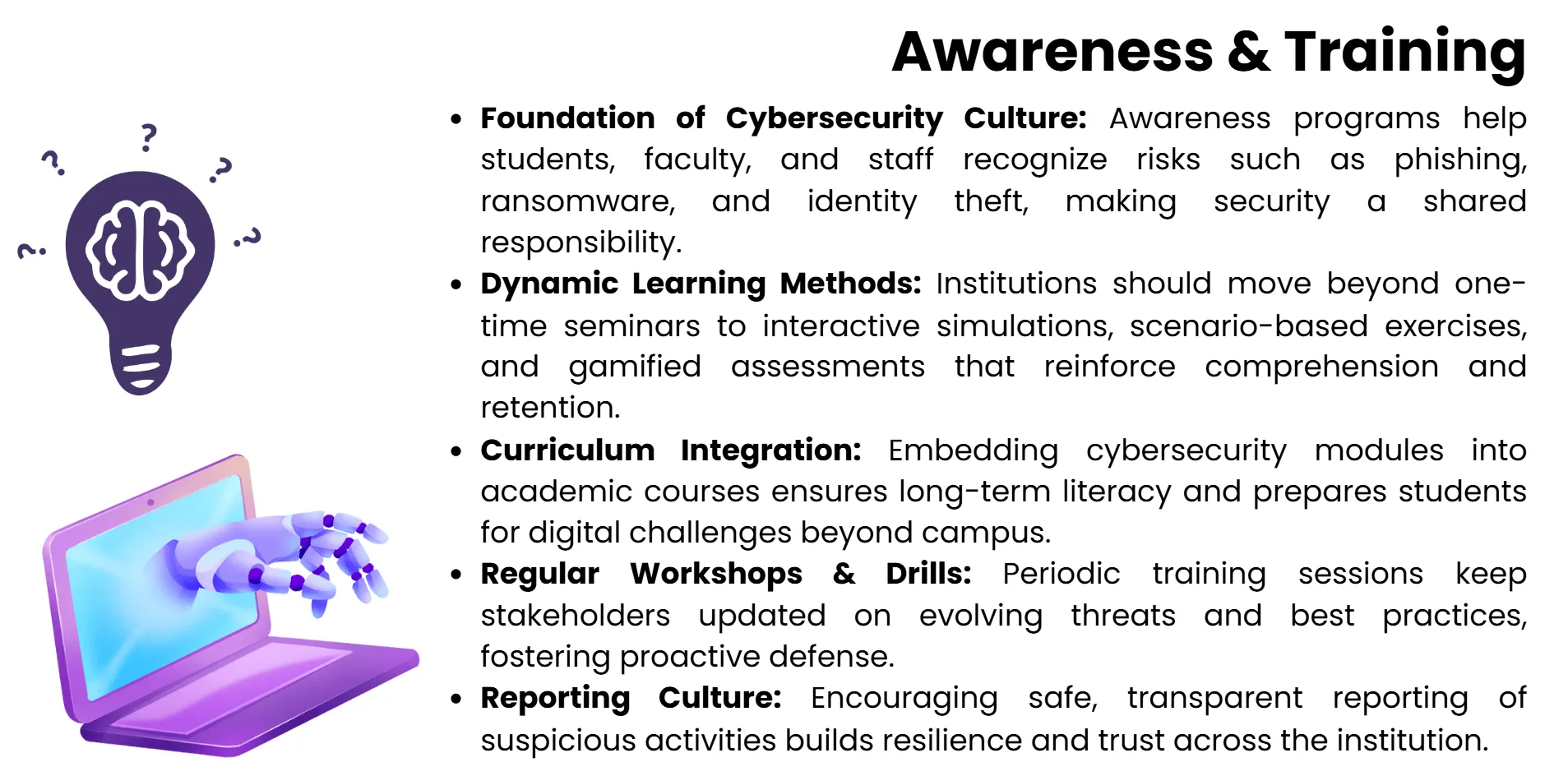
Cybersecurity education must be a continuous effort targeting students, faculty, and administrative staff alike. A one-time seminar is insufficient instead, dynamic learning methods including interactive simulations, scenario-based training, and gamified assessments help reinforce awareness and comprehension.
|
Tips for Aspirants
The article is of particular interest to competitive exams like the UPSC Civil Services Examination and the State Public Service Commission examinations because it enriches the knowledge of the candidate concerning the governance frameworks, ethical concerns, and digital literacy, thus improving the responses in the General Studies papers, essay compositions, and interview discussions on cybersecurity.
|
|
Relevant Suggestions for UPSC and State PCS Exam
- Maintaining organizational trust is promoted by the protection of educational data so that it stays confidential, intact, and accessible to users and managers, including recording student data, financial statements, research reports, etc.
- Awareness and education programs, including organized workshops, simulation, and integration into the curriculum, are effective in strengthening the facet of digital literacy and promoting protective behaviour.
- Strong policy formulation, inclusion of the legal requirements like the FERPA and GDPR, and the creation of an institutionalized oversight committee can be seen as a guarantee of accountability and increased resilience of an institution.
- The use of secure network architecture, multi-factor authorization, AI-based surveillance, and cloud-based security enhances the defensive stance of the organization.
- The integration of cybersecurity issues into the very fabric of the identity of the institution can be achieved through community outreach and ethical stewardship, i.e., the creation of a digital ethics framework and collaborative programs with parents, alumni, and industry experts.
- Cybersecurity culture is a phenomenon that cannot be confined to the technical dimension per se; it has a distinctly moral or ethical nature, it involves participation, and is controlled by the principles of general governance.
- These insights are important in General Studies Paper II (Governance), General Studies Paper III (Security and Technology), essay topics, and the ethics case studies in the context of UPSC and StatePSC examinations.
|
Modern-day digitalisation has made educational institutions increasingly reliant on technology in respect of educational delivery, academic research, managerial functions, and modes of communication. Although this reliance promotes efficiency and innovation of operations, on the other hand, it subjects institutions to a wide range of cybersecurity-related risks, including data breaches, phishing, ransomware, and identity theft. Academic data, including student records, research results, and fiscal reports, is highly sensitive, which makes schools, colleges, and universities particularly vulnerable to ill-motivated participants. In this regard, the formation of a strong cybersecurity culture is a strategic requirement instead of a peripheral issue.
Key Elements of a Strong Cybersecurity Culture in Schools and College Institutions
Cybersecurity culture is not necessarily limited to technical protection, but it is a collective of values, dispositions, and practices that help take digital security over all stakeholders. This, in an educational setting, gives way to the incorporation of awareness campaigns, the establishment of clear governance systems, the establishment of safe technological systems, and the establishment of moral accountability across the educational fraternity. This type of integrative approach ensures that cybersecurity is not viewed as a mere information-technology activity, but rather as an institutional culture to be trusted in. Training should be ongoing and cover identifying phishing emails, strong password practices, multi-factor authentication, malware risks.This means that through such a culture, institutions are likely to defend intellectual property, protect personal data, and build a generation of digitally responsible citizens likely to thrive in the realities in a globalized world.
Training Programs and Awareness
The development of a robust cybersecurity culture among the staff, students, and administrators of educational establishments should be based on awareness and training programs, through which it becomes possible to guarantee that the responsible citizens protect digital resources and confidential information. Consistent messaging through digital newsletters, awareness drives, and cyber committees helps maintain a security-first mindset.
Significance of Cybersecurity Awareness
This is not a technical need, but rather it becomes a cultural need in the academic world, which is that of cybersecurity awareness. Institutions deal with large volumes of sensitive information such as student data, research results, and financial information, making them appealing targets to inquisitive cybercriminals. The awareness programs will make the stakeholders realize how dangerous these risks are and understand their role in reducing them. When integrated with the concept of cybersecurity within the organization, these institutions can instil the philosophy of healthiness, wherein a proactive mindset can arise that would minimize breaches and build trust among the academic community.
Well-organized Training Programs
The forms of training programs should shift to continuous learning, rather than limited seminars. Simulations with interactive elements, scenario-based games, and game-based tests were shown to strengthen the understanding and memorization of cybersecurity principles. Faculty and staff members are provided with data handling and incident response-specific modules, and students obtain insight into proper online behaviour and ethical online activities. This is the case with such organized efforts that would help to spread cybersecurity expertise not only to IT but also to an institution-wide aspect.
Assimilation in Curriculum and Policy
Implementing cybersecurity awareness into formal curricula increases its legitimacy and sustainability. Undergraduate, as well as graduate courses can be integrated into the curriculum on digital literacy, ethical hacking, and information security, thus making sure that the future professionals learn safe practices at the earliest stage. At the same time, institutional policies must be established to conduct regular training and compliance assessments. This two-fold approach of curricular integration and policy enforcement is a holistic approach that makes cybersecurity an institutional ethos and not a choice, but a voluntary activity.
Developing a Culture of Shared Responsibility
Awareness and training programs are effective in terms of collective responsibility. Transparency and resilience are boosted through encouraging the open reporting of suspicious activities in the absence of a sense of fear of being punished. Partnership with external professionals, graduates, and industry partners further enhances the content of training, as well as keeps institutions abreast of the developing threats. Finally, the issue of cybersecurity awareness should be presented as an ethical duty to share with the overall goal of promoting educational institutions to raise responsible and digitally literate citizens.
Strong Policies and Governance
Strong policies and governance are essential in entrenching the concept of cybersecurity as a sustainable institutional practice, compliance, accountability, and resilience to the changing digital threats in educational institutions.Fostering open dialogue around security concerns allows for a supportive learning environment. Building a strong cybersecurity culture requires shared responsibility. Consistent messaging through digital newsletters, awareness drives, and cyber committees helps maintain a security-first mindset.
Development of Clear Perimeters on Cybersecurity
The educational establishments should start with the creation of extensive cybersecurity systems that outline the duties, the norms, and the practices that should be observed. Such structures would be the data privacy, the use of devices, access control, and the incident response guidelines. Codified expectations put in place a structured environment whereby all stakeholders (students, faculty, and administrators) understand their position in ensuring the protection of information. This is as clear as possible to reduce cases of ambiguity and enhance institutional responsibility.
Compliance with the Legal and Regulatory Standards
The policies are supposed to be consistent with the national and global data protection laws, including the Family Educational Rights and Privacy Act (FERPA) in the US and the General Data Protection Regulation (GDPR) in Europe. This is because compliance helps institutions to safeguard confidential student and research information and, at the same time, prevent legal consequences. There should also be a system of periodic audits and compliance performance at governance to check the performance. Such congruency strengthens institutional credibility and develops trust with the stakeholders.
Governance Committee and Mechanism of Oversight
Good governance requires special committees or task forces, which would oversee cybersecurity implementation. These teams should have IT, administration, faculty, and student representatives to ensure they are inclusive. Control functions such as risk tests, system vulnerability tests, and the incident reporting system offer unremitting control. Institutionalization of governance makes cybersecurity a collective and not a technical silo system alternative, and as a result, the aspect of resiliency is integrated into the academic fabric.
Development of Policies and Organizational Culture
Cybersecurity risks develop quickly, and they need to have flexible policies that are constantly revised. To update policies to acknowledge the new risks of ransomware, phishing, and intellectual property theft, institutions have to put in place review cycles. Cultural integration should also be prioritized in governance, and cybersecurity should be a matter that is not viewed as a compliance liability, but seen as an ethical duty. Incorporating these values into institutional identity creates sustainability in the long term and makes cybersecurity a part of academic integrity.
Technological Infrastructure and Surveillance
The surveillance and technological infrastructure are the key underpinnings of cybersecurity in learning institutions, thus making sure that digital platforms, networks, and sensitive information are protected with security against dynamic threats.Tools like multi-factor authentication (MFA) and advanced encryption algorithms are essential for safeguarding sensitive information. As cloud adoption grows within the academic sector, securing these cloud-based environments becomes even more critical to institutional resilience.
Network Architecture Authentication
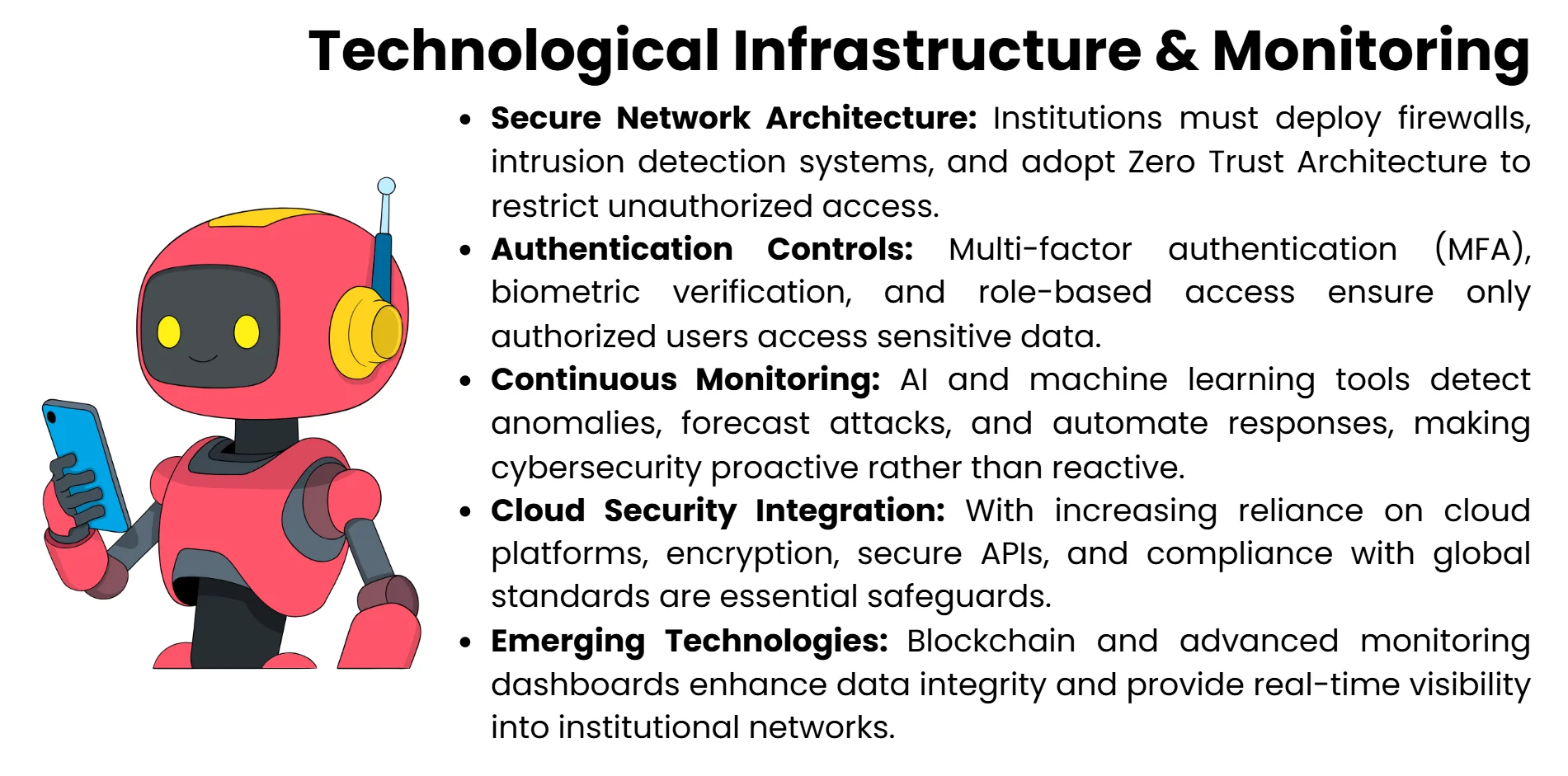
A strong culture of cybersecurity will start with sound network architecture. Schools are mandated to implement firewalls, intrusion detection systems, as well as encrypted Wi-Fi, which helps in keeping off unauthorized individuals out. Implementation of Zero Trust Architecture, which requires continuous authentication of people and devices, has taken center stage in higher education. Such a paradigm helps reduce the threats as it limits access at all points, therefore, minimizing the chances of a failure and making sure that sensitive academic data will be secure.
Authentication and Access Controls
Vigorous authentication systems cannot be ignored in pre-empting identity theft and unauthorized access into institutional systems. Multi-factor authentication (MFA), biometrics checks, and role-based access control ensure that license holders can only get access to resources that are vital. Such measures not only conserve the integrity of all student records and research findings but also instil confidence in the stakeholders that their information is safe. The regular audits also contribute to institutional resilience by identifying and removing unnecessary permissions.
Tracking and Detection of Threats
Monitoring systems are very important in detecting anomalies before major incidents occur. Machine learning (ML) and artificial intelligence (AI) are more frequently used to identify suspicious behaviour, predict possible attacks, and automate responses. Higher education becomes advantageous through real-time dashboards that provide information about network activity so that the administrators can react with an immediate response to the emergent threat. Constant observation of such systems keeps the cybersecurity in an active and not a reactive mode and limits the time spent downstream and protects the image of the institution.
Cloud and Emerging Technologies Integration
With the growing use of cloud-based solutions by institutions to deliver teaching, research, and administration services, the acquisition of these environments is becoming central. The cloud security protocols, namely, encryption, secure API, and international standards integration, should be embedded into institutional infrastructure. New technology, such as blockchain, can also improve data integrity by ensuring tamper-proof records. Combining traditional protection measures and new ones, the institutions create a multidimensional defense system, which can respond to new threats.
Ethical Responsibility and CommunityEngagement
The aspects of ethical responsibility and community engagement are the vital elements of the cybersecurity culture in educational institutions, which confirms that the use of digital safety has become a shared responsibility and a moral priority.Integrating dedicated learning modules, courses and frameworks on cyber hygiene, data privacy, and technology ethics within educational programs can drive adoption of informed and responsible cyber behaviors vital for life in the digital age.
Empowering Collective Participation
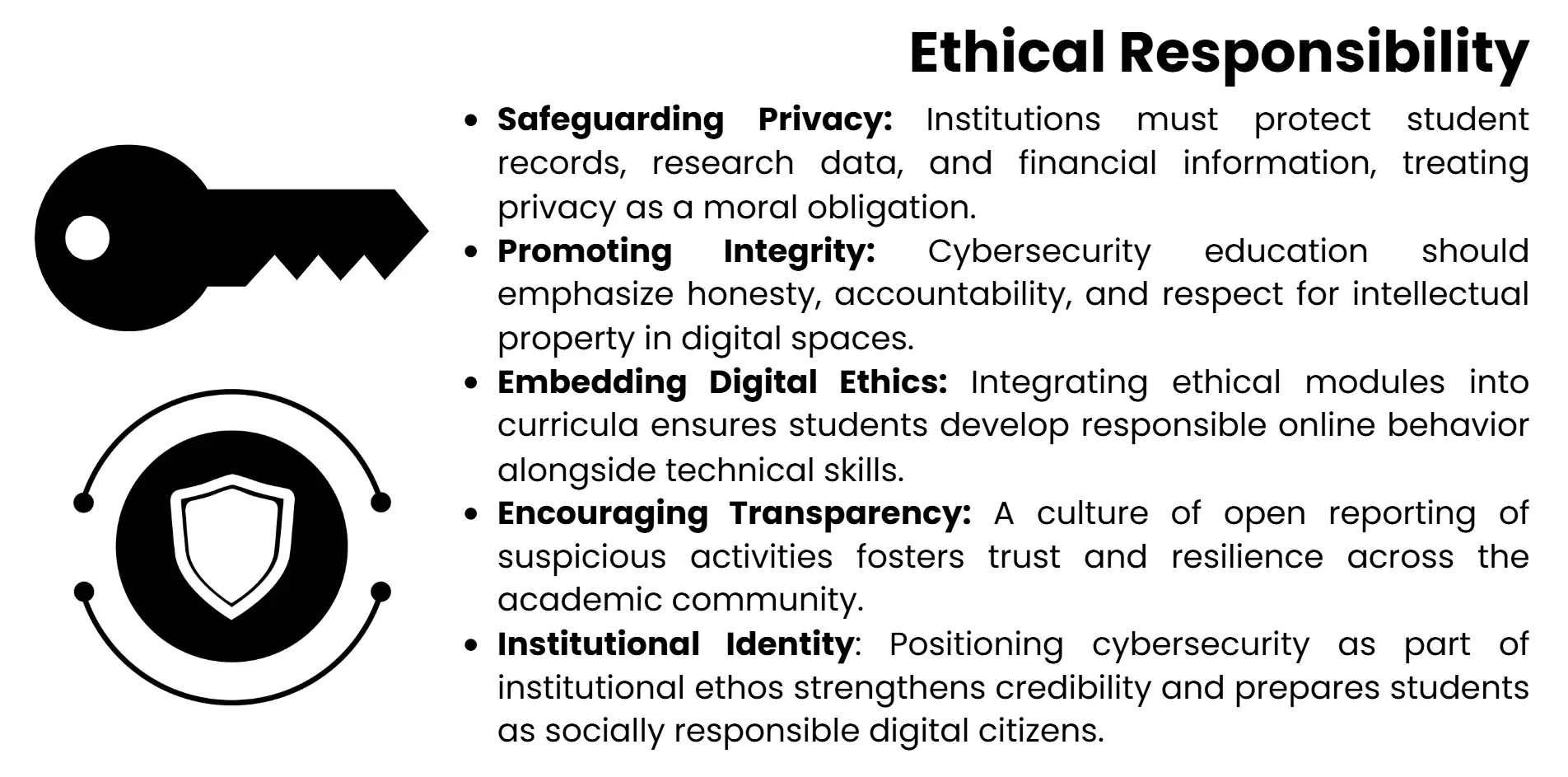
Cybersecurity cannot be assigned to any technical department but must be led by all the members of the academic community. Creation of awareness, workshops, and collaborative efforts will have to be done by students, faculty, administrators, and parents. This kind of engagement makes cybersecurity not only a compulsory measure but also an institutional value. With the inclusion of participation in routine operations, participation encourages inclusivity and invulnerability, in which all the stakeholders would aid in the protection of digital resources.
Cooperation with External stakeholders
Schools and colleges are reaping a lot of advantages through networks with alumni, industry specialists, and government bodies. These partnerships provide access to modern knowledge, resources, and best practices in cybersecurity. Joint programs, e.g., Hackathons, lectures, and community outreach, boost institutional preparedness and help to bridge the gap between theory and practice. The external interaction also enhances the aspect of mutual trust of the institutions with the society, as well as the academia being a responsible learner of digital integrity.
Raising Digital Ethics and Responsibility
The maintenance of a strong cybersecurity culture is pegged on ethical responsibility. The organizations need to pay much attention to such values as honesty, accountability, and respect for privacy in online communication. A curriculum and extra-curricular program of incorporating digital ethics into the curriculum helps in providing students with a sense of morality in addition to technical skills. By encouraging responsible online conduct via discouraging plagiarism, honouring intellectual property, and electronic reporting of suspicious online practices, the socio-cultural perception of cybersecurity as an ethical obligation instead of a technical mandate can be realized.
Making Cybersecurity part of Institutional Identity
The concept of community involvement and moral accountability should be interpreted as part of institutional identity. Integrating cybersecurity at the mission, codes of conduct, and strategic levels is a component of the ethos of the institution. This cultural assimilation will ensure sustainability in the long term, since the stakeholders will internalize cybersecurity as a kind of characterization of academic integrity. Ethical responsibility not only protects the digital ecosystems in institutions but also helps to produce socially responsible citizens who are ready to face global digital challenges.
Conclusion
The pursuit of a strong cybersecurity culture in institutions of higher learning is a strategic and ethical consideration of the modern digital environment. By means of organized awareness and training schemes, elaborate policy systems and governance systems, investment in highly modern technological infrastructure and constant surveillance systems, and nurturing of community relations based on moral responsibility, institutions can hence devise a robust system of holistic integrity. These will not only guarantee confidentiality of academic information but also instil cybersecurity in the institutional culture, thus guaranteeing trust, integrity, and readiness. Over a long period, learning institutions that value cybersecurity lead to raising the digitally conscious citizens who are in a position to face intricate global issues with reliability and responsibility.