Prime Minister Mark Carney’s forthcoming visit to India is generally consider as a reliably transformative milestone in Canada–India relations. India–Canada relations enter a new phase as Carney’s visit symbolizes renewal, dialogue and opportunities for deeper bilateral cooperation. Canada–India relations are presently experiencing a significant strategic reset after a phase of strong and unique diplomatic strain.
|
Key Highlights
- Historical Strains and a diplomatic freeze between India and Canada
- Allegations and Trigger events b/w India-Canada
- India-Canada Pathways to Reconciliation
- India-Canada Economic and Strategic Aspect
- Trilateral Collaboration
- Indian Diaspora and People-to-People Connect
|
The visit of Canadian Prime Minister Carney to India has reserve a lot of attention, and as a result, it has had a stark contrast to the previous year, when there were strained relations between India and Canada on diplomatic affairs. This incident is consequential because it signifies the reestablishment of trust in each other, the potential revival of the trade negotiations, and the enhancement of cooperation in such areas as education, technologies, and security in the Indo-Pacific area that will redefine the relations between India and Canada as a stronger, more globally relevant one. The situation about the relations between India and Canada has lately come into the limelight after Canadian Prime Minister Carney visited New Delhi, a trend that would otherwise have been considered inconceivable, considering the diplomatic standoff that had characterized the past year. Political differences, sensitivities between the communities of the diaspora, and the halting of trade negotiations had made the bilateral relationship a strained one.
In this scenario, the visit not only gains academic and policy relevance but also a conscious attempt to complete a recalibration of relationships by dialogue, the development of trust, and the solidification of shared democratic principles. The re-engagement does not simply end in symbolic gestures, but has practical connotations upon the economic collaboration, movement of students, and coordination of strategies within the Indo-Pacific. The analysis places the episode in the larger context of the global governance issues, thereby highlighting the role of rapprochement between India and Canada in forming a mutually robust, inclusive, and progressive partnership.
Historical Strains and a diplomatic freeze between India and Canada
While the diplomatic rift was initially sparked by allegations from Justin Trudeau that the Indian government was linked to the killing of Hardeep Singh Nijjar, the broader and continuing tensions between the two countries have largely been driven by longstanding disagreements over the Sikh separatist movement advocating for Khalistan. One of the most turbulent times in the history of India-Canada relations was the period between 2023 and 2024, when both sides accused each other, expelled diplomats, and built a lack of trust in one another, leading to a freeze of official relations and the disruption of bilateral cooperation.
Allegations and Trigger events b/w India-Canada
This was triggered directly by a comment by the Canadian Prime Minister Justin Trudeau in September 2023, who asserted that the Indian agents had been involved in the assassination of Sikh separatist leader Hardeep Singh Nijjar in British Columbia. This assertion sparked an immediate jump in tensions and triggered the situation when both nation-states expelled diplomatic staff, as well as suspended certain consular rights. Canada was then forced to shut three consulates in India, an act that made the dominant level of mistrust apparent.
Diplomatic Expulsions and Freeze b/w India-Canada
Ottawa expelled the six Indian officials by the month of October 2024, citing them to have been intimidated and involved in violent actions linked to separatist systems. As a retaliatory move, India sent home Canadian diplomatic personnel, which included the acting High Commissioner, thus creating a tit-for-tat retaliation resulting in the diplomatic processes being literally frozen. This was a dead end to trade negotiations, in particular the Comprehensive Economic Partnership Agreement (CEPA), and caused insecurity among students and the diaspora populations.
Implication on India-Canada Bilateral Relations
The diplomatic freeze did not have any tangible effect: bilateral trade talks came to a halt, and Canadian officials issued travel warnings against visiting India. As per News reports, Canadian authorities accused Indian staff of violent acts, thus delaying collaboration in the education and technology fields. In these developments, the extent to which political conflicts can spill over into the economic and social spheres was demonstrated, affecting approximately 1.6 million Canadians of Indian origin.
India-Canada Pathways to Reconciliation
The recent diplomatic reset between the two countries comes after years of strained relations, alongside Canada’s ongoing Truth and Reconciliation process addressing historical injustices faced by Indigenous (First Nations) peoples—who were historically labeled as “Indians” in legal terminology. This process of slow improvement in India-Canada relations can be explained by diplomatic restructuring, the realization of the need to dry up past blunders, and the focus on common interests in trade, education, and international governance.
Canadian PM Visiting India
In February 2026, officials of Canada officially claimed that India was no longer involved in violent crimes in Canada, which is a timely step towards the end of previous accusations. This recognition gave a bridge towards discussion and trust establishment, thus ensuring the eventual visit of Prime Minister Carney to India.
Multilateral Engagements b/w India-Canada
The process of reconciliation was supplemented by meetings in international forums, including the G7 Summit of 2025, when both countries' leaders demonstrated the desire to restore the situation. These engagements highlighted the importance of observing sensitivities and people-to-people relations and economic complementarities, as signified by the Ministry of External Affairs.
Education and Culture Bridging India-Canada
Stabilizing factors were given importance to educational mobility and engagement in Diasporas. Canada has more than 300,000 Indian students, and the two governments realized the need to protect the academic interchange and cultural cooperation. This humanist practice strengthens reconciliation and makes bilateral relations inclusive.
India-Canada Economic and Strategic Aspect
As of early 2026, India–Canada relations are navigating a delicate phase of “strategic rebalancing,” in which strong economic complementarities and enduring institutional ties continue to sustain cooperation despite persistent political strains and diplomatic uncertainty. Economic and strategic engagement has grown to be the foundation of the India-Canada reconciliation by way of cooperation in commerce, technology, energy, and security in the large Indo-Pacific and global governance.
Revival in Trade and Investment b/w India-Canada
In G20 negotiations, Prime Ministers Modi and Carney agreed to restart talks regarding the Comprehensive Economic Partnership Agreement (CEPA) in the 2025 G20 Summit in Johannesburg. Doubling of bilateral trade to the target of USD 50 billion by the year 2030 highlights an economic aspiration that underpins reconciliation.
Trilateral Collaboration
Australia-Canada-India Technology and Innovation (ACITI) Partnership was a major milestone in trilateral collaboration, which occurred in 2025. It has focused on collaboration on artificial intelligence, quantum computing, and space research, with Canada endorsing the Indian proposal of the AI Summit to be held in India in 2026.
India-Canada Energy & Climate Cooperation
The significance of Canada as a uranium and heavy crude oil supplier to India has got a strategic value. Both countries are investigating clean key energy transformation, with mutual projects in renewable energy and climate volatility somewhat pointed out in bilateral talks.
India-Canada Security and Strategic Alignment
Indo-Pacific has taken the form of a common strategic priority. Joint statements were made in 2025 to focus on the use of calibrated responses to restore stability and enhance defence cooperation without breaching the sensitivities and concerns of the other.
Indian Diaspora and People-to-People Connect
People-to-people connections continue to serve as the strongest bridge between India and Canada, strengthened by a dynamic and influential Indian diaspora. The historically emerging mode of Diaspora and people-to-people connect has served a stabilising effect in the India-Canada relationship, where states have managed to maintain activity in their relations even during periods of diplomatic tension and political differences.
Indian Diaspora in Canada
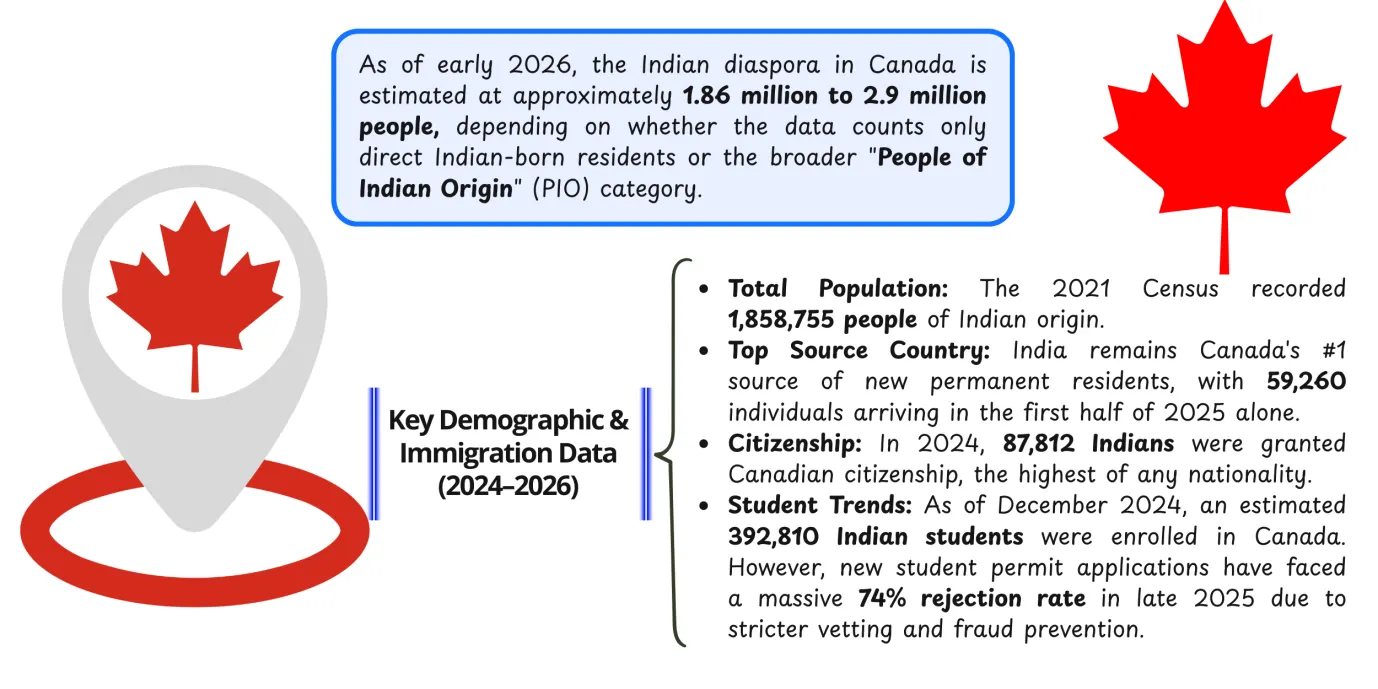
The Indians represent about 1.6 million people of Canada, which is nearly 4 percent of the Canadian population. This ethnic group has been especially valuable in shaping and developing the Canadian multicultural policy that has served to promote bilateral relations and act as a facilitator between the concerned states.
Educational Mobility b/w India-Canada
The biggest contributor to the international student population in Canada is India, and the number of enrolled Indian students is more than 300,000 as of 2024 (Immigration, Refugees and Citizenship Canada). The educational exchanges not only add to the economy of Canada, but they also lead to long-term cultural as well as professional connections, making student welfare a strategic agenda in the processes of reconciliation.
India-Canada Social and Cultural Collaboration
Through the work of the diaspora organisations, cultural festivals, research partnerships, and healthcare services have been exchanged, thus making the inclusiveness stronger. These practices indicate that bilateral relations are not purely dependent on the financial factors, but rather resilient as they are built on mutual values and social interaction.
Conclusion
The reconciliation process between India and Canada relation in a new diplomatic process that underscores resilience and pragmatism. The fact that Prime Minister Carney visited New Delhi is not just an indication of restoring trust but also rebuilding the priorities again in trade, technology, education, and strategic security. Through the diaspora linkage and multilateral levels, both countries have shown the ability to go past historical tensions and the role played by inclusive, forward-looking collaboration in ensuring that a balanced and internationally relevant partnership is formed.
Frequently asked questionsFrequently asked questions
Historical Strains and a diplomatic freeze between India and Canada?
While the diplomatic rift was initially sparked by allegations from Justin Trudeau that the Indian government was linked to the killing of Hardeep Singh Nijjar, the broader and continuing tensions between the two countries have largely been driven by longstanding disagreements over the Sikh separatist movement advocating for Khalistan. One of the most turbulent times in the history of India-Canada relations was the period between 2023 and 2024, when both sides accused each other, expelled diplomats, and built a lack of trust in one another, leading to a freeze of official relations and the disruption of bilateral cooperation.
India-Canada Pathways to Reconciliation?
The recent diplomatic reset between the two countries comes after years of strained relations, alongside Canada’s ongoing Truth and Reconciliation process addressing historical injustices faced by Indigenous (First Nations) peoples—who were historically labeled as “Indians” in legal terminology. This process of slow improvement in India-Canada relations can be explained by diplomatic restructuring, the realization of the need to dry up past blunders, and the focus on common interests in trade, education, and international governance.
India-Canada Economic and Strategic Aspect?
As of early 2026, India–Canada relations are navigating a delicate phase of “strategic rebalancing,” in which strong economic complementarities and enduring institutional ties continue to sustain cooperation despite persistent political strains and diplomatic uncertainty. Economic and strategic engagement has grown to be the foundation of the India-Canada reconciliation by way of cooperation in commerce, technology, energy, and security in the large Indo-Pacific and global governance.
Indian Diaspora and People-to-People Connect?
People-to-people connections continue to serve as the strongest bridge between India and Canada, strengthened by a dynamic and influential Indian diaspora. The historically emerging mode of Diaspora and people-to-people connect has served a stabilising effect in the India-Canada relationship, where states have managed to maintain activity in their relations even during periods of diplomatic tension and political differences.