Women participation in politics is an important part of true Democracy. Democracy is not only about conducting elections and allowing people to vote. It is also about ensuring that different sections of society get an equal opportunity to participate in decision making and power sharing. Women constitute about half of the total population so their participation in every sphere should be around half of the total strength.
During the Rig vedic period women were allowed to participate in the assemblies like Sabha and Vidatha. But the situation changed after the Later Vedic Period where women were generally confined to the household. Their situation worsened in the Medieval period. But Over the years since Independence, Indian women have made significant progress in education, employment, social awareness and public life. India has also witnessed women holding important constitutional and political positions.
But the presence of women in politics has not improved significantly, comparatively fewer women receive election tickets or reach positions of political authority. This creates a gap between political participation and political representation.
Importance of Women's Political Participation
The United Nations defines women’s empowerment into five core dimensions. One such dimension is the power to direct and control one's own life, both inside and outside the home. Thus women participation in politics constitutes one of the important dimensions of Women empowerment.
It is important for several reasons:
- Strengthening democracy: A democracy becomes more representative when women and men have equal opportunities to participate in decision-making.
- Inclusive policymaking: Women leaders can bring attention to issues such as maternal health, education, nutrition, sanitation, women's safety and childcare.
- Gender equality: Political representation helps women raise their concerns and demand equal rights and opportunities.
- Better governance: Women's participation can bring different experiences and perspectives into public administration and policy discussions.
Example: Chattopadhyay and Duflo’s study of West Bengal and Rajasthan. The study found out that women leaders were more likely to invest in facilities closely linked to women’s needs, such as drinking-water .
- Social transformation: Women in leadership positions can challenge traditional stereotypes and encourage younger generations to participate in public life.
Example: UNFPA reports examples such as Nongarh panchayat in Bihar’s Lakhisarai district, where women’s leadership was associated with the eradication of child marriage, and Namanguda, where a gram sabha declared zero tolerance for violence and set up a women’s help desk.
- Accountability: Greater representation can help ensure that public institutions respond to the needs of different groups within society.
Example: In Sikkim, women sarpanches such as Shela Subba of Rumbuk Gram Panchayat encouraged active public participation in village water management.
Thus, women's political participation is not simply a matter of giving representation to one gender. It is essential for building a fair, inclusive and responsive democracy.
Status of Women in Indian Politics
India has made progress in providing political rights to women. The Constitution guarantees equality and gives women the right to participate in elections without discrimination based on gender. However, the representation of women differs across political institutions.
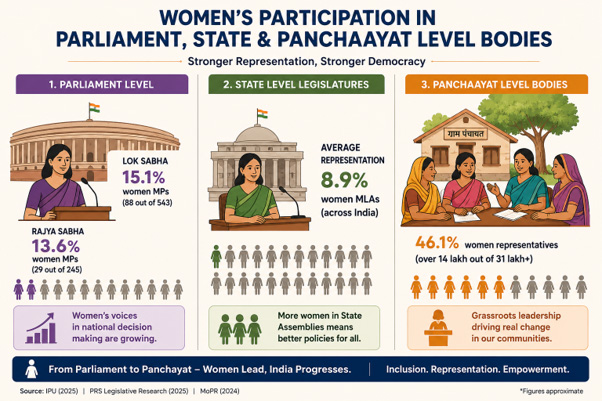
A. Women's Representation in Parliament
Women have been part of the Indian Parliament since the first general elections in 1951–52. However, their representation has increased slowly. Table below summarizes the slow pace of increase in women participation:
| Year | Women participation in Lok sabha |
| 1951 | 4.5% |
| 1991 | 7.3% |
| 2019 | 14.9% |
| 2024 | 13.6% |
This shows that although women have the right to contest elections, their actual representation in Parliament remains limited.
Case Study: Rwanda is a global example of women's political empowerment, with women holding 63.8% of seats in its lower house of Parliament (2024 election). Rwanda has demonstrated how women's representation can strengthen inclusive governance and policymaking.
B. Women's Representation in State Legislative Assemblies
Women participation in state legislative assemblies is even lower. According to the Association for Democratic Reforms (ADR), women constituted only around 8% - 9% of the sitting MPs and MLAs analysed in its 2026 report. According to 2026 data, 19 Assemblies have less than 10% women representation.
- Of 4,123 MLAs across states and Union Territories, 390 are women.
- No state assembly currently has more than 20% women MLAs.
| State | Percentage |
| Chhattisgarh | 14% |
| West Bengal | 13% |
| Uttar Pradesh | 11% |
| Tamil Nadu | 5% |
| Karnataka | 3% |
| Jammu and Kashmir | 2% |
C. Women's Participation in Panchayati Raj Institutions
At the grassroots level, India has achieved considerable progress in women's political representation. The 73rd and 74th Constitutional Amendments introduced reservation of at least one-third of seats for women in Panchayats and Municipalities. Several states have increased this reservation to 50%. As a result, lakhs of women have become elected representatives in Gram Panchayats, Panchayat Samitis, Zila Parishads and urban local bodies.
Case Studies of Effective Participation:
- Neeru Yadav, Rajasthan, Known as the Hockey Wali Sarpanch, she formed a girls' hockey team, arranged coaching and promoted sports opportunities for rural girls.
- Chhavi Rajawat, Rajasthan, An MBA graduate and former Sarpanch of Soda village, Tonk, she worked towards rural infrastructure, sanitation, water facilities and village development.
- Puspanjali Bhuyan, Odisha, She mobilised women through a Mahila Sabha to raise issues of gender-based violence, girls dropping out of school and women's economic opportunities.
D. Women's Participation as Voters
One positive development is the increasing participation of women as voters. Women are now actively participating in electoral campaigns, public meetings and political discussions. In several elections, women's voter turnout has been comparable to or higher than men's turnout. Example: In the 18th Lok Sabha Elections, the overall female voters’ turnout was 65.78 percent, just .02 percent short of the overall male voters’ turnout, which amounted to 65.80 percent.
This shows that women are no longer just passive participants in the political process. They are becoming an important part of India's electoral democracy. However, higher voter participation has not automatically resulted in higher representation in Parliament and State Assemblies.
Constitutional Provisions Related to Women's Political Participation
The Indian Constitution provides several safeguards to ensure women's participation in political institutions, decision-making and governance.
| Article | Provision |
| Article 14 | Equality before law and equal protection of laws. |
| Article 15(1) | Prohibits discrimination on the ground of sex. |
| Article 243D | At least 1/3 reservation for women in Panchayati Raj Institutions, including SC/ST women. |
| Article 243T | At least 1/3 reservation for women in Urban Local Bodies, including SC/ST women. |
| 73rd Constitutional Amendment, 1992 | Added Part IX to the Constitution. |
| 74th Constitutional Amendment, 1992 | Added Part IX-A. |
| 106th Constitutional Amendment, 2023 | Provides one-third reservation for women in Lok Sabha, State Legislative Assemblies and Delhi Assembly. |
73rd and 74th Constitutional Amendments
The 73rd and 74th Constitutional Amendment Acts, 1992 were landmark steps towards women's political empowerment in India. They provided constitutional reservation for women in rural and urban local self-government institutions, enabling them to participate directly in grassroots democracy and decision-making.
Key features for women empowerment:
- Mandatory Reservation (Article 243D): Guarantees not less than one-third (33%) of the total number of seats and offices of chairpersons in Panchayati Raj Institutions (PRIs) for women. Many states have further increased this quota to 50%.
- Impact on women participation: Female representation in local bodies has increased from negligible to nearly 46% to 49.7% of total PRI members.
106th Constitutional Amendment Act, 2023
Also known as Nari Shakti Vandan Adhiniyam Act, it mandates a 33% reservation for women in Lok Sabha, State Legislative Assemblies, and Delhi Legislative Assembly.
Key provisions:
- Articles 330A and 332A: Provide 33% reservations for women in the Lok Sabha and State Legislative Assemblies, respectively.
- Article 239AA Amendment: Extends this framework to the Delhi Legislative Assembly.
- Article 334A: The become operational after the first delimitation exercise post-census and remain valid for 15 years.
- The act did not cover Rajya Sabha or State Legislative Councils.
Key Challenges to Women's Participation in Politics in India
Although India has made progress through constitutional provisions such as the 73rd and 74th Amendments and the 106th Constitutional Amendment Act, 2023, women continue to face several challenges regarding their participation in politics:
- Proxy Representation ("Sarpanch Pati"): Women may hold elected positions but male relatives frequently exercise power behind elected women representatives. This weakens the purpose of political reservation.
- Patriarchal Mindsets: Politics is considered a male-dominated field. Deeply rooted traditional structures question women’s leadership capacity, making it difficult for them to assert independence.
- Financial constraints: Elections require money for campaigning, travel and publicity. Women often have less independent access to financial resources and political funding.
- Low Literacy: Rural female illiteracy and complex documentation working at panchayat level affect their administrative capacity. Language and digital barriers can further restrict access to political information.
- Dual Burden and Household Responsibilities: Elected women representatives continue to have a double burden of household chores and political duties.
- Gender-Based Violence: women in positions of power out of their traditional roles often face abuse, violence, threats and coercion by the orthodox elements.
- Delayed implementation of 106th Constitutional amendment act: Under Article 334A, implementation is linked to the first Census conducted after the commencement of the Act and the subsequent delimitation exercise.The 2024 Lok Sabha elections took place without implementation of the 33% reservation. And it is highly unlikely that delimitation would be completed by 2029 elections.
Measures Required to Strengthen Women's Participation in Politics
Equal women participation is necessary for achieving gender equality and social justice. The focus should shift from increasing women's representation to ensuring their meaningful participation in decision-making. Few measures required:
1. Constitutional and Legal Measures: to strengthen the provisions related to women representation.
- Effective implementation of the 106th Amendment: Ensure timely implementation of one-third reservation in Parliament and State Legislative Assemblies.
- Strict action against proxy representation: Ensure that elected women representatives independently exercise their constitutional powers.
- Electoral reforms: Promote greater transparency in political party candidate selection and campaign financing.
2. Political Party Reforms:
- Political parties should provide more election tickets to women.
- Establish leadership and mentorship programmes for aspiring women politicians.
3. Education and Capacity Building:
- Provide training to elected women representatives on administration.
- Promote political awareness among rural and marginalised women.
- Strengthen digital literacy so women can access government information and participate in e-governance.
- Example: The Ministry of Panchayati Raj's Rashtriya Gram Swaraj Abhiyan (RGSA) supports capacity-building and training of Panchayat representatives.
4. Economic Empowerment: involves increasing women’s access to independent financial resources or state funding of elections to support women candidates. Example: The Deendayal Antyodaya Yojana–National Rural Livelihoods Mission (DAY-NRLM) has mobilised rural women into SHGs, creating opportunities for collective leadership and participation in local governance.
5. Social and Cultural Reforms: Along with political and legal measures, Patriarchal attitudes need to be changed to promote women empowerment. Society often expects women to prioritise family responsibilities over public life. Therefore, gender sensitisation programmes should be conducted in schools, colleges and communities to promote equal participation.
6. Ensuring Safety and Security: The government should establish effective complaint mechanisms and provide legal support to women facing political violence. Political parties and election authorities should take appropriate measures against gender-based harassment during election campaigns.
7. Learning from International Experiences: India can learn from countries such as Rwanda, where constitutional gender quotas and institutional support have resulted in high women's representation in Parliament. Similarly, Nordic countries have promoted women's participation through supportive social policies, childcare facilities and gender equality measures.
Conclusion
Strengthening women's political participation requires more than providing reservation in elected institutions. It demands political reforms, economic independence, education, social awareness, institutional support and equal opportunities. India must move from numerical representation to meaningful participation and independent decision-making. Only then can women become equal partners in governance and contribute effectively to building an inclusive and representative democracy.