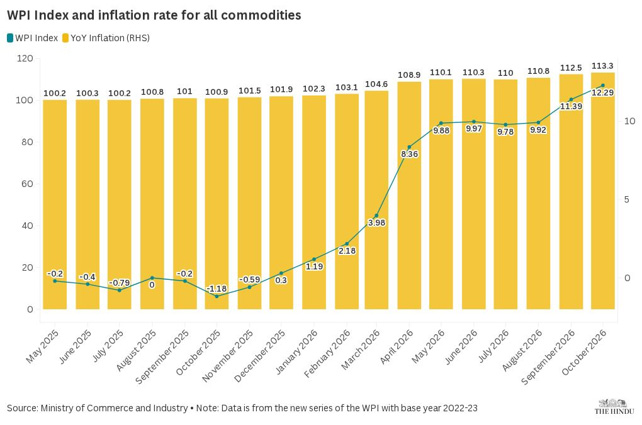
India's wholesale inflation increased sharply to 12.3% in October 2026, marking the second consecutive month of double-digit inflation. Rising fuel and crude petroleum prices were the major reasons behind this increase. Higher wholesale prices may also increase the cost of manufactured goods and put further pressure on retail inflation.
Why in the News?
The Ministry of Commerce and Industry released the latest Wholesale Price Index (WPI) data, showing that wholesale inflation reached 12.3% in October 2026.
- This was the second consecutive month of double-digit wholesale inflation.
- Inflation in October was the highest recorded since April 2024 under the new WPI series.
- The crude petroleum and natural gas segment recorded inflation of 70.8%.
- Retail inflation had also crossed the RBI's upper tolerance limit of 6% in October 2026.
What is the Wholesale Price Index (WPI)?
The Wholesale Price Index (WPI) measures changes in the prices of goods at the wholesale level, before they reach consumers. Note: The new WPI series contains data from April 2024 onwards. Therefore, a longer historical comparison is not possible using this series.
- It tracks price movements of goods traded in bulk.
- It helps measure inflationary pressure in the production and wholesale sectors.
- It is released by the Office of the Economic Adviser, Department for Promotion of Industry and Internal Trade (DPIIT), Ministry of Commerce and Industry.
Major Reasons Behind the Rise in WPI
The increase in wholesale inflation was mainly driven by fuel, crude petroleum and food prices.
1. Fuel and Power Inflation
Inflation in the overall Fuel and Power category increased to nearly 33% in October 2026. It was around 26% in September 2026.
- The increase was partly influenced by a low base, as prices in this segment had remained in contraction for large parts of 2025.
2. Crude Petroleum and Natural Gas
Inflation in crude petroleum and natural gas increased to 70.8% in October 2026. It was 57.3% in September 2026.
- This was against a 7.2% contraction in prices in October 2025.
- Rising crude petroleum prices remain a major source of inflationary pressure.
3. Food Inflation
Food inflation increased to 8.3% in October 2026. It was the highest level in 22 months.
- Higher food prices contributed to the overall increase in wholesale inflation.
Impact on Manufactured Goods and Consumer Prices
Rising wholesale prices can gradually increase the prices paid by consumers. Price Pass-through: When businesses face higher production and input costs, they may transfer these additional costs to consumers by increasing the prices of their products.
- Inflation in manufactured goods reached 9.5%.
- High inflation was recorded in:
- Textiles
- Tobacco products
- Chemicals
- Rubber products
- Metals
- Electrical equipment
- This may increase retail inflation in the coming months.
- The impact is expected to be reflected in the core component of the Consumer Price Index (CPI), depending on the pricing decisions of industries.
Possible Impact on RBI's Monetary Policy
The sharp increase in wholesale inflation, along with elevated retail inflation, may influence the Reserve Bank of India's monetary policy decisions. Geopolitical tensions, particularly in the Russia-Ukraine region, may further increase risks to inflation and economic growth.
- A possible repo rate hike in the December 2026 Monetary Policy Committee (MPC) meeting has been indicated by market experts.
- Higher interest rates may increase borrowing costs.
- This can reduce lending activity, investment and consumption.
- Higher borrowing costs may also put pressure on economic growth and financial market sentiment.
WPI and CPI: Key Differences
| Basis | WPI | CPI |
| Full Form | Wholesale Price Index | Consumer Price Index |
| Measures | Price changes at the wholesale level | Price changes at the retail level |
| Price Level | Wholesale transactions | Prices paid by consumers |
| Main Focus | Goods traded in bulk | Goods and services consumed by households |
| Use | Measures wholesale inflation | Measures retail inflation |
| RBI's Inflation Target | Not the direct target | Used for monetary policy targeting |
Conclusion
The rise in wholesale inflation to 12.3% in October 2026 highlights growing price pressures in the Indian economy, particularly from fuel, crude petroleum and food. Higher input costs may gradually push up consumer prices and affect household purchasing power. The RBI will need to balance inflation control with economic growth while considering the impact of interest rate changes on investment, consumption and overall economic activity.
Test your understanding
Questions from this article
Prelims practiceQuestion: Consider the following statements regarding inflation in India:
- The Consumer Price Index (CPI) measures changes in the prices of goods and services consumed by households.
- The Wholesale Price Index (WPI) includes prices of services.
- The Reserve Bank of India uses CPI inflation as the nominal anchor for its monetary policy framework.
Which of the statements given above is/are correct?
- 1 and 2 only
- 1 and 3 only
- 2 and 3 only
- 1, 2 and 3
View answer and explanation
Suggested answer: (b) 1 and 3 only
Explanation:
- Statement 1 – Correct: CPI tracks changes in retail prices of goods and services consumed by households.
- Statement 2 – Incorrect: India's WPI measures price changes in goods; it does not include services.
- Statement 3 – Correct: RBI's inflation-targeting framework uses CPI inflation, with a target of 4% and a tolerance band of 2%–6%.
Mains practiceQuestion: “Persistent inflation in India affects not only economic growth but also the purchasing power and welfare of vulnerable sections of society. Discuss the major causes of inflation in India and examine the role of monetary and fiscal policies in controlling it.” (GS Paper III – Indian Economy | 15 Marks | 250 Words)
View answer-writing approach
Answer approach:
- Introduction: Define inflation and briefly mention its impact on the economy.
- Causes: Supply-chain disruptions, rising fuel prices, food inflation, excessive demand and global commodity price fluctuations.
- Impact: Reduced purchasing power, rising cost of living, income inequality and uncertainty for businesses.
- Monetary measures: RBI's repo rate, liquidity management and inflation targeting.
- Fiscal measures: Reducing import duties on essential goods, improving food supply, buffer-stock management and targeted subsidies.
- Way forward: India needs a balanced approach combining monetary discipline with supply-side reforms to control inflation without affecting economic growth.
Frequently asked questionsFrequently asked questions
What is India's Wholesale Inflation Hits 12.3% in October 2026: Key Reasons?
India's wholesale inflation increased to 12.3% in October 2026 for the second month in a row. Rising fuel, crude oil and food prices were the main reasons. Higher costs may make goods more expensive for consumers and create challenges for the RBI in controlling inflation
Why is India's Wholesale Inflation Hits 12.3% in October 2026: Key Reasons relevant for UPSC preparation?
Rising fuel and crude petroleum prices were the major reasons behind this increase
What key points should aspirants remember about India's Wholesale Inflation Hits 12.3% in October 2026: Key Reasons?
The article covers Why in the News?, What is the Wholesale Price Index (WPI)?, Major Reasons Behind the Rise in WPI and 1. Fuel and Power Inflation.