The new fiscal rules are significant in the restructuring of the FY27 deficit-reduction plan of India, which involves a significant reduction in the cut on development spending, with the rural and agricultural sectors being emphasized to a large proportion. Its importance lies in the trade-off it creates: while ensuring fiscal discipline and an increase in macro-economic stability, it evokes a level of concern about the possibility of a slowdown in the rural demand, the decline in agricultural growth, and the undermining of the inclusive development goals.
|
Key highlights
- What is India’s new Fiscal Rule?
- Evolution of India’s Fiscal Responsibility
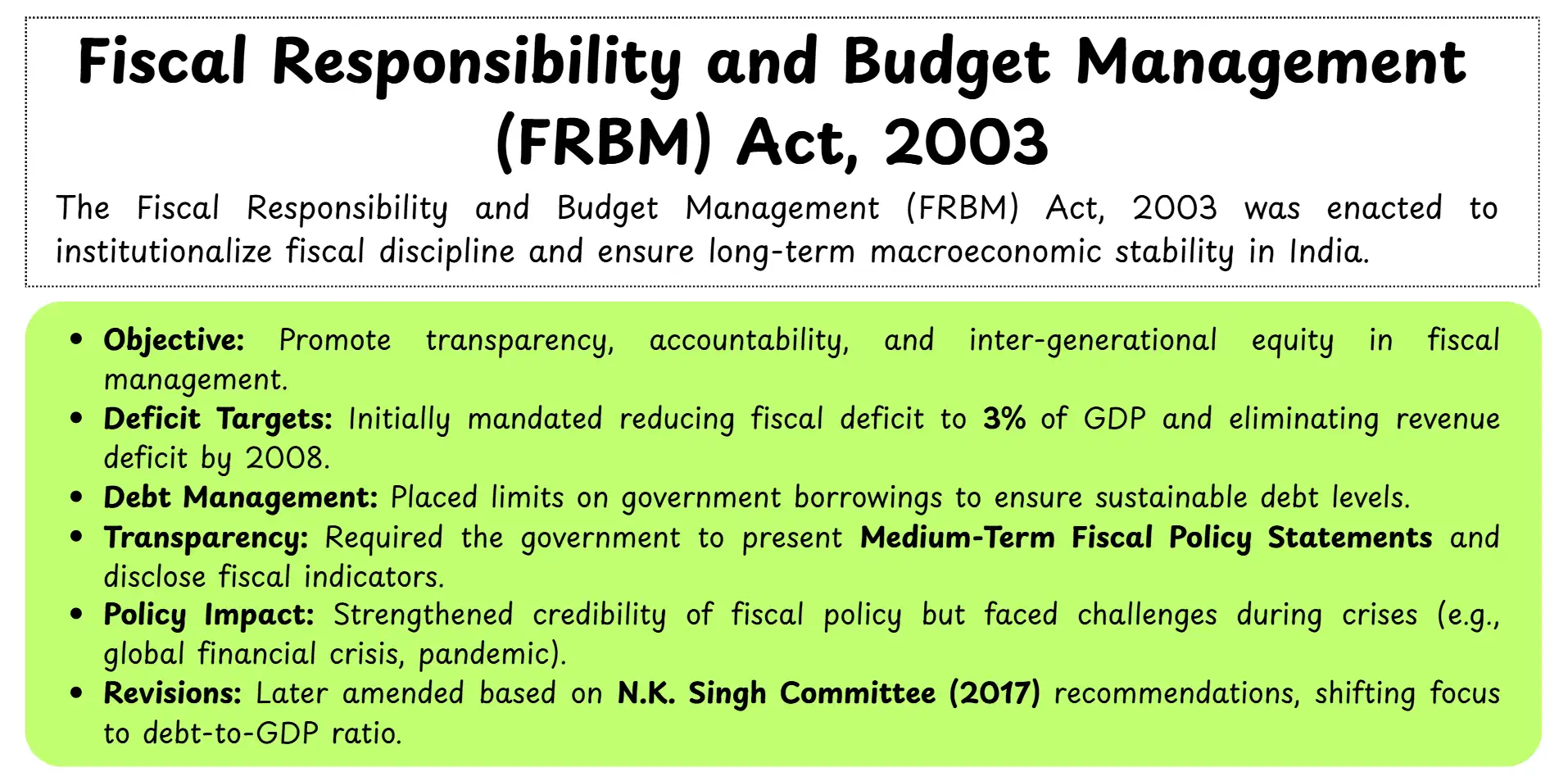
- Fiscal Responsibility and Budget Management (FRBM) Act, 2003
- India’s Deficit Reduction Plan and Spending Cuts
- Implication on Indian Economic Growth and Equity
- Policy Alternatives and Way Forward for India
|
Neo-adopting the new fiscal rule is an exception in the way India has always reconciled economic growth with fiscal consolidation. The policy should be followed by asking crucial questions regarding its long-term implications, by meeting the FY27 deficit target mostly through cuts in development spending. The contraction is in the most noticeable areas, such as rural and agricultural sectors, which traditionally are engines of inclusive growth and social cohesion. On the one hand, the emphasis of the rule on the commitment of the government towards fiscal prudence; on the other hand, the rule makes visible the tensions between the macro-economic stability and the developmental imperatives, and thus it merits a careful review of its implications on equity, productivity, and sustainable growth paths.
What is India’s New Fiscal Rule?
The new fiscal policy in India is an attempt to balance macro-economic stability and the developmental agenda. It is rooted in its context in terms of debt objective development, deficit management, and expenditure rationalisation.The new rule allows the government to maintain a higher debt-to-GDP ratio than the 40% level prescribed under the FRBM Act. This updated version of the sound finance rule has at least two key implications for this year’s Budget.
Evolution of India’s Fiscal Responsibility
The Fiscal Responsibility and Budget Management FRBM Act, 2003, which initially focused on the fiscal deficit being limited to 3% of GDP, has shaped the fiscal structure of India. However, there were changes in the Union Budget 2026-27, which changed the focus on the debt-to-GDP ratio instead of the fiscal deficit, with a target of 50±1 percent by 2031. Such a change is a break with the previous FRBM target of 40%, which represents a more understanding attitude by the government to work through greater levels of debt in an attempt to achieve macro-economic stability and credibility.
India’s Deficit Reduction target for FY27
In line with FY27, the government has set a fiscal deficit target at 4.3% of GDP, which is a significant reduction compared to the levels during the pandemic. This is cut down by making significant decreases in development spending, especially in rural and agricultural sectors. Empirical evidence shows that the percentage ratio of government spending to GDP has shrunk from 17% in FY21 to 13%in FY27, therefore highlighting the nature of fiscal contraction.
Policy Significance of India’s New Fiscal Rule
The fiscal rule is an indication of a firm dedication of India to good fiscal practices, where debt sustainability has been the focus rather than large fiscal expenditures. However, the dependency on expenditure compression, particularly in rural development, elicits concerns relating to inclusion in growth, agricultural productivity, and maintenance of long-term equity.
India’s Deficit Reduction Plan and Spending Cuts
The fiscal tightening in India in FY-27 is mainly pegged on cutting expenses and not increasing revenues. The theme of government is evident by a conscious reliance on debt readability and not developmental spending.
Fiscal Deficit Targets set by India
The fiscal deficit of 4.3 percent of GDP is being proposed in the Union Budget 2026-27, which is quite low compared to 4.4 percent in the previous year. This move will go in line with the fiscal rule of overall measures of reaching a 50% debt-to-GDP ratio by 2031. Their focus is on achieving the deficit targets by rationalization of expenditure instead of vigorous mobilization of revenue, and therefore, the characteristic is an indication of the careful approach to fiscal tightening.
India’s Plan to Cut Development Expenditure
The cut in the deficit has been achieved largely by cutting down the development expenditure, particularly in the rural and agricultural sectors. The extent of the compression has been indicated by the reduced government spending ratio from17% in FY21 to 13% in FY27. This narrows access disparately on the programmes catering to rural infrastructure, farming productivity and social welfare, hence creating concerns about inclusivity and long-term growth opportunities.
Policy Trade-Offs by India
Even though the strategy strengthens the credibility of fiscal policy and shows that it follows the principles of good finances, it can also serve as a threat to rural demand and agricultural sustainability. Economists argue that reduced investment in these categories can slow down the path of inclusive growth, widen the gap between regions, and lead to an inability to transform the structure. The fiscal rule thus represents a trade-off between short-term stability and developmental requirements in the long term.
Implication on Indian Economic Growth and Equity
The expenditure compression held in the fiscal rule in FY27 has significant implications for the growth path and equity returns in India, especially in the rural and agricultural sectors.
Impact on India’s Growth Prospects
The Economic Survey 2025-26 shows that India is forecasted to achieve a growth of 6.8-7.2% in FY27 indicating that it will be resilient even with the tightening of the fiscal policy. However, less investment in rural infrastructure and agricultural programmes could cause dampening of domestic demand, productivity gains and limit structural transformation. According to empirical studies, the proportion of rural consumption covers about 40% of the total demand, which entails the importance of rural consumption in supporting the pace of growth.
Equity and Inclusivity Concerns in India
Reduction in development spending disproportionately impacts the marginalized communities that are dependent on Agriculture and on rural employment. As the government's share of the GDP reduces, this decline is threatening to widen inequality and regional disparities. Its implementation from the view of fiscal contraction at the cost of social and rural investment diminishes inclusive growth in a way that may reverse the improvement in the indicators of poverty reduction and human development.
Long-Term Implications on the Indian Economy
Although financial prudence promotes transparency and debt sustainability, the trade-offlies in lower investment in areas that will be critical in providing equity. Sustainable growth,therefore,requires a balance between macro-economic stability and targeted spending that protects the rural livelihoods and agricultural resilience. Without such a balance, fiscal prudence could be an unwitting sabotage of the long-term developmental goals of India.
Policy Alternatives and Way Forward for India
The fiscal consolidation course that was determined to enshrine macroeconomic stability also necessitates a strict evaluation of policy options in the effort to maintain growth trends as well as uphold equity in the rural and agricultural sectors.
India Should Improve Its Revenue Mobilization
The implementation of a sustainable channel of revenue collection is under the conditions of tax base expansion and strengthening of control systems. The Economic Survey 2026 shows that the tax-to-GDP ratio of India currently stands at 11.7%, which is lower than that of many emerging economies. Increasing the efficiency of GST, rationalisation of exemptions, and the implementation of digital platforms present potential opportunities for increasing revenues, without limiting the struggling demographics to unnecessary loads.
India needs to work on Targeted Development Expenditure
Instead of forming blanket cuts, movement of budgetary allocations should be re-prioritised in high-impact rural and agricultural programmes. The results reported in the Rural Development Report (2025) by the NITI Aayog highlight that the investments in irrigation and rural infrastructure generate long-term productivity growth, which supports both the growth of the economy and inclusive development.
Public-Private Partnerships: Need of the Hour for India
Increasing the efficacy of state spending and expansion of the public-private partnership (PPP) are some of the possible measures to reduce the fiscal burden. It has been empirically proven that PPPs in the fields of rural infrastructure and agri-tech have resulted in positive results, reducing state expenditures without losing the developmental momentum.
Conclusion
To conclude, the newly introduced fiscal rule highlights India's determination to achieve deficit reduction and debt sustainability. However, its dependence on reducing the amount of money spent on development raises critical concerns. The decline in spending in rural areas and agriculture augurs a reduction in demand, the reduction of productivity, and possibly an inclusive growth can be eroded. Although fiscal discipline is a contributor towards institutional credibility, long-term stability requires a balanced solution that ensures developmental priorities are not jeopardized. Revenue mobilisation, precise investment, as well as effectiveness reforms must be incorporated in a sustainable structure so that fiscal differentiation does not put equity as well as growth curves under monetisation.
Frequently asked questionsFrequently asked questions
What is India’s New Fiscal Rule?
The new fiscal policy in India is an attempt to balance macro-economic stability and the developmental agenda. It is rooted in its context in terms of debt objective development, deficit management, and expenditure rationalisation.The new rule allows the government to maintain a higher debt-to-GDP ratio than the 40% level prescribed under the FRBM Act. This updated version of the sound finance rule has at least two key implications for this year’s Budget.
Policy Significance of India’s New Fiscal Rule?
The fiscal rule is an indication of a firm dedication of India to good fiscal practices, where debt sustainability has been the focus rather than large fiscal expenditures. However, the dependency on expenditure compression, particularly in rural development, elicits concerns relating to inclusion in growth, agricultural productivity, and maintenance of long-term equity.
India’s Deficit Reduction Plan and Spending Cuts?
The fiscal tightening in India in FY-27 is mainly pegged on cutting expenses and not increasing revenues. The theme of government is evident by a conscious reliance on debt readability and not developmental spending.
Implication on Indian Economic Growth and Equity?
The expenditure compression held in the fiscal rule in FY27 has significant implications for the growth path and equity returns in India, especially in the rural and agricultural sectors.
Policy Alternatives and Way Forward for India?
The fiscal consolidation course that was determined to enshrine macroeconomic stability also necessitates a strict evaluation of policy options in the effort to maintain growth trends as well as uphold equity in the rural and agricultural sectors.