|
Key Highlights
- Gap Between Academia and Industry
- Funding Gap in R&D
- Need for cooperation
- Triple Helix Model
- Development of National Innovation Culture
|
The lack of innovation gap in India is due to inadequate industry-academia connections. Unlike countries that have since made science an industry by matching investments of corporations with university capabilities, India does not have long-term and on-going research pipelines. In order to turn knowledge into economic puissance, companies should continuously invest in campus-based research and development, supported by consistent policies and a culture of the country, which considers research a stimulus for industrial expansion.
"Bridging the Gap: Aligning Industry Outlays with Campus Strengths" refers to strategies for aligning academic programs and university resources (campus strengths) with the skills and talent needs (industry outlays) of the job market.
|
Tips for Aspirants
The article is vital in both the UPSC CSE and State PSC exams as it further enhances the knowledge about governance, policy on innovation, industry-academia relationships, and economic development, which are fundamental themes of the General Studies and essay papers.
|
|
Relevant Suggestions for UPSC and State PCS Exam
- The lack of innovations is attributable to a poor nexus industry-academia unlike in other countries, which have effectively built strong research systems in India.
- The corporate liquidity in research and development has been relatively low, and it stands at about 0.65 percent of gross domestic product; hence, the corporate involvement has been significantly lower when compared to other countries like South Korea and the United States.
- Indian universities continue to hold large amounts of intellectual capital; however, they are limited by a lack of sufficient financial resources and poor infrastructural facilities that together hinder the process of commercializing the research of these institutions.
- Policy tools, such as the Anusandhan national research foundation and the incentive of R&D funds to be released in the 2025 Budget, aim to enhance the coordination of the mechanisms, yet their functionality is shattered by incoherent implementation procedures.
- Constant innovation regimes require the implementation of the triple-helix model that incorporates the triple-helix participants of academia, industry, and government.
- The continuity of operations over a period of several years would be predicted, a climate of trust would be created, and industries would become more competitive.
- Building a national culture of innovation would put India in a position to move out of a technology-consuming export-based economy to an engine of growth driven by national-level innovation.
|
The history of the national development in the twenty-first century will more often depend on the possibility of transforming the knowledge of the sciences into innovation in the industry. The few countries where this disconnect has been meaningfully bridged include the United States, Germany, South Korea, and China; they have achieved this goal by fostering long-term research pipelines, which link corporate investment and academic strengths. These pipelines make sure that the firm outlays are not random and haphazard but are partnered with the long-term capacity of universities and research centres. This crucial connectivity has not been developed in India. Though the country has a tremendous series of institutions of higher learning, a growing stock of scientific strength, the lack of consistent partnership between industry and academia has hindered the transfer of research into scale-up technologies and competitive sectors.
This gap has further been compounded by short-term terms of funding, the discontinuous nature of policies, and the lack of incentives to drive firms to invest in campus-led research. Addressing such flaws in the structural material requires a strategic plan to develop foreseeable attempts at capital, talent, and infrastructure movements within the layers of research. The economic need to hold such pipelines together is not only an economic urge, but a national one too, in the sense that it will allow India to stop being a consumer of world technologies and be an innovation-based source of growth.
The Lost Link between University and Industry
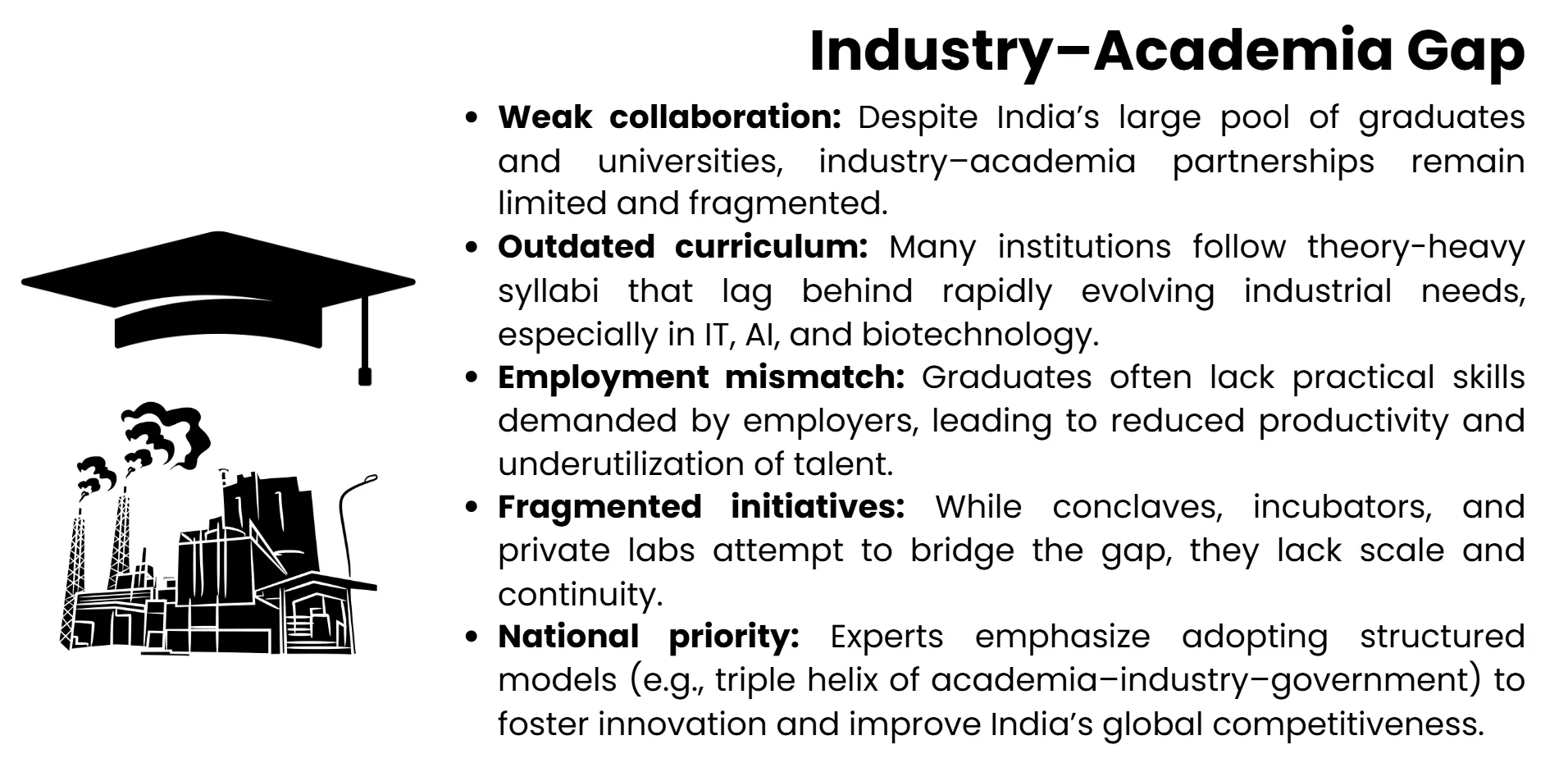
The Indian ecosystem of innovations is limited and hampered by a lifestyle of the absence of bridging the gap between research and practice. In spite of the excessive talent and institutions, the lack of organized coordination impedes the knowledge transformation into economic value.The gap between university research and industry application is a well-documented challenge, representing a "lost link" that hinders innovation and economic growth.
Structural Disconnect
The Indian higher education system is yielding a high number of graduates and research works, but there is not a very high industry input. Indian companies do not perceive university campuses as research partners, as global leaders do; they see them as sources of employees. This disconnection in the structure leads to poor use of academic knowledge and poor commercialization of scientific discoveries.
Funding and Incentives
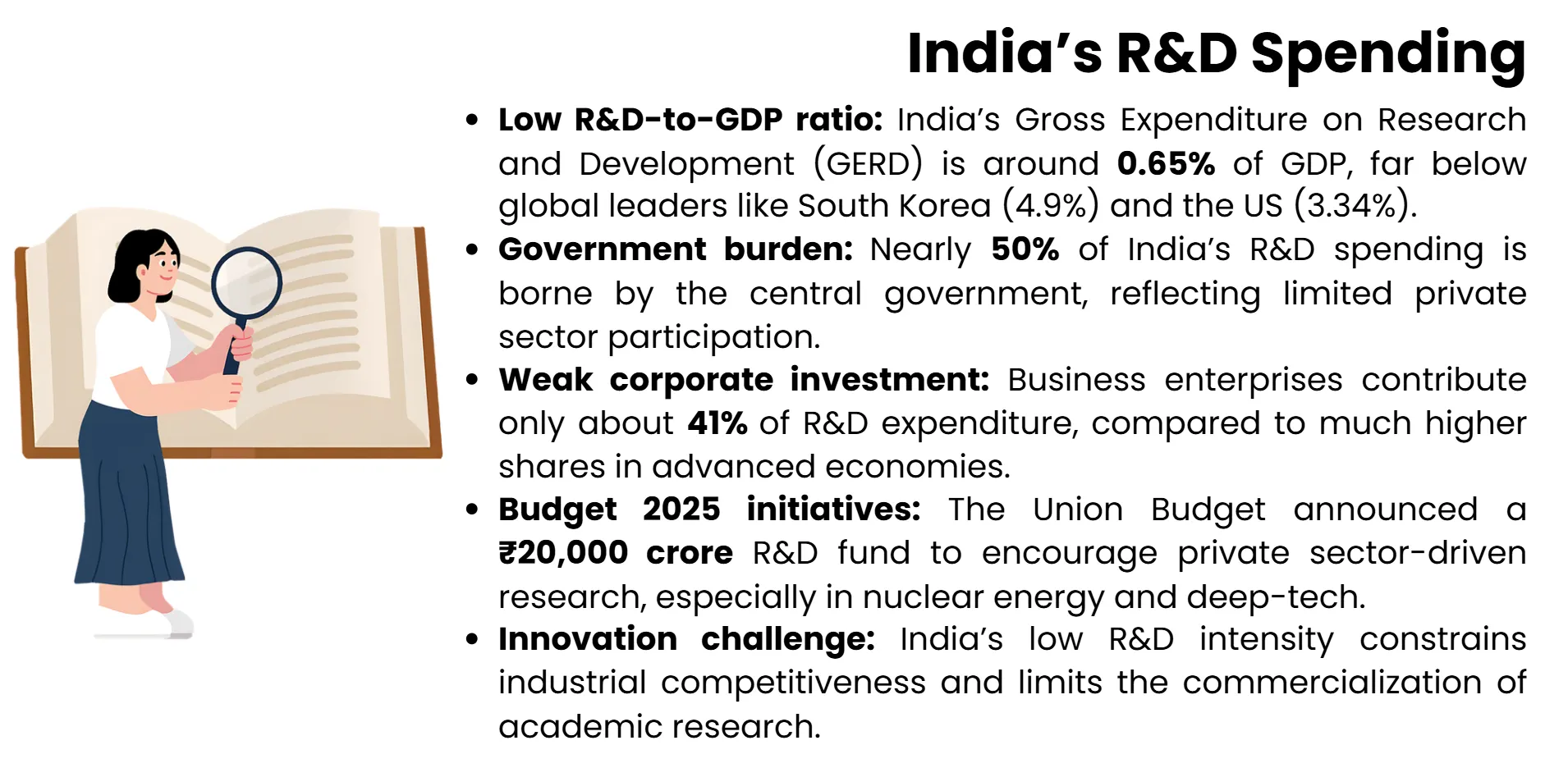
One of the vital obstacles is poor and improper funding. The R&D spending in India stands at about 0.7% of GDP, which is very low compared to such countries as South Korea (4.9%) and the United States (3.34%). Investments by companies in research conducted at the university level are very low, with companies favouring short-term projects compared to long-term pipeline projects. The industry is not willing to invest in academic partnerships without predefined incentives in the form of tax benefits, joint grants, or intellectual property systems to support them.
Institutional and Policy Lapses
Policy frameworks have tried to support the idea of partnerships, but there has been disjointed implementation. Innovation clusters and startup incubators are promising initiatives, but they do not have continuity and scale. The lack of formalized ways of intellectual property exchange, shared infrastructure, and extending project financing does not make either party invest in long-term relationships. India will need to implement a triple helix model of academia, industry, and government in order to promote systemic innovation as the Office of the Principal Scientific Adviser suggests.
Towards Sustainable Pipelines
The gap is to be filled in a purposeful manner with careful planning to develop sustainable research pipelines. These must be pipelines that match firm outlays to campus strengths so that there is continuity of projects over more than a year. By having common infrastructures, open forms of governance, and predictable funding streams, universities can be used to drive industrialization. More to the point, instillation of a culture that gives importance to research as a national resource will help India elevate itself from being a consumer of the world's technology to a producer of innovation-based industries.
Firm Strengths and Strengths of Campuses
The direction of innovation that India follows is based on how well the outlays that corporate research has applied fit the academic capabilities of Indian universities. Without long-term cooperation, scientific talents will not be well exploited, hence eroding industrial competitiveness."Bridging the Gap" refers to aligning the distinct strengths of universities (campuses) and private firms (corporations) to foster mutual benefits, such as innovation, talent development, and economic growth
The Landscape of Firm Outlays at the Present
India has a small funding of corporations in research and development. The Economic Survey 2025 shows that business enterprises are the only source of contribution to the national R&D expenditure by not more than 41 percent, and at the same time, the governmental contribution is closer to fifty percent. This disparity depicts the addiction to state financing and the unwillingness among companies to invest in long-term academic collaboration. Conversely, powerhouses like South Korea and the United States have developed strong innovation systems by continuing to support corporate research through university-based R&D.
Potential Strengths of Campus
The education sector in India has more than 1100 universities and 40000 colleges, of which many are full of specialised knowledge in the fields of engineering, biotechnology, and information technology. However, the firm's outlays rarely match such strengths. The institutions often cannot afford to maintain state-of-the-art facilities, or even draw in the best talent in the world, and companies are not ready to invest without assured short-term commercial payoffs. The incompatibility hinders the capability of campuses to act as economic units of industrial innovation, regardless of intellectual capital.
Interventions and New Models of Policy
Recent policy measures like the INR 20,000 crore R&D fund declared in the Union Budget 2025 are intended to provide motivation to research that is initiated by the private sector. The measures will facilitate capital limitations and collaboration in deep tech and emergent sectors. Similarly, the innovation cluster and joint incubator suggestions highlight the need to match the firm investments in alignment with campus fortitude. But piecemeal implementation and inadequate funding cycles in the short term still have an effect of undermining continuity.
A Sustainable Pipeline Construction
In order to close this divide, India needs to form consistent, multi-year research pipelines that blend the company outlays and scholarly skills. The common infrastructure, open intellectual property regimes, and tax breaks can motivate companies to participate in unremitting investment in university-based projects. More importantly, the development of a culture of trust between industry and academia will be such that research will not be viewed as only being occasional but rather as a strategic national resource. Therefore, it is crucial to align the firm's outlays with the strengths of the campuses to convert the knowledge base of India into industrial power.
Building Steady Pipelines
The Indian innovation ecosystem is characterized by the need to have predictable and extended research streams. Without continuity, scientific talent and industry potential are thus disjointed, hence limiting the ability of the country to convert knowledge into long-term economic growth.Building Steady Pipelines" refers to a strategic approach for addressing mismatches between current supply and future demand in various fields, primarily talent acquisition, infrastructure development, and technology.
Importance of Continuity
Constant pipelines ensure that research projects are not affected by fluctuations in their funding cycle and policy shifts. Nations such as South Korea and Germany have demonstrated that long-term investments in industry-academia cooperation lead to the establishment of trust, the creation of windmill infrastructure, and the opportunity for researchers to realize ambitious goals. In India, universities and companies often struggle to build long-term relationships; however, such an obstacle is often created by disruptions in grants and poor coordination of initiatives.
Investing in Stability and Institutional Design
The Gross Domestic Expenditure on Research and Development (GERD) in India is still at its current stage of 0.65%of GDP, predominantly dependent on governmental investments. The involvement of corporations remains minimal since the companies are reluctant to invest in long-term academic partnerships. India needs to be able to build consistent pipelines by enacting stable funding streams through joint grants, tax breaks, and industry-targeted R&D goals. The ways to provide continuation would be through institutional mechanisms, like innovation clusters and shared laboratories, to make sure that the outlays of firms are consistent with the strengths of the campus in the long term.
Lessons and Policy Frameworks All Around the World
International standards remind us about the importance of long-term corporate investment in the construction of pipelines. Major companies like Alphabet and Huawei invest in research and development, 5-20 percent of the revenue, and usually, in cooperation with universities. India can follow similar paradigms by enforcing the R&D to sales ratios in important industries such as pharmaceuticals, electronics, and energy. Policy frameworks should also enforce intellectual property and ease the process involved in the transfer of technology, thus making it less uncertain for the firms and academic institutions.
Towards a National Innovation Culture
Other than finances, a cultural change is needed with regard to constant pipelines. Research should not be considered as an academic game, but it has to be seen as a national asset. The approaches to accessing systemic innovation through the triple helix model, which incorporates academia, industry, and government in a single model, give a way forward. India must put collaboration in the national agenda and turn its universities into the industrial growth engine because by doing this, there would be a constant presence of scientific discoveries in the markets.
The Direction towards a National Culture of Innovation
The Indian developmental curve over a long period does not just rely on individual research, but it is essentially a calculated nurturing of the Indian culture of innovation. This culture requires the organizational incorporation of research, industry, and governmental cooperation as a part of the overall developmental culture of the nation. The Direction towards a National Culture of Innovation" refers to an ongoing discourse and various reports, particularly in the contexts of India and the UK, that discuss strategies for fostering innovation ecosystems and improving the translation of research into commercial success. It is not a single, universally known report but rather a framing of a common policy goal.
Getting Innovation Culture Strauss
The national culture of innovation goes beyond making funds available in labs or setting up incubators. It involves the acknowledgment of research as an asset of the group, the stimulation of sensible risk-taking, and the promotion of interdisciplinary interaction. Economies that have attempted to innovate, including South Korea and Germany, have empirically shown that innovation is possible when universities, firms, and policymakers work in synergy and hence create a collective ecosystem where the channel of knowledge flows into the industrial practice flows smoothly.
The Triple Helix Model
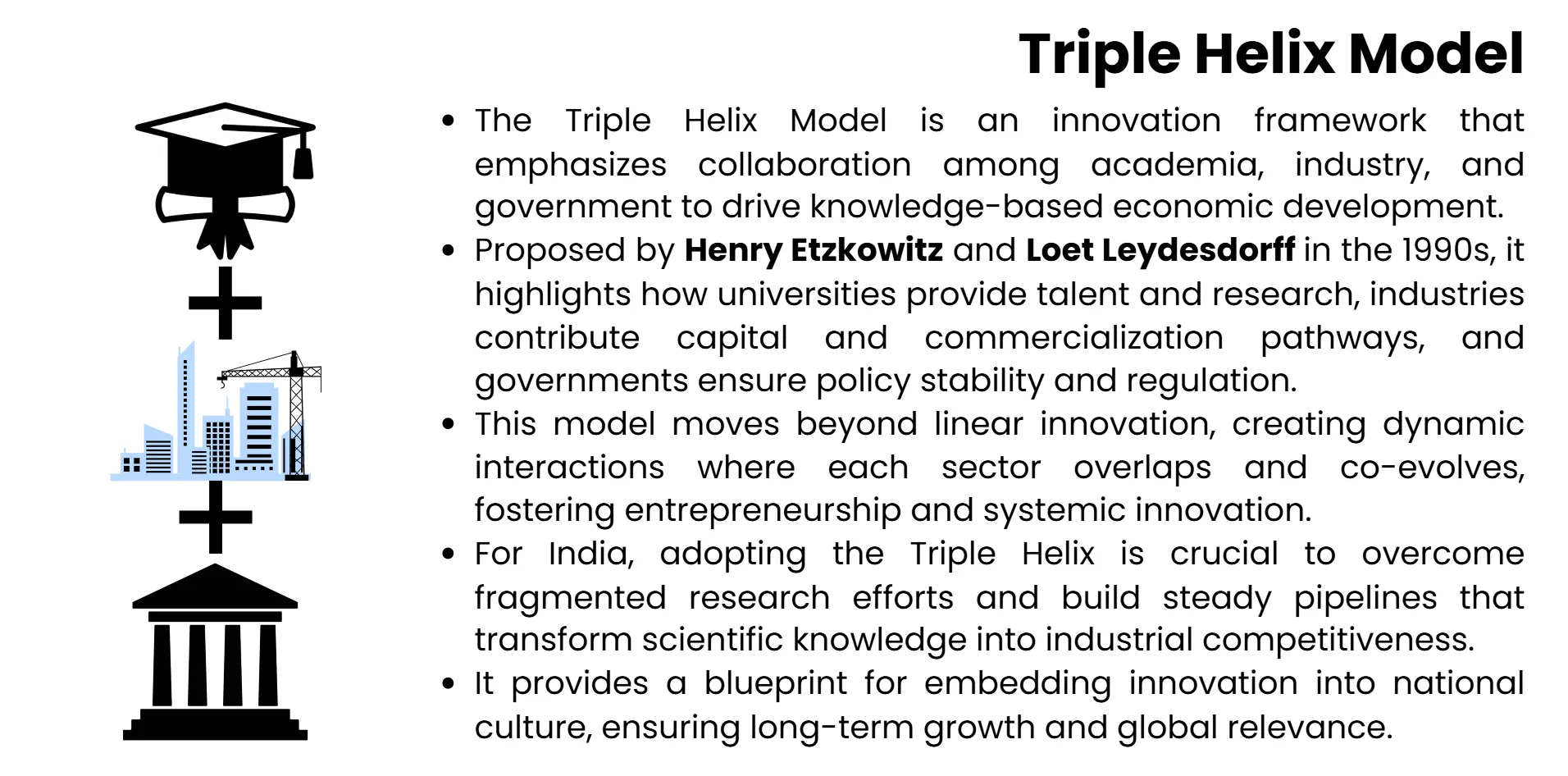
India has to assume the triple helix paradigm that revolves around combining academia, industry, and government. This model can be described by the Office of the Principal Scientific Adviser as improving research efficacy as it makes sure that universities furnish skilled talent, firms furnish capital and commercialisation routes, and the government furnishes policy dependency. This commendable integration would eliminate fragmentation and build intellectual pipelines to support innovation in the next decades.
Policy Support and Institutional Reforms
There have been recent agendas such as the Anusandhan National Research Foundation (ANRF), which was established under the 2023 Act in a bid to democratise research funding and enhance industry-academia connections. Equally, NITI Aayog has gone on to underscore the necessity to promote the research culture in state universities with the need to foster institutional reforms to elevate research and development as a national mission. These frameworks offer the structure that is required to make a culture where innovation becomes a constant and not a punctuated event.
Developing Social Trust and Recognition
In addition to the policies, the culture of innovation needs the research undertakings to be recognized in society. Scientists, entrepreneurs, and universities must be seen as national assets, and institutional mechanisms that incentivize risk-taking and sustain a long-term partnership developed. Research can be normalised to be an engine of prosperity through public awareness campaigns, industry initiatives, fellowships, and government-supported innovation awards, and thus can be a source of trust and encouragement for long-term commitment to academic strengths.
Learning to institutionalise a national culture of innovation is critical to transforming India from a consumer of global technologies into a producer of national solutions. India can tap into its demographic and intellectual capital to power its industrial stagnation through the integration of continuity, teamwork, and recognition in its research ecosystem.
Conclusion
The realization of India to be an innovation-led economy will rely on the establishment of sustainable research pipes that incorporate academia, industry, and the government. Lack of long-term cooperation has hindered the transfer of scientific talent to industrial competitiveness. Through corporate investment in research, where India focuses its resources on existing institutional capabilities, continuity in financing such efforts and the development of a national attitude toward innovation, India can convert knowledge into a powerhouse of economic activity. Such systemic changes will not only help to fill the structural gaps that exist, but they will also help to make India a global leader in science-led industrial development, in which research is viewed as a strategic national resource and innovation as a cornerstone of development.