|
Key Highlights
- DHRUVA Framework
- Digital Address Identifier
- DIGIPIN
- One Nation One Address
- Challenges in Implementation
- Way Forward
|
The Digital Public Infrastructure of India Post is the DHRUVA framework that is aimed at enabling physical addresses to be standardized and digitized. The system converts addresses into consent-based, secure digital identifiers in the form of email identifiers that are equivalent to DIGIPIN (a geocoded ten-digit pin). Although the initiative aims to ease the process of governance, logistics, and citizens' services as a part of the concept of One Nation, One Address, some issues related to privacy and digital divide, as well as inter-agency coordination, arise.
|
Tips for Aspirants
The article gains specific relevance to the aspirants of the UPSC Civil Services Examination and the State Public Service Commission examinations, in that it embraces the topics of governance, digital infrastructure, and citizen services, along with policy reforms, which can be considered as important topics in the General Studies syllabus and the current affairs curriculum.
|
|
Relevant Suggestions for UPSC and State PCS Exam
- DHRUVA Framework: An idea presented by Indian Post as a Digital Hub for reference and a unique virtual address.
- Target: Physical addresses to be standardised and digitalised; introduce a consent-based system of addressing (digitally).
- Digital Address Identifier (DAI): An email-like digital code that is connected to physical addresses.
- DIGIPIN: A ten-character alphanumeric geocoded code which offers perfect location mapping as opposed to the traditional PIN codes.
- Governance Applications: Facilitates the welfare delivery, taxation, electoral records and environmental clearances.
- Logistics Benefits: Minimises delivery errors, Routes, e-commerce and Address-as-a-Service.
- Citizen Services: Public services are made more approachable, inclusive, and personal, particularly among the rural and marginal communities.
- Challenges: There have been issues associated with these initiatives, such as the challenge of data privacy, the digital divide, and cross-agency coordination.
- Way Forward: Good legal protection, awareness of people, pilot projects and integration with Aadhaar, UPI, and ONDC.
- Vision: Supports One Nation, One Address and adheres to the overall Indian digital transformation objectives.
|
Modern digital governance is becoming more and more dependent on the accuracy and availability of citizen information; therefore, the accuracy of service provision depends on accurate addresses. One issue that has continued to impose burdens on the administration and logistical processes in India is the lack of standardization, verifiable, and universally available addresses. Conventional postal contacts are often uncoordinated and ambiguous, which hampers appropriate governance, slows down the provision of services, and makes business logistics harder. In order to eliminate this systemic flaw, India Post has introduced the DHRUVA system (Digital Hub for Reference and Unique Virtual Address) as a transformational component of the changing Digital Public Infrastructure in the country. DHRUVA is envisioned as a system that utilizes consent-based digital addressing in order to transform physical addresses into digital identifiers, which will facilitate an easy integration of the systems of governance, commerce, and citizen services.
The framework intends, having experimented with technologies like DIGIPIN, the alpha-numeric page coding, and by adopting digital address identifiers, similar to email IDs, the structure envisions having a One Nation, One Address paradigm. Not only is this initiative bound to make public administration more transparent and efficient, but India Post also becomes a strategic stakeholder in transforming the country into a digital one. This article explores the conceptual underpinnings, functionality, uses, and difficulties of the DHRUVA framework in more detail.
Background & Context
India is becoming more reliant on digital infrastructure to govern itself and offer citizens services in an efficient way that relies on paperwork. One of the major challenges surrounding this scenario has been the inconsistency and ambiguity of physical addresses, which in the past has compromised sound management as well as logistics. India Post's DHRUVA (Digital Hub for Reference and Unique Virtual Address) is India's new Digital Public Infrastructure (DPI) for a unified, standardized digital addressing system, acting like a "UPI for addresses" to bring seamless, consent-based, geocoded addresses for better e-commerce, governance, and logistics, leveraging DIGIPIN for precise location, enabling Address-as-a-Service (AaaS) for accuracy, privacy, and interoperability across sectors, much like Aadhaar for identity.
Traditional Addressing
Address data in both the Indian postal and administrative systems has always been totally vague, incomplete, or non-standardised. This, in turn, slows down service delivery, becomes less efficient with logistical processes, and slows down planning processes of urban as well as rural infrastructure. The non-harmonised addressing system places barriers to governance and business, particularly in consideration of the geographic diversity and the rate of urbanisation in India.
The Digital Public Infrastructure
Recently, India has launched the top digital solution, i.e., Aadhaar, to verify identity and UPI to carry out financial operations, thus demonstrating a digital Public Infrastructure (DPI) transformative power to improve transparency, efficiency, and inclusivity. The India Post has used this momentum to suggest the Digital Hub for Reference and Unique Virtual Address (DHRUVA), which is a digital addressing system that is aimed at normalising and protecting physical addresses.
DHRUVA
DHRUVA seeks to replace physical addresses with Digital Address Identifier (DAI), which is similar to electronic mail identifiers, and associate it with DIGIPIN, a ten-digit alphanumeric identifier based on geo-coordinates. The goal of this innovation will be to come up with a verifiable, consent-based, and universally available addressing system. With either the addition of geospatial technology and digital identifiers, DHRUVA boasts of being part of the core of the Indian vision of a One Nation, One Address.
Implications for Governance and Policy
The DHRUVA framework is being developed by amending the Post Office Act of 2023, which is why it is important in the context of any legislative and governance framework in India. Being a digital public infrastructure project, DHRUVA is expected to simplify service provision, strengthen citizen experience, and serve the commercial entities with a model that is referred to as Address-as-a-Service. Such a shift indicates the way India Post is changing its traditional position as a postal administration to a key player in digital governance.
Core Features of DHRUVA
The framework DHRUVA, put forward by India Post, is a substantive innovation of the Digital Public Infrastructure of India, and its task is to transform physical addresses into secure and standardised, and universally available digital identifiers.India Post's DHRUVA (Digital Hub for Reference and Unique Virtual Address) is a national digital addressing system creating UPI-like, short digital IDs (Digital Address Identifiers - DAIs) from physical addresses, built on geocoded DIGIPINs, offering Address-as-a-Service (AaaS) for secure, consent-based sharing, enhancing e-commerce, logistics, banking, and government service delivery with precision and interoperability.
Digital Address Identifier (DAI)
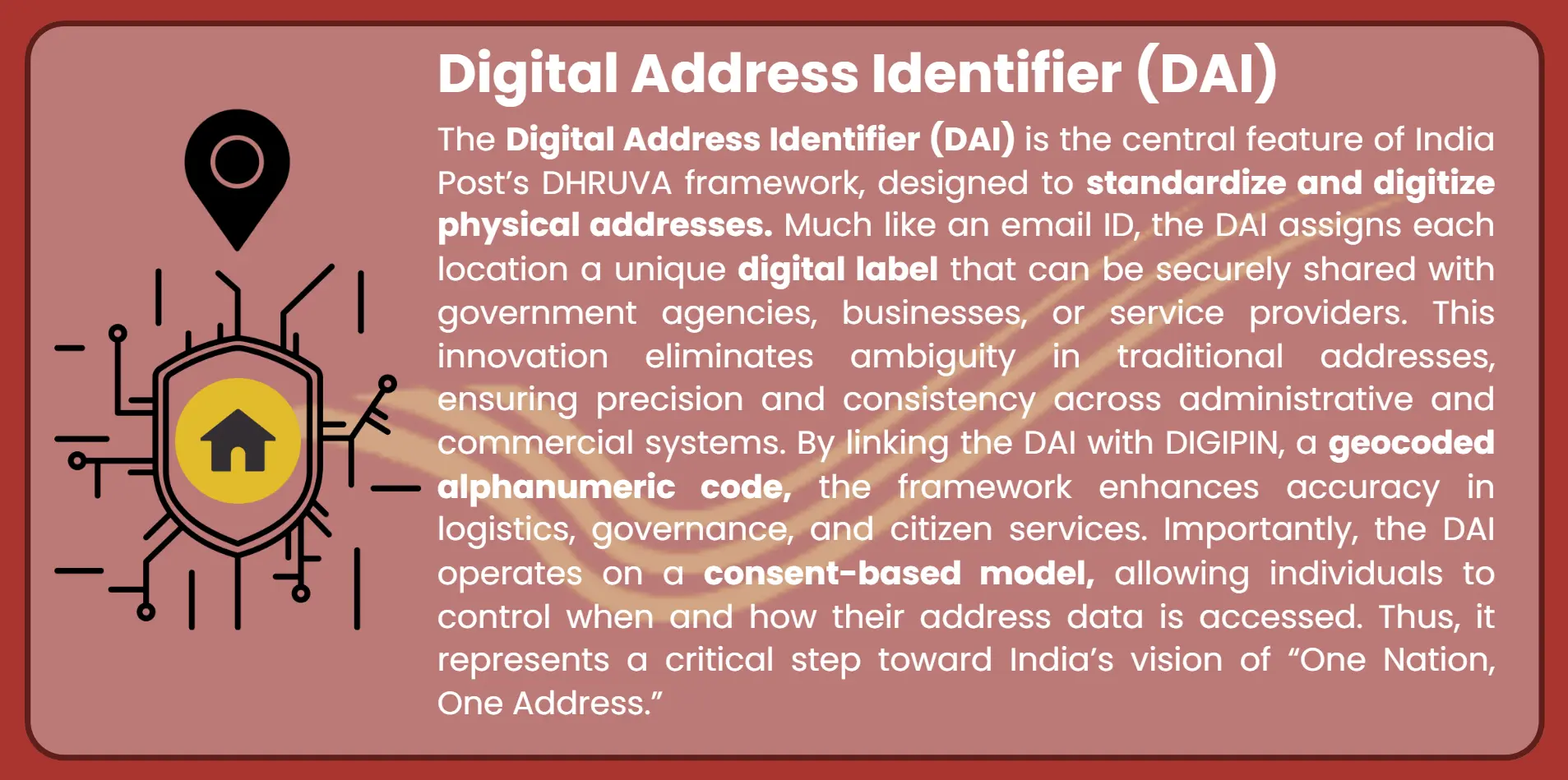
The DHRUVA architecture has the Digital Address Identifier (DAI) at its core that works similarly to the email address of geographical locations. All of the physical locations receive distinct digital identifiers, which can be distributed to service providers, government, or individual businesses. Such an identifier is one that brings uniformity, reduces ambiguity, and aids citizens in controlling access to and use of their locational information.
DIGIPIN Integration
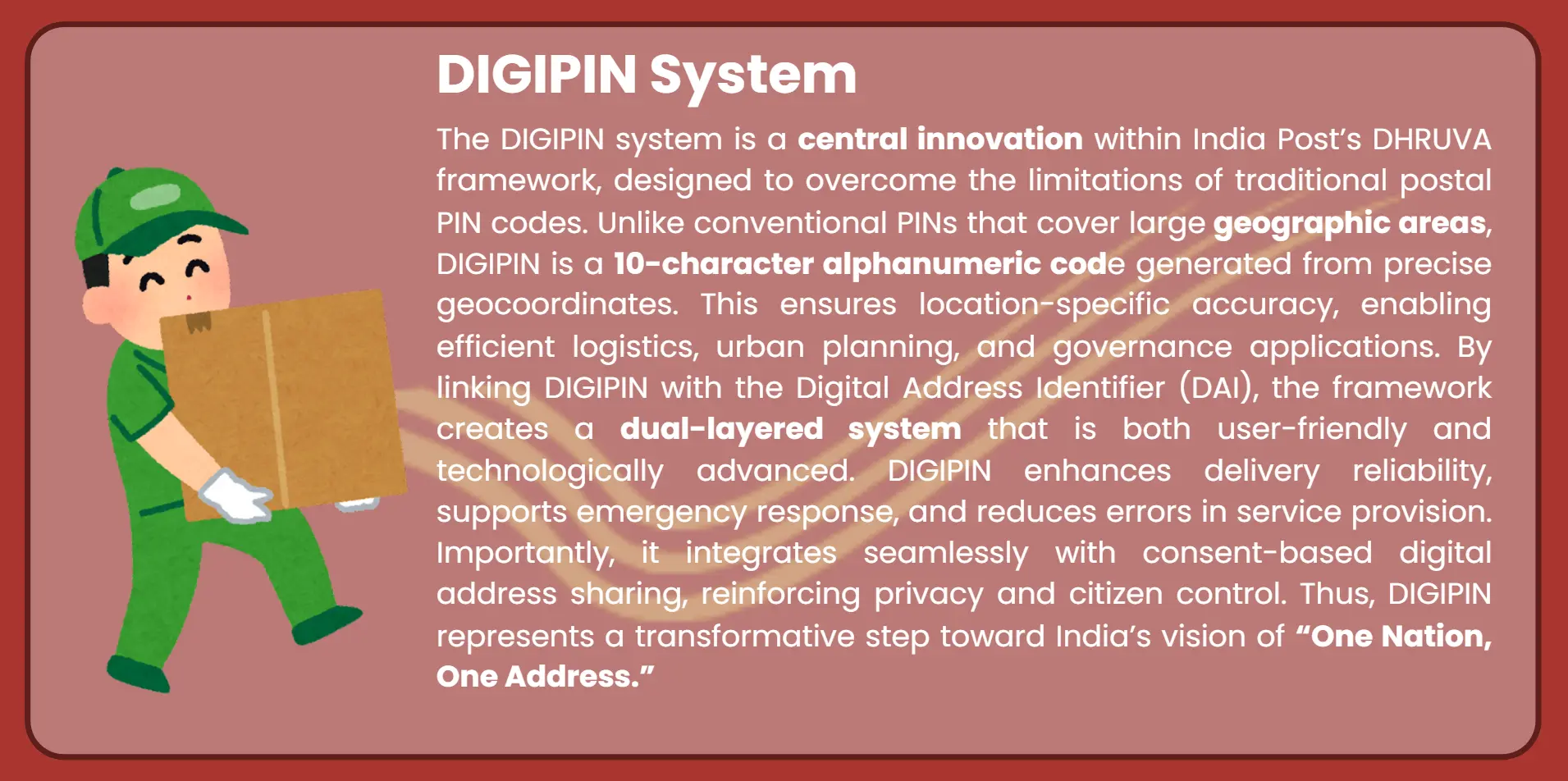
Complementing the DAI is the DIGIPIN, which is a 10-character alphanumeric code, based upon geo-coordinates. Unlike the traditional use of postal codes to define geographic areas, which are extensive, DIGIPIN gives locations accurate mapping. It is an innovation that improves the efficiency of planning in logistics, response to emergencies, and governance, as well as assisting in high-tech geospatial planning. The amalgamation of DIGIPIN and DAI in DHRUVA creates a two-layered system, which is easy to use and at the same time resistant to any technological breakdown.
Consent-based and Secure Model
The key feature of DHRUVA is its focus on sharing data based on consent. The citizens have the freedom of their digital addresses, and only they decide when and to whom they will share these addresses. This is in tandem with the constitutional principle of privacy establishedin the Puttaswamy case and assures that the framework will not undermine the right of an individual. Moreover, the system is interoperable, secure, and flexible across various platforms, which strengthens confidence in digital governance.
Address‑as‑a‑Service Model
DHRUVA proposes a concept of the Address-as-a-Service, which will allow businesses, logistics operators, and government agencies to get access to standard address data through their digital frontiers. As a result, the reduction of inefficiencies in delivery systems is enabled, the growth of e-commerce is encouraged, and the interactions of the citizens and the public services are facilitated. By making addresses within the context of a service-oriented framework, DHRUVA can be viewed as a key player in the digital economy of India.
Towards one Nation one Address
In the end, the framework is aiming towards the realisation of the vision of One Nation, One Address. The DHRUVA attempts to improve the addressing network and disjointed system in India by integrating the geospatial technologies, the principle of digital identifiers, and the secure governance of the system. This aspiration imparts larger national goals of inclusiveness, effectiveness, and transparency in governance.
Applications & Benefits
The DHRUVA model that was developed by the India Post is framed as a revolutionary Digital Public Infrastructure. Its areas of operation include governance, logistics, and citizen services, and it offers a considerable benefit in efficiency, transparency, and inclusivity.
Towards good governance
One of the most important uses of DHRUVA relates to governance and policy implementation. The framework is based on digital distribution of addresses that can be achieved via Digital Address Identifiers (DAI) and DIGIPIN, which enables improved distribution of welfare schemes, tax collection, and elections. It is also the foundation behind the environmental clearance processes by making accurate geospatial information available, thus promoting transparency and accountability in the regulatory decision-making process.
Logistics and Commercial Services
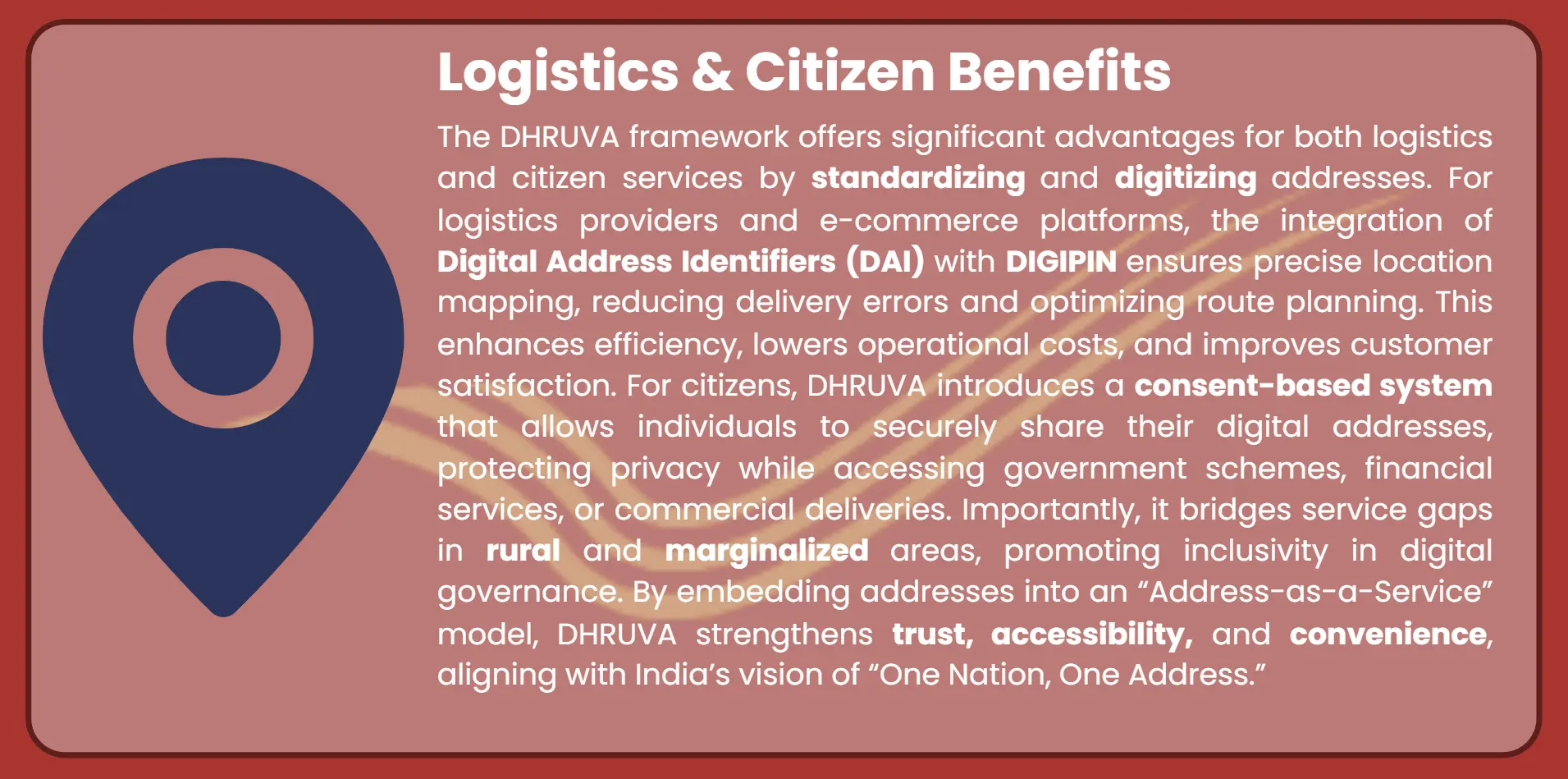
DHRUVA has meaningful consequences regarding logistics and commerce, especially in the fast-paced e-commerce area. Delivery errors are discouraged through standardized digital addresses, route optimization, and minimal expenses are incurred in operations. DHRUVA can be integrated into the systems of logistics providers to ensure more efficient and efficient services in terms of delivery. This efficiency is not only beneficial to the enterprises but also improves consumer satisfaction, thereby strengthening the digital economy of India.
Customer-Focused Service Provision
To citizens, DHRUVA has inclusive, user-friendly services. People are able to post their online addresses safely on a consent basis, and ease of privacy will be ensured in the process of using either government or personal services. This removes bureaucracy and results in a better user experience. Additionally, the structure enables communities in the rural and marginal areas to be empowered as it helps fill structural inequalities in the accessibility of services, and these efforts are associated with the broader goals of digital inclusion in India.
Challenges & Way Forward
Given that the DHRUVA framework promises one of the potentially transformative effects on the digital governance situation in India, several obstacles faced by the framework must be addressed in a systematic manner to ensure a successful implementation process and subsequent sustainability of the same.
Data Privacy and Security Issues
One of the major problems is the protection of the privacy of citizens. DHRUVA will significantly increase the chances of abuse, unauthorised access, or tracking since it is a translation of physical addresses into digital formats. This framework must then meet the constitutional privacy values as provided in the Puttaswamy ruling, and it should include strong encryption, consent-sharing of the data, and strict rules of data management. Without proper security measures, the citizens can lack confidence in the system.
Digital Inequality and Disability
The issue of digital divide still prevails in India, especially between rural and urban citizens. Low digital literacy and internet penetration, along with infrastructural shortages, can hinder a fair implementation of DHRUVA. The inclusivity will require specific capacity-building programmes, the accessibility of digital tools at affordable costs, and the links to the existing welfare schemes. This gap should be bridged in order to ensure that the vulnerable communities are not marginalised by the benefits of digital addressing.
Institutional Implementation and Co-ordination
The other issue is that of interagency coordination. Effective implementation of DHRUVA will require coordination between India Post, state governments, municipal authorities and the stakeholders in the public and private sectors. Administrative fragmentation and overlapping of jurisdictions may be obstructive to the implementation process. A clear governance structure, uniform procedures and interoperability systems will play an important role in ensuring universal adoption.
Policymaking and Law Enforcement
The effectiveness of the framework depends on a strong legal basis. It should be amended to give it an initial sense of legitimacy, although a detailed policy framework on data protection, accountability, and redress in the event of a grievance is yet to be developed. A clear regulatory framework will guarantee that DHRUVA functions within the confines of the constitution and evokes innovation and involvement by the private sector.
Developing Trust and Integration
The solution is to strengthen the trust, inclusivity, and integration. The real benefits could be demonstrated through public awareness campaigns, pilot projects that take place in different regions, and partnerships with e-commerce and logistics enterprises. The DHRUVA, combined with other Digital Public Infrastructure programs like Aadhaar, UPI, and ONDC, will create a holistic ecosystem. Ultimately, by long-term investment, citizen participation and responsive governance, the vision of One Nation, One Address becomes a reality.
Conclusion
The DHRUVA framework presented by India Post is one of the major developments in the digital governance framework of India. It transforms the ancient administrative, logistical and citizen service delivery inefficiencies by changing physical addresses into standardised and secure digital references. The Digital Address Identifiers and the Digital Identifier group with DIGIPIN is one vision of the future: One Nation, One Address. However, these problems of privacy, inclusivity and institutional coordination should be handled well to make adoption equitable. With proper controls and governance through cooperation, DHRUVA can be a pillar of Indian Digital Public Infrastructure, which will strengthen transparency, efficiency, and trust in the population.