|
Key Highlights
- Cosmic Filaments
- Formation
- Structure
- Significance
- Implications
- Dark Matter and Energy
|
The Cosmic filaments are the biggest coherent structures in the universe that build up a huge web in the universe that consists of galaxies, intergalactic gas, and dark matter. Present in primordial density perturbations, which happened a little bit after the Big Bang, these filaments are several hundred million light-years across as they connect the clusters of galaxies with enormous voids. The presence of these objects determines the development of the galaxies, explains the distribution and effects of dark matter, and provides decisive information about the geometry and dynamical expansion of the Universe.
Cosmic filaments are the universe's largest structures, vast, thread-like networks of galaxies, gas, and dark matter forming a gigantic "cosmic web" that acts as a gravitational highway system, guiding matter flow and fuelling star formation in galaxies.
|
Tips for Aspirants
The current article is of specific significance to the exam taken by the UPSC CSE and state-level Public Service Commission (PSC) exam in that it contributes to increased scientific literacy, helps to prepare the General Studies section, and provides an understanding of the relevance of cosmology, technologies, and the development of society as a whole.
|
|
Relevant Suggestions for UPSC and State PCS Exam
- The cosmic filaments are the largest galaxies in the Universe, which are the basis of the cosmic web.
- They cover distances of the order of hundreds of millions of light-years, thus connecting galaxies, clusters and cosmic voids.
- They were formed from density variations just after the Big Bang, and further development is dictated by the gravitational pull of the dark matter.
- These filaments consist of galaxies, dark matter halos, and diffuse intergalactic gas (the Warm-Hot Intergalactic Medium, WHIM).
- They regulate galaxy evolution and star formation; serve as reservoirs of baryonic matter, thus solving the issue of the missing baryons; and provide insights into the location of the dark matter, as well as the impact of the dark energy on cosmic expansion.
- They enable the development of cosmology models and numerical calculations, as well as instigate philosophical considerations that are concerned with how ordered and connected the Universe is.
- Relevance to exam: it strengthens scientific literacy, helps prepare students for General Studies (Paper III), and elucidates areas of overlap between the cosmological theory and other areas, including governance, technology and dynamics of society.
|
Being the brightest structures that can be identified in the visible universe, the cosmic filaments present a fine structure of the large-scale architecture that is very different from a chaotic distribution of matter. These filamentous structures are made of bright galaxies, diffused baryonic gas, and large dark matter sections that are spread over several million light years. With the expansion of extensive sky surveys and large-scale numerical models, our knowledge of this complex network has become crystallized: matter has been shown to be stratified into an interlaced network of filaments and nodes. As conduits of gravity, the fibers wring the diffuse content into the ruptured structures as well as drawing huge gaps, both of which form the general matter field throughout the universe. The significance of cosmic filaments is even greater than their size, as this structure is considered to play a crucial role in regulating galaxy dynamics, star formation, and the spatial organization of dark matter. They provide necessary observational data of the mechanisms governing the cosmic expansion and the dynamical impact of the dark energy.
The Goa incident, along with similar incidents such as the Birch incident of the Romeo Lane, shows the extreme importance of questioning the role of combustion chemistry and toxic aerosol dynamics, as well as the architectural protection of the public. This article attempts to elucidate the prevalence of suffocation as compared to burns as the cause of immediate death in a fire accident, and, at the same time, outlines mitigation measures, such as smoke alarms, sprinklers, and effective evacuation procedures. The intersection of science and policy issues in analysis aims at increasing information awareness and institutional accountability to human life in the case of fire hazards.
The Cosmic Filaments - The Role of Cosmic Filaments in Galaxy Formation and Evolution
The cosmic filaments are one of the most visible elements of the large-scale structure of the universe that serve as the support of the cosmic web, interconnecting the galaxies, clusters, and vast voids over large distances that are beyond intuitive perception. Cosmic filaments are the largest known structures in the Universe: vast, thread-like formations of galaxies and dark matter that form a cosmic scaffolding. They also act as 'highways' along which matter and momentum flow into galaxies.
Cosmic filaments are the universe's largest structures, vast strands of dark matter and gas forming the backbone of the cosmic web, acting as cosmic highways that channel matter, fuel star formation, and guide galaxy growth and evolution by connecting galaxy clusters and providing the necessary ingredients (gas, dark matter) for galaxies to form and build up over time, influencing everything from mergers to black hole activity.
Definition and Scale
Cosmic filaments comprise galaxies, intergalactic gas, and dark matter, and take the appearance of thread-like collections thatstretch across hundreds of millions of light-years. They are not given in a vacuum, but are a part of a huge interconnected web. These threads delineate the edges of cosmic gaps and serve as pathways through which the directed flow of matter can occur in more and more dense zones and galaxy clusters. Due to their massive size, they are the largest coherently related structures to be understood in the field of cosmology, and are larger than any single galaxy or collection of galaxies.
Formation and Origin
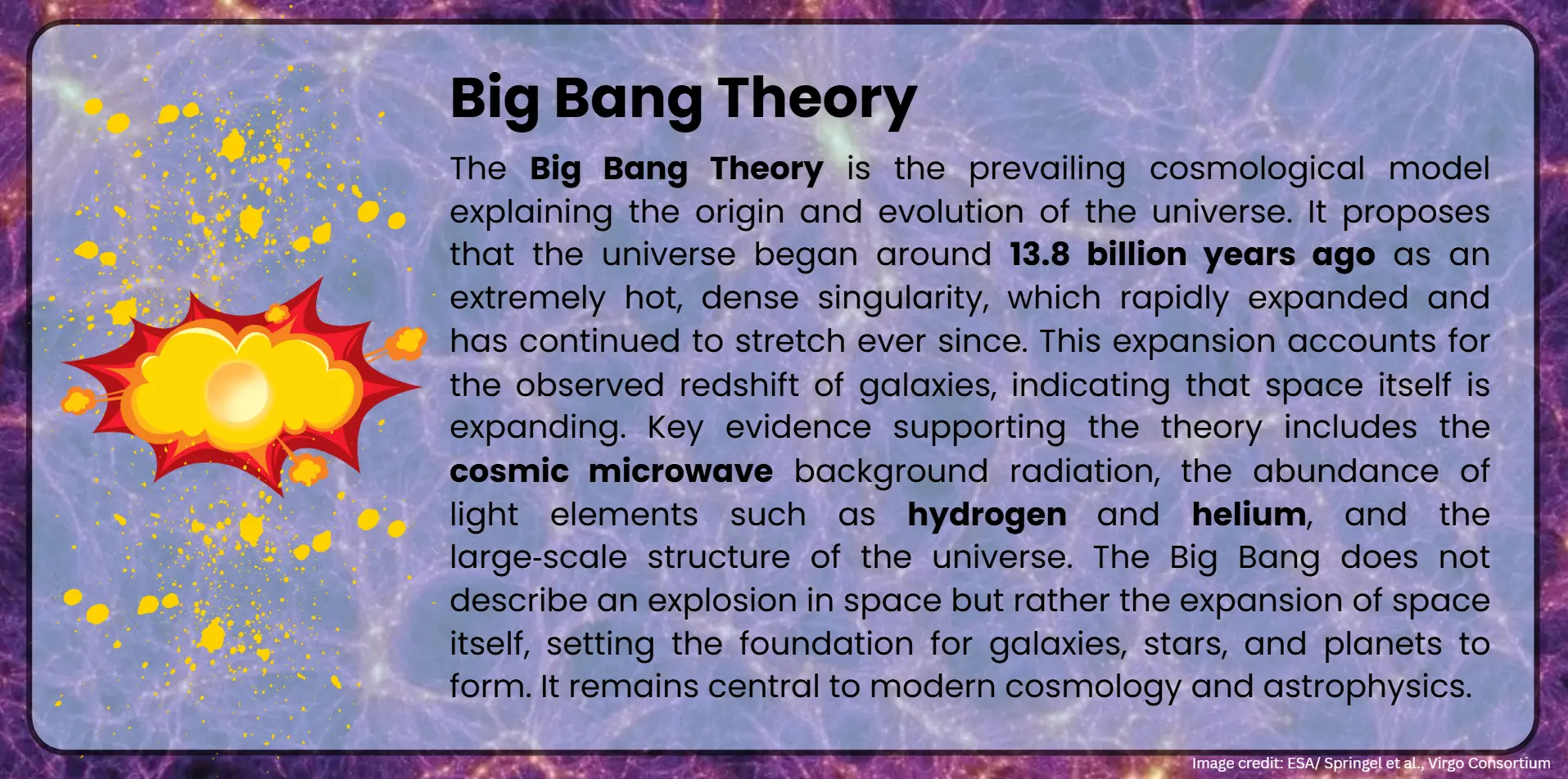
It is possible to trace the origin of filaments to the primordial density perturbations that appeared a little bit after the Big Bang. When the dark matter fell in due to the pull of the gravitational force, it created a framework that baryonic matter, in turn, settled on. This hierarchical process in successive billions of years produced filamentary networks that determined the spatial distribution of galaxies. Cosmological simulations support the claim that filaments are naturally formed out of gravitational interactions, hence highlighting the tendency of the Universe to organize hierarchically.
Make-up and Physical Appearance
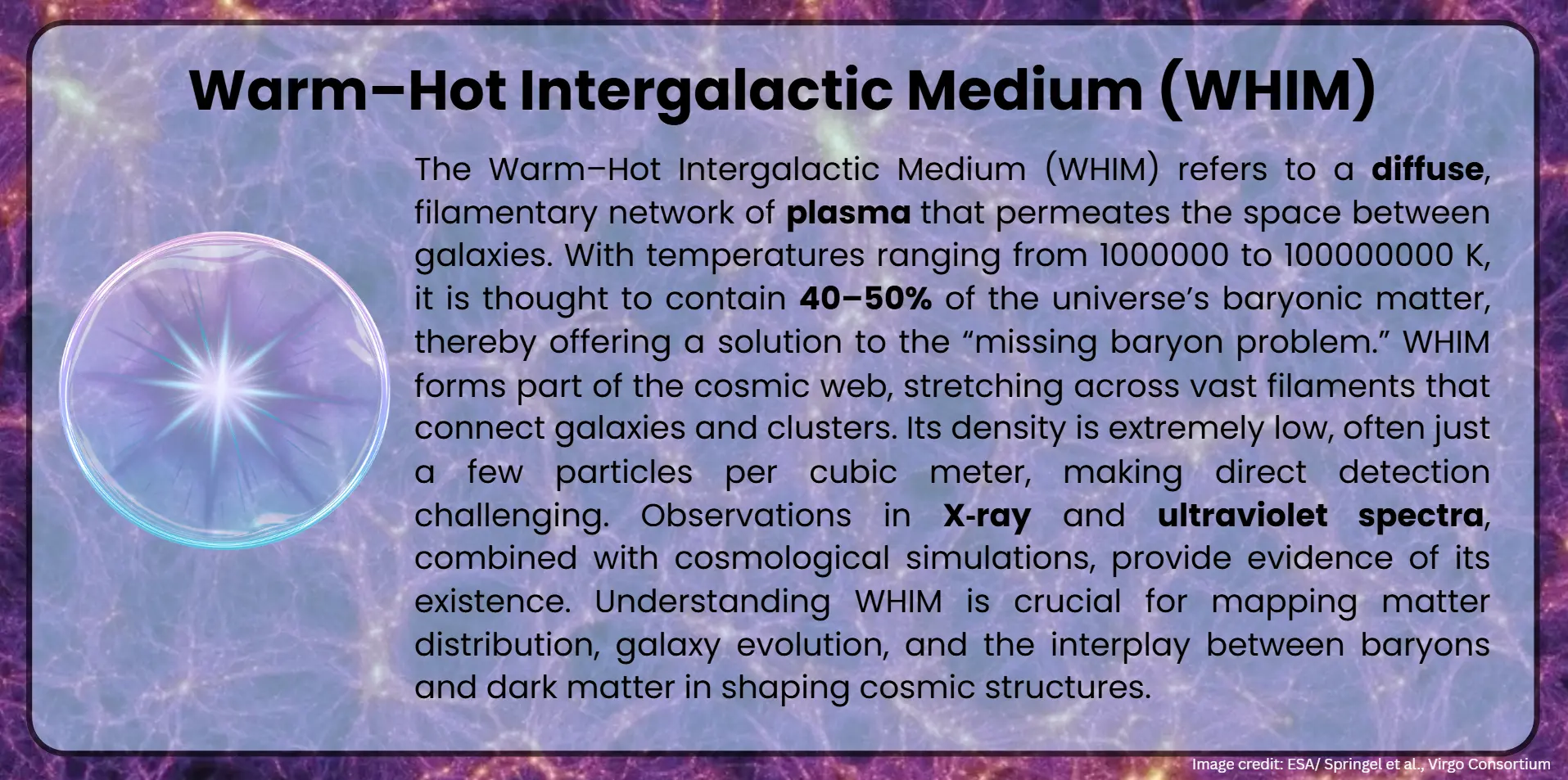
Dark matter halos, diffuse intergalactic gas, and galaxies make up the filaments. While studies show that they contain a significant portion of the baryonic matter in the Universe, most of which is in a warm-hot intergalactic medium (WHIM). This gas is difficult to observe, but with the help of X-ray and radio measurements, together with simulations of the cosmos, there is evidence revealing the fact of its existence. The filaments, therefore, serve as repositories of matter, hence controlling the formation of stars and the evolution of the galaxy by the control of gaseous inflow into the galaxies.
Importance
The study of cosmic filaments has become critical to explain galaxy evolution, the distribution of dark matter, and the cosmic expansion. Their geometrical characteristics provide information on the role played by dark energy in determining the structure of the large-scale objects. Besides, filaments are natural laboratories for testing cosmology models, since the properties of filaments are mirror images of the underlying universal processes that control the structure formation. With the mapping of these structures by both deep-sky surveys and simulations, scientists will keep on enhancing the current knowledge on the architecture of the Universe.
Formation and Structure
Cosmic filaments are large-scale structures in the form of filaments that form the large-scale organization of the universe. Their formation and their complex structure reveal the key operations that regulate the evolution of galaxies, clusters, and cosmic voids.Cosmic filaments are the Universe's largest structures, vast threads of galaxies and dark matter forming a cosmic web, acting as highways for matter flow. Their formation involves gravity pulling matter into sheets and filaments from the early Universe's smoother distribution, with processes like shock heating creating the warm-hot intergalactic medium (WHIM) within them.
Formation in the Early Universe
Formation in the Early Universe
Dynamics and Collapse
These rays occur at the interface of sheets of matter which collide and, moreover, collapse, thus forming slender channels of concentrated quantity. These are the areas that funnel or channel the gas and smaller galaxies towards the densely clumped clusters. The geometry of filaments, as well as giving the filaments and the galaxies embedded within them angular momentum, is a result of gravitational force, which causes the filaments and their host galaxies to spin. The dynamic process explains why filaments are non-static as they constantly develop and redistribute matter on the cosmic scales.
Characteristics
Structurally, filaments consist of dark-matter halo, diffuse intergalactic gas and a linear chain comprising galaxies. It has been observed that a significant portion of the baryonic matter in the universe is contained in the form of filaments, mainly, the warmer-hot intergalactic medium (WHIM). This gas is faint and difficult to detect, yet X-ray and radio surveys, combined with the help of computer simulations, prove the existence of this gas. The entities were observed recently on a rotating filament study where a galaxy moves by a thin thread synchronous with other galaxies, and this complexity is clear in the dynamical behaviour of the galaxy and its similarity to galaxy evolution.
Scientific Significance
Cosmic filaments are not just giant clusters of galaxies and dark matter, but they hold a fundamentally important role in the current cosmology. Their importance lies in their use to control the evolution of the galaxies, to determine the spatial distribution of the dark matter, and they are critical constraints that can be used by models of cosmic expansion.The scientific significance of cosmic filaments lies in their role as the "scaffolding" of the universe (known as the "cosmic web"), which dictates where and how galaxies form and evolve.
Galaxy Formation and Evolution
The filaments act as channels or conduits of gravity, which direct the contents into the galaxy clusters. This continuous supply of gases maintains the process of star formation and affects the morphology of the galactic objects. The evidence indicates that both the number and velocity of stars forming are generally high in galaxies located within the filamentary structure as compared to galaxies located in secluded regions. In addition, the filamentary context also determines the galactic orientation, such that spin axes are more likely to be oriented along filamentary axes. Filaments are therefore dynamic regulators of the galactic growth and evolution as opposed to passive structures.
Baryonic Matter
A large portion of the universe's missing baryon is also theorised to have been absorbed within filaments, and most so in the warm-hot intergalactic medium (WHIM). This diffuse component is still difficult to detect; nevertheless, it has been convincingly seen in the X-ray and radio regimes, and with the help of cosmological simulations, it is certainly known to exist. The study of filamentary environments provides astronomers with essential information about the distribution of ordinary matter, thus contributing to finding answers to the long-standing cosmological conundrums and the way in which galaxies obtain the material to turn them into stars.
Mapping Dark Energy and Dark Matter
The dark matter is the most common sculptor of the filament since it provides the gravitational frame against which they are formed. A study of the geometry of filaments enables a scientist to determine the distribution of the large-scale dark matter. Moreover, the macro-scaling of filaments provides the information that is relevant to the impact of dark energy, particularly the matter of its contribution to the expansion of the universe. Cosmological studies of the composition of the universe are done through detailed studies of filamentary networks and are used to test competing theoretical proposals.
Cosmological Models and Future Research
The filament analysis is critical for confirming cosmological simulations. Theoretical predictions have been proven to hold in the large-scale surveys, especially the Sloan Digital Sky Survey (SDSS), which has been used to map filamentary structures more and more precisely. Planned missions will seek to study filaments in even more detail with more sophisticated telescopes and complicated calculation codes to find small gas and to measure filament behaviour. These efforts will further our knowledge of the way the universe was formed since it was in its primitive state.
Broader Implications
The cosmic filaments, being the ultimate extravagant structures in the universe, do not just represent their physical beings, but they also have deep scientific and philosophical implications. Their inquiry causes restructuring of cosmological constructs, dictates the astrophysical theory, and questions the human understanding of the precedence of order of the cosmos.
Dark Matter and Energy
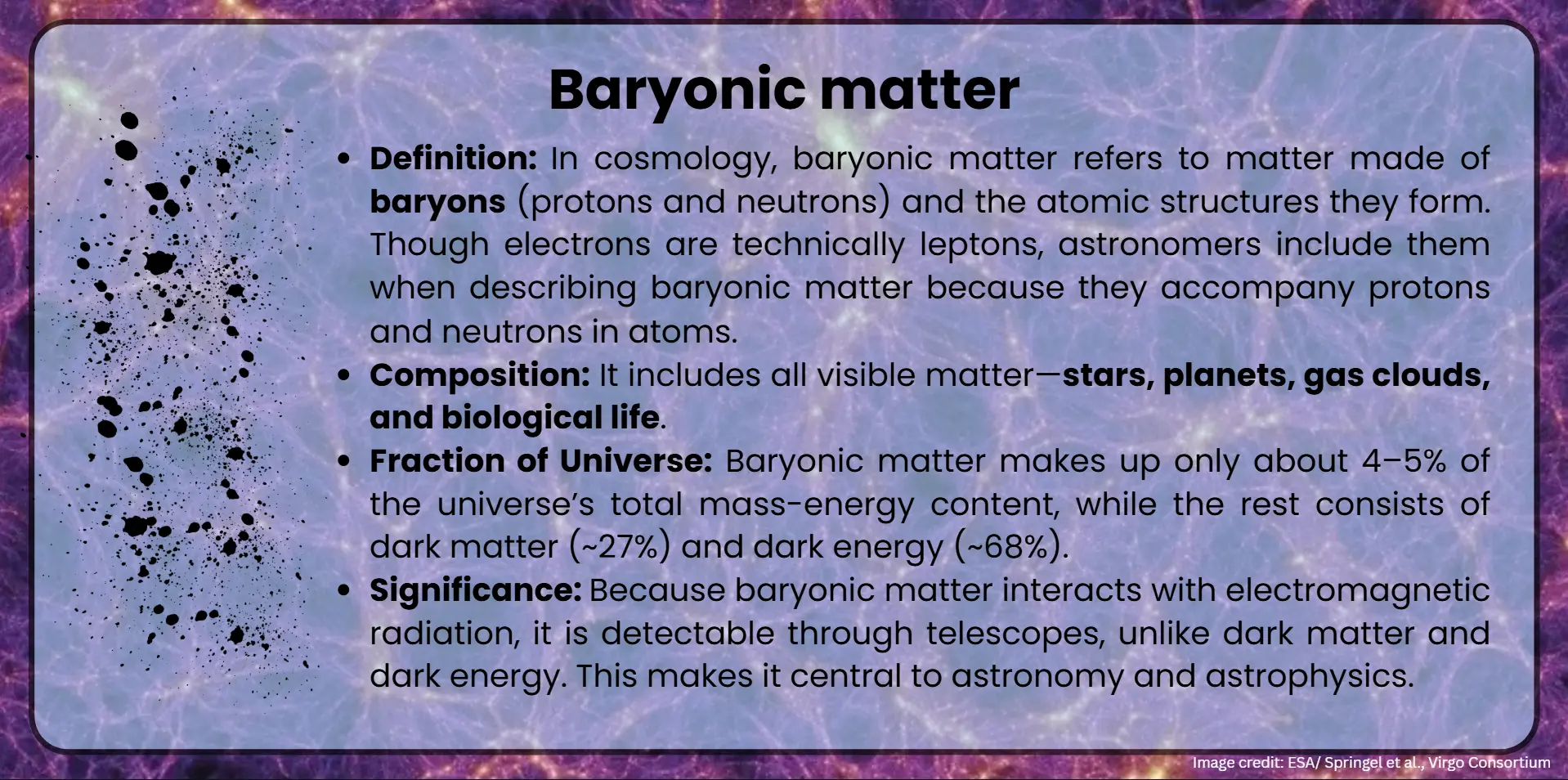
The structuring is primarily done by the dark matter, which provides the gravitational structure required in the formation of the filaments. Through their geometry, the scientists are able to determine the distribution of dark matter in space on cosmological scales. Also, filament-based geometry provides significant limitations on the effect of dark energy in mediating cosmological expansion. By sharply critiquing filamentary networks, intellectuals narrow down on cosmological paradigms and test and compare rival speculations touching on the makeup and eventual fate of the universe.
Cosmic and Galaxy Evolution
The filament is a starch channel that guides the matter towards the galaxy clusters, thus regulating the star formation processes. The fact that they carry gas and baryonic matter is an indication of their relevance in maintaining the ecosystem of the galaxy. Galaxies that get engulfed in filaments often have ordered evolutionary progressions in contrast to the pattern of their formation by isolated areas, thus demonstrating the critical role of the environment in determining the celestial evolution. This ecological explanation puts filaments at the center of the active participation in the ongoing change of the universe.
Philosophical and Existential
In addition to the space domain of astrophysics, filaments raise some philosophical questions of the nature and nature of order and connectedness in the universe. When they are very large and highly connected, this has meant that the universe is not in some way fundamentally disorderly; instead, it is based on certain underlying principles of symmetry and balance. To human beings, the acknowledgement of these filaments as the framework of existence makes us consider our position in a framework that is both enormous and highly detailed. These insights are the ones that connect scientific knowledge with metaphysical thoughts and thus contribute to the dialogue between cosmology and philosophy.
Implications for Technology
The governance makes a conclusive impact on safety outcomes. The government should randomly carry out safety inspections of places of high risk, such as clubs, cinemas, and restaurants. Non-adherence to rules should be penalized adequately to discourage carelessness. The proactive safety culture can be provided through collaborative efforts involving the municipal bodies, fire departments, and civil society organizations. Accountability is also enhanced by public reporting systems, which allow citizens to report unsafe premises.
Conclusion
The case in the Goa nightclub is used to highlight an important fact: the leading cause of fire-related deaths is not direct thermal injury, but being smothered by the poisonous fumes and subsequent loss of oxygen. Science has proven that victims are paralyzed by smoke easily, thus impeding escapes, increasing the number of casualties in the enclosed space. What this tragedy thus underscores are the urgency of extreme regulation enforcement, laying down of well-built infrastructural protective measures such as early warning alarms and programmed sprinkler systems, and an extensive educational effort on the issue of fire hazard. Through the amplification of the visibility of fumes as the main deadly threat, the policymakers, the institutions, and the population, as a whole, have the opportunity to reinforce preventive mechanisms, which will result in the fact that recreational or residential areas will not turn into fields of preventable disasters.