|
Key Highlights
- Integrated governance
- Lessons from Beijing
- Energy transition
- Transport reforms
- Urban planning
- Day-to-day Monitoring
- Public participation
|
The story of how Beijing has managed to reduce its air pollution by a substantial margin in the span of ten years can be deemed useful to Delhi. Its success was achieved by means of integrated governance, state-of-the-art industrial restructuring, and the use of cleaner energy, strong transport regulation, and real-time monitoring with the involvement of citizens. The application of this theoretically holistic approach, that is, the integration of policy implementation, technological development, and civic participation, can help Delhi work towards a state of chronic smog-free breathable air.
|
Tips for Aspirants
The article is crucial in relation to both the UPSC CSE and the State PSC exams since it offers a unified approach to governance, environmental challenges, and policy making, hence being a worthy tool in writing essays, analyzing papers of General Studies, as well as discussion in an interview.
|
|
Relevant Suggestions for UPSC and State PCS Exam
- Integrated Governance: The multi-layered coordination structures used at the very centre of the administration of Beijing have intensified accountability, and it is important to note that the need to have an integrated air-quality agency in Delhi exists.
- Industrial Restructuring: Methodical closure ving of the polluting industries, as well as the introduction of clean industrial technologies, has been proven to cut emissions; therefore, Delhi should implement strict regulatory actions against small-scale industrial enterprises.
- Energy Transition: A move by Beijing towards natural gas and renewable energy is a great example of the strategic importance of diversifying fuels and fast-tracks toward the use of clean energy, and this is what Delhi needs to adopt, properly organized incentive measures and policies.
- Transport Reforms: Changing the modal composition of cities through the introduction of vehicle emission standards, odd-even car registration policies, and the introduction of the Metropolitan rail.
- Urban Planning: The decreased commuting distance in Beijing is attributed to the plan including green belts, zoning laws, and compact-city policies; Delhi needs to embrace sustainable land-use policy in order to reduce travel demand.
- Public Engagement: citizenship was fostered through campaigns and online solutions; Delhi has to incorporate citizen education into the policy process.
|
Air pollution has proven to be one of the most urgent urban issues of the twenty-first century, which takes place especially in the fast-growing megacities. Delhi, being one of the most frequently ranked polluted capitals of the world, faces extreme health, environmental, and economic impacts because of the constantly high percentages of particulate matter and toxic pollutants. The answer to this crisis should not only be in achieving the interventions in the form of technology, but also an adequate and effective policy framework. The experience of Beijing in this respect is a good comparative example. Beijing had once been known as a smog city of massive proportions that had, over a span of ten years, maintained an incredible air pollution level through the implementation of strict state control, restructuring of its industry, the shift to energy sources, and the engagement of its citizens. The success of the city was not an accident, as the occurrence in the city, but a combination of the political will to achieve it, integrated planning, and strict enforcement measures.In the case of Delhi, in order to implement such a framework, it has to modify these lessons to fit into its socio-institutional environment.
This article will analyze four main aspects of the clean-air movement of Beijing, including policy integration, industrial and energy reform, transport control, and monitoring with involvement of the citizens, and discuss how the city can inform Delhi on its way to improving air quality sustainably. Adopting lessons from Beijing, Delhi could take a step closer to breathing advantageous air and protecting people's health.Delhi can adapt the "Beijing Model" by implementing long-term, coordinated strategies that include a rapid transition to clean energy, strict enforcement of industrial and vehicle emission standards, and robust regional cooperation.
Policy Integration and Governance
The case of Beijing's improvement of air quality is an example of how coherent policy structures and integrated governance can be used to drive significant changes to the environment. The success of the city was not by chance, but through specific institutional coordination, which castrated goals, and had developed hard enforcement instruments.
"Pollution to Solution: Policy Integration and Governance" means tackling pollution by breaking down silos between environmental, energy, transport, and economic policies, ensuring they work together, not against each other, through coordinated rules (governance) involving government, businesses, and citizens to achieve sustainable solutions like reducing plastic waste or improving air quality.
Multi-level Co-ordination
The point under the Beijing approach that stood out was the central government being the main actor in setting high air quality goals. The national directives were implemented in the local action plans and ensured that the municipal authorities, provincial governments, and industrial regulators worked in tandem. This multi-level coordination helped in alleviating the process of fragmentation and also provided some accountability measures that are currently lacking in Delhi. Without such integration, it is likely that the policies will tend to be symbolic, not transformative.
Legal Implementation and Obligatory Bonds
The government of Beijing suggested legally enforceable emission-cutting limits with fines imposed on failure to meet them. The industries had either to use less polluting technologies or move, and the local governments faced immediate ramifications of non-compliance. This body of law has made environmental goals not a choice but a requirement. In the case of Delhi, enforcement of targets in the National Capital Region could be a solution to the jurisdictional issues that often hinder development.
The Institutional Innovation and Transparency
The other key aspect was the formulation of specialized monitoring and enforcement institutions. Beijing also invested in real-time monitoring of air quality, and it was even made publicly available and which made it more transparent and made people have more confidence. Such an institutional innovation fostered a culture of compliance and made policymaking evidence-based. The fragmented state of the monitoring systems in Delhi might be helped by having a single body that has the mandate of harmonizing the data, imposing penalties, and liaising between states.
Lessons for Delhi
The apparent lack of distinction between the two systems of governance lies in the fact that the governance issues facing Delhi are in contrast to the centralized and harmonious system Shanghai faces in Beijing due to overlapping jurisdiction, ineffective enforcement of laws, and central politicking. To replicate the experience attained in Beijing, the institutional reforms must be based on promoting not fragmentation but integration. The creation of one powerful authority with legal requirements and open monitoring might offer Delhi the formal structure needed to sustain air-quality progress.
Transport and Urban Planning
The recent improvement of the air quality in Beijing is a good illustration of the vital role of transport control and city development in the elimination of emissions. The interventions that comprised mobility, infrastructure, and land use within coordinated interventions have brought about a substantial reorientation of the city in terms of environmental path.
Pollution to Solution in transport and urban planning means designing cities to prioritize people over cars, using compact, mixed-use layouts, investing heavily in public transit (buses, trams, rail) with electric options, creating safe cycling/walking infrastructure (lanes, paths), implementing car-free zones, and integrating green spaces (parks, green roofs) to naturally filter air, all reducing emissions, congestion, and improving public health and urban liability.
Emission Control and Traffic
The air pollution in Beijing has also been of historic importance; its vehicle fleet is growing fast and is regarded as a major contributor to the city’s air pollution. As a reaction, the government came up with strict emission regulations, culled old cars systematically, and encouraged people to use cleaner fuels. Limitations by way of licence plate numbers and the odd-even method in traffic control were able to reduce congestion and peak emissions. The pace at which there has been vehicular proliferation in Delhi will require a similar type of systemic regulations, except with a stronger control mechanism coupled with increased integration of the National Capital Region.
Increasing Public Transport Systems
The heavy use of metro systems and bus rapid transit, coupled with bicycle-sharing systems in Beijing, has significantly reduced the reliance on personal cars. The metro net was developed at a tremendous rate, and it provided cheap and effective options to the commuters. Not only did this change in modal shift reduce emissions, but it also changed the habits of urban movements. Though the metro network in Delhi has attained considerable coverage, expansion, and connecting buses, providing the last-mile delivery is still a necessity to follow the achievements in Beijing.
Spatial reorganisation and Urban Planning
Outside of transport interventions, urban planning methods were implemented in Beijing that allowed for a decrease in the level of pollution. The movement of the industries out of congested city areas, the creation of green areas, and the introduction of strict limitations on the zoning regulations all combined to scuttle the goals of development and environmental safeguards. Planning of compact cities reduced commutative scale, and green infrastructure additions enhanced the air quality. The dysfunctional urbanisation that defines Delhi, a mixture of sprawl and unconstrained building, requires a response of space re-structuring and land use sustainability.
Technology, Innovation, and Citizen Engagement
The technological innovations, such as the real-time traffic tracking, the smart card system, and the mobile app used to utilise the public transport in Beijing, supported the implemented transport reforms. The involvement of the people happened as a result of mobilization campaigns and incentives that were used to promote the use of cleaner mobility. Delhi can aspire to put some muscle into its transport governance through amplifying the digital platforms, promoting the adoption of electric vehicles, and encouraging people to adopt sustainable forms of commuting.
Industrial and Energy Transition
The radical overhaul of the air quality in Beijing largely relied on the systematic restructuring of industries and a radical change in energy policy. The city transformed its economic and energy structure by tackling the root causes of emissions that resulted in the attainment of sustainable environmental benefits.
The transition from pollution to solution in the industrial and energy sectors involves a fundamental global shift from fossil fuels to renewable energy sources, driven by technological innovation and supportive policies. This transformation aims to mitigate climate change and prevent millions of premature deaths associated with air pollution.
Restructuring and outsourcing in industries
One of the key steps that Beijing took consisted of closing down or spatially transferring the big polluting businesses of the urban centre. The major industries like steel production, manufacture of cement and power generation, which were mainly powered by coal, were either modernised by the use of cleaner technologies or moved to the margins. This program reduced the level of compressed emissions within a densely populated area and enabled the introduction of a greater level of supervisory control over the functioning of industries. Based on the problems of Delhi, where industrial clusters and small, informal units form a significant part of air pollution issues, a similar restructuring strategy, supported by policies of relocation and regular audits, would help smooth out the local air quality crises.
Transition to Cleaner Fuels
Beijing has implemented a violent restructuring of its reliance on coal to cleaner energy sources, especially in the form of natural gas and renewable forms of energy. Massive programmes substituted coal-burning boilers with gas-burning versions, and homes were even encouraged to use cleaner cooking and heating fuels. This switch-over not only reduced the level of particulate matter, but it also reduced greenhouse gas emissions. An analogous fuel-substitution plan would help Delhi, where biomass burning and diesel use are still widespread, and in this case, it will be supported by subsidies on clean-energy use and strict control of fuel usage by fossil fuels.
Renewable Energy and Efficiency Funds
To supplement the energy change, Beijing heavily invested in renewable energy sources and specifically in solar and wind, in conjunction with energy-efficiency efforts. The industries were required to install energy-saving technologies, and the government subsidies accelerated the installation of renewables. This two-pronged approach minimised the reliance on fossil fuels and created some quick progress in the markets of clean energy. The renewable energy targets and industrial efficiency standards could be introduced into the policy framework of Delhi to align economic growth and environmental sustainability.
Government and Administrative Solutions
The achievement of the energy transition in Beijing was based on strong governance, where legally binding emission limits, monetary fines, and performance-related assessment of the local authorities contributed to the success of the transition initiatives. Monitoring was done transparently so as to comply and prevent regressions. In the case of Delhi, it would be vital to have a single energy and industrial commission that will have the authority to enforce its mandate across administrative borders in order to be like Beijing.
Surveillance, Community Involvement, and Implementation
As not just industrial and transportation reforms, but the process of betterment of the air quality in Beijing may be credited to the establishment of the extensive monitoring systems, the active participation of the citizens, and the most powerful enforcement mechanisms that combined in one way or another, assure accountability. The transition from Pollution to Solution is a multi-faceted approach that hinges on three key pillars: robust surveillance, active community involvement, and effective implementation.
Detailed Supervision Systems
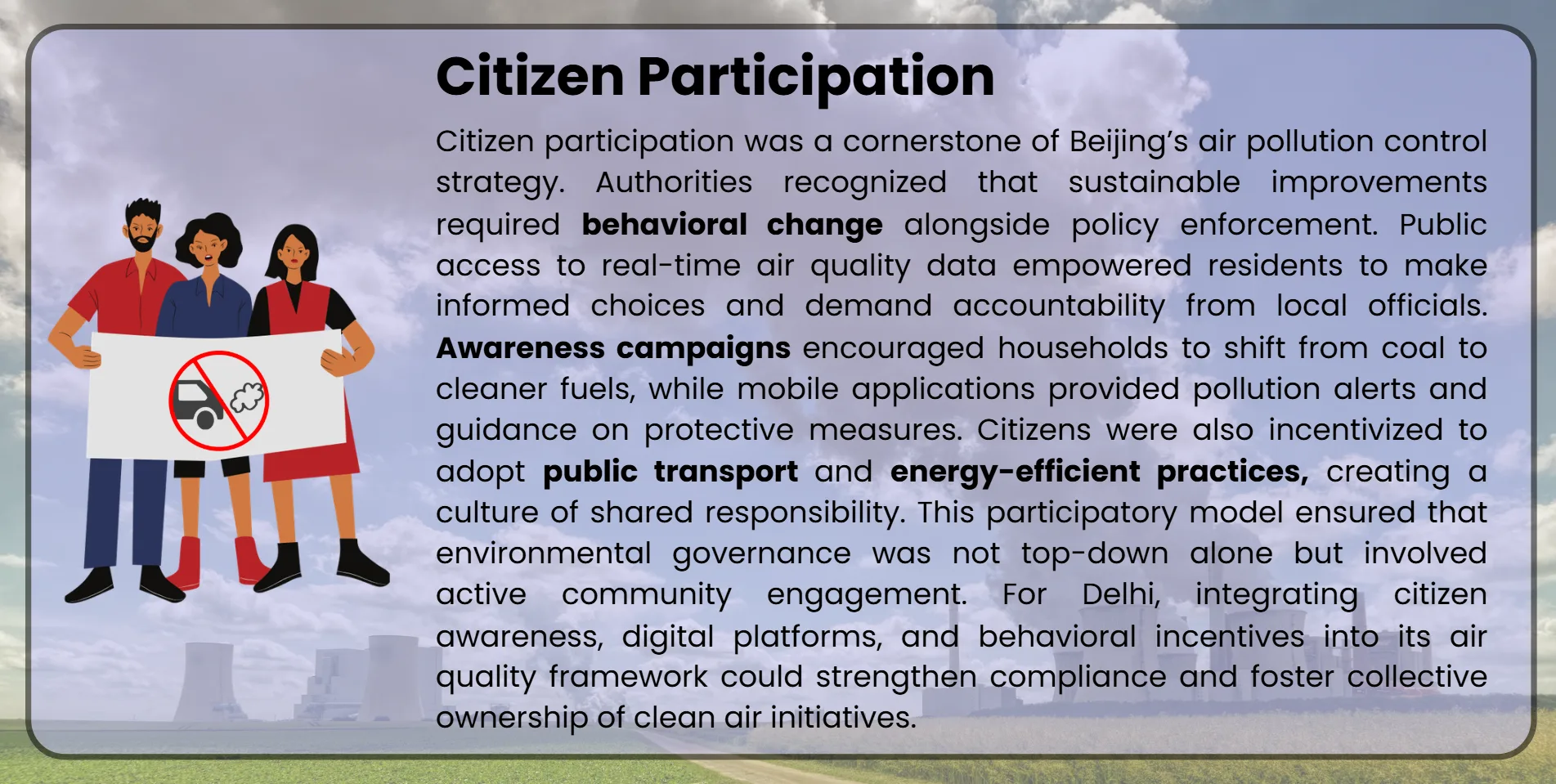
Beijing has created one of the largest air-quality monitoring systems in Asia, as it covers several districts with real-time sensors. These systems were able to capture pollutants like PM2.5, NOx,and SO2 and hence identify emission sources accurately. Publications of data were made through the Beijing Air Quality Index (AQI) and thus contributed to the transparency and offered the researcher the required information to carry out a source-apportionment study. Full monitoring of this nature ensured evidence-based policy interventions and measurable ones.
Openness and the Citizens' Involvement
Accessibility of the public on air-quality information placed the power in the citizens to seek accountability and make changes in their day-to-day practices. An Awareness campaign was used to promote the use of cleaner methods, such as a decrease in domestic coal use and higher use of public transportation. The involvement of the citizens was also enhanced by using mobile applications that provided real-time notifications of the pollution. This participatory method created the spirit of collective accountability, and this approach demonstrated that environmental governance works best where citizens are treated as stakeholders.
Implementation and Legal Processes
The success experienced in Beijing was also based on strict implementation. There were fines imposed on industries and local governments in case of non-compliance with the emission standard, and the performance of the officials was evaluated, taking into account environmental indicators. This was enhanced by legal requirements, making it a non-negotiable requirement. Such a framework discouraged regression, ensured the uniformity of measures to control pollution. In the case of Delhi, imitating these types of enforcement would require them to give power to an integrated authority whose jurisdiction is state-wide.
Lessons for Delhi
The disjointed watchdog infrastructure, as well as the weak enforcement of vulnerable monitoring in Delhi, is in contrast with the integrated system in Beijing. Setting up a centralised monitoring body, ensuring transparency of data to the populace, and integrating environmental performance indicators with governance reviews would significantly boost the air-quality management in Delhi. In addition, encouraging the involvement of citizens in the form of awareness tactics and online platforms would go in line with the policy goals, establishing a more sustainable system of governance.
Conclusion
Despite the significant decline in airborne pollutants in Beijing, one can note the immense significance of integrated governance, industrial restructuring, energy transformation, transport restructuring, and citizen involvement. This case shows that even the most polluted urban settings can be changed due to the consistent political will, the policies that can be followed, and the clear monitoring. In order to apply this framework to the context of the city of Delhi, the strategies should be tailored to its socio-economic and institutional reality, but coordination should be made between jurisdictions. Through the lessons learned in Beijing, Delhi can go beyond the piecemeal interventions into an all-inclusive, enforceable, and participatory model of air-quality management, so as to both protect the general health of the population and enhance the greater goals of sustainable city development.