The European Union has negotiated a Free Trade Agreement with India for over two decades, which has come to a conclusion. The agreement, commonly referred to as the mother of all deals, has been seen to create an enormous market with a population of approximately 2 billion people, thus determining the ways of trading globally.The India–EU Free Trade Agreement (FTA) is being heralded as a landmark deal, often described as the "mother of all deals" due to its scale, strategic importance, and potential to redefine global trade.India and the European Union have signed a free trade agreement that both sides have hailed as “the mother of all deals”.
|
Key highlights
- India-EU FTA
- Historical Event for India-EU
- Measure and Importance of the India-EU FTA
- Strategic and Geopolitical Implications
- India-EU FTA: Prospects and Challenges
|
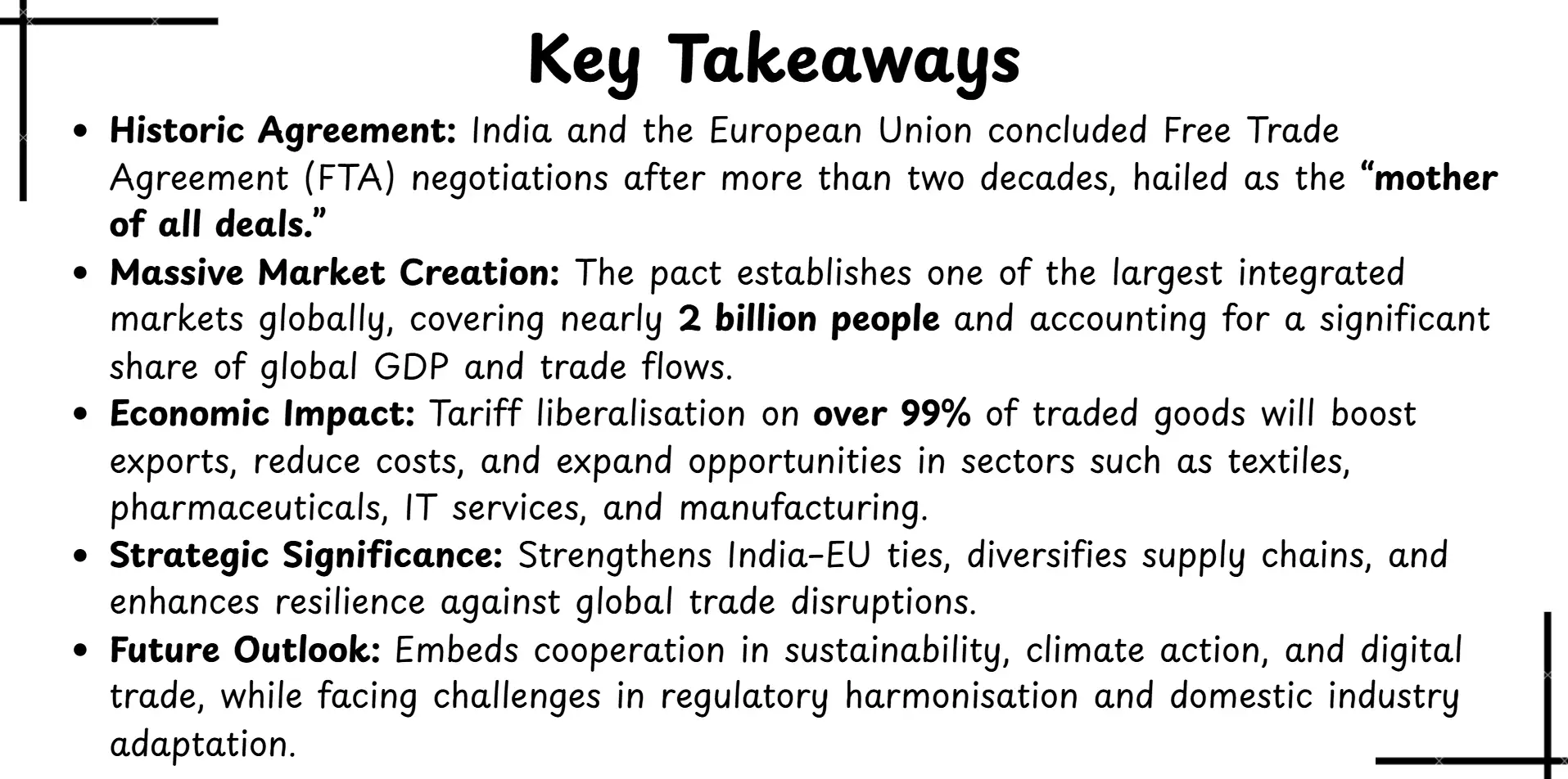
The Free Trade Agreement (FTA) talks between the European Union and India have come to an end; this is a historic development in international economic relations. The pact, signed as a result of more than twenty years of negotiations, is known as the mother of all deals and has been put into documents by the parties. The accord is expected to form one of the biggest combined markets in the world that would have an almost two billion population. In addition to its economic importance, the FTA is an exercise in strategic convergence between India and the EU, enhancing collaboration in trade, investment, sustainability, and global governance, and creating peripheries of the present-day global trade relations.
Free Trade Agreement between India and the European Union: Historical Event for India-EU
In a historic milestone, India and the European Union (EU) announced the conclusion of negotiations for a mega Free Trade Agreement (FTA) on 27 January 2026. Dubbed the "Mother of All Deals," the pact creates a free trade zone of 2 billion people, representing approximately 25% of global GDP. The negotiations on the Free Trade Agreement between India and the European Union came to a conclusion after over 20 years, which is a historic event in the area of global economic relations and diplomatic attitudes towards trade.
Greatest success in India-EU Trade Diplomacy
The FTA signing is a historical event in international trade because it brings to an end almost 20 years of negotiation between the EU and India. This deal has also been termed as the mother of all deals because it is of the largest magnitude and ambition never before. It is more than a trade agreement but a mark of survival in trilateral negotiations, which have waded through political, economic, and regulatory snags to impede its finalization.
Economic Importance of India-EU FTA
The FTA will result in a market of about 2billion individuals, which consumes about 25% of the global GDP and a third of the trade flows worldwide. The EU, according to Business Standard, has agreed to tariff liberalisation of approximately 99.5 percent of the value of goods imported into the EU in 96 percent of product groups. This scale has seen it become one of the largest bilateral trade arrangements worldwide, whereby the exporters in India are likely to have more opportunities of accessing the market, and also diversification is an option that they had not had before with their traditional partners.
Strategic and Geopolitical Aspects of India-EU FTA
Outside the field of economics, the transaction increases the strategic partnership between India and the EU in the times of changing global trade dynamics. It makes India a solid partner in Asia and provides the EU with an antidote to supply-chain reliance. Sustainability, digital trade, and climate coalition, which are the promises of the agreement, are also in accordance with the current global priorities.
Measure and Importance of the India-EU FTA
The partnership between India and the European Union (EU) has evolved into a strategic, multi-faceted relationship, recently underscored by the conclusion of negotiations for a landmark Free Trade Agreement (FTA) on January 27, 2026. Representing 25% of the global GDP and nearly one-third of global trade, this economic integration creates a massive,, unified market of over 2 billion people. India-EU Free Trade Agreement (FTA) is one of the most ambitious trade agreements in the world, which was concluded after 20 years of negotiations, and promises to bring revolutionary economic and strategic changes on both sides.
Expansive Market Reach for India and the EU
The accord creates a unified market featuring about 2 billion people, hence making it one of the biggest bilateral trade systems in history. Such a scale is consequential in that it combines the fast-growing Indian economy with the advanced industrial substantiation of the European Union to provide the enterprises and consumers with previously unknown opportunities. The agreement is expected to ensure that trade barriers are kept to a minimum, enhance competitiveness, and spur cross-border investments.
Trade between India and the EU
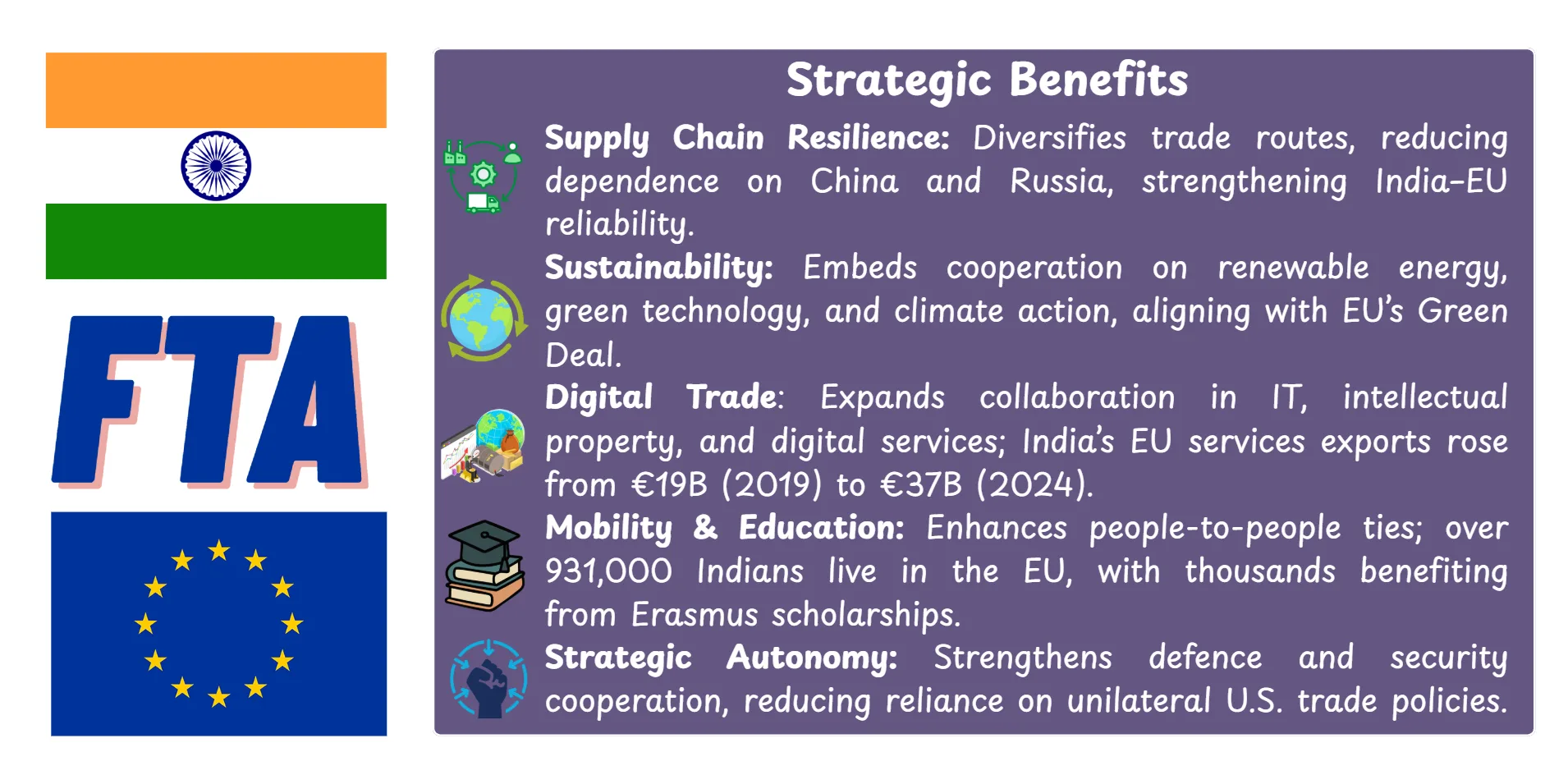
The trade between India and the EU has already shown a healthy growth. During 2019-2024, the service exports of India into the EU have increased to EUR 37billionfromEUR 19billion with, EU exports to India increasing to EUR 29billion. It has been estimated that the FTA will see a tens of billions of dollars expansion of the exports by India in the next decade, especially in the automobile, electronic, textile, and pharmaceutical industries. Liberalisation of tariffs in over 99 percent of traded items will greatly lower the cost and will benefit consumers as well as industries in both regions.
Strategic Significance of India-EU FTA
Most importantly, the agreement promotes India-EU strategic relationships in a multipolar world beyond economic levels. It boosts supply-chain resiliency, co-innovation of technology, and sustainability and climate pledges. Thus, the FTA is not only a trade arrangement, but a foundation of the global government and mutual diplomacy.
Strategic and Geopolitical Implications of India-EU FTA
The conclusion of the India-EU Free Trade Agreement is not only a step in economic history, but it is a geopolitical and strategic turning point that smoothens out the lines in international trade and relations.
Global Trade Alignments through India-EU FTA
The India-EU FTA can be taken as a clear example of a conscious attempt to adjust the commerce relations in the world in the conditions of growing protectionism and insecurity. The agreement enhances India's standing as a reliable partner in Asia by decreasing reliance on traditional partners like China and Russia, as well as supplying the EU with supply chain diversification. Analysts have described the deal as a strategic anchor in a multipolar world that can affect global trade standards by its huge economic bulk, which includes about two billion people and more than a quarter of the world's GDP.
India-EU Strategic Autonomy and Security
Strategic autonomy also has implications for the pact. To India, it increases bargaining power in trade talks with other blocs, but to the EU, it reduces exposure to unilateralism by the United States and supply-chain risks in the East Asia region. They note that the deal will reduce the dependency on Moscow and Beijing at the same time, creating talent paths to offset the tariff and currency policies implemented by Washington.
Technology Cooperation through India-EU FTAh
Other than trade, cooperation is entrenched within the FTA under sustainability, digital trade, and climate governance. Experts in the industry add that it might increase the compliance costs, but the agreement will open the technology transfer and investment that is necessary to meet the global standards on climate. This makes the agreement a strategy of long-term collaboration.
India-EU FTA:Prospects and Challenges
The India-European Union Free Trade Agreement (FTA), which has been concluded after two decades of negotiation, offers significant opportunities for economic growth and, on the other hand, generates complex issues that will impact the long-term effectiveness of the FTA.
Growth & Development of marketsin India and the EU
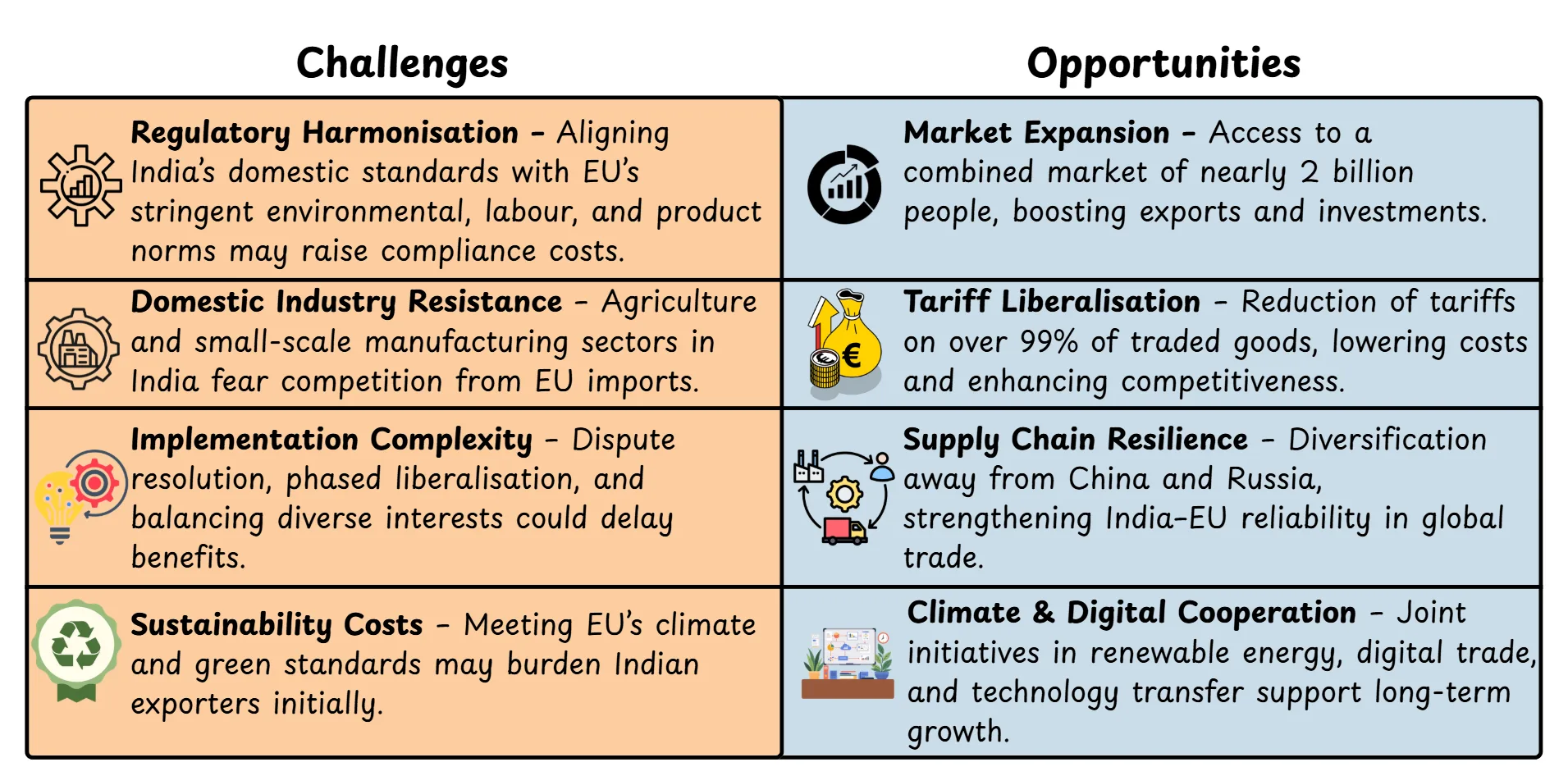
The FTA, which is expected to significantly boost bilateral trade, in 2023 measured at EUR 120 billion in goods and EUR 37 billion in services (data by European Commission), will help to reduce tariffs on over 99 percent of trade in goods and open new export opportunities to the Indian industries, such as textiles, pharmaceuticals, and information technology services, and provide accessibility to the increasingly growing consumer market in India. The integration could add a number of billions to the gross domestic product of the two economies.
Regulatory and Implementation Challenges of India-EU FTA
The deal is faced with challenges of harmonisation of regulatory systems despite its promising nature. The domestic producers of India, especially the ones in the agricultural sector and the small-scale level of production, may have an opposition to the liberalisation due to the fears of increased competition. The high environmental and labour standards practised by the EU would also increase compliance costs to exporters in India. Analysts argue that, unless such a roll-out is gradual and accompanied by special help facilities, the resultant differences would nullify the benefits that the FTA is supposed to bring about.
Strategic Cooperation through India-EU FTA
The FTA instils the partnership's actions within climate action, digitaltrade, and sustainable development, thus in line with the current global concerns. However, close coordination of policies will be required to balance economic progress with sustainability undertakings. The validity of the pact will be based on open dispute resolution and balanced sharing of benefits.
Conclusion
The conclusion of the India-EU Free Trade Agreement is a historic landmark in global economic relations. The formation of a single market holding the leading economies of the world is intended to increase the level of trade and improve the perspectives of investment and strategic partnership in an incentivized range of various spheres.Despite the persistent difficulties with implementation and harmonisation of regulations, the agreement reiterates the common commitment towards sustainability, digital innovation, and global governance. Eventually, the FTA will make India and the EU the key actors in developing the future direction of global trading relations.
Frequently asked questionsFrequently asked questions
Free Trade Agreement between India and the European Union: Historical Event for India-EU?
In a historic milestone, India and the European Union (EU) announced the conclusion of negotiations for a mega Free Trade Agreement (FTA) on 27 January 2026. Dubbed the "Mother of All Deals," the pact creates a free trade zone of 2 billion people, representing approximately 25% of global GDP. The negotiations on the Free Trade Agreement between India and the European Union came to a conclusion after over 20 years, which is a historic event in the area of global economic relations and diplomatic attitudes towards trade.
Measure and Importance of the India-EU FTA?
The partnership between India and the European Union (EU) has evolved into a strategic, multi-faceted relationship, recently underscored by the conclusion of negotiations for a landmark Free Trade Agreement (FTA) on January 27, 2026. Representing 25% of the global GDP and nearly one-third of global trade, this economic integration creates a massive,, unified market of over 2 billion people. India-EU Free Trade Agreement (FTA) is one of the most ambitious trade agreements in the world, which was concluded after 20 years of negotiations, and promises to bring revolutionary economic and strategic changes on both sides.
Strategic and Geopolitical Implications of India-EU FTA?
The conclusion of the India-EU Free Trade Agreement is not only a step in economic history, but it is a geopolitical and strategic turning point that smoothens out the lines in international trade and relations.
India-EU FTA:Prospects and Challenges?
The India-European Union Free Trade Agreement (FTA), which has been concluded after two decades of negotiation, offers significant opportunities for economic growth and, on the other hand, generates complex issues that will impact the long-term effectiveness of the FTA.