|
Key highlights
- Climate Change
- Threats to Indian Agriculture
- Half of the Workforce in Agriculture
- Loss in Yield
- Need for climate-resistant crop varieties
- A Country-wide roadmap is needed
|
The Article “Sowing Resilience: Why India Needs a Climate-Smart Agriculture Roadmap” clarifies the need for climate-resistant farming in India by mapping the growing climatic risks, the socio-economic risks, and the technological change front. It highlights the need to have a consistent country roadmap that can merge the variegated policies, ensure food security, safeguard the livelihoods of the farmers, and promote sustainable agronomic practices. Finally, it holds that resilience is one of the conditions of agrarian continuity and national stability in India.
|
Tips for Aspirants
The article is relevant to the UPSC CSE and State PSC exams as it contributes to a better understanding of climate-resilient agriculture and, by extension, governance frameworks, policy tools, and sustainability indicators, which are some of the fundamental themes in environmental sciences, economic studies, and urban-rural development.
|
|
Relevant Suggestions for UPSC and State PCS Exam
- Unpredictable monsoons, temperature surges, and the escalating occurrences of severe weather conditions are extreme threats to food security and to the livelihood of the rural population.
- India uses almost half of its workforce in agriculture; climate shocks increase poverty, migration, and inequality.
- Staple foods like rice and wheat will suffer a loss of yield by 10-40 percent in 2050 without adaptation.
- The alternative to this is climate-resistant varieties of crops, water-intensive irrigation, the recovery of the health of the soil, and online consulting services, which are imperative.
- Divided efforts do not allow adaptation; a country-wide roadmap must be coherent to provide fairness, scalability, and development to climate objectives.
- Agriculture also adds up to 18% of Greenhouse gas emissions in India; resilience plans need to be incorporated with the Nationally Determined Contributions of India.
|
The Indian economy largely depends on agriculture, with almost half of the population serving in this sector, and food security in the country. Nevertheless, the industry is becoming exposed to the ever-increasing effects of climate change, which are in the form of erratic monsoons, persistent droughts, floods, and escalating temperatures. These are not only climatic disruptions that cause serious impacts on crop production, but also on the livelihoods of the rural populations, increasing poverty, and widening socio-economic inequalities. It is in this respect that the idea of climate-resilient agriculture has taken on a high-level paradigm, with its key points in adaptive practices, technological creativity, and ecological sustainability. The adoption of climate-resilient agriculture entails the aim of increasing productivity and at the same time protecting the natural resources; hence making it resilient to climatic shocks in the long-run. However, the contemporary policy environment in India is still disjointed with fragmented initiatives that cannot be connected and scaled. There is thus a need to have a unified national roadmap in order to harmonize the research, financial activities, and farmer outreach under a shared vision.
India needs a Climate-Smart Agriculture (CSA) roadmap because climate change threatens food security and farmer livelihoods through extreme weather (droughts, floods, heatwaves) impacting vulnerable rainfed agriculture (51% of sown area), while conventional farming struggles. This roadmap would combine the old system of knowledge with the new science, enhance the equitable distribution of resources, and promote institutional support mechanisms of change. Through cultivating micro and macro resilience, India will be able to achieve sustainable agriculture, create security for vulnerable populations, and deliver to the global climate agenda. The importance of such a shift is further supported by the urgency of the need to have a consistent country approach to climate-resilient food production.
Climate Vulnerabilities in Indian Agriculture
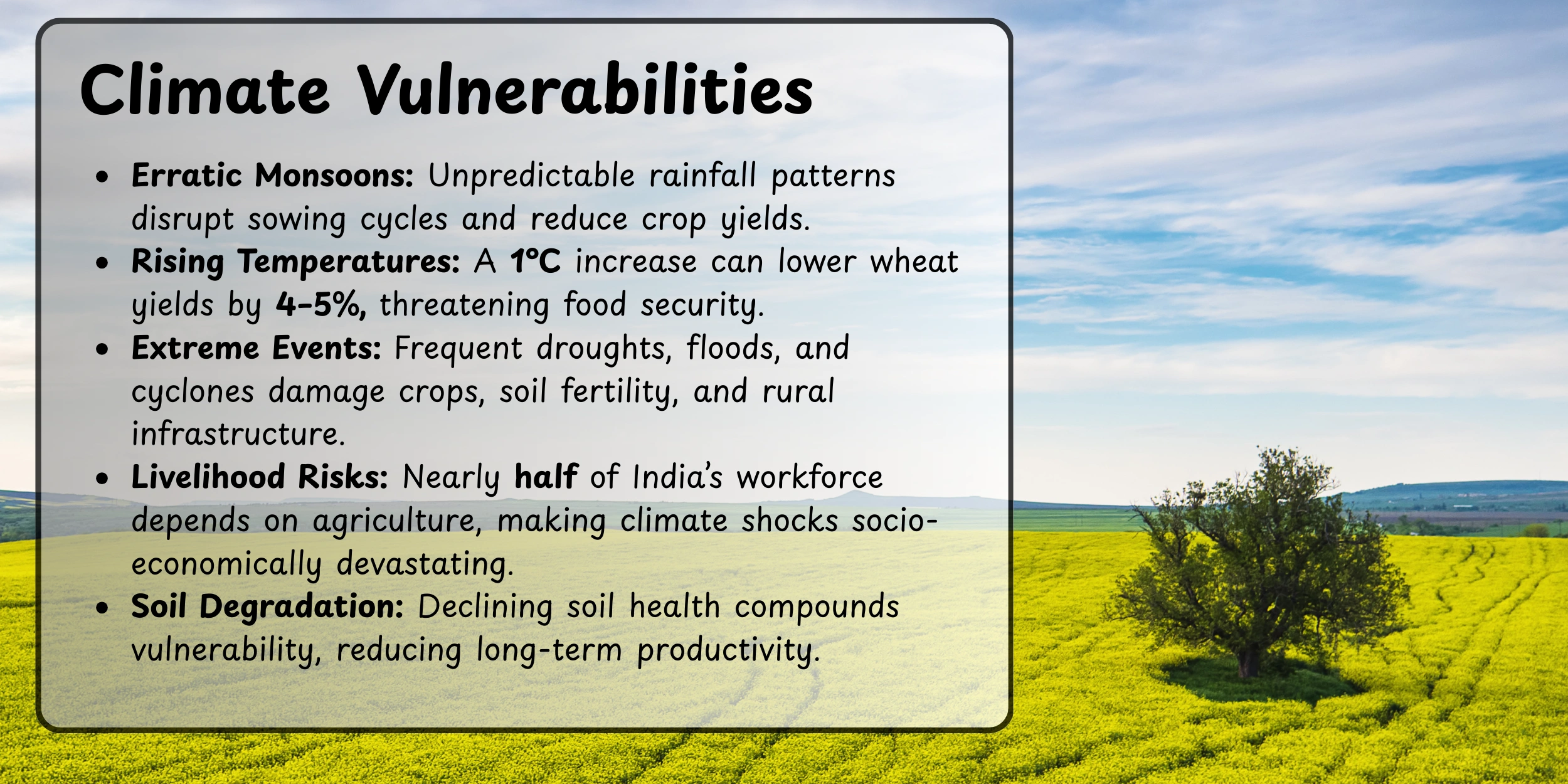
The agricultural industry, which is mainly characterised by a high reliance on the monsoon and native natural resources, is getting faced with the mounting dangers that can be attributed to climate change. Unpredictable weather patterns, high temperatures and increasing occurrence of extreme weather situations are slowly threatening food security and livelihoods of the rural population. Indian agriculture faces severe climate vulnerabilities, including erratic monsoons, extreme heatwaves, droughts, and floods, leading to lower yields for staples like rice and wheat, increased pest/disease outbreaks, water scarcity, soil degradation (erosion, nutrient loss), and nutritional decline in crops, threatening food security and farmers' livelihoods, especially for rainfed smallholders with limited adaptive capacity.
Irregular monsoon
There has been a significant level of unpredictability in the Indian monsoon that supports about 60% of the cultivated land mass. Empirical analysis indicates that the distribution of precipitation possesses a significant anomaly, making crop yields unstable and deficient. The analyses on a district-level show that the variability in rainfall has a direct negative impact on the productivity of staple cereals like rice and wheat, which negatively affects the incomes of farmers and the food supply of the nation.
Overheating and Thermo-genic Stress
These vulnerabilities are aggravated by high temperatures. According to quantitative measures, wheat yields can be reduced by 4-5 percent in northern India, with just a 1˚C rise in average temperature. Heat stress simultaneously hastens soil moisture loss, enhances evapotranspiration, and reduces crop duration, which reduces overall productivity. The Department of Science and Technology estimates that by the year 2050, there could be yield losses of between 10 and 40 percent of the major cereals in the absence of any adaptive interventions due to climatic conditions.
Amplified occurrence of Extreme Events
The floods, drought and cyclonic activity have had increased severity. The timeframe 2010- 2020 has seen notable droughts and floods that devastated several million hectares of agricultural land in India. These incidents not only cause direct destruction of standing crops, but also reduce the soil fertility and interfere with the irrigation facilities. It has been estimated that the economic cost of agricultural disasters caused by climate annually reaches into the billions of dollars, with a dispersion in the smallholder farms.
Socio Economic Implications
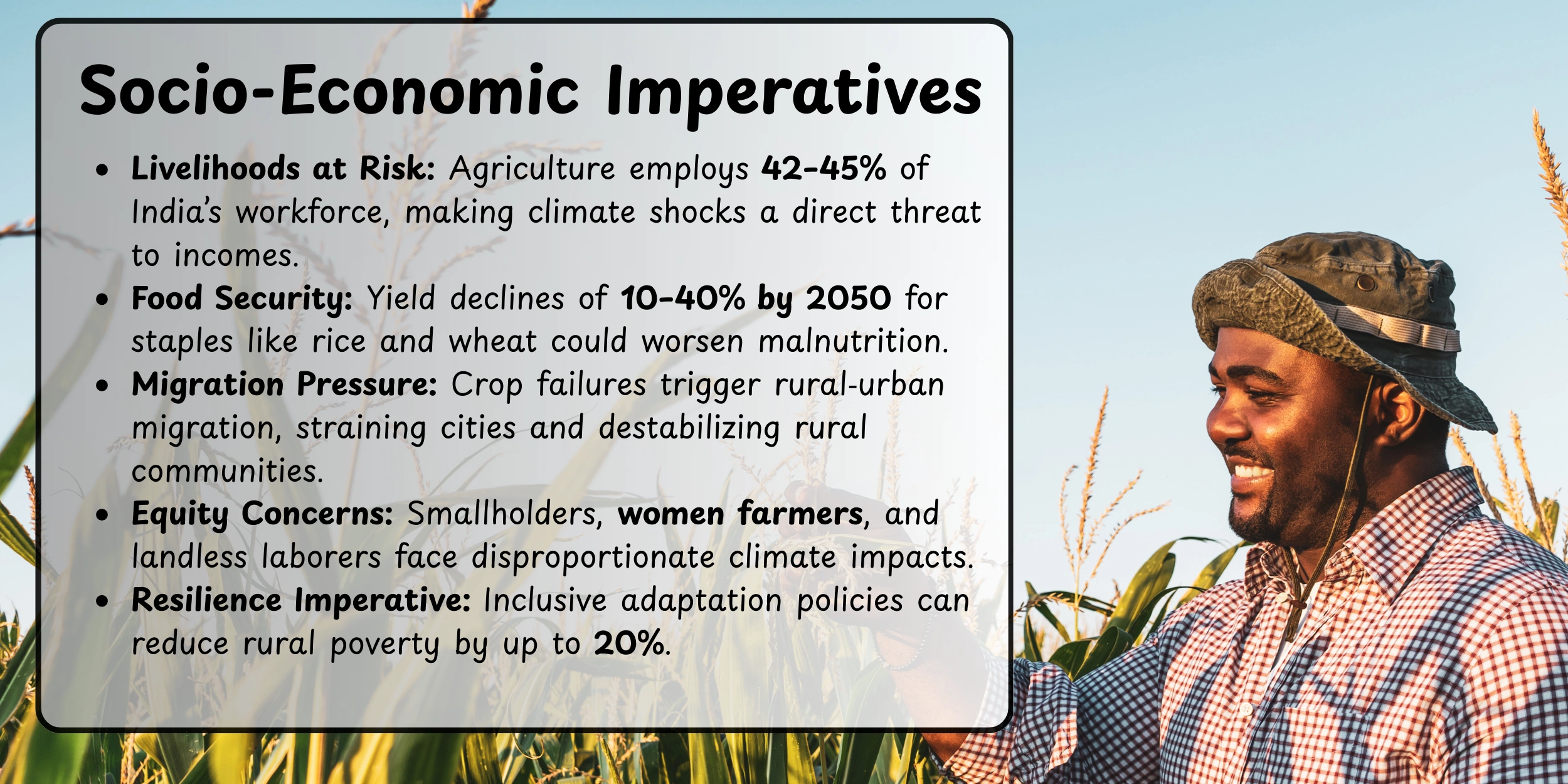
To a greater degree, agricultural activity serves as the foundation of the labour force in the country, which makes climate vulnerability an urgent challenge to well-being. The failures in crops trigger debt, rural migration and food insecurity. The largest share of the adverse shocks happens on the marginalised groups of people, such as smallholders, female farmers and rain-fed cultivators. Even in the absence of systematic resilience plans, the risks of climate change may produce more poverty in rural areas and exacerbate inequality.
Socio-Economic Requirements of Resilience
The agriculture sector in India is not only an economic activity, but it also serves as a lifeline to millions of citizens in India. Food security, rural labour, and social stability are undermined by disruptions caused by climate change, making resilience an issue of national concern. Socio-economic requirements for resilience involve a mix of financial stability, access to essential services, strong social networks, adaptive capacity (skills, education, diverse income), and robust governance to help individuals, communities, and systems withstand, adapt to, and recover from shocks like economic downturns or disasters, focusing on both immediate needs and long-term systemic strength. Key elements include basic needs (food, water, housing), assets (productive/durable), services (health, energy), safety nets (aid, remittances), and social capital (trust, networks).
Agriculture as a Backbone
In India, around 42-45 percent of the workforce is engaged in agriculture, and the industry provides about 18 percent of the national GDP. Climate shocks like droughts and floods cause a direct effect on household incomes and lead to chronic debt and poverty among vulnerable farmers. Therefore, resilience is essential in preventing the loss of livelihoods and the prevalence of rural misery.
Food Security and Food Stabilisation
The climate-sensitive crops like wheat and rice are very significant insofar as the food security of India is concerned. In extreme climatic conditions, simulation models project that yield reductions will go to 10-40% by 2050, and this will not only reduce the calories but also worsen malnutrition, especially among children and marginalised populations. Diversified systems of cropping and efficient irrigation are thus important to ensure nutritional stability.
Migration
Climate change is often triggered by agricultural failures that lead to distress rural-urban migration. The studies show that migration is higher in areas that have frequent droughts, and this leads to congested cities, which increases the pressure put on infrastructure. Resilience can thus be enhanced in the agriculture sector, which will decrease forced migration, stabilise the rural communities and alleviate the problems of the urban setting.
Equity and Inclusion of Adaptation
Women farmers, landless labourers and smallholders are the ones who are disproportionately affected by climate shocks. Climate change would contribute to the worsening of inequality in the absence of specific resilience actions. Policies such as the ease of access to credit, crop insurance, and extension services generally form part of inclusive policies as they are critical in ensuring that marginalised populations benefit in terms of adaptation benefits. It should have a consistent national roadmap that emphasises equity to prevent the increasing socio-economic rifts.
Technological and Ecological Vehicles
The synthesis of technological innovation and ecological sustainability is the key to the future trend of Indian agriculture. Sustainable approaches to climate-resilient paths should incorporate modern developments in science, pre-modern agronomy, and resource-efficient systems that would maintain sustainability in their productivity and the environmental quality. Technological and ecological vehicles are green transportation innovations, primarily electric (BEVs, PHEVs), hybrids (HEVs), and hydrogen fuel-cell (FCEVs), that reduce emissions using advanced tech like regenerative braking, alternative fuels (biodiesel, ethanol, CNG), and smart systems, aiming for zero tailpipe pollution, better efficiency, and sustainability through electric powertrains and eco-friendly materials.
Smart Development
Advancements made in biotechnology and breeding of plants have helped in the production of crops that are drought-tolerant, flood-tolerant, and heat-tolerant. For example, Indian Council of Agricultural Research (ICAR), has released over 1,500 climate-resilient crops since 2010, such as rice and wheat strains, adapted to unpredictable rainfall patterns. These innovations reduce vulnerability and ensure fair returns even in the changing regimes of climate change.
Water-Efficient Irrigation
Water scarcity is one of the most significant issues, which is due to the fact that about 85 percent of the freshwater in India is used in agriculture. Drip irrigation, sprinklers, and sensor-precision irrigation are technological interventions that significantly reduce water usage and improve crop productivity. It has been empirically shown that drip irrigation is able to save 30-50 percent of water as compared to traditional flood irrigation, and at the same time, it is able to increase yields by 20-30 percent.
Soil Health
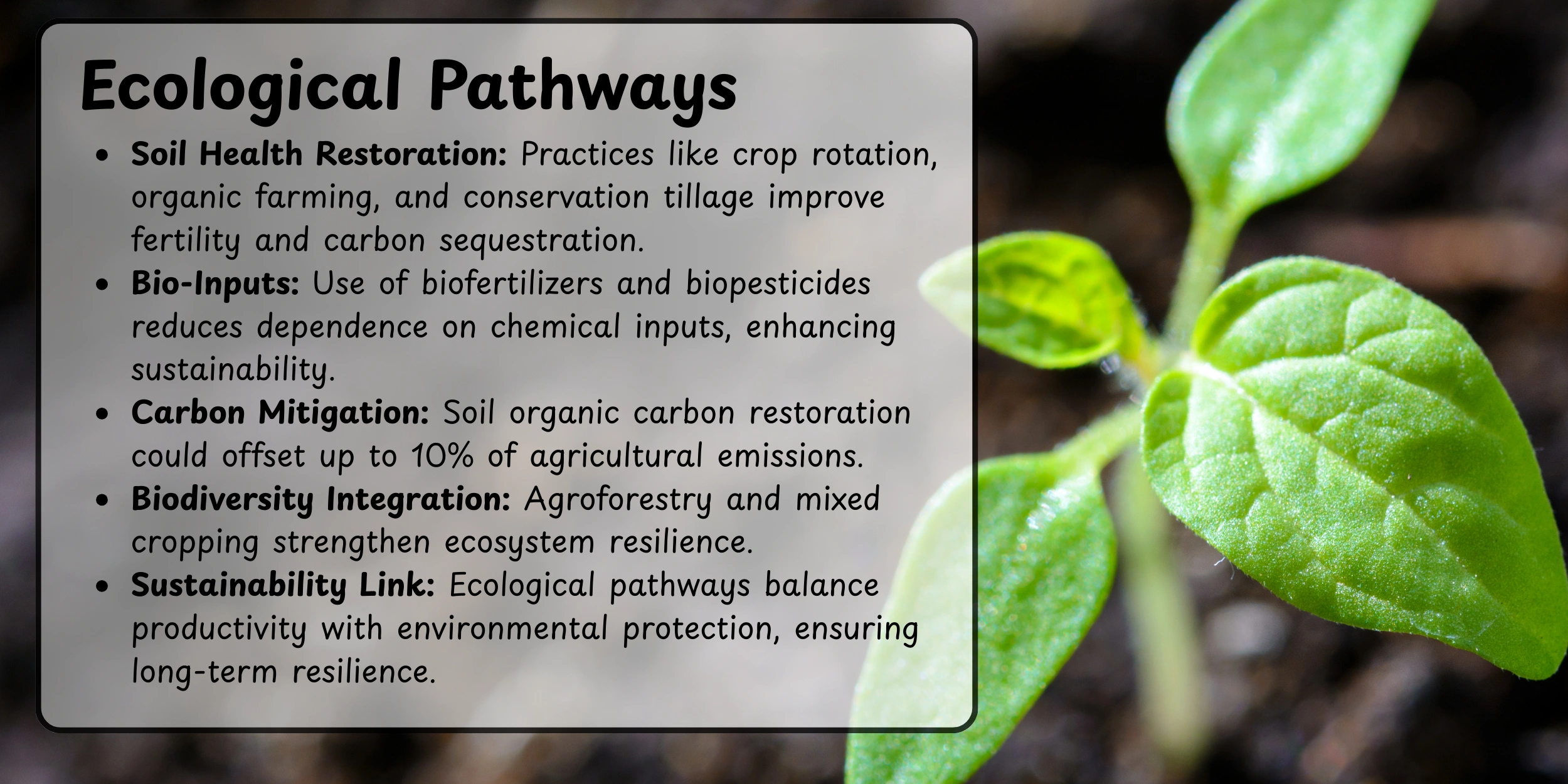
Much emphasis is placed on the restoration of soil productivity and biodiversity because of ecological pathways. In the adoption of practices, including organic farming, crop rotation, and conservation tillage, it is possible to observe the increase in the process of carbon sequestration of soil, as well as the decrease in dependence on synthetic materials. FAO estimated that restoring soil organic carbon could counter up to 10 percent of agricultural greenhouse emissions in India since the technique is crucial as a resiliency element.
Digital Technologies
The concept of digital agriculture, which is inclusive of satellite-based weather prediction, mobile guidance platforms, and AI-based crop tracking, provides farmers with up-to-date information. For example, the Kisan Suvidha application of the Ministry of Agriculture broadcasts localized weather forecasts and market price information, and thus, enables informed agronomic decision-making. Studies reveal that 15-20 percent of crop lossesmay be mitigated by the availability of digital advisories, especially in the rain-fed zones of agricultural land.
Need of Coherent National Roadmap
The agricultural industry in India is facing the growing threat of climatic hazards, but the available adaptation strategies are in bits. An integrated national roadmap is a necessity that would ensure the coordination of policies, technologies, and institutional processes that were needed in agriculture to be climate-resilient. A coherent national roadmap is a unified and well-planned strategy that aligns policies, efforts, and resources across various government ministries, states, and stakeholders to achieve a shared vision or goal. The need for such a roadmap has been highlighted in discussions relating to several key areas in India, including climate-resilient agriculture, energy transition, and national security.
Divided Policies and Institutional Gaps
The existing initiatives, including the National Mission on Sustainable Agriculture (NMSA) and the state-level climate action plans, are silo-based. Without integration, duplicate efforts and inconsiderate implementation still exist. A study undertaken by the Council on Energy, Environment and Water (CEEW) reveals that over 60 percent of climate-adaptation programmes are not coordinated across ministries; hence, those aimed at addressing the needs of climate change are not effective. A national roadmap would be needed to harmonise these policies and make them consistent and scalable.
Research, Technology and Farmer Outreach
India has banked on climate-resistant varieties of crops, water-saving irrigation systems and digital advisory systems. However, it is up-taking whereby the extension services and awareness are insufficient. As per ICAR, merely 30-35 percent of farmers currently use these technologies. A coherent roadmap would help in bridging the gap between the research institutions, individual innovators and the grassroots extension networks and hence equitable innovations diffusion to the smallholders.
Political Adaptation and Equity
The agro-climatic regions in India vary and hence require localised strategies. Rain-fed regions, which make up to 55 percent of the cultivated land, are especially vulnerable. A national roadmap would focus on region-related interventions, but would ensure equity for the marginalised population, such as the smallholders and women farmers. Research by the International Food Policy Research Institute (IFPRI) shows that, via inclusive adaptation plans, poverty in rural areas can be alleviated by as much as 20 percent in vulnerable regions.
Connecting Agriculture and National Climate Goals
India has made commitments on cuts in the intensity of GDP emissions: The country vows to cut GHG emissions by a percentage of 45 by 2030 via its Nationally Determined Contributions (NDCs). These targets have to be in line with agriculture, which contributes almost 18 percent of the national greenhouse-gas emissions. An integrated roadmap would consider turning around resilience and mitigation to support these practices and improving soil-carbon restoration, renewable energy in irrigation, and livestock management.
Conclusion
The agricultural sector in India is at a crossroads, and climate change has shifted the concept of resiliency from a discretionary factor back to a necessity factor. The fluctuating monsoon regimes, the rise in ambient temperature and the rising rate of climate change are all acting out as exposed risks to livelihoods and food security as well as national stability. Social economic needs, technology, and ecological repair are converging to emphasize the necessity of social action. However, the aggregation of the current policies limits the adaptive capacity. It is necessary to have a unified national roadmap that will integrate research, equity, and sustainability pledges to cushion farmers, maintain nutritional security, and ensure that agricultural operations are in tandem with India's climate responsibilities. How resilience developed today will determine the future direction of the Indian agrarian economy and its mastery of responding to global environmental issues.
Frequently asked questionsFrequently asked questions
Climate Vulnerabilities in Indian Agriculture?
The agricultural industry, which is mainly characterised by a high reliance on the monsoon and native natural resources, is getting faced with the mounting dangers that can be attributed to climate change. Unpredictable weather patterns, high temperatures and increasing occurrence of extreme weather situations are slowly threatening food security and livelihoods of the rural population. Indian agriculture faces severe climate vulnerabilities, including erratic monsoons, extreme heatwaves, droughts, and floods, leading to lower yields for staples like rice and wheat, increased pest/disease outbreaks, water scarcity, soil degradation (erosion, nutrient loss), and nutritional decline in crops, threatening food security and farmers' livelihoods, especially for rainfed smallholders with limited adaptive capacity.
Socio-Economic Requirements of Resilience?
The agriculture sector in India is not only an economic activity, but it also serves as a lifeline to millions of citizens in India. Food security, rural labour, and social stability are undermined by disruptions caused by climate change, making resilience an issue of national concern. Socio-economic requirements for resilience involve a mix of financial stability, access to essential services, strong social networks, adaptive capacity (skills, education, diverse income), and robust governance to help individuals, communities, and systems withstand, adapt to, and recover from shocks like economic downturns or disasters, focusing on both immediate needs and long-term systemic strength. Key elements include basic needs (food, water, housing), assets (productive/durable), services (health, energy), safety nets (aid, remittances), and social capital (trust, networks).
Technological and Ecological Vehicles?
The synthesis of technological innovation and ecological sustainability is the key to the future trend of Indian agriculture. Sustainable approaches to climate-resilient paths should incorporate modern developments in science, pre-modern agronomy, and resource-efficient systems that would maintain sustainability in their productivity and the environmental quality. Technological and ecological vehicles are green transportation innovations, primarily electric (BEVs, PHEVs), hybrids (HEVs), and hydrogen fuel-cell (FCEVs), that reduce emissions using advanced tech like regenerative braking, alternative fuels (biodiesel, ethanol, CNG), and smart systems, aiming for zero tailpipe pollution, better efficiency, and sustainability through electric powertrains and eco-friendly materials.
Need of Coherent National Roadmap?
The agricultural industry in India is facing the growing threat of climatic hazards, but the available adaptation strategies are in bits. An integrated national roadmap is a necessity that would ensure the coordination of policies, technologies, and institutional processes that were needed in agriculture to be climate-resilient. A coherent national roadmap is a unified and well-planned strategy that aligns policies, efforts, and resources across various government ministries, states, and stakeholders to achieve a shared vision or goal. The need for such a roadmap has been highlighted in discussions relating to several key areas in India, including climate-resilient agriculture, energy transition, and national security.