Theme: Welfare for All, Happiness of All
Date: 16–20 February 2026
Venue: Bharat Mandapam, New Delhi
INTRODUCTION
- India hosted the India–AI Impact Summit 2026 in New Delhi.
- It is the first global AI summit hosted in the Global South.
More than:
- 20 Heads of State
- 60 Ministers
- 500 Global AI leaders
- 300+ exhibitors from 30 countries
The Summit shows India’s strong focus on
responsible, inclusive and development-oriented AI.
It is aligned with:
- Viksit Bharat@2047 vision
- Digital India
- IndiaAI Mission
The Prime Minister inaugurated the AI Impact Expo and addressed the Summit.
BASIC OVERVIEW
| Aspect |
Details |
| Event |
India AI Impact Summit 2026 |
| Duration |
6 days |
| Venue |
Bharat Mandapam, New Delhi |
| Theme |
Human-centric AI for welfare and happiness |
| Edition |
4th Global AI Summit (Earlier: UK 2023, South Korea 2024, France 2025) |
WHY AI IS IMPORTANT FOR INDIA?
- AI is not just technology.
- It is a tool for development.
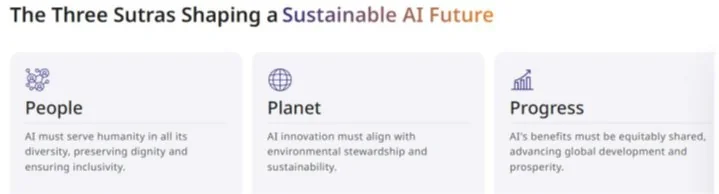
- The Summit is based on 3 Sutras (Foundational Pillars):
1. People
- AI must improve lives of citizens.
2. Planet
- AI must support environment and sustainability.
3. Progress
- AI must strengthen economy and governance.
SECTOR WISE ROLE OF AI IN INDIA
AI in Healthcare
AI helps especially in rural areas.
- Remote diagnosis through AI tools
- TB and cancer detection using image analysis
- AI chatbots for telemedicine
- Disease outbreak prediction
- AI-based drug discovery
- Affordable and personalized treatment
Result: Better access, faster diagnosis, lower cost.
AI IN AGRICULTURE & RURAL ECONOMY
AI supports farmers.
- Weather prediction
- Pest control alerts
- Crop monitoring through drones
- Satellite-based harvest forecasting
- Market price prediction
- Regional language advisory (like Kisan tools)
Result: Higher income and reduced risk.
AI IN EDUCATION
- AI makes learning easy and personal.
- Adaptive learning systems
- AI tutors for 24/7 support
- Language translation into regional languages
- Personalized feedback
- Platforms like DIKSHA are using AI.
Result: Inclusive and equal learning.
AI IN FINANCE
AI improves financial security.
- Fraud detection
- AI credit scoring for loans
- Banking chatbots
- Personalized financial advice
Result: Financial inclusion and safety.
AI IN GOVERNANCE
AI improves public services.
- Translation of court judgments
- Faster scheme approvals
- Smart traffic management
- Better case management in courts
Result: Transparent and efficient governance
THREE SUTRAS
7 CHAKRAS (AREAS OF COOPERATION)
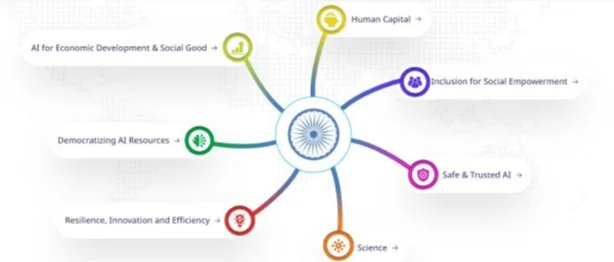 1. Human Capital
- AI skilling
- Workforce readiness
2. Inclusion for Social Empowerment
- Last-mile delivery
- Citizen-centric AI
3. Safe and Trusted AI
- Ethical AI
- Governance framework
- Public trust
4. Resilience, Innovation & Efficiency
- Sustainable AI
- Environmental responsibility
5. Science
- AI for research
- Equal access to data and compute
6. Democratizing AI Resources
- Affordable AI tools
- Startup access
- Research access
7. AI for Economic Growth & Social Good
- High-impact AI solutions
- Inclusive growth
Together, these create a structured global AI roadmap.
MAJOR EVENTS
1. AI Impact Expo
- Organized by MeitY
- Spread over 70,000 sq metres
- 300+ exhibitors
- 7 thematic pavilions
Focus: From AI research to large-scale deployment.
2. Regional AI Conferences
Held in 8 states: Meghalaya, Gujarat, Odisha, MP, UP, Rajasthan, Kerala, Telangana.
Purpose:
- Identify state-level AI needs
- Policy inputs
- Capacity gaps
3. AI Compendium
Released on 17 February 2026.
Contains real case studies of AI in:
- Health
- Education
- Agriculture
- Energy
- Gender empowerment
It acts as a knowledge document.
GLOBAL CHALLENGES
These challenges move from discussion to action.
1. AI for ALL
- Large-scale AI solutions
- Partnership with Startup India & Bhashini
- Prize up to ₹2.5 crore
2. AI by HER
- Women-led AI innovation
- In partnership with NITI Aayog
- Prize up to ₹2.5 crore Promotes gender inclusion.
3. YUVAi Challenge
- Youth (13–21 years)
- Partnership with MyBharat & NIELIT
- Prize up to ₹85 lakh
Encourages young innovators. Over 4,650 applications from 60+ countries.
KEY INSTITUTIONAL FRAMEWORKS
1. MeitY
- Policy direction
- Coordination
- Regulatory framework
2. IndiaAI Mission
- AI infrastructure
- Indigenous AI models
- Skilling programs
3. STPI
- Startup incubation
- Technical support
- Industry linkage
4. Digital India
- Digital public infrastructure
- Large-scale AI adoption
INDIA JOINS PAX SILICA
| Aspect |
Details |
| Event |
India joined Pax Silica at India–AI Impact Summit 2026 |
| Date |
20 February 2026 |
| Location |
Bharat Mandapam, New Delhi |
| Main Objective |
Strengthen India–US strategic technology cooperation |
| What is Pax Silica? |
Coalition of trusted democratic nations to secure the global “Silicon Stack” |
| Silicon Stack Includes |
Critical minerals, semiconductor fabs, chip design, AI systems, data centres |
| Core Aim |
Reduce supply chain overdependence and prevent economic coercion |
| Strategic Principle |
Economic security = National security |
The initiative covers the entire technology value chain:
- Mining of critical minerals
- Semiconductor fabrication
- Chip packaging and testing
- AI model development
- Data centre deployment
It ensures:
- Diversified supply chains
- Reduced geopolitical risk
- Stronger global partnerships
This reduces risk of overconcentration in one region.
M.A.N.A.V.
- Background
- At the India–AI Impact Summit 2026, Prime Minister Narendra Modi presented a clear and value-based vision for artificial intelligence.
- He said AI should not be seen only as data, machines, and algorithms. It must reflect human values, ethics, and dignity.
- India, being home to one-sixth of the world’s population and the largest youth population, has both opportunity and responsibility in shaping global AI discussions.
- To guide this approach, the Prime Minister introduced the framework called A.N.A.V.
MEANING OF MANAV
M.A.N.A.V. stands for:
- M – Moral and Ethical Systems
- A – Accountable Governance
- N – National Sovereignty
- A – Accessible and Inclusive AI
- V – Valid and Legitimate Systems
It is a roadmap for responsible AI development.
PILLAR 1: MORAL & ETHICAL SYSTEMS
- AI must be fair, transparent, and unbiased.
- Human oversight is necessary.
- Ethical AI design is non-negotiable.
- National Education Policy 2020 promotes AI literacy and computational thinking.
- India secured Guinness World Record with 2,50,946 pledges for responsible AI in 24 hours.
- Ethics must move from policy to public commitment.
PILLAR 2: ACCOUNTABLE GOVERNANCE
- Trust in AI depends on clear rules and oversight.
- IndiaAI Mission approved with ₹10,300+ crore outlay.
- Focus on compute infrastructure, datasets, skilling, and innovation.
- AI Governance Guidelines promote fairness, accountability, and transparency.
- AI systems must be explainable and aligned with democratic values.
PILLAR 3: NATIONAL SOVEREIGNTY
- Sovereignty includes control over data, algorithms, and digital infrastructure.
- India Semiconductor Mission strengthens domestic chip manufacturing.
- Focus on trusted data governance frameworks.
- Investment in domestic compute capacity and secure digital infrastructure.
- Aim: Strategic autonomy without digital isolation.
PILLAR 4: ACCESSIBLE & INCLUSIVE AI
- AI should benefit all sections of society.
- Digital Public Infrastructure enables large-scale AI deployment.
- MeghRaj GI Cloud supports cloud services.
- IndiaAI Compute Portal provides access to GPUs and TPUs.
- IndiaAI Kosh offers datasets and AI models.
- National Supercomputing Mission strengthens computing capacity.
- Goal: Reduce entry barriers for startups, researchers, and institutions.
PILLAR 5: VALID & LEGITIMATE SYSTEMS
- AI systems must be safe, lawful, and trustworthy.
- IT (Intermediary Guidelines and Digital Media Ethics Code) Amendment Rules, 2026 regulate synthetic content and deepfakes.
- Safe and Trusted AI pillar focuses on:
- Bias mitigation
- Privacy protection
- Algorithm auditing
- Risk assessment
Test your understanding
Questions from this article
Prelims practiceWith reference to INDIA AI IMPACT SUMMIT, consider the following statements:
- India hosted the India–AI Impact Summit 2026 in New Delhi.
- It is the first global AI summit hosted in the Global South.
- 300+ exhibitors from 30 countries
Which of the statements given above are correct?
- 1 and 2 only
- 2 and 3 only
- 1 and 3 only
- 1, 2 and 3
View answer
Answer: (d) 1, 2 and 3. All three statements are drawn from the article.
Mains practiceDiscuss the background, key issues and significance of INDIA AI IMPACT SUMMIT for India.
Answer in 250 words.
View answer approach
- INTRODUCTION
- BASIC OVERVIEW
- WHY AI IS IMPORTANT FOR INDIA?
- SECTOR WISE ROLE OF AI IN INDIA
- AI IN EDUCATION
Frequently asked questionsFrequently asked questions
Why is India Ai Impact Summit in the news?
Theme: Welfare for All, Happiness of All Date: 16–20 February 2026 Venue: Bharat Mandapam, New Delhi INTRODUCTION India hosted the India–AI Impact Summit 2026 in New Delhi. It is the first global AI summit hosted in the Global South.
What are the key facts about India Ai Impact Summit?
More than: 20 Heads of State 60 Ministers 500 Global AI leaders 300+ exhibitors from 30 countries The Summit shows India’s strong focus on responsible, inclusive and development-oriented AI. It is aligned with: Viksit Bharat@2047 vision Digital India IndiaAI Mission The Prime Minister inaugurated the AI Impact Expo and addressed the Summit. BASIC OVERVIEW Aspect Details Event India AI Impact Summit 2026 Duration 6 days Venue Bharat Mandapam, New Delhi Theme Human-centric AI for welfare and happiness Edition 4th Global AI Summit (Earlier: UK 2023, South Korea 2024, France 2025) WHY AI IS IMPORTANT…
Why is India Ai Impact Summit important for UPSC preparation?
The topic connects current developments with Economy, Polity & Governance, Health and is relevant for both objective revision and analytical answer writing.