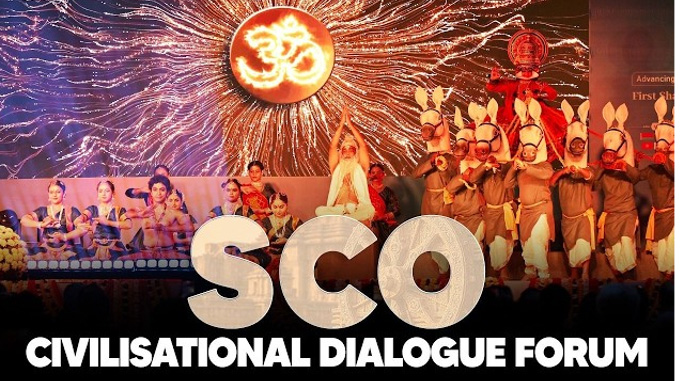
The First Shanghai Cooperation Organisation (SCO) Civilisational Dialogue Forum was inaugurated by Prime Minister Narendra Modi at Purana Qila, New Delhi. The forum aims to strengthen cultural connections, preserve shared heritage and promote mutual understanding among SCO member states. It highlights the role of civilisational dialogue in promoting global peace and cooperation.
Why in the News?
On 20 November 2026, Prime Minister of India Narendra Modi inaugurated the First SCO Civilisational Dialogue Forum at Purana Qila, New Delhi. The forum brought together SCO ministers, ambassadors, high commissioners, scholars, artists and other dignitaries from SCO member states.
- The event highlighted the importance of cultural and civilisational connections at a time when global discussions are dominated by wars and unrest.
- The Prime Minister emphasised that cultural connections can act as a strong foundation for world peace.
- The initiative also builds upon the 25th anniversary of the Shanghai Cooperation Organisation (SCO) and its growing cooperation in security, economy and connectivity.
Historical Significance of Civilisational Connections
The Prime Minister highlighted how trade, travel, religion, knowledge and cultural exchanges have connected different civilisations for thousands of years.
- Indus Valley Civilization and Mesopotamia: Trade links existed between the Indus Valley Civilization and other ancient civilisations around 5,000 years ago, facilitating the exchange of goods, ideas, cultural practices and technological knowledge through well-established trade networks..
- Silk Routes: Trade networks connected India, China, Central Asia and Eurasia, facilitating the movement of merchants, scholars, travellers and religious ideas.
- Buddhist Connections: Buddhist monks and scholars such as Faxian, Xuanzang, Yijing and Kumarajiva helped spread Buddhist philosophy and knowledge across regions.
- Educational Centres: Institutions such as Nalanda and cultural centres such as Kucha and Dunhuang played an important role in knowledge and cultural exchanges.
The Prime Minister highlighted that while empires changed geographical boundaries, civilisational dialogues transformed and enriched global ideas.
Examples of Cross-Cultural Knowledge Exchange
The Prime Minister Narendra Modi highlighted several examples showing how knowledge, literature, science, and cultural traditions travelled across regions.
1. Literature and Religious Traditions
- Panchatantra: An Indian literary work that travelled to Persian and Arabic as Kalila wa Dimna.
- Ramayana: It influenced the culture, literature, and performing arts of Southeast Asian countries.
- In Cambodia, it is known as Reamker.
2. Science and Mathematics
- Mathematical ideas of Indian scholar Brahmagupta reached Baghdad.
- Scholars such as Al-Khwarizmi contributed to the further development and spread of mathematical knowledge.
3. Architecture and Music
- Music: Central Asian Maqam traditions share cultural connections with Indian Raga traditions.
- Sufi Influence: Sufi traditions enriched Qawwali in India.
- Architecture: Central Asian garden traditions from Samarkand and Herat influenced the development of the Charbagh style.
These examples demonstrate how cultural exchanges have enriched societies across geographical boundaries.
Role of Technology in Cultural Connectivity
The Prime Minister highlighted the role of modern technology in strengthening cultural relations among SCO countries.
- Faster Connectivity: People living in countries that were once separated by months of travel can now connect within seconds.
- Digital Platforms: They have made knowledge sharing, cultural exchange and international collaboration easier.
- Artificial Intelligence (AI): AI can accelerate the translation of ancient literary and intellectual works into different languages.
- Digital Preservation: Technology can help preserve ancient manuscripts, rare texts, historical documents and artefacts stored in museums, libraries and archives.
Suggestions for SCO Countries
The Prime Minister proposed several areas of cooperation:
- Digitisation of Ancient Texts: Joint efforts to digitise and translate ancient manuscripts and historical documents.
- Joint Research: Undertake research projects to discover new dimensions of shared history.
- Museum Cooperation: Organise joint exhibitions through museums and cultural institutions.
- Academic Exchanges: Promote exchanges of scholars and researchers between universities.
- Heritage Circuits: Develop cultural routes connecting Silk Route and Buddhist heritage sites.
- Cultural Tourism: Promote tourism based on shared historical and cultural heritage.
- Cultural Festivals: Organise joint cultural festivals and encourage artist exchanges.
Role of Youth in Preserving Shared Heritage
The Prime Minister emphasised that younger generations have an important role in taking civilisational dialogue forward.
- Youth Participation: Young people should get greater opportunities to understand different languages, literature and cultural traditions.
- Digital Platforms: Young artists, writers and filmmakers can use digital media to communicate shared cultural heritage.
- Local Artists and Artisans: Their participation should be encouraged to preserve traditional knowledge and cultural practices.
- Cultural Understanding: Greater interaction among young people can strengthen mutual understanding and trust between SCO countries.
India's Cultural Philosophy: Vasudhaiva Kutumbakam
The Prime Minister highlighted India's traditional philosophy of ‘Vasudhaiva Kutumbakam’, which means the entire world is one family.
- It reflects the idea that individual and national welfare are closely connected with global welfare.
- It promotes mutual harmony, goodwill and cooperation among nations.
- India considers mutual goodwill as the foundation of global well-being.
- The Prime Minister also highlighted India's ability to embrace different languages, lifestyles and traditions.
- Unity in Diversity: Diversity can become a foundation of unity when different cultures are respected and celebrated.
Important Vedic Message
The Prime Minister concluded his address by invoking the Vedic message:
‘Sangachchhadhwam Samvadadhwam Sam Vo Manansi Janatam’
Meaning: Walk together, converse together and achieve harmony of thoughts.
The message highlights the importance of collective action, dialogue and mutual understanding.
Conclusion
The First SCO Civilisational Dialogue Forum highlights the importance of cultural diplomacy in strengthening international relations. By promoting heritage preservation, digital connectivity, academic exchanges and youth participation, the initiative seeks to strengthen mutual trust and understanding among SCO countries. It also reflects India's philosophy of Vasudhaiva Kutumbakam, which considers the entire world one family.
Test your understanding
Questions from this article
Prelims practiceQuestion: With reference to the First SCO Civilisational Dialogue Forum (2026), consider the following statements:
- It was proposed by India at the SCO Summit held in Tianjin in 2025.
- Its first edition was held at Purana Qila, New Delhi.
- The forum aims to promote cultural cooperation and people-to-people ties among SCO countries.
- The forum is an initiative of UNESCO.
Which of the statements given above are correct?
- 1 and 2 only
- 1, 2 and 3 only
- 2, 3 and 4 only
- 1, 2, 3 and 4
View answer and explanation
Suggested answer: (b) 1, 2 and 3 only
Explanation:
●
Statement 1: Correct – Proposed by
India at the 2025 Tianjin SCO Summit.
●
Statement 2: Correct – Held from
20–22 November 2026 at Purana Qila, New Delhi.
●
Statement 3: Correct – It promotes
shared heritage, cultural exchange and people-to-people ties.
●
Statement 4: Incorrect – It is an
initiative under the SCO framework, not UNESCO.
Mains practiceQuestion: Examine the significance of the SCO Civilisational Dialogue Forum for India and the challenges in translating cultural engagement into meaningful regional cooperation. (15 Marks, 250 Words)
View answer-writing approach
Answer approach:
- Introduction: First SCO Civilisational Dialogue Forum, held at Purana Qila, New Delhi
- Significance for India: Cultural diplomacy, soft power, shared heritage, people-to-people ties and strategic engagement with Central Asia.
- Challenges: Geopolitical tensions, historical differences, terrorism, mistrust and limited institutional implementation.
- Way forward: Academic exchanges, digital archives, AI-based translation, joint heritage projects and youth engagement.
Frequently asked questionsFrequently asked questions
What is First SCO Civilisational Dialogue Forum: Significance and Objectives?
The First Shanghai Cooperation Organisation (SCO) Civilisational Dialogue Forum aims to strengthen cultural understanding, mutual respect and cooperation among SCO member states. The initiative highlights shared civilisational heritage, historical connections, cultural exchanges and people-to-people relationships. It seeks to promote intercultural dialogue, regional harmony and stronger diplomatic ties across the.
Why is First SCO Civilisational Dialogue Forum: Significance and Objectives relevant for UPSC preparation?
The forum aims to strengthen cultural connections, preserve shared heritage and promote mutual understanding among SCO member states
What key points should aspirants remember about First SCO Civilisational Dialogue Forum: Significance and Objectives?
The article covers Why in the News?, Historical Significance of Civilisational Connections, Examples of Cross-Cultural Knowledge Exchange and 1. Literature and Religious Traditions.