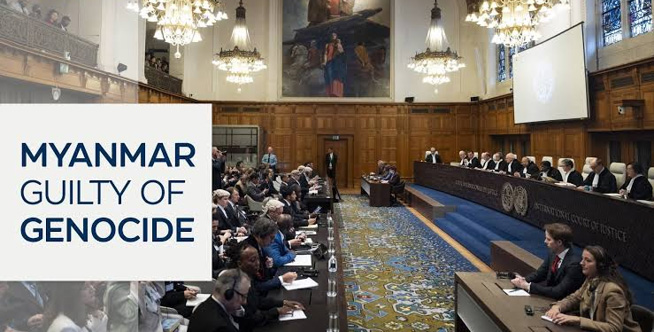
The International Court of Justice (ICJ) held Myanmar responsible for committing genocide against the Rohingya Muslim minority during the military's 2017 clearance operations in Northern Rakhine State. The judgment recognised the mass killings, sexual violence and other acts committed against the community. It is significant because this is the first time the ICJ has held a state responsible for committing genocide.
Why in the News?
On November 19, 2026, the ICJ delivered its judgment in the genocide case against Myanmar. The case was filed by The Gambia in 2019 under the 1948 Genocide Convention.
- The judgment was delivered by a vote of 9–6.
- The court held Myanmar responsible for genocide against the Rohingya community during the 2017 military operations.
- The judgment is final and cannot be appealed.
1. Key Findings of the ICJ
The court found that Myanmar's military and security forces committed several acts against the Rohingya population during the 2017 clearance operations.
Major findings included:
- Mass killings: Thousands of Rohingya civilians were killed.
- Mass executions: Men and boys were executed on a large scale.
- Sexual violence: Widespread rape and sexual violence were committed against Rohingya women.
- Violence against children: Children were subjected to extreme violence.
- Destruction of villages: Hundreds of Rohingya villages were burned or destroyed.
- Attacks on fleeing civilians: Security forces attacked Rohingya people attempting to escape.
The court also found that Myanmar's military spread hate speech against the Rohingya community through Facebook, which was the most popular social media platform in Myanmar at the time.
Other Violations by Myanmar
The ICJ also found that Myanmar:
- Failed to prevent genocide by individuals acting alongside its security forces.
- Failed to punish those responsible for the crimes.
- Did not enact the laws required under the Genocide Convention.
- Destroyed evidence in violation of the ICJ's 2020 interim order.
Charge of Direct and Public Incitement
- The court rejected the charge that Myanmar directly and publicly incited private individuals to commit genocide.
- This decision was passed by 14 votes to 1.
- The court also declined to order citizenship for the Rohingya community.
2. Legal Basis for the Genocide Ruling
The court examined the case under the 1948 Genocide Convention. Genocide requires proof of a specific intention to destroy, in whole or in part, a protected group.
The Convention protects four groups:
- National groups.
- Ethnic groups.
- Racial groups.
- Religious groups.
ICJ's Finding:
- The court concluded that the only reasonable explanation for Myanmar's actions was an intention to destroy a substantial part of the Rohingya population in Northern Rakhine State.
- This fulfilled the legal requirement for genocide.
- The court accepted the UN fact-finding mission's estimate of at least 10,000 deaths during the clearance operations.
3. Background of the Case
| Particulars | Details |
| Applicant country | The Gambia |
| Respondent country | Myanmar |
| Court | International Court of Justice |
| Case filed | 2019 |
| Legal framework | 1948 Genocide Convention |
| Affected community | Rohingya Muslims |
| Main location | Northern Rakhine State, Myanmar |
| Military operations | 2017 clearance operations |
| Voting on genocide ruling | 9–6 |
Background of the Case
The Gambia filed the case with the support of the Organisation of Islamic Cooperation (OIC).
- Myanmar denied the allegations and maintained that its security forces were responding to a violent insurgency.
- The 2017 military offensive forced at least 700,000 Rohingya to leave Myanmar.
4. Who are the Rohingya?
The Rohingya are a predominantly Muslim community living mainly in Myanmar's Rakhine State. They speak an Indo-Aryan language closely related to the Chittagonian dialect.
- The 2014 Census of Myanmar estimated that more than one million Rohingya lived in the country.
- They were mainly concentrated in:
- Maungdaw.
- Buthidaung.
- Rathedaung.
These areas are located along the Bangladesh border.
Historical Background of the Rohingya
| Period / Year | Historical Development |
| 15th–18th century | Muslims lived in the Rakhine region, also known as Arakan, during the Mrauk U Kingdom. |
| 1799 | British physician Francis Buchanan recorded that Muslims who had long settled in Arakan called themselves "Rooinga". |
| Colonial period | Many more Muslims migrated from Chittagong to the region during British colonial rule. |
| Late 1950s | The term "Rohingya" acquired political and ethnic meaning as Muslim leaders adopted it to claim the status of a national race. |
| 1961 | Brigadier Aung Gyi of the Burmese Army publicly accepted the Rohingya as an ethnic group. |
| 1962 | General Ne Win's military coup marked the beginning of decades of military junta rule in Myanmar. |
5. Directions Issued by the ICJ
The court placed several obligations on Myanmar.
| Direction | Details |
| Investigation | Investigate those responsible and prosecute them if warranted. |
| Non-repetition | Provide guarantees that similar violations will not happen again. |
| Safe return | Facilitate the safe, voluntary and dignified return of displaced Rohingya. |
| Family reunification | Facilitate the reunification of displaced families. |
| Compensation | Compensate the Rohingya for the damage caused. |
Timeline for Compensation:
The amount and form of compensation will be decided in a later phase of the proceedings.
- Myanmar must submit a report to the court within two years of the judgment.
- The court will decide the compensation after receiving the report.
Important: The judgment holds the state of Myanmar responsible. It does not convict any individual.
6. Impact on the Rohingya Community
Around 1.2 million Rohingya have been forced into exile in Bangladesh. Many live in the large refugee settlement in Cox's Bazar.
- More than 1,000 people gathered in the settlement to watch the court's verdict on television.
- Rohingya representatives described the judgment as a historic recognition of their suffering.
Statements by Rohingya Representatives:
- Wai Wai Nu, Executive Director of the Women's Peace Network and a former political prisoner, said that the ruling challenged decades of denial of Rohingya identity and suffering.
- Sayed Ullah, a community representative in Cox's Bazar, said that the judgment would strengthen efforts to return home.
7. International Reactions and Significance
- The Gambia: Called the judgment a historic day for international justice.
- United Kingdom: Announced the expulsion of Myanmar's defence attaché and indicated further action.
- British lawmakers: Urged the UK government to bring a resolution before the UN Security Council for enforcement action.
- Open Society Justice Initiative: Its Executive Director, James Goldston, highlighted the role of international institutions in establishing truth, assigning responsibility and protecting human rights.
Significance for Other Genocide Cases
- The judgment may influence other cases involving allegations of genocide.
- It may have implications for South Africa's 2023 case against Israel, which concerns allegations of genocide in Gaza.
- It is important for understanding how international courts establish state responsibility for genocide.
8. Previous International Court Recognitions of Genocide
International courts had previously recognised genocide in the following cases:
| Case / Event | Year / Period | Location |
| Rwandan genocide | 1994 | Rwanda |
| Srebrenica killings | 1995 | Bosnia |
| Khmer Rouge atrocities | Late 1970s | Cambodia |
- The Myanmar judgment is described as the fourth such recognition by an international court since the Nazi Holocaust.
- It is the first time the ICJ has held a state responsible for genocide.
9. Limitations of the ICJ Judgment
ICJ judgments are final and cannot be appealed. However, the court has limited powers to enforce its decisions.
- Ensuring Myanmar's compliance with directions on compensation, safe return and non-repetition remains a major challenge.
- The judgment alone does not guarantee that displaced Rohingya can return to their homes.
Conclusion
The ICJ judgment marks an important development in international law by holding Myanmar responsible for genocide against the Rohingya community. It obliges Myanmar to investigate those responsible, prevent future violations, provide compensation, and facilitate the safe return of displaced people. However, the limited enforcement powers of international courts remain a major challenge.
Test your understanding
Questions from this article
Prelims practiceQuestion: Consider the following statements regarding the International Court of Justice (ICJ):
- It is the principal judicial organ of the United Nations.
- Both states and individuals can directly approach the ICJ for dispute resolution.
- Its judgments in contentious cases are binding on the parties concerned.
- It is headquartered in Geneva, Switzerland.
Which of the statements given above are correct?
- 1 and 2 only
- 1 and 3 only
- 2, 3 and 4 only
- 1, 3 and 4 only
View answer and explanation
Suggested answer: (b) 1 and 3 only
Explanation:
- Statement 1 – Correct: ICJ is the principal judicial organ of the UN, established under the UN Charter.
- Statement 2 – Incorrect: Only states can be parties to contentious cases before the ICJ; individuals cannot directly file cases.
- Statement 3 – Correct: Judgments are binding on the parties to that particular case.
- Statement 4 – Incorrect: ICJ is headquartered at the Peace Palace, The Hague, Netherlands, not Geneva.
Mains practiceQuestion: “The Myanmar genocide case before the International Court of Justice highlights the limitations of international justice in preventing atrocities against vulnerable populations.” Discuss the significance of the ICJ proceedings against Myanmar and examine the challenges in enforcing international law. (250 words| 15 marks)
View answer-writing approach
Answer approach:
- Introduction: Refer to the Rohingya crisis
- Recent development: the ICJ found Myanmar responsible for genocide against the Rohingya
- Significance: Reinforces the Genocide Convention, state responsibility, protection of minorities and international justice.
- Challenges: Lack of direct enforcement powers, political constraints of the UNSC, military regime's resistance and continuing humanitarian crisis.
- Way forward: Targeted international pressure, humanitarian assistance, accountability, safe and voluntary repatriation, and multilateral cooperation.
Frequently asked questionsFrequently asked questions
What is ICJ Ruling on Myanmar's Genocide Against Rohingya Muslims?
The International Court of Justice (ICJ) is examining allegations of genocide against Rohingya Muslims in Myanmar following a case filed by The Gambia in 2019. The case highlights human rights violations, international accountability, and Myanmar's obligations under the 1948 Genocide Convention
Why is ICJ Ruling on Myanmar's Genocide Against Rohingya Muslims relevant for UPSC preparation?
The judgment recognised the mass killings, sexual violence and other acts committed against the community
What key points should aspirants remember about ICJ Ruling on Myanmar's Genocide Against Rohingya Muslims?
The article covers Why in the News?, 1. Key Findings of the ICJ, Other Violations by Myanmar and Charge of Direct and Public Incitement.