India's path to value chain security for strategic minerals involves robust international partnerships (US, Japan, Australia, Africa), leveraging its diaspora, PSUs (Public Sector Under takings), KABIL and the MSP, focusing on joint ventures for extraction, processing, recycling, and technology transfer to build self-reliance (Atma Nirbhar Bharat) for its clean energy and tech ambitions, moving beyond mere resource acquisition to full value chain integration. The minerals diplomacy of India has taken its rightful appearance in public discussion as a reaction to the anticipation of making critical minerals, processing and recycling a priority in the Union Budget 2026.
|
Key highlights
- India’s Strategic Mineral Partnership
- Global Minerals Landscape
- India’s Current Approach
- Country-by-Country Strategy of India
- Building Resilience in Supply Chain
- Challenges and Opportunities for India
|
This area of growth is associated with the strengthening of export controls in China, which highlights the urgency of India to diversify supply chains and invest in supply chain resilience in its energy transition.Increased need for critical minerals (i.e. lithium, cobalt and rare earths) on the global stage has redefined the geopolitics of resource diplomacy. In the case of India, the country needs to ensure access to these minerals so that it can support its energy transition, industrial modernisation, and strategic autonomy. Recent supply chain shocks in the global market, added to by the decreased exportation by China, highlight the inappropriateness of excessive reliance on a small number of suppliers. In this context, the country-by-country policy of mineral diplomacy in India can be viewed as a viable option in diversifying relationships, enhancing domestic processing policies, and resilience in the entire value chain, and hence, protecting both long-term economic and strategic interests.
Global Minerals Landscape
The changes based on energy transition and technological advancement are causing a rapid shift in the global minerals industry. Critical minerals such as lithium, cobalt, nickel, and rare earth elements become essential items in clean-energy systems and highly advanced processes.The global minerals landscape is defined by surging demand for critical minerals (like lithium, rare earths, copper) for energy transition (EVs, renewables), driving major investments and geopolitical focus, with significant supply concentrated in specific regions like China for processing.
Increased Demand for Critical Minerals
According to reports of the International Energy Agency on Global Critical Minerals Outlook 2025, the demand for lithium saw a gain of close to 30% in 2024, but the increase in nickel, cobalt, graphite, and rare earths was reported to be 6-8%.By 2040, as predicted, an eightfold rise in the demand for lithium and the demand for copper and nickel will increase by two-fold. It can be mainly caused by the proliferation of electrified vehicles, battery-storage systems, and processes of renewable energy.
Risks and Supply Concentration of Critical Minerals
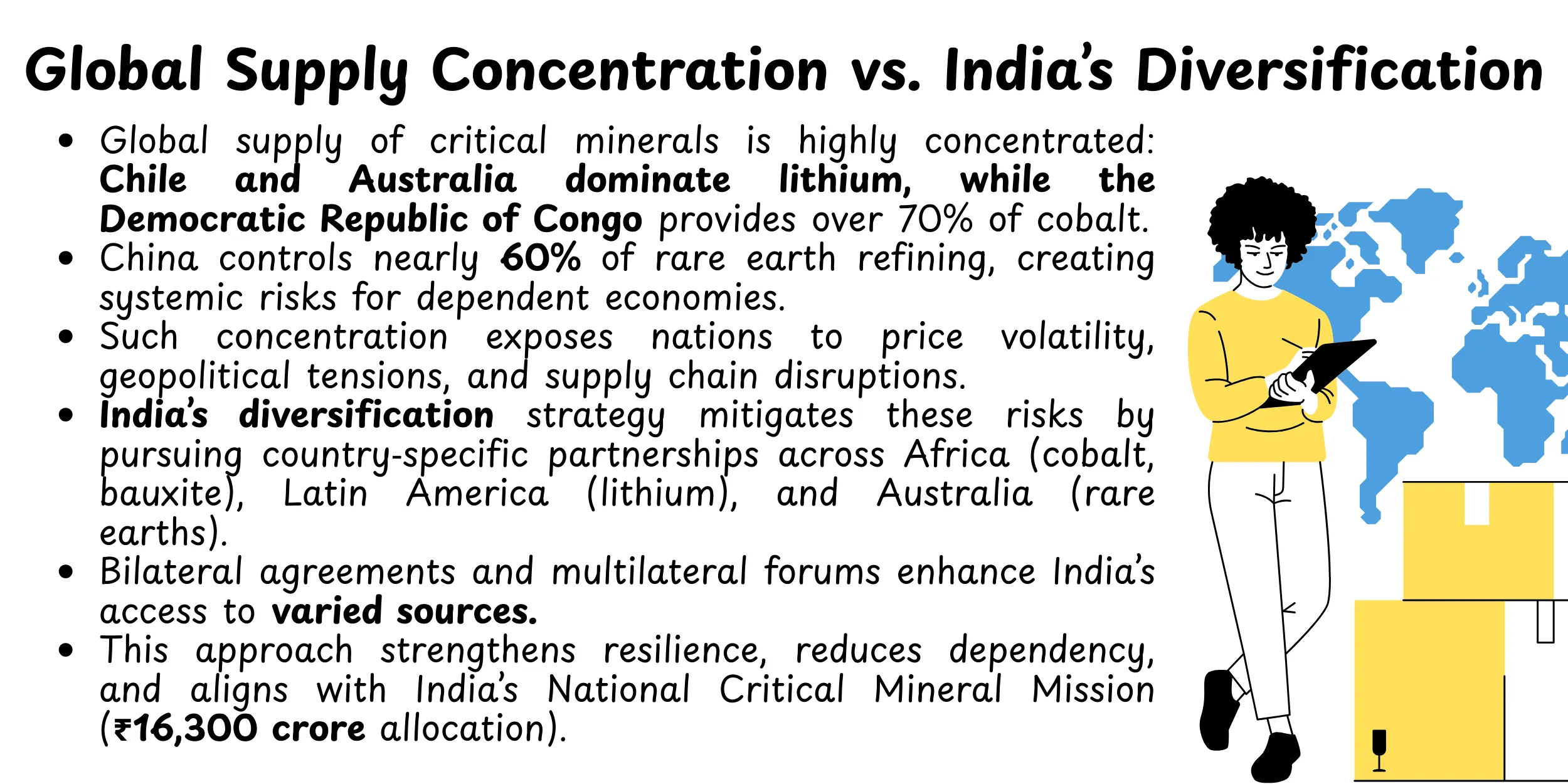
With the increasing demand, the supply is very concentrated. Chile and Australia dominate the production of lithium, but over 70-% of the world's cobalt production is supplied by the Democratic Republic of Congo. Refining capacity is also strongly concentrated in China, which raises the concern of the issue of geopolitical vulnerability and bottlenecks in the supply chains.
Strategic Implications for India
This fact increases the need for diversifying sources, investing in the domestic refining capacity and developing international relations. Without these measures, the world's energy security, as well as the resilience of its industries, will remain at stake.
India's Current Approach towards Critical Minerals
The minerals diplomacy of India has come to the age where the domestic reforms are combined with the international partnerships in a multi-layered approach that will ensure the urgency of acquiring the critical mineral and, at the same time, resiliency, and this is a long-term strategy.
Bilateral and Multilateral Negotiations by India
India has established nearly one dozen bilateral and multilateral relationships on various continents in the last five years. The country that has become one of the most reliable partners is Australia, which offers political stability and lithium, as well as other rare earth reserves in large amounts. At the same time, India has also been building stronger relationships with the United States and the G7 economies, where the country can also take part in the high-level talks on the supply chain of critical minerals in 2026 in Washington. These activities will be aimed at reducing reliance on China, which currently controls refining and processing capacities.
Internal Policy Projects of India
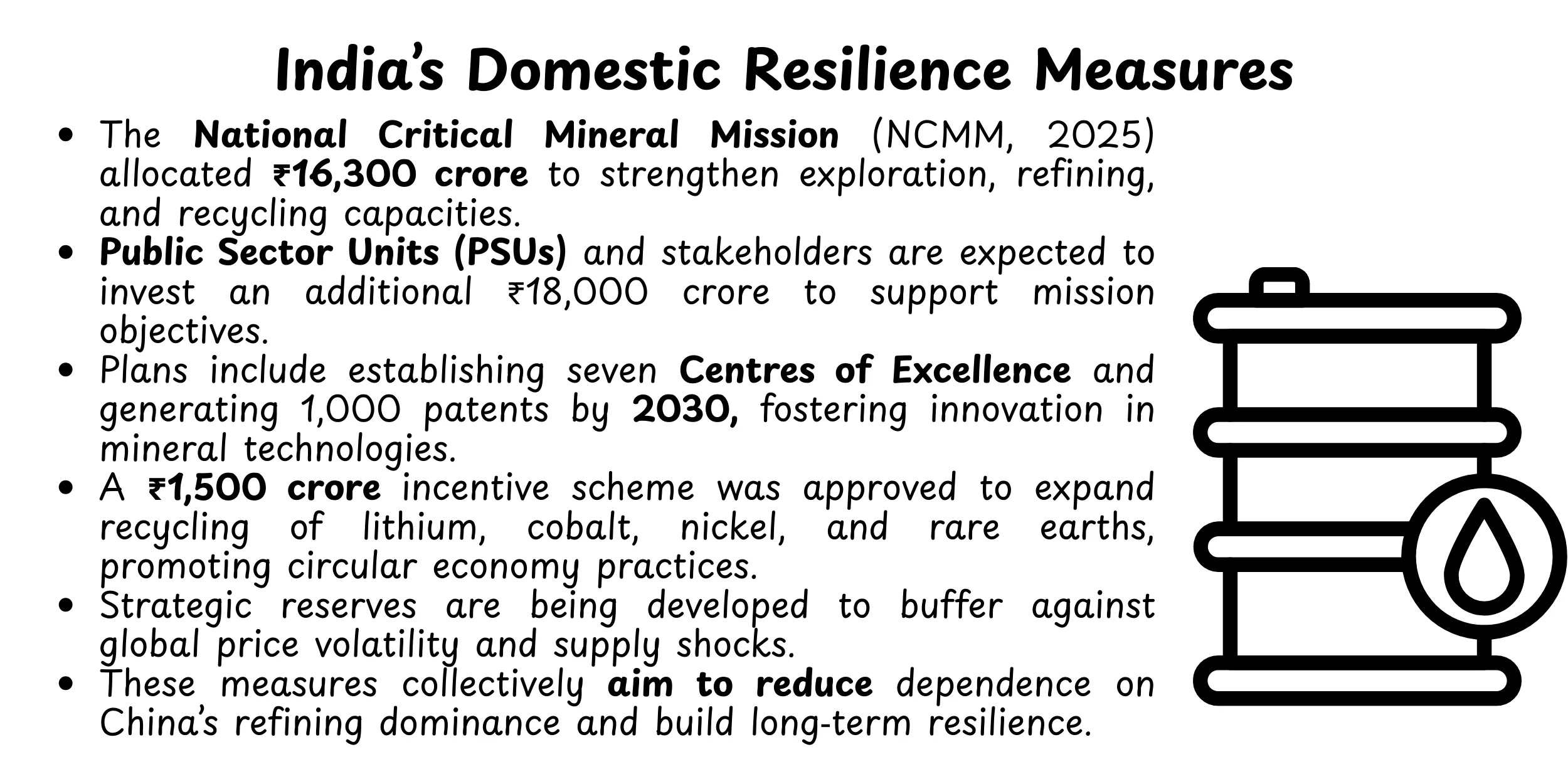
Domestically, the National Critical Mineral Mission (NCMM), which was initiated in the year 2025, estimates the expenditure of INR 16,300 crore and the investment of INR 18,000 crore by the public sector undertakings and the stakeholders. The mission seeks to have 1,000 patents secured by 2030 and have seven Centres of Excellence, which will generate breakthroughs in exploration and extraction. Moreover, anINR 1,500 crore incentive scheme is approved to boost the recycling of lithium, cobalt, nickel, and rare earths,reflecting India’scommitment tothe circular economy.
Country by Country Strategy of India
The diplomacy of minerals in India is steadily based on a countrybycountry approach, which is based on the realization that an unprecedented alliance is necessary to adapt supply chain diversification and reduce the geopolitical risk in the critical minerals industry.
Africa: Cobalt and Bauxite
India has been increasing its activities with African countries, most notably the Democratic Republic of Congo, which is the source of more than 70% of the world's cobalt. India has also signed a deal in Guinea on bauxite to guarantee the raw material availability to the aluminium industries.
Latin America: Lithium Partnerships
Chile, Argentina, and Bolivia comprise the Lithium Triangle of Latin America,which is at the heart of India's battery ambition. India has also begun a process of joint ventures and technology transfers with a goal to ensure long-term lithium supplies, which is vital in electric mobility.
Australia and the Developed Economies
Australia is still an alliance, with stable governance and reserves of lithium and various rare earths. The partnerships between India, the United States, and Japan focus on the perfection of technologies and markets that are based on standards and make the nation less dependent on China.
Strategic Outlook for India
This Country-specific strategy has a balance between short-term accessibility and long-term strength. Diversity and sustainability help India to enhance its critical minerals value chain and place it in the position of a responsible global stakeholder.
Creating Value Chain Resilience in Critical Minerals
The resilience of the critical minerals value chain has become one of the key pillars in the Indian strategic planning, aimed to make sure that in the situation when there could be a supply disruption, the energy transition and modernisation agenda of India would not suffer.
Diversification of Critical Mineral Sources
India is also striving to diversify its mineral imports so as to reduce its dependency on a particular supplier. According to the International Energy Agency (IEA, 2025), more than 70 % of cobalt is produced in the Democratic Republic of the Congo, but China possesses almost 60 % of all the rare-earth refining capacity globally. In turn, the bilateral relations of India with Australia, Chile, and other African countries are aimed at risk dispersion throughout geographic borders.
In-country Processing and Refining by India
Increasing the refining capacity at home is an important element of national policy. The National Critical Mineral Mission (2025) has allocated a sum of INR 16,300 crores of funds to create advanced processing plants and recycling plants. This project is meant to reduce India's reliance on external refining, specifically in China.
Recycling and Strategic Reserves
India has approved an INR 1,500 crore recycling incentive scheme to increase the recycling of lithium, cobalt and nickel. There are also plans to formulate strategic reserves which are aimed to soften in the global price instability and hence create long term resilience.
Challenges & Opportunities for India
The challenges together with its opportunities have been faced by India through mineral diplomacy in light of global supply chain breakdowns, geopolitical competition, as well as the need to ensure sustainable resource management.
Key Challenges for India
Imported minerals continue to play a significant role in the changes in the country to clean energy.
- China controls almost 60 % of the world's refining of rare-earth metals, and is the sole refinery of lithium and cobalt. Such a concentration exposes India to supply shocks, fluctuations in prices and vulnerability to strategy.
- Moreover, the struggle against the United States, European Union, and China concerning the right to mineral-rich lands increases the challenge of having a long-term contract.
- The international interaction of India is even more complicated by the environmental issues and the need to ensure ethically responsible mining practices.
Emerging Opportunities for India
Despite these challenges, India sees a lot of potential.
- Diversification of lithium, cobalt, and bauxite sources through bilateral deals with Australia, the United States and the African countries provides continued access.
- The National Critical Mineral Mission (2025) allottedINR 16,300 Crores to add to the domestic processing and recycling, thus lowering the dependence on outside refining.
- The diplomatic capital of India, along with its increased influence in the multilateral forums, puts the country in a position to compound clear and standards-based markets and to advance sustainable mining.
Conclusion
The mineral diplomacy India has undertaken is indeed a clear-cut move towards attaining strategic independence in the wake of the energy transition. The country-by-country approach will allow the nation to diversify its sources, strengthen the domestic refining infrastructure and introduce sustainability into the entire value-added chain. Whereas the challenges that have arisen, including geopolitical competition and supply concentration, might not fully fade out, the prospects of resilient collaboration and technological innovation are large. Finally, mineral diplomacy needs to become a pillar in the economic and strategic policies of India, which will have a long-lasting strength in the relationship of resource management in the global system.
Frequently asked questionsFrequently asked questions
Global Minerals Landscape?
The changes based on energy transition and technological advancement are causing a rapid shift in the global minerals industry. Critical minerals such as lithium, cobalt, nickel, and rare earth elements become essential items in clean-energy systems and highly advanced processes.The global minerals landscape is defined by surging demand for critical minerals (like lithium, rare earths, copper) for energy transition (EVs, renewables), driving major investments and geopolitical focus, with significant supply concentrated in specific regions like China for processing.
India's Current Approach towards Critical Minerals?
The minerals diplomacy of India has come to the age where the domestic reforms are combined with the international partnerships in a multi-layered approach that will ensure the urgency of acquiring the critical mineral and, at the same time, resiliency, and this is a long-term strategy.
Country by Country Strategy of India?
The diplomacy of minerals in India is steadily based on a countrybycountry approach, which is based on the realization that an unprecedented alliance is necessary to adapt supply chain diversification and reduce the geopolitical risk in the critical minerals industry.
Creating Value Chain Resilience in Critical Minerals?
The resilience of the critical minerals value chain has become one of the key pillars in the Indian strategic planning, aimed to make sure that in the situation when there could be a supply disruption, the energy transition and modernisation agenda of India would not suffer.
Challenges & Opportunities for India?
The challenges together with its opportunities have been faced by India through mineral diplomacy in light of global supply chain breakdowns, geopolitical competition, as well as the need to ensure sustainable resource management.