|
Key Highlights
- AI in schools
- Pros and cons
- Ethical issues
- Global preparedness
- Policy implementation gaps
|
The article “AI in Schools: Revolution or Risk?” discusses the pros and cons and ethical issues, and equity concerns of teaching students artificial intelligence in schools because of the upcoming technological revolution. AI in schools is both a revolution and a risk, offering significant benefits like personalized learning and administrative support, while also posing threats such as data privacy issues, algorithmic bias, and the potential for increased inequality.
|
Tips for Aspirants
The article is aimed at helping the aspirants of the Union Public Service Commission (UPSC) and State Public Service Commission (PSC) to get organised in understanding the aspects of AI policy, ethics, equity, and education, which are some of the most recurrent themes when writing General Study papers, essay compositions, and analysis of current affairs.
|
- AI Literacy as a Multiple Core Skill: The Early AI education will foster computational thinking, criticism, ethical discussion, and future-readiness, which fits the purpose of creating new policies discussed in The National Education Policy (NEP) 2020.
- Interdisciplinary Intervention: Ecumenical learning and the experience learning are incurred through the integration of artificial intelligence in various disciplines, including civics, mathematics, and literature.
- Ethical Issues: Students need to learn fully about algorithmic prejudice, data protection, and the overall social consequences of artificial intelligence, and how to be responsible digital citizens.
- Equity and Access:AI use is associated with being under threat to the expansion of the digital divide in the presence of no inclusive infrastructure, without professionally trained teaching staff, especially in rural and marginalized communities.
- International Preparedness: AI curricula must align with international standards while being sensitive to local cultures, thus equipping students to become citizens and professionals in the global community.
- Policy Relevance: The shift of the Ministry of Education to AI teaching after Class 3 will be a reflection of the strategic forces of the Indian Union on the concept of technology-based learning.
- Gender and Socioeconomic Inclusion: AI learning must now be actively used to prevent obstacles to STEM participation among girls and study groups with low income.
|
The introduction of artificial intelligence (AI) into the school curriculum has become a focal point in the modern education policy and pedagogy. With the rise of AI technologies in many economic fields, including health, administration, communication, and the creative industry, the necessity to provide future generations with the basics of AI literacy has become quite popular. This article offers a critical analysis of the logic and rationality, as well as ethical implications, surrounding the concept of the introduction of artificial intelligence in organized school education processes. It makes this discussion a part of a wider context that covers digital readiness, equity, and the changing nature of work and citizenship that is typical of the twenty-first century. Advocates believe that early training on concepts of AI helps in enhancing computational thinking, problem-solving, and teaching responsibility. Conversely, opponents argue about an untimely growth curriculum, structural inequality, and possible techno-centric study. The discussion also explores the ways in which AI education could be operated across the disciplinary lines, thus promoting interdisciplinary research and responsible invention.
The Case for Learn AI in the Early Years
Early learners with the smallest experience in AI demonstrate the ability to implement fundamental cognitive and ethical tools to work in a fast-changing digital environment. The decision to include it in school curricula is revolutionary and in time.
AI as a Foundational Competency
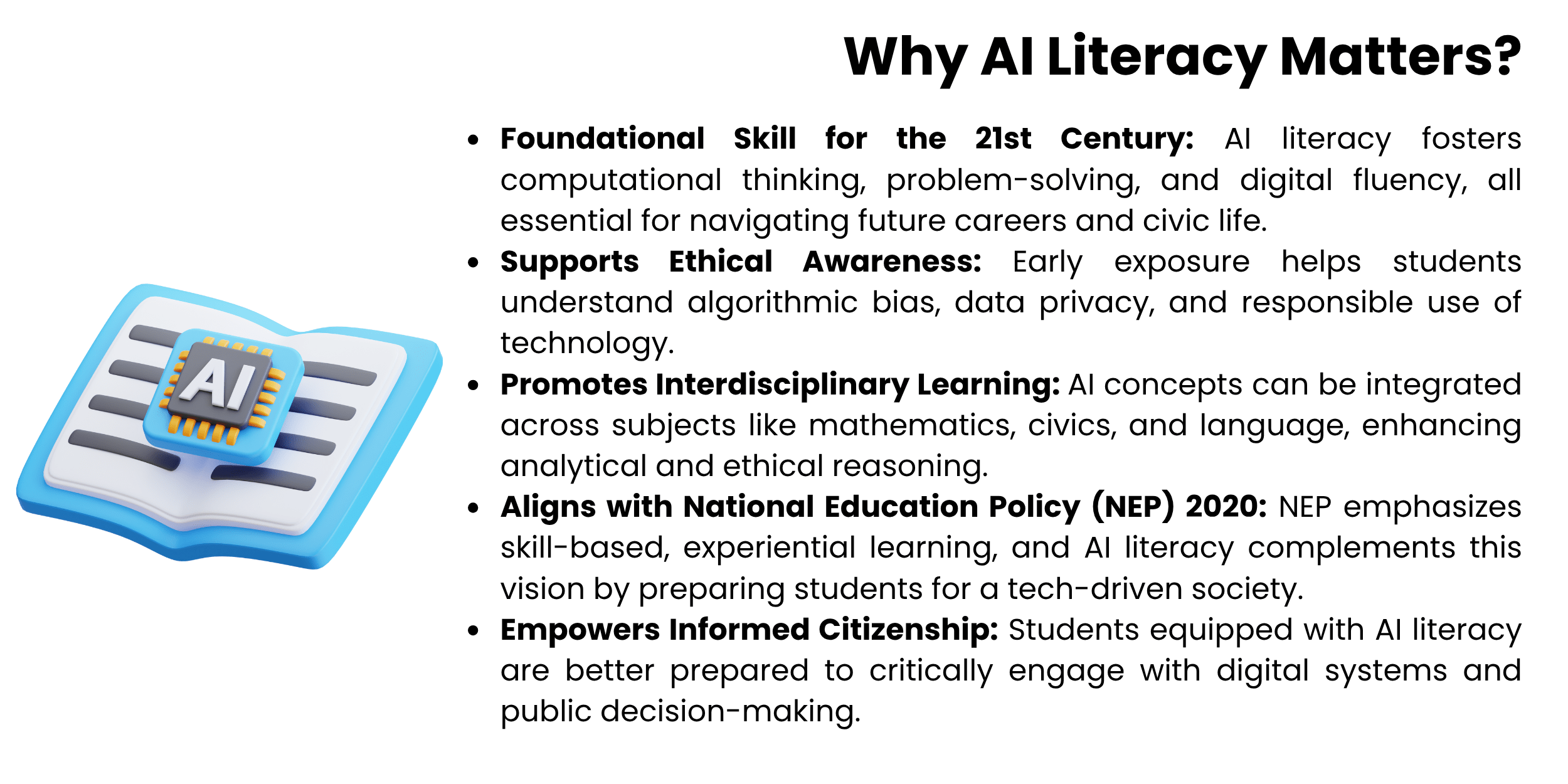
Artificial Intelligence as a field has become more than a small and somewhat obscure sector; it is currently the ubiquitous and unavoidable force that permeates communication, governance, healthcare, and education. Teaching AI literacy in the schools encourages background knowledge of algorithms, data structures, and machine learning principles. This exposure at this early age develops computational thinking and problem solving, which are now considered as one of the core competencies of learners of the 21st century. he World Economic ForumT has already considered AI literacy as the key to developing the very nature of human intelligence, as opposed to being merely technical.
Improving Critical Thinking and Ethical Awareness
AI literacy does not only involve coding or technical interaction, it also involves ethical thinking and digital accountability. Students should not only learn to question the idea of algorithmic bias, the privacy of information, and the impact of automation on society. Early exposure to such notions stimulates critical thinking and trains students to interact with the AI systems as intelligent citizens. Researchers observe in earlier research that it is important to differentiate between AI literacy and AI skills: the latter involves the use, whereas the former enables the ability of critical perception.
Bridging the Digital Divide
The introduction of AI in schools can provide future-ready education, which can be democratized, on the condition that its implementation is inclusive. AI education will continue to keep the digital divide unless good infrastructure and teacher education are achieved. The development of education for classes III and higher based on the 2025 programme proposed by the Ministry of Education in reaction to the National Education Policy ( NEP ) 2020, where AI is introduced, presents a policy of inclusive curriculum change. However, it is a matter of local adaptation and a long-term investment in capacity building that should prevail.
Future Ready Citizens
It is also through AI literacy that students possess the capability to engage with an AI-mediated society in the future and also to participate as citizens. A career change due to automation: therefore, knowledge of AI will be essential to adaptability. In addition, knowledgeable citizens should be able to question the application of AI in government decision-making, surveillance, and the media. Early integration of AI in education will make sure that students are participating in its path actively and become ethical contributors to AI, and not merely its consumers.
The opportunities and challenges
There are potential changes and challenges in the implementation of Artificial Intelligence (AI) in schools. It requires a balanced approach that is necessary to ensure pedagogical relevance, inclusivity, and sustainability.
Interdisciplinary Potential and Pedagogical Innovation
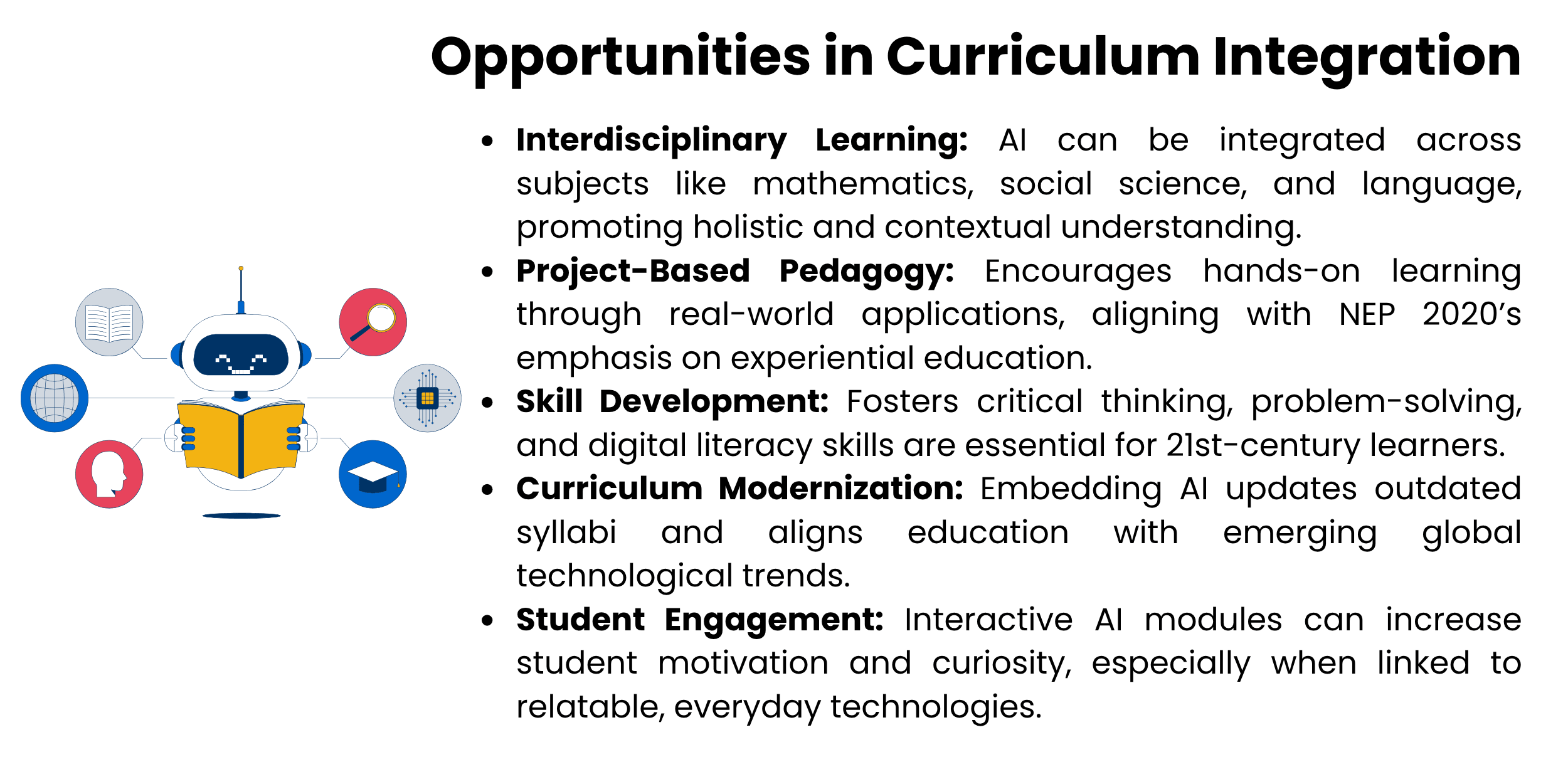
The possibilities provided by AI education are rich in their interdisciplinary attitudes, covering computer science, mathematics, social studies, and language arts, thus producing critical thinking and ethical reasoning. Examples of studies that students can conduct are to study algorithmic bias in civics or use natural language processing to study literature. Cross-curricular integration fosters the idea of holistic learning and provides learners with the characteristics of considering AI as not a technical device but a phenomenon that changes society.
Training and Resources Gap of Teachers
Curriculum integration has its potential despite the high impediments to implementation. At the top of the list is the fact that there is a lack of teachers who have an understanding of AI. The majority of the teachers need to be developed professionally to understand AI concepts and learning methods. In addition, not all schools, especially rural and underserved ones, have the digital infrastructure operations to facilitate AI education. Unless specific efforts have been made to improve the capacity and access to hardware among teachers, AI education may not become a human right, but a luxury of the select few. According to the 2023 report on AI in education by UNESCO, the modular approaches to teacher-training and the open digital environment will require inclusion and scalability.
Policy Alignment and Curriculum Overload
The in-curriculum inclusion of AI creates questions on the cognitive load and cognitive coherence of instruction. The policymakers should make sure that the AI modules complement the existing subjects instead of competing with them. This requires careful mapping of the curriculum, formulation of age-related content, and adherence to national education systems like the NEP. The NEP suggests experiential and skills-based learning, which is aligned with the project-based pedagogy of AI; however, this needs to be carried out in the local context through trials.
Fairness, Cultural Competencies, and Local Relevance
The linguistic and cultural diversity should also be taken care of by curriculum integration. The concepts of AI are to be presented in native languages and adjusted to local reality so that they are accessible. In addition, students belonging to the disadvantaged groups should be given a priority in outreach and resource setup. Unless there are strategic equity initiatives, AI education can contribute to the current social disparities. According to the Brookings Institution, an AI-inclusive curriculum should also represent a variety of opinions and address ethical interaction with technology.
Ethical and Social Implications
The introduction of artificial intelligence into school education implies that one will have to scrutinize its moral and social consequences. These implications are not limited to pedagogy but create values, agency, and digital citizenship.
Data Protection and Academic Freedom
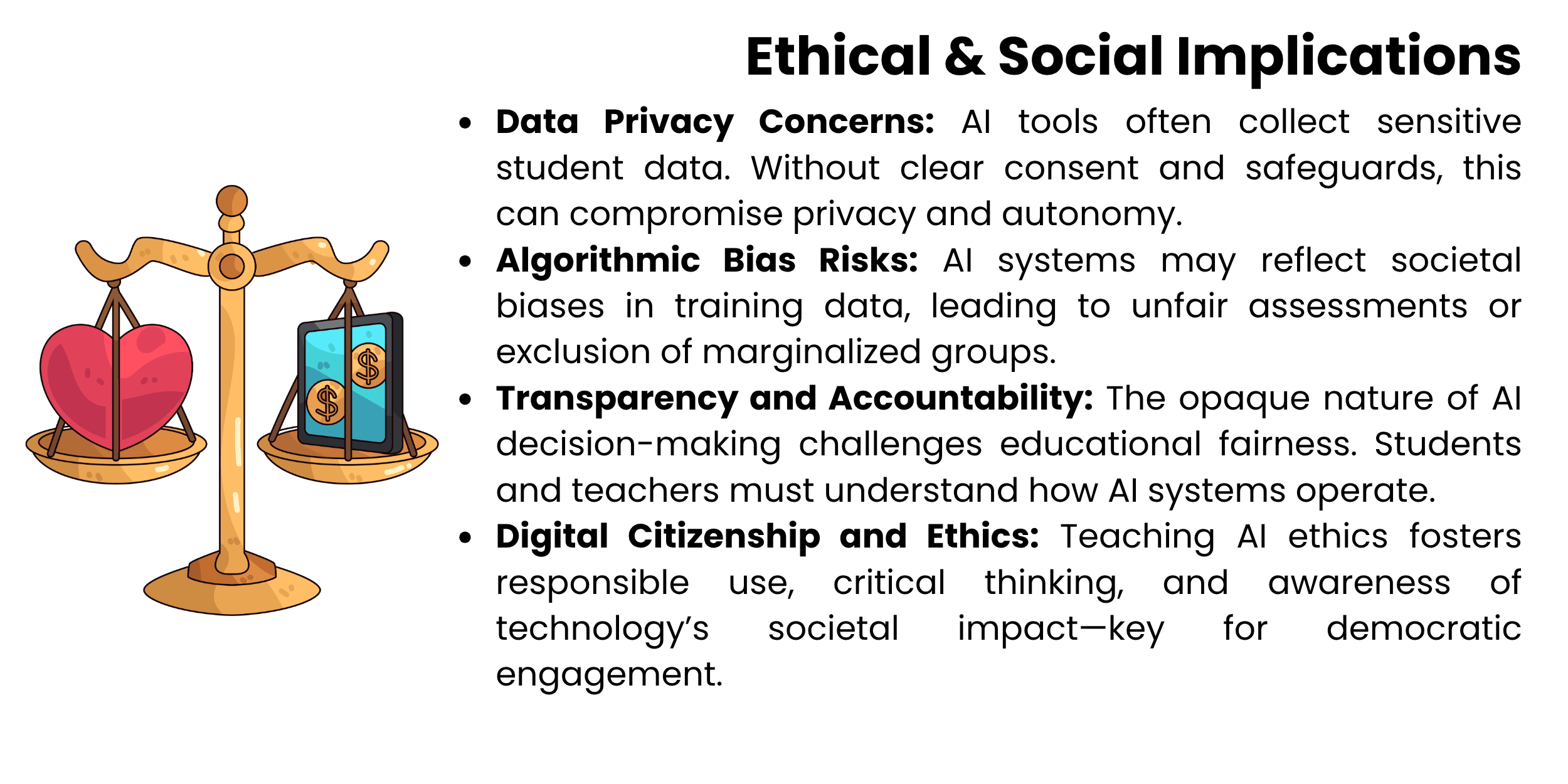
AI technology in education frequently has to use high levels of statistical trip counts of learning habits for behavioural analysis. Although this data allows individuals to learn individually, it creates a question of consent and ownership, along with surveillance. The students, particularly minors, might not be able to fully understand the way their data is utilized or kept, or not. The AI tools threaten to violate the privacy and autonomy of students unless they have strong data governance structures. The issue of ownership of information arises in the context of AI platforms processing sensitive education information on a regular basis.
The Risks of Algorithms and Bias in Equity
The technology of AI is as unbiased as the information it is trained on. In case the biases of the past are entrenched within the training data, AI technology can cause or even deepen discrimination- in this case, against the marginalized population. As an example, dynamically changing learning environments may wrongly categorize the skills of students due to linguistic/cultural variations and provide biased evaluations and unequal opportunities. Studies show that uncontrolled reinforcement of inequality systems by educational AI is possible instead of breaking them down.
Transparency and Accountability
The obscurity of AI decision-making (which has also been called a black box) is a problem that could challenge educational accountability. It might not be clear how AI systems come to some recommendations or grades for teachers, students, and parents. This level of secrecy causes reduced confidence as well as restricts the capacity to challenge or audit decisions. The application of AI in ethical procedures needs explicable models and certification on the constraints and the decision-making logic of the system. According to EdTech RCE, deployment of AI, especially in classrooms, must be ethical enough to augment and not to substitute human judgment, unlike in the past.
How to Raise Conscientious Digital Citizens
In addition to being technologically literate, AI learning should develop moral reasoning and civic responsibility. Students are supposed to ask themselves the question of how AI affects media, politics, employment, and relationships between other people. Teaching ethics to AI students will create a better understanding of technology and how to use it wisely in society. This strategy is in line with the overarching aim of education as a democratic empowerment and social justice.
Fairness, Opportunity, and Global Preparedness
Implementing artificial intelligence into educational systems requires the principles of equity, accessibility to all, and readiness to operate at the global level, thus protecting against the enhancement of the existing inequality gaps in the educational levels.
The Solution of the Digital Divide
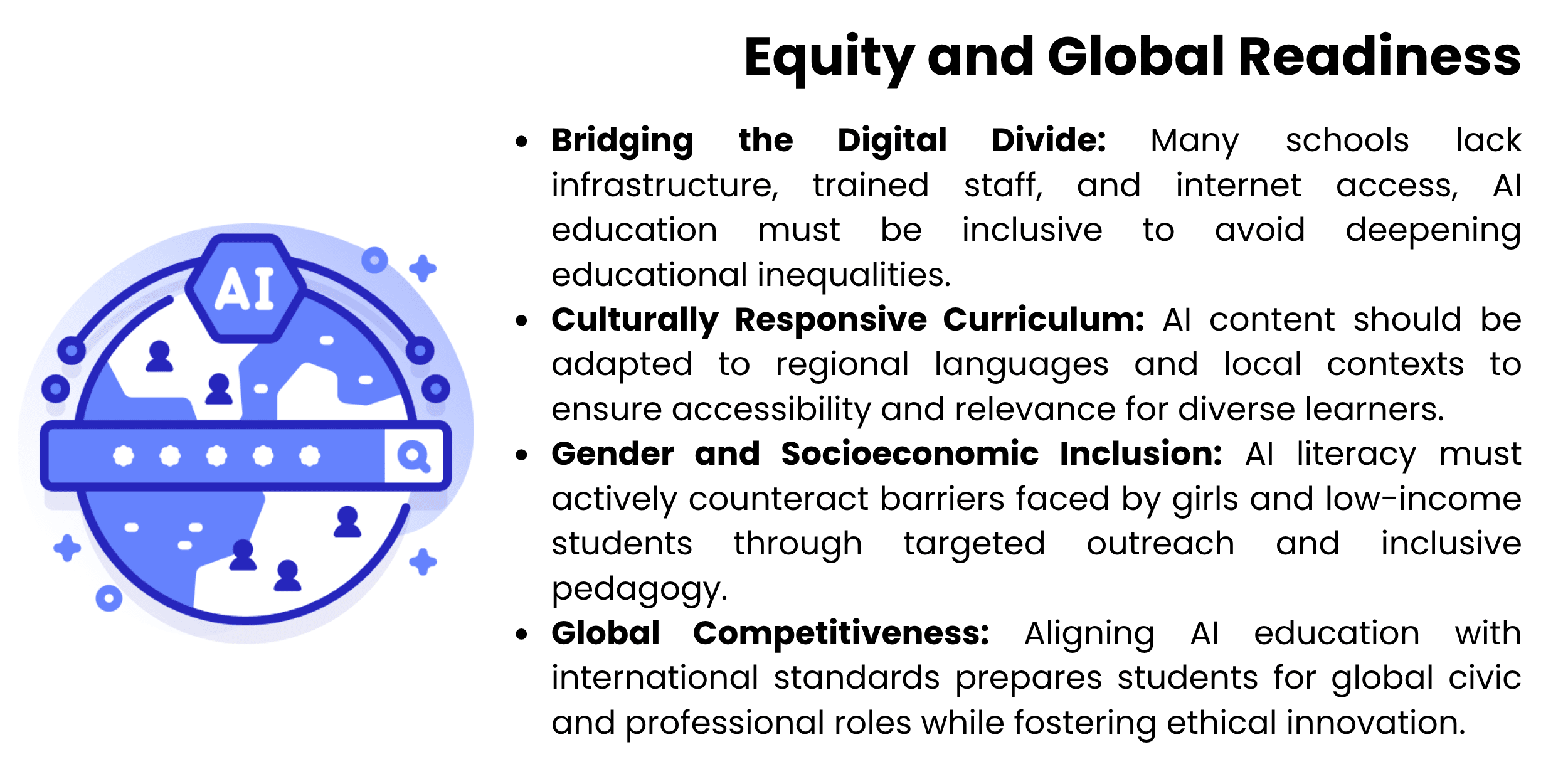
The opportunity of AI to disrupt educational practice is inherently based on the decentralized access to the necessary digital infrastructure. In many locations, especially in the Global South, educational institutions often do not have reliable internet access, proper equipment, and highly trained staff that can apply AI-based educational techniques. Without a specifically aimed investment, the pedagogy of AI runs the risk of being a privilege enjoyed by well-endowed urban institutions only with money to spend. The 2023 report on AI and education issued by UNESCO highlights that in curriculum reform, digital equity needs to form a core ideal, with the risk of widening the achievement gap being severe and systemic processes becoming institutionalized.
General Curriculum Development
Culturally and linguistically responsive content is also required in terms of equity in AI education. The presentation of instruction should be based on the regional languages and make sense in local realities, and increase its understanding and relevance. Additionally, it is the task of curriculum designers to make sure that AI modules provide anecdotes reflecting a variety of views without being subjugated by Western-centric accounts, but rather a more globally oriented one. The Brookings Institution proposes inclusive AI education to allow heterogeneous students to critically interact with technology and its implications for society.
Socioeconomic Inclusion and Gender
The efforts toward AI literacy must actively override gender and socioeconomic prejudice. Girls and students from low-income families frequently face obstacles participating in STEM, which are caused by stereotypes and an underlying biased view, as well as the lack of resources and mentorship. Introducing AI in the school curriculum is a way forward to breaking these barriers, with one condition being to prioritize outreach, scholarships, and community involvement. The Education Equity Framework by the World Bank suggests the inclusion of gender-sensitive education practices, the use of inclusive digital practices, and the application of this innovative teaching method to guarantee that AI education brings positive impacts to all learners.
International Preparedness
The global fully automated economy will require collaborative agreements across borders to prepare students to work in it. States should organize AI education to meet the ratios of global standards, and at the same time, should be able to serve the interests of the locality. Such alignment will presuppose the sharing of best practices, creating open-source resources, or involving themselves in transnational research projects. The National Education Policy 2020 of India and its introduction of AI curriculum since Class 3 are indicative of a calculated attempt to place learners in the global competitive market, at the same time publishing ethical and non-discriminatory innovation.
Conclusion
To conclude, the integration of Artificial intelligence into the training curriculum is a strategic necessity of the future-oriented educational setting. Since AI is still redefining the fabric of society, early literacy will give the cognitive, ethical, and technical capabilities that students need to survive in a more algorithmic world. Its inclusion is supported by the interdisciplinary potential, the ability to create critical minds, and to address the changing civic and professional environment. However, the need to be thoroughly careful in terms of infrastructural equity, teacher readiness, and culturally responsive pedagogy is the key to a successful implementation. Ethical issues, including the privacy of data, algorithm bias, and others, should be implemented into the educational context to make the interaction with the AI services responsible. In addition, inclusion and correspondence to international policy are needed to alleviate the widening educational inequalities. Finally, the general idea of AI implementation in schools is not only a curricular change, but a social investment in education of the informed and empowered, and morally sound individuals to work in the digital era.