India’s 1,760+ Global Capability Centres (GCCs) are develop from cost-focused back-office operations into strategic, AI-powered innovation hubs, generating $68 billion in direct economic value. They are transforming the landscape India’s position as a global technology leader, with 58% of centres adopting Agentic AI and 83% scaling Generative AI, while increasingly expanding their footprint into Tier-II cities.
|
Key Highlights
- Global Capability Centres (GCCs)
- Evolution of India’s GCC Ecosystem
- Strategic Benefits of GCCs and Worldwide Effect
- Challenges on the Horizon for GCCs
- The Solutions for the Sustainable GCCs
|
There has been significant focus on the spread of Global Capability Centres (GCCs) in India when multinational corporations are taking their operations to the country, thus turning the traditional back-office functions of the country into an innovation-focused strategic centre. The growth of Hyderabad and Bengaluru in India demonstrates their rising popularity in the sphere of artificial intelligence, research and development, and digital transformation. This shift is significant to the creation of high-value jobs, improvement of global competitiveness and the future course of corporate strategy. India has Global Capability Centres (GCCs), which are a turning point in the economy and technology of the country. These centres have become the sources of strategic innovation, research and global decision making, having been viewed as more of cost-effective back-office functions.
What are Global Capability Centres?
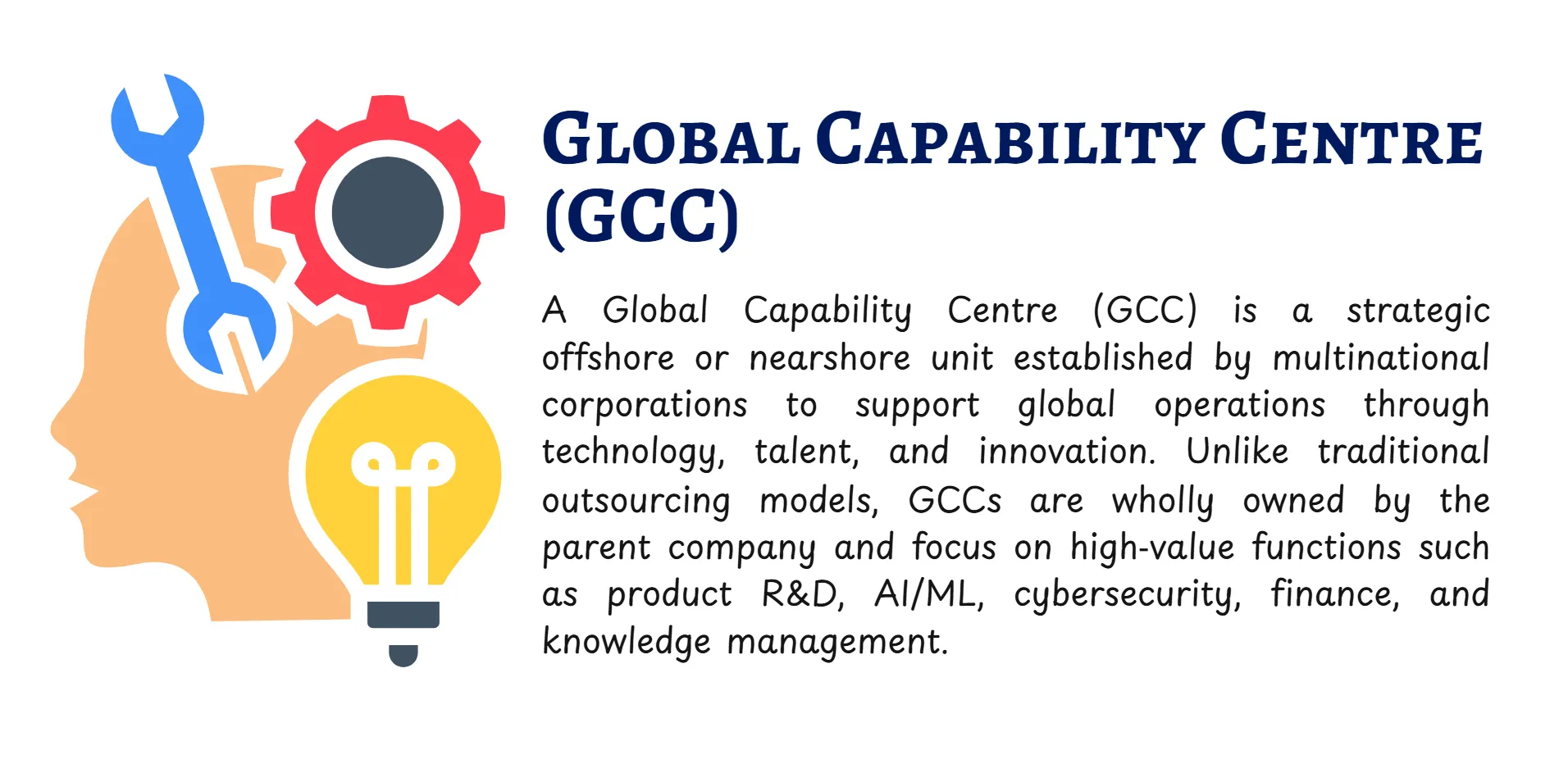
Global Capability Centres (GCCs) are overseas units set up by multinational companies to make the most of skilled local talent. They handle important business functions such as IT, R&D, engineering, and finance while helping companies innovate and operate more efficiently from cost-effective locations around the world. How Global Capability Centres (GCCs) are reshaping India’s global role, driving innovation, talent development, and strategic business transformation. India’s role as a global technology leader, with 58% of centres leveraging Agentic AI and 83% scaling GenAI, while expanding into Tier-II cities.
|
Evolution of India’s GCC Ecosystem
India’s Global Capability Centres (GCCs) have evolved from basic IT back-offices into strategic hubs driving global innovation, AI, and R&D. The Global Capability Centres (GCCs) in India have undergone a radical change through the shift to strategic engines of innovation and global integration instead of being transactional outsourcing organisations. The trends are reflective of macro-economic structural changes and increased trust in the abilities of the Indian workforce by multinational corporations.
From Outsourcing to Strategic Ownership through GCCs
The first GCCs in India were developed to provide cost-effective back office services. They were later transferred to high value activity like product design, research and development, as well as enterprise strategy. The EY GCC Pulse Survey 2025 sees Indian centres as change agents now, orchestrating digital change and the creation and scaling of intellectual property.
Diversification and Inclusiveness in GCCs
Although some cities such as Bengaluru, Hyderabad and Pune continue to be the powerhouses, the tier-2 cities are also becoming the destination for the GCC investments. A report by Savills (2025) identifies this attribution of geographic diversification as one of the ways of distributing the employment opportunities and lowering the concentration in cities.
Sectoral Diversification in GCCs
GCCs have moved across various sectors and industries such as software, pharmaceuticals, retail and consumer services, which depict the incorporation of the Indian economy as a whole into global value systems. Such diversification helps strengthen resilience and makes India a reliable collaborator in the development of corporate strategies across the world.
Strategic Benefits of GCCs and Worldwide Effect
Global Capability Centres (GCCs) have evolved from cost-focused back-office units into strategic, innovation-led assurance centres for multinational corporations. By 2025–2026, they have become central to global expansion strategies, digital transformation initiatives, and advanced R&D operations, with India hosting more than 50% of the world’s GCCs. The sector is projected to reach USD 105 billion in revenue by 2030, underscoring its growing economic and strategic significance. Global Capability Centres (GCCs) in India have become great sources of global corporate change. The fact that they have been transformed into cost-cutting option outlets as well as strategic centres or hubs provides insight into the increasing role of India in determining multinational decision-making and innovation.
1. Talent Diversity and Scale of GCCs
The GCC ecosystem in India hires above 1.9 million professionals and facilitates 2.2 million STEM graduates annually. This multicultural workforce helps companies to combine engineering, financial, analytical and design in a single global operation. According to the EY GCC Pulse Survey 2025, Indian centres are the orchestrators of innovation, which have enterprise strategy and digital transformation on scale.
2. Innovation in GCCs
In India, GCCs take on more tasks of high-end services, including artificial intelligence creation, cybersecurity, and sustainability services. The leasing activity hit a historic high of 31.3 million square feet in 2025, marking the structural change that involves the model integration of India in the global issue models of operations. This growth attests to the fact that India is a reliable source of intellectual property development and a high level of research.
3. Internationalisation and Economic Outcomes of GCCs
The number of U.S.-based companies taking almost 70 percent of the GCC demand in India shows how important the country is to global corporate strategies. Having a market worth of USD 65 billion and a projected growth of 10.2% CAGR up to 2030, the GCCs in India are not only transforming the corporate structure, but also strengthening their level in the global knowledge economy.
Global Capability Centre Challenges in India
Global Capability Centres (GCCs) challenges in India are confronting significant headwinds as they transition into high-value innovation hubs. Global Capability Centres Key challenges include an acute talent shortage in niche domains such as AI and cloud computing, rising attrition rates, and sustained wage inflation driven by intense competition. At the same time, these centres must manage escalating cybersecurity threats, comply with increasingly stringent data protection regulations, and operate amid potential financial and policy uncertainties.
The growth of India's GCCs is very high this necessitates them to deal with structural issues to make them more sustainable. There is an impending problem of talent deficits, cybersecurity issues and financial burdens that are becoming major concerns among policy makers and industry pioneers.
Talent Shortages and Specialised Skill Lapses
The GCCs are deficient in specialised skills in fields like AI, data science, and cybersecurity despite the fact that it graduates more than 2.2 million graduates annually, majoring in STEM. In the EY GCC Pulse Survey 2025, it is observed that 67 percent of leaders in GCC indicate reskilling and closing academia-industry gaps as a priority for growth sustainability.
Increasing Cybersecurity Threats
The continuous spread of cyber threats can be explained by the joint struggle of GCCs to protect confidential corporate information and intellectual property. The Hindu states that the GCCs are more susceptible to ransomware and phishing, which means that investing in the provision of strong online security is an urgent necessity.
Fiscal Constraints and Cost Matching
Although India is still cost-effective, fiscal strains are increasing. According to Savills, GCCs leasing activity amounted to 31.3 million square feet, as an indication of an increase in the operational costs. The challenge of investing in innovation and still remaining affordable is turning out to be a strategic issue for firms in India.
Regional Equity and Inclusivity
The development of the GCCs in the metropolitan centres of Bengaluru and Hyderabad is a hazard of imbalanced growth. It is necessary to extend operations to more cities, hence to facilitate a more equal ratio of job opportunities.
The Solutions for the Sustainable GCCs
The Global Capability Centres (GCCs) of India are currently going through a critical initiation stage, where the sustainability of these organizations is determined by the combined coordination of innovation, inclusivity, and resiliency. This has led to the articulation of strategic pathways, which will shift India to a global think tank.
Infrastructure and Policy Support to GCCs
Government policies that facilitate the existence of digital infrastructure, skill-development schemes, and regulatory transparency are clear-cut facilitators of GCC growth. Savills points out that India generates over 2.2 million STEM graduates each year, which creates a large talent pool to drive GCCs into the world of artificial intelligence, machine learning, and cybersecurity in the future.
Industry‑Academia Collaboration for GCCs
The fact that there is no end to the gap between industry and academic institutions is a bottleneck that is still critical. According to the EY GCC Pulse Survey, to maintain a competitive edge, GCCs are becoming innovation orchestrators that require reskilling by constantly and continually developing collaborative research ecosystems.
Geographic Diversification of GCCs
The GCC is still predominant with Bengaluru, Hyderabad, and Pune, although the tier-2 cities are fast becoming well-known. According to a report on India GCC Guide of JLL, the leasing activity hit a high of 31.3 million square feet in 2025, with new centres spreading the parties of employment outside the metropolitan centres.
International Partnership for GCCs
The presence of U.S.-based companies in the GCC demand in India is about 70 percent, which underscores the need to have diversified alliances in the global arena. The growing activity in various geographies and instilling sustainability ideas can help defuse financial strain and support India in the global knowledge economy.
Conclusion
India Global Capability Centres (GCCs) exemplify a radical change in the economic and technological profile of the country, anchoring corporate strategies, developing multidisciplinary abilities, and speeding up digital transformation by relocating their functions from mere back-office to strategic innovation hubs. However, this gain must be maintained by a systematic process of skill gaps, cybersecurity vulnerability safeguarding, as well as documenting the financial strides. India has strong support in terms of its policies, inclusion, and international cooperation, which means that developing India is in a strong position to solidify its place as a reliable cognitive centre in the emerging knowledge economy.
Frequently asked questionsFrequently asked questions
Evolution of India’s GCC Ecosystem?
India’s Global Capability Centres (GCCs) have evolved from basic IT back-offices into strategic hubs driving global innovation, AI, and R&D. The Global Capability Centres (GCCs) in India have undergone a radical change through the shift to strategic engines of innovation and global integration instead of being transactional outsourcing organisations. The trends are reflective of macro-economic structural changes and increased trust in the abilities of the Indian workforce by multinational corporations.
Strategic Benefits of GCCs and Worldwide Effect?
Global Capability Centres (GCCs) have evolved from cost-focused back-office units into strategic, innovation-led assurance centres for multinational corporations. By 2025–2026, they have become central to global expansion strategies, digital transformation initiatives, and advanced R&D operations, with India hosting more than 50% of the world’s GCCs. The sector is projected to reach USD 105 billion in revenue by 2030, underscoring its growing economic and strategic significance. Global Capability Centres (GCCs) in India have become great sources of global corporate change. The fact that they have been transformed into cost-cutting option outlets as well as strategic centres or hubs provides insight into the increasing role of India in determining multinational decision-making and innovation.
Global Capability Centre Challenges in India?
Global Capability Centres (GCCs) challenges in India are confronting significant headwinds as they transition into high-value innovation hubs. Global Capability Centres Key challenges include an acute talent shortage in niche domains such as AI and cloud computing, rising attrition rates, and sustained wage inflation driven by intense competition. At the same time, these centres must manage escalating cybersecurity threats, comply with increasingly stringent data protection regulations, and operate amid potential financial and policy uncertainties.
The Solutions for the Sustainable GCCs?
The Global Capability Centres (GCCs) of India are currently going through a critical initiation stage, where the sustainability of these organizations is determined by the combined coordination of innovation, inclusivity, and resiliency. This has led to the articulation of strategic pathways, which will shift India to a global think tank.