|
Key Highlights
- Role played by The Opposition in Democracy
- Checks and balances
- Representatives of diversity
- Strengthening Democratic Culture
- Policy innovation and Democratic resilience
- Position of Opposition in India
|
As the winter session of Parliament has begun, it is important to learn about some of the concepts of the Parliament.In this order today, we will look at the concept of opposition in a democracy. Democratic societies cannot do without a strong opposition, as it ensures there is some degree of checks and balances on matters like the executive, the heterogeneous constituencies are represented, and accountability is maintained. By offering constructive criticism and developing alternative policies, which oppose each other, it promotes new forms of governance and makes administration more effective.
In addition, the opposition helps strengthen democratic culture, and a culture of deliberation, tolerance, and citizen participation helps prevent authoritarian backsliding of the system and helps in enriching pluralistic discourse.Strong opposition is crucial for a healthy democracy because it ensures accountability, transparency, and balanced governance by providing a necessary system of checks and balances on the ruling party's power.The Opposition acts as a watchdog of democracy, holding the government accountable, scrutinizing legislation, and offering alternative policies.
|
Tips for Aspirants
The article is relevant to the aspirants of UPSC CSE and State PSC examinations because it improves the grasp of democratic institutions, system of governance, and accountability as one of the fundamental inquiries in polity, essay writing, and the general studies syllabus.
|
|
Relevant Suggestions for UPSC and State PCS Exam
- Checks and Balances: The opposition ensures accountability, prevents the control instinct, and strengthens transparency in the system of governance.
- Stakeholder of Diverse Voices: The opposition ensures that pluralism is preserved by voicing out the minority issues; the opposing party enriches the public discussion and prevents majoritarian control.
- Policy Innovation: Giving constructive critique, coming up with feasible alternatives, and unleashing aggressive deliberation result in better legislation and policies that are more inclusive.
- Empowering Democratic Culture: The opposition fosters debate with information, does not limit opposition, and invites the citizenry into the system, which strengthens trust in the democratic system.
- Democratic Resilience: The opposition acts as a safeguard against the concentration of power and makes democracy participatory and inclusive.
- Relevance to Exam: These arguments are applicable to polity, governance, essay writing, and ethics.
|
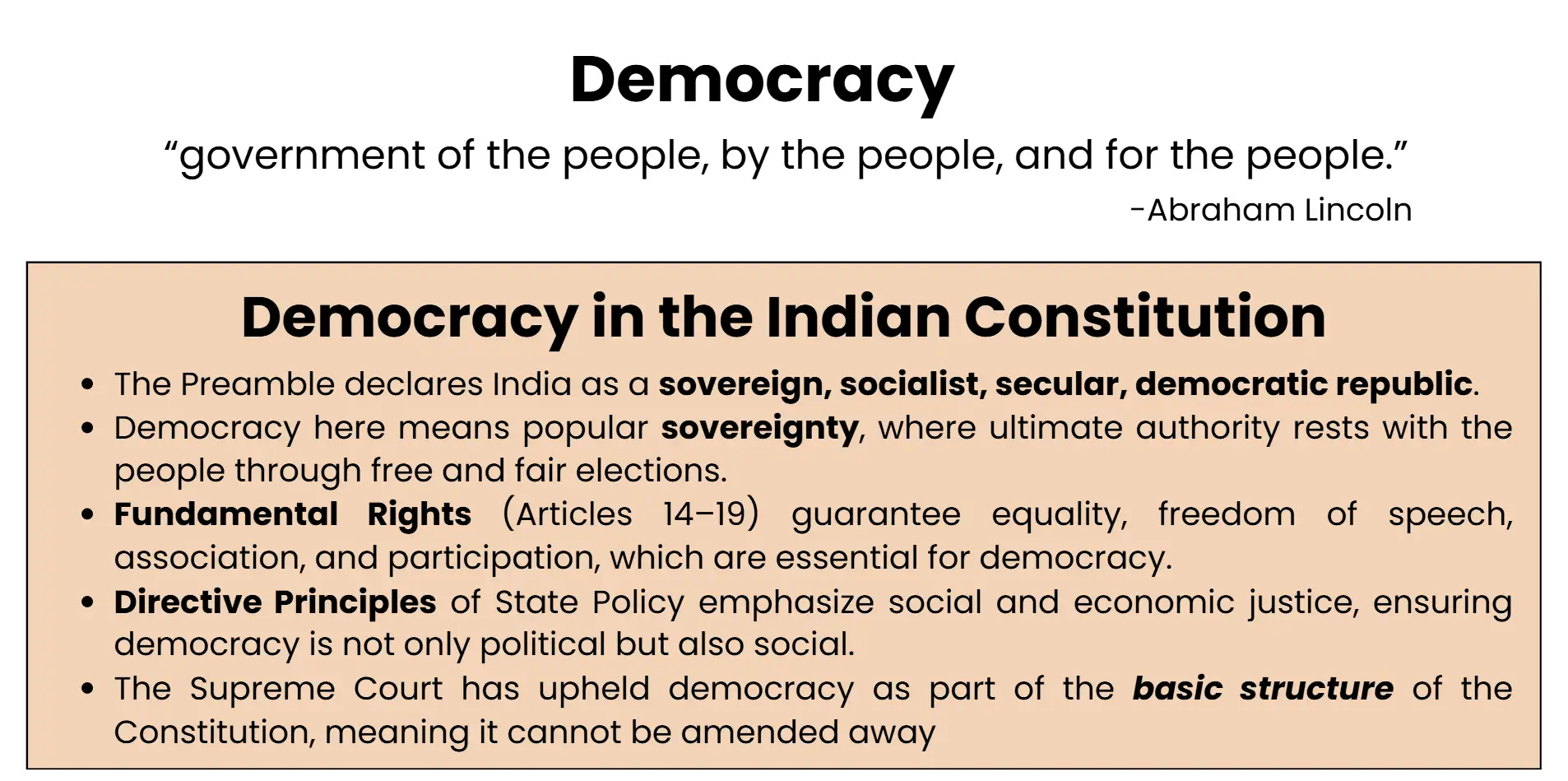
Democracy as a form of government, which includes the active involvement of the citizens, and the presence of the institutional processes that guarantee the responsibility of those who exercise the power, gives democracy its legitimacy. Although the party or coalition holding office obstructs the role of policy implementation, as well as defining the course on which the country will evolve and prosper, the role of opposition administration is equally important in ensuring the state remains in fully functioning democracy. The strong opposition acts as a protector of the constitutional principles and puts the much-needed checks on the powers of the executive to avert the undermining of democratic protection. It is the quintessential pluralism because it embodies a range of voices and interests and perspectives that would otherwise be unheard in the halls of power. Also, the opposition parties improve the quality of the current policy, offering constructive criticism and other solutions to the outbreak and giving new heights to the quality of the legislative discourse. In addition to its institutional values, the dynamic resistance contributes to the strengthening of democratic culture by developing tolerance to dissent, encouraging the civic constituency, and increasing confidence in democratic institutions. In turn, the existence of a strong opposition is not just a formal instrument of procedure but a fundamental requirement for the strength and health of democracy.
Checks and Balances on Power
A strong opposition is crucial in a democracy because it is the primary mechanism for ensuring checks and balances on the ruling government's power. Democratic government needs a strong opposition due to its role as a check on the executive power. By engaging in systematic questioning of the decisions made, questioning of the policies, and demanding accountability, the opposition maintains a perfect balance in the distribution of powers and protection of the constitutional values.
Protests as a Guardian of Accountability
The major role of the opposition is to question the governing party on its actions. Through parliamentary deliberations, organizing interventions in committees, and taking part in popular discussions, the opposition parties would uncover the shortcomings of governance and shed light on issues of omission on the part of the executive. Through this accountability mechanism, it is possible to prevent the misuse of power and ensure that policy decision-making is in accordance with democratic standards and not arbitrary inclinations.
Authoritarian Drift Prevention
Power hoarding is usually a trigger of totalitarian tendencies. Such risks are allayed by a watchful opposition against choices taken in unilateral ways and resisting forces that corrode the integrity of institutions. Questioning executive power atrocities, the opposition maintains the autonomy of the judicial system, and the media. This kind of power is essential to retain the democratic resiliency and prevent the monopolization of power.
Increasing Openness and Trust
Openness in the government is enhanced when the opposition demands transparency when it comes to policies, budgets, and administrative actions. The opposition fosters the confidence the people have in institutions by asking questions and demanding transparency. By this, citizens achieve comfort that their concerns are represented not by an incumbent-only party but also through contrarian actors who subject governance to excellent scrutiny. The democratic systems are given greater legitimacy by this dual representation.
Provoking Policy Improvement
The resistance is not limited to criticism, but simultaneously, propositional alternatives are provided. Positive good-faith interaction leads to the refinement of the policy, and the governing parties must consider the diverse viewpoints. This vigorous give and take of criticism and counter-proposal makes legislative discourses more welcoming and effective. The opposition, therefore, leads to creativity and also ensures that policies should have a feel to a wider societal interest as opposed to partisan interests.
|
Present Position of the Opposition in India
|
|
India is currently in a difficult and dynamic position in the democratic system, which the opposition comprises. After the 2024 general elections, Bharatiya Janata Party (BJP) got its third consecutive term, but its outright majority in the Lok Sabha was lost, thus forcing it to search for partners outside the party, the National Democratic Alliance (NDA), to form the government. This has given a new currency to the opposition and especially the Indian National Congress (INC) and the overall INDIA as a whole bloc in debates and legislative bargaining in parliaments.
In spite of this advancement, the opposition has been facing challenges which are marked by division, leadership crises, and a lack of consistency in strategies. Analysts observe that although the opposition has managed to anticipate governance, unemployment, and social justice challenges, it has not managed to articulate any unifying vision, which generally weakens their effects. At the other sub-national level, the opposition parties have significantly differing strengths, and regional parties have played significant roles in opposing the ruling government.
In general, the opposition in India is more vocal and recognizable than it was during the last ten years, but its efficiency depends on the development of the internal unity, the ability to offer realistic options, and strengthening its organizational foundation to play the role of a deserving counterforce with the ruling party.
|
The Reflection of Different Voices
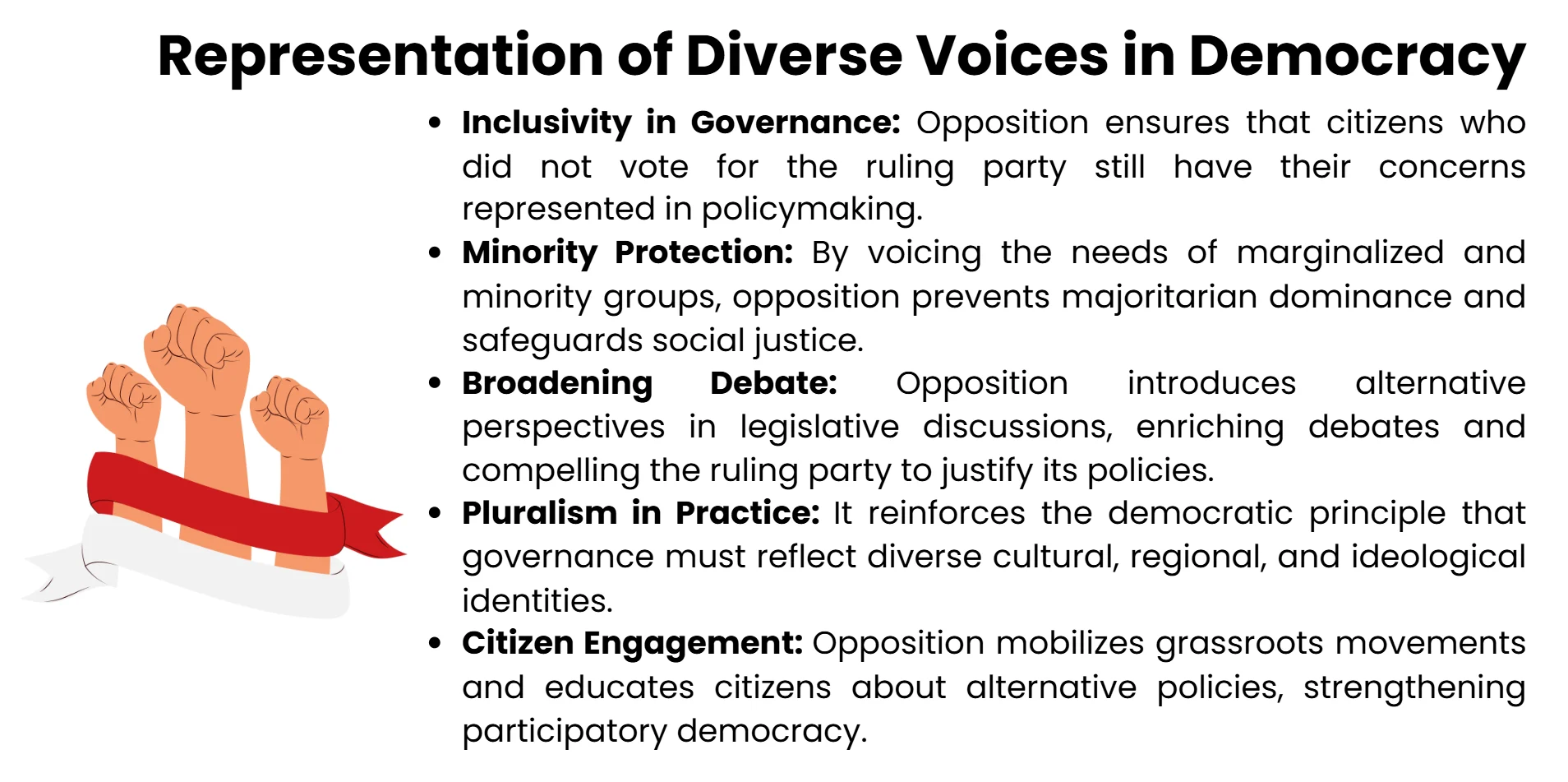
Democracy prospers when the concept of inclusivity is realized, and under this notion, the opposition holds a central role in ensuring that governance is the plurality of voices, identities, and interests that fill society. A strong opposition is essential to a healthy democracy, primarily because it ensures that different voices and perspectives are not only heard but also integrated into governance and policy-making. Its importance can be categorized into several key functions
Minorities Voices
Strong opposition provides a political platform for groups of people that may have different interests from the ruling party's agenda. The opposition weakens the threat of majoritarian domination by voicing the concerns of the minorities, the marginalized groups, and the citizen dissenters. This kind of representation is crucial to protecting social justice and preventing discriminatory policies that may jeopardize the establishment of democratic legitimacy.
Parliamentary Debate
The opposition parties present alternative views during legislative discussions, hence widening the scope of discussion. Their acts of intervention are a light into shadowed areas; challenge dominant discourses, and make the ruling party answerable to its policies. The presence of this plurality of perspectives strengthens deliberative democracy, whereby statutes and policies receive scrutiny, which is done through different perspectives before enactment.
Protecting Pluralism
Pluralism is a pillar of democratic governing, and the opposition demonstrates this principle by opposing homogenization in political talks. Through dissent, the opposition safeguards the character of governance as being one-dimensional and strengthens the idea that democracy is not defined by unanimity, but by contestation. This protection has ensured that national policymaking is not narrow or localized to be biased towards specific cultural, regional, and ideological characterizations.
Promoting the Participation of Citizens
The opposition focuses on the promotion of the culture of democracy by encouraging the participation of citizens outside the ruling party, as well. It informs the electorate about other policies, organizes grassroots movements, as well as promotes political literacy. The active engagement of such nature enables people to see democracy as a system of responsiveness capable of accommodating a variety of voices and not a domesticating position that reinforces one dominant story.
Policy Innovation and Constructive Criticism
A strong political opposition is vital for a healthy democracy as it provides essential checks and balances, drives policy innovation, and ensures government accountability through constructive criticism. Democracies flourish when the state is subjected to perpetual improvement, and it is the opposition that is central in these cyclical enhancements. The opposition makes sure that the policymaking process is dynamic and inclusive, as it offers critique and alternative suggestions.
Generator of Alternative Ideas
The opposition parties contribute to the ultimate democracy by offering alternative policy frameworks. Their propositions are often the result of different ideological orientations, regional interests, or social interests, thus expanding the constitutionality of the public policy. This kind of diversity forces the ruling parties to listen to other views that are not tied to their agenda, and this way, the administration will be representative of the needs of more people.
Healthy Criticism
The opposition criticism is not only obstructive; it is an important process of perfecting the laws and policies. During debates, question periods, and committee discussions, the members of the opposition point out the flaws of suggested laws. This inspection holds the ruling party to explain its policy and include the changes that have to be made, and this will improve the quality of governance and ensure that the actions taken are not hasty or ill-considered.
Promotion of Competition
The fact that there is a strong opposition also leads to healthy competition in the policymaking space. The ruling parties, out of concern for accountability during elections, are driven to be innovative and present viable solutions to safeguard the interests of the people. Challenges promoted by the opposition promote innovation, hence more inclusive and sustainable policies. This attribute of competition ensures that the sphere of governing is in transformation with the changes of social, economic, and technological phenomena.
Establishing State Goodwill
Positive criticism also enhances the trust of people in the institutions of democracy. Citizens find that the policies are not arbitrated, but they are subjected to high levels of debate and scrutiny. Opposite parties also assure voters that governance is responsible, accountable, and transparent. This process of participation improves legitimacy and strengthens the democratic aspect of opposition as a part of a progressive process.
Democratic Culture Strengthening
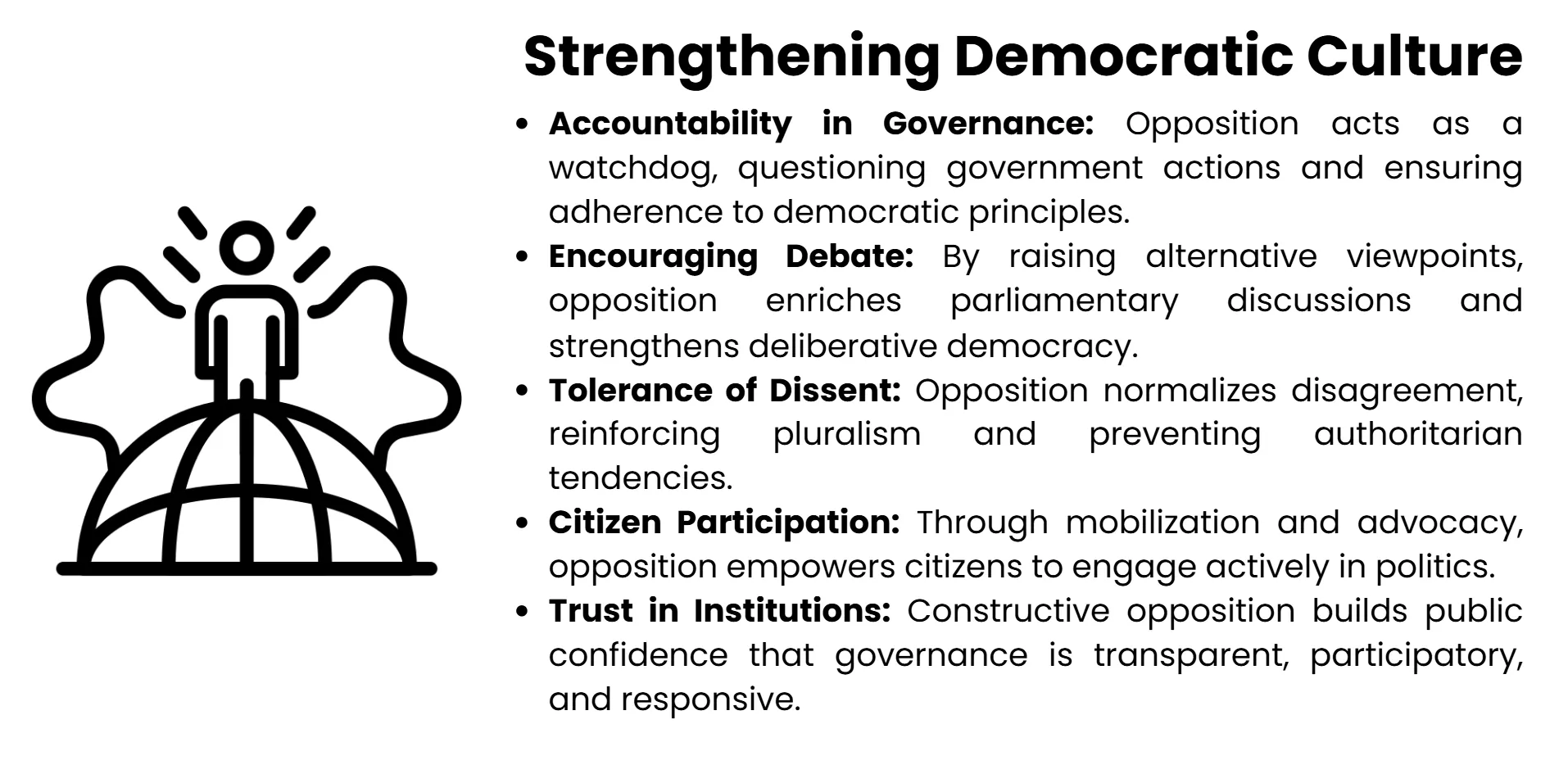
Democracy does not just survive through institutions and voting methods, but it is a culture based on participation, argumentation, and forbearance. The Opposition has a leading role in fostering this democratic spirit.A strong opposition is crucial for strengthening democratic culture by providing essential checks and balances, ensuring government accountability, and offering the public a viable alternative vision for the country.
Conscience of Governance
The main role of the opposition parties within the country is to play the watchdog of democracy and always question the actions and policies of the government. Their vigilance makes the governance to be regarding and accountable to the citizens. Through important matters, they remind the ruling party that democracy is not about having a free hand but being answerable to the people.
Developing a Culture of Debate and Deliberation
Both the existence and the culture of democracy are enhanced through a vibrant opposition that creates debate both in the legislatures and outside. Parliamentary debates, interactivity in media and forums, enable the opposition to persuade citizens to be critical of policies. This form of deliberation enhances democracy by rendering it active as opposed to passive, and therefore, governance is associated with reasonable thinking as opposed to unilateral ruling.
Tolerance of dissent
Dissent is an ingredient upon which democratic culture flourishes. Opposition is a realisation of this principle, whereby it attempts to offer other perspectives and criticism of other perspectives of dominance. The fact of their existence normalises discord, so that citizens can be assured that what democracy is not unanimity but pluralism. Such acceptance of dissent implies no polarisation and democratic strength against authoritarian propensity.
Promoting Civic Enterprises
Another way citizens are motivated through opposition is the grouping of causes and the formation of movements, as well as the introduction of different versions of governance. This participation gives the people the power to view themselves as participants, and not mere consumers of policy. Opposition enhances democratic legitimacy by extending political involvement and, development of an inclusive and accountable culture.
Conclusion
Democracy cannot merely survive on the basis of free elections and representative institutions, but also on the existence of a strong opposition. The opposition serves as a guard against authoritarian tendencies and adds pluralism and accountability to the administration through checks and balances, representation of multiple voices, constructive criticism, as well as the establishment of a democratic culture. Its perpetuation is not only limited to challenging authority but also to the formulation of inclusive policies and enhancing faith in policies by the population. A strong opposition, therefore, is one of the key pillars of democratic resilience, without which it is impossible to maintain transparency, stimulate innovation, and promote citizenship engagement in the long term.