India announced a defence budget of about 86 billion dollars for the 2026 financial year, up from roughly 81 billion dollars allocated previously. India's defence budget 2026-27 boost to ₹7.84 lakh crore, a 15.3% increase, highlight 'Make in India' and self-reliance. The Union Budget 2026-27 has allocated a record amount of INR 7.84 lakh crore to defence; hence, a significant increase in capital disbursement.
|
Key highlights
- ₹7.84 Lakh Crore for Defence
- Increase in Defence Budget
- Improving Indigenous Defence Manufacturing
- Modernisation and Capability Strengthening of Indian Defence
- Strategic and Economic Multiplier Effects for India
|
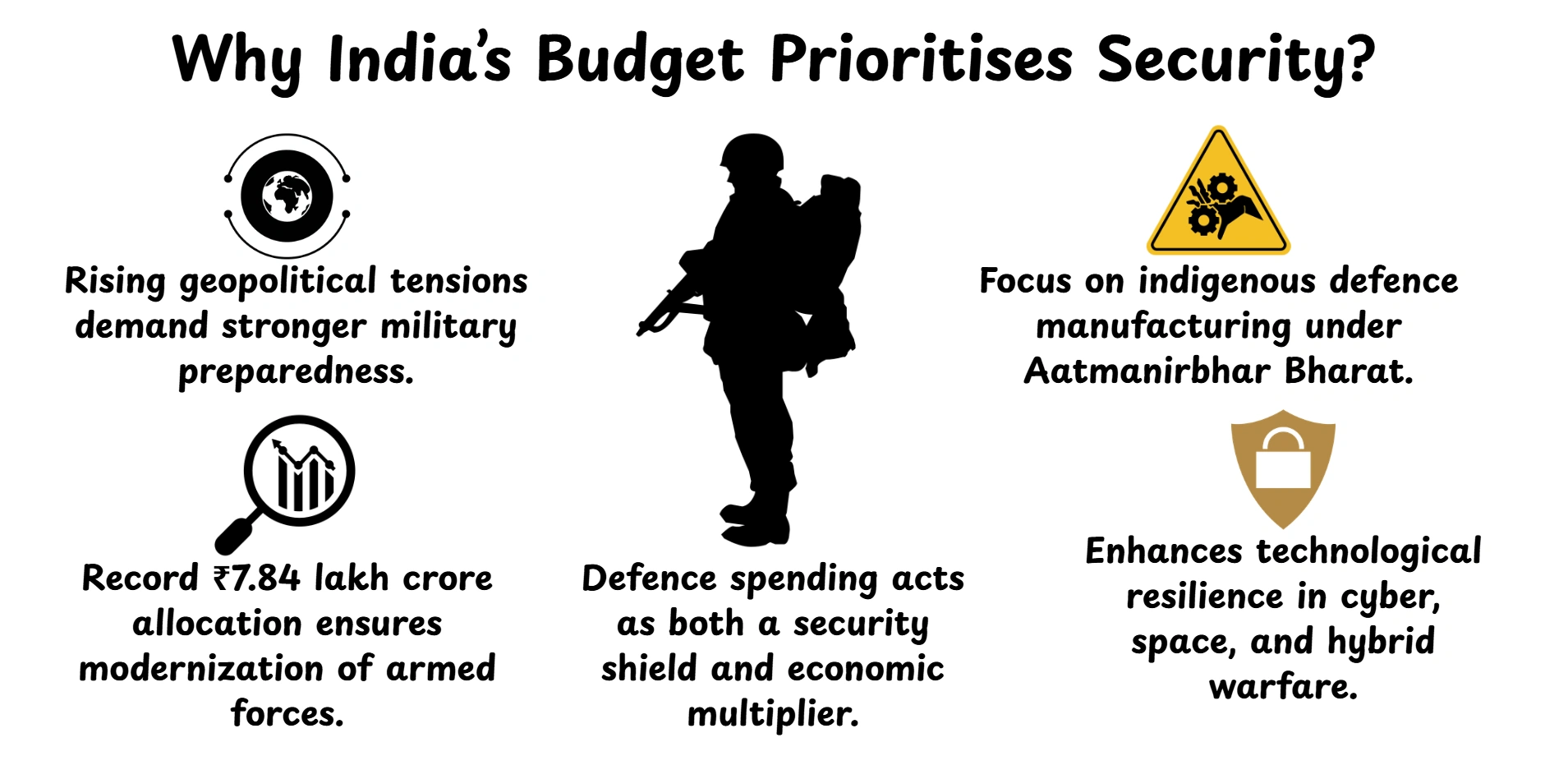
India defence budget 2026 The Union Budget 2026-27 has seen a major policy change with a record all-time INR 7.84 lakh crore set to be given to the defence sector. This is a boon of an increase in capital disbursement that has never been witnessed before, which indicates that the government identified the changing geopolitical challenges and the pressing need for military modernisation. Besides urgent security demands, the increased disbursement also shows a long-term investment in the development of local defence production as part of the Aatmanirbhar Bharat Initiative. The budget focuses on defence investment as a driver of economic growth, industrial resilience and national self-reliance, by focusing on indigenous production; technological innovation; and infrastructure development, rather than defence investment as a reaction to external threats. This is noteworthy, as it is the reaction of India to the increased geopolitical tensions and the urgent military requirements. It is significant in enhancing national security, increasing the production of indigenous defence products, and promoting the Aatmanirbhar Bharat vision.
What is India Defence Budget 2026-27?
India defence budget 2026 In the Union Budget 2026-27 announced on 1 February 2026, the Ministry of Defence received its highest-ever allocation of ₹7.85 lakh crore ($93.5 billion). This reflects a 15.19% increase over the previous year, following the military success of Operation Sindoor.
Defence in Union Budget 2026–27 :
- ₹7.85 lakh crore allocated to the Ministry of Defence in Union Budget 2026-27, the highest among all Ministries.
- The allocation marks a 15.19% increase over the FY 2025-26 Budget Estimates (BE) and accounts for 14.67% of total Central Government disbursement
- ₹1.39 lakh crore earmarked for procurement from domestic defence industries.
- ₹12,100 crore allotted to the Ex-Servicemen Contributory Health Scheme in FY 2026-27, 45.49% higher than FY 2025–26 at BE stage.
- Allocation to DRDO increased to ₹29,100.25 crore in FY 2026-27 from ₹26,816.82 crore in FY 2025–26.
With a strong emphasis on indigenous defence manufacturing, targeted investments in research and infrastructure, and sustained attention to veterans’ welfare, the Defence Sector budget aims to build a more secure and resilient India, in line with the long-term vision of Viksit Bharat@2047.
India defence budget- Increase in the Defence Budget
India's defence budget stand up from ₹2.53 lakh crore in 2013–14 to ₹7.85 lakh crore in 2026-27, an increase of approximately ₹5.32 lakh crore, marking about a three-fold rise. The record defence disbursement of the Union Budget 2026-27 in India demonstrates that financial prioritisation is not only a result of the changing security priorities but an outcome of a strategic response to the rising geopolitical tensions and the rise in security issues.
Security Concerns by India
In the Union Budget 2026-27, India has allocated an all-time high of ₹7.85 lakh crore for its defence budget, marking a significant 15% increase over the previous year's estimates. In India, the rate of increase in defence disbursement is 15.19% from FY2025-26, reaching 7.84 lakh crore, the highest compared to any other ministry. This rise is after the events that include Operation Sindoor, which was a four-day confrontation with Pakistan in May 2026 as a result of the Pahalgam terror attack that claimed 26 lives. The necessity of enhancing conventional and asymmetric deterrence and preparedness is highlighted by such developments.
Strategic Modernisation of Indian Defence
Capital disbursement of 2.19 lakh crore is channelled in the acquisition of the hi-tech systems like fighter aircraft, warships, submarines, artillery and unmanned platforms. Analysts point out that the security calculus of India has ceased to be limited to conventional warfare, but has expanded to cyber, space, and hybrid warfare, and this means that the process of modernisation must take a holistic approach.
Significance for India
The defence budget of India indicates a more general strategy reaction to the broken supply networks, technology competition and regional instabilities. Focusing on defence, New Delhi sends the message that it aims at protecting its sovereignty and establishing itself as a force to be reckoned with in the Asian strategic identity dilemma.
Improving Local Defence Manufacturing
The year 2026-27 Union Budget has given unprecedented priority to strengthening the defence sector in India by manufacturing these products in the country; hence, the policy falls in line with the vision of the Aatmanirbhar Bharat and harmonising the reliance on foreign products.
Encourages indigenisation of Indian Defence
The government plans to procure almost 75 percent of capital acquisitions, and this indicates a radical change in policy of going totally towards the path of self-sufficiency. This allocation will make certain that local companies, MSMEs, and other private stakeholders play a leading role in the defence supply chain in India, which will diminish the susceptibility to outside shocks and increase technological independence.
Boost to India’s Defence-Tech Development
Investment in future-oriented technologies like AI, robotics and cyber defence is also prioritised in the budget and is promoted to be developed by cooperation between defence public sector undertakings (DPSUs), the private industrial sector and research establishments. This approach makes innovation and operational preparedness deeper, and the Indian defence ecosystem is demonstrated as a global one.
Economic Significance for India
An increased defence production within the country has further economic effects. It creates jobs, spurs other related sectors and fosters skills. In addition to this, India’s import dependency reduces and, at the same time, generates resilience to geopolitical shocks in the supply chain by decreasing the reliance on imports. This continues to boost the credibility of India as an emerging power in Asia.
Modernness and Capability Strengthening of Indian Defence
The change in India's defence budget FY2026-27 shows a clear transition to modernisation of technology and capabilities, which shows the willingness of the government to have a military force ready to meet the new age challenges as the regional instability increases.
Expanding New Defence Platforms
In the budget 2026-27, INR 2.19 lakh crore has been allocated for the capital outlay, which is 17.6 percent higher than the budget of last year. This is allocated to procurement of sophisticated fighter aircraft, naval warships, underwater missiles and artillery, with India's armed forces being technologically up to the task in the event of changing threats.
Integration of emerging defence technologies
In addition to traditional platforms, the budget focuses on AI, robotics, cyber defence, and space security as characteristic of a strategic transition to the readiness of hybrid wars. Such attention to future-oriented technologies improves operational preparedness and coincides with the trends in the modernisation of the military in the world.
Increasing Research and Cooperation in Defence
The government has also encouraged co-operation between the Defence Research and Development Organisation (DRDO), DPSUs and the private industry in the area of innovation and less reliance on imports. As analysts point out, this ecosystem strategy not only speeds up the capability-building process but also aids the Aatmanirbhar Bharat initiative to enhance the domestic technological knowledge.
Strategic and Economic Multiplier Effects for India
The defence budget in the Union Budget 2026-27 is not only a reaction to the security prerequisites but also an influence of economic development and an instrument of strategic power through the multiplier effect.
India’s Defence Disbursement as an Economic Stimulus
The defence budget has increased to 7.84 lakh crore, which is an increase of 15.18% compared to FY2025-26. Analysts note that this high form of capital spending creates jobs in the defence industry, military logistics and support industries. The trend of corporate sourcing locally (almost 75% of capital acquisitions are allocated to Indian companies) causes a certain level of demand among MSMEs and privately owned businesses, which consequently activates the development of industries and innovations.
Strategic Independence for India
In addition to the economic aspect, the defence disbursements increase the strategic independence of India. India is reducing its reliance on imports and enhancing its bargaining strength in international geopolitics by investing in indigenous production and high technologies. The increase in capital disbursement reached 17.62%, which allowed obtaining new platforms that strengthened deterrence and credibility in the contested security landscape of Asia.
Multiplier effects on a long-term basis
The multiplier impacts on research, skill development and infrastructure. The defence relationship with universities and industry has facilitated spillovers in other sectors of the economy because of the technological advancements generated by research and development, and employment opportunities boost consumption and government revenue. This twin effect of security and growth, according to experts, is the reason defence disbursement is ready to become a pillar of the long-term strength of India.
Conclusion
To summarize, the provision of the record defensive disbursement in the Union Budget 2026-27 indicates a calculated meeting of strategic neediness and growth expectation. Through laying more emphasis on capital disbursement, the government aims at offering an immediate solution to the current security issues and at the same time promote domestic production, technological advancement, and industrial resilience under Aatmanirbhar Bharat. The defence spending, therefore, does not only act as a form of spending but rather as a form of investment in sovereignty, economic development and strategic independence and puts India in a position to emerge as a credible and autonomous power in a rapidly volatile global order.
Frequently Asked Questions (FAQ)
India's defence budget stands up from ₹2.53 lakh crore in 2013–14 to ₹7.85 lakh crore in 2026-27, an increase of approximately ₹5.32 lakh crore, marking about a three-fold rise.
India's annual financial statement is known as the Union Budget of India. The union budget is the government's plan regarding the finances, revenues, and spending for the upcoming financial year.
The four main types of business budgeting methods are Incremental, Zero-Based (ZBB), Activity-Based (ABB), and Value Proposition Budgeting, each offering a different approach to planning spending by either adjusting past budgets.
The United States maintains by far the world’s largest defence budget, outspending every other country by a wide margin. In 2024–2025, U.S. military expenditures are estimated to range from about $880 billion to more than $949 billion annually, with China and Russia trailing as the second- and third-largest spenders.
India’s military spending for the 2026–27 fiscal year is set at ₹7.85 lakh crore, amounting to roughly 2% of its projected GDP. This represents a 15.19% increase over the previous year, with a strong emphasis on modernization, capital expenditure rising to ₹2.19 lakh crore—and self-reliance, according to Forbes India.
Frequently asked questionsFrequently asked questions
What is India Defence Budget 2026-27?
India defence budget 2026 In the Union Budget 2026-27 announced on 1 February 2026 , the Ministry of Defence received its highest-ever allocation of ₹7.85 lakh crore ($93.5 billion). This reflects a 15.19% increase over the previous year, following the military success of Operation Sindoor.
India defence budget- Increase in the Defence Budget?
India's defence budget stand up from ₹2.53 lakh crore in 2013–14 to ₹7.85 lakh crore in 2026-27, an increase of approximately ₹5.32 lakh crore, marking about a three-fold rise. The record defence disbursement of the Union Budget 2026-27 in India demonstrates that financial prioritisation is not only a result of the changing security priorities but an outcome of a strategic response to the rising geopolitical tensions and the rise in security issues.
Improving Local Defence Manufacturing?
The year 2026-27 Union Budget has given unprecedented priority to strengthening the defence sector in India by manufacturing these products in the country; hence, the policy falls in line with the vision of the Aatmanirbhar Bharat and harmonising the reliance on foreign products.
Modernness and Capability Strengthening of Indian Defence?
The change in India's defence budget FY2026-27 shows a clear transition to modernisation of technology and capabilities, which shows the willingness of the government to have a military force ready to meet the new age challenges as the regional instability increases.
Strategic and Economic Multiplier Effects for India?
The defence budget in the Union Budget 2026-27 is not only a reaction to the security prerequisites but also an influence of economic development and an instrument of strategic power through the multiplier effect.