Key highlights
- One million species under threat
- Extinction causes loss of resources
- Destroys indigenous knowledge
- Need global conservation efforts
- Local community participation
|
Currently, humanity is entering an extinction crisis caused by human anthropogenic stress, which threatens one million species, thereby destroying biodiversityand the treasure trove of irreplaceable information. Each organism has its unique adaptive nature, cultural significance, and potential in the fields of medicine, technology, and agriculture. Extinction of such species inevitably leads to the degradation of ecosystems, impediments to human progress, and cultural losses, thus enhancing the need to implement holistic conservation strategies, sustainability, and safeguardingthe living library of the Earth.
Tips for Aspirants
This article is important for the UPSC CSE and the State Public Service Commission (PSC) exams since it incorporates the concepts of biodiversity, ethics, governance, and sustainability, which are some of the focal points of the GS papers and essay writing. |
Relevant Suggestions for UPSC and State PCS Exam
- According to the Intergovernmental Science-policy Platform on Biodiversity and Ecosystem Services (IPBES), nearly one million species are under threat due to anthropogenic activities like deforestation, pollution, and climate change.
- Extinction eradicatesthe Genetic archives needed in medicine, agriculture, and technology.
- Biodiversity loss will destroy Indigenous knowledge systems, ethical responsibilities, and spiritual traditions.
- Global obligations like KMBA seek to protect 30 per cent of all terrestrial and marine environments by 2030.
- Local lands controlled by indigenous populations have a high level of biodiversity, and participatory governance of Native lands improves conservation success.
|
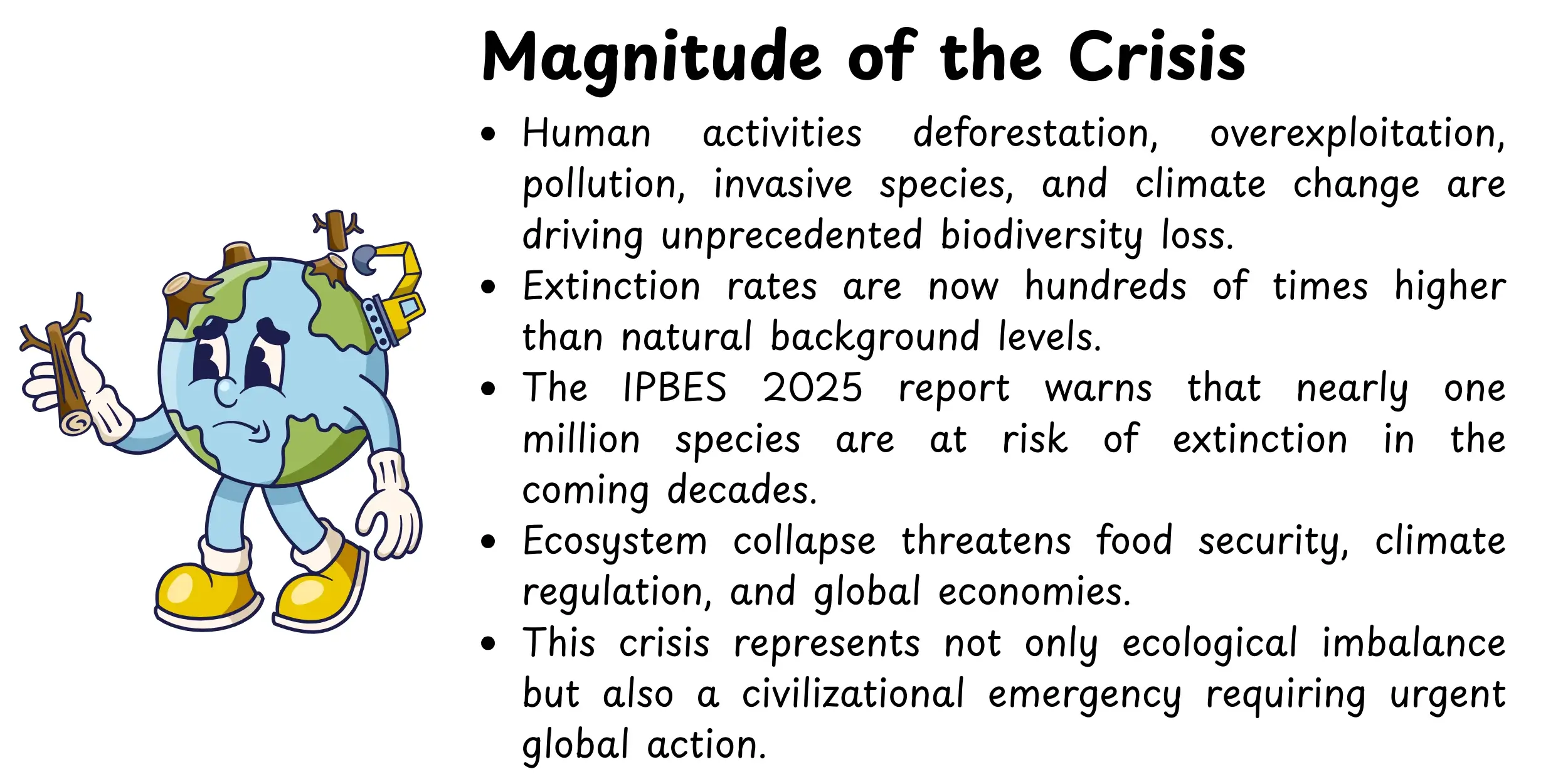
The modern-day crisis of biodiversity is one of the greatest problems faced bythe world in the twenty-first century. Scientific studies reveal that an array of human actions, such as deforestation, habitat fragmentation, overexploitation, pollution, and climate change, are contributing to an unprecedented level of species extinction. It is estimated today that almost one million species are on the verge of extinction in the next few decades, a trend that is comparable to the great mass extinctions that happened on Earth in the past. Still, there is much more than ecological disequilibrium in the implications of extinction. Every species represents a kind of special repository of the evolutionary knowledge, ecological roles, and biochemical innovations, which are not yet very well studied. Eradication of these life forms will not only be canonized as they disappear but also missed as sources of medical discoveries, agricultural stability, and technological influence.
Understanding Nature’s Wisdom and Its Value
Nature's wisdom refers to the practical insights and fundamental truths about life, existence, and ourselves that we can gain by observing the natural world's systems and patterns. The value of this wisdom lies in providing a blueprint for building resilient, sustainable, and meaningful personal lives, societies, and economies. In addition, extinction also undercuts cultural practices, native knowledge regimes, and ethical duties associated with the management of life. Here, it is crucial to realize that the extinction crisis should be perceived as a scientific and a civilizational crisis. To resolve, it takes a multi-dimensional solution which incorporates conservation science, sustainable development, and international collaboration.
Extinction Crisis
The extinction crisis that is developing is an unprecedented combination of magnitude and speed. This process is largely caused by the anthropogenic forces; the problem of such obliteration of a considerable portion of the biodiversity of the Earth is highly threatening, and the ecological stability is under threat, as well as human welfare.
Rapidly Increasing Species Loss
The current empirical evaluations or analyses indicate that the current extinction rates far out-compete natural rates by several orders of magnitude. Close to one million taxa or organisms could vanish in the next few decades unless changes happen in how the current trends are implemented, according to the Intergovernmental SciencePolicy Platform on Biodiversity and Ecosystem Services. Deforestation, excess exploitation, pollution, and climate change are the primary factors that cause this acceleration and render ecosystems unstable and incapable of withstanding environmental disruptions.
Biodiversity: Global Threats
According to a report of the United Nations (2025) on Sustainable Development Goals, the global forest cover continues its steady depletion, with the safeguarding of important biodiversity habitats remaining at a standstill. Forest ecosystems that harbour over 80-percent of the land species are particularly vulnerable. The simultaneous loss of coral reefs, wetlands, and grasslands also demonstrates the vastness of this crisis. These habitats not only operate as biotic assemblies, but also as key governing systems with regard to climate, hydrological cycles, and food security.Global biodiversity faces severe threats from Habitat Loss, Climate Change, Pollution, Overexploitation, and Invasive Species, driven primarily by human activities like population growth, land-use change, and unsustainable resource consumption.
Ecological and Civilizational Implications
The species emigration has a ripple effect and, as species decline, not only affects the important processes within the ecological network, including pollination, nutrient cycling, and soil fertility, but also significantly reduces biodiversity. These upheavals have direct negative effects of disrupting agricultural productivity and food systems, thus jeopardising human survival. In addition to ecological consequences, the phenomenon of extinction is a crisis of civilization. When medicinal plant taxa or keystone species are lost, the chances of scientific discovery are lost, and the indigenous knowledge systems have co-existed with the biodiversity over thousands of years.
A Call to Transformative Change
The IPBES Transformative Change Report states that consumption, production, and governance system changes are prerequisites to the reduction of biodiversity loss. The application of interventions is not enough because we should use transformational policy frameworks to align conservation goals with the focus on sustainable development. With the adoption of the Kunming-Montreal Global Biodiversity Framework, biodiversity depletion will be addressed with more ambitious goals set, but the effectiveness of the final results is based on both international cooperation and national responsibility. Without such measures, the extinction crisis will continue to dissipate the pillars of ecological and cultural health to reduce them.
Biological Knowledge and Innovation Loss
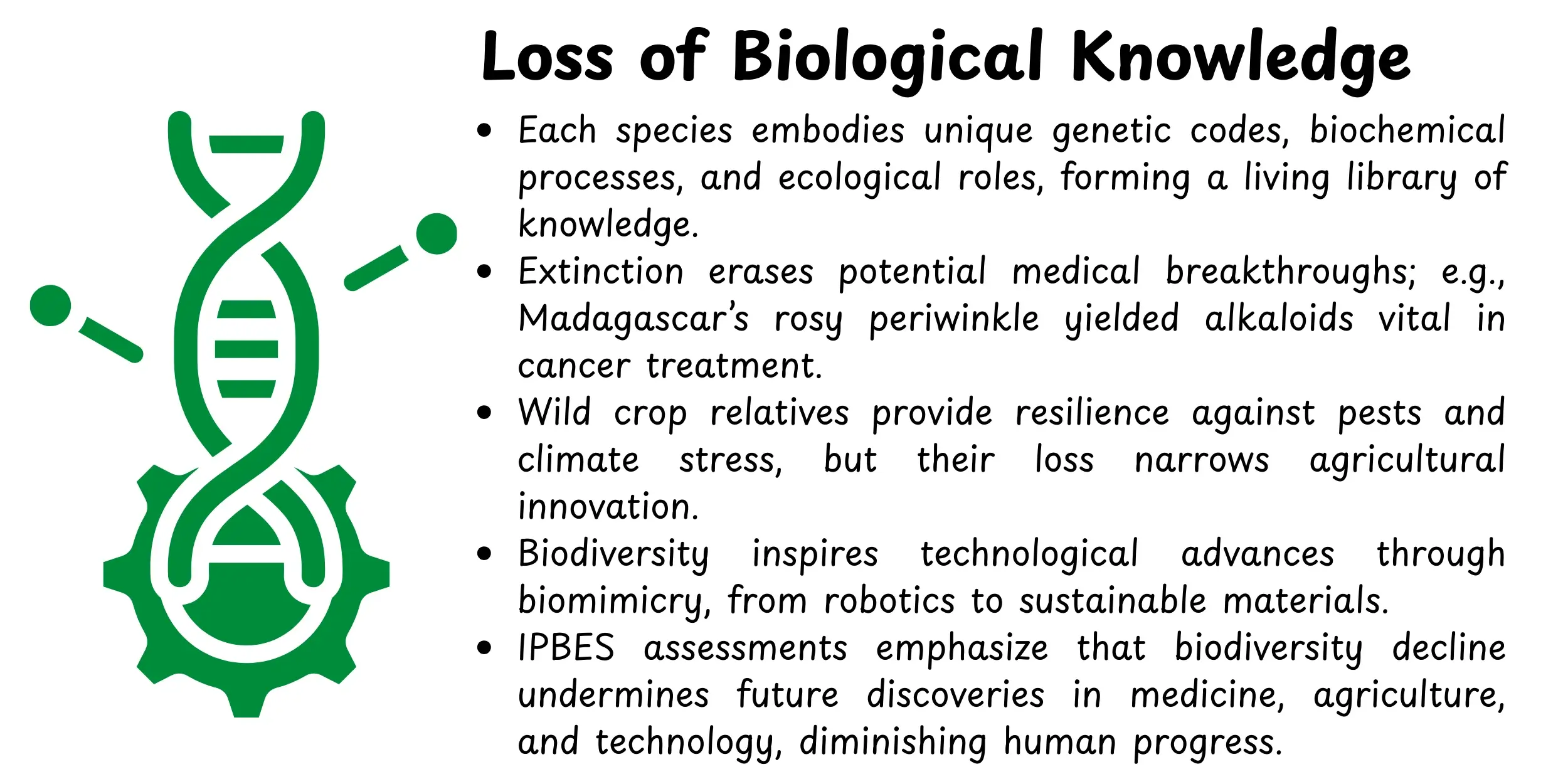
Species extinction is not only an ecological disaster, but it represents an irreversible loss of biological knowledge and new potential inventive opportunities that nature has stored, thuslimiting the scientific and cultural horizons of the human race. The loss of biological knowledge and innovation is driven by two main factors: the ongoing extinction of species (biodiversity loss) which erases potential solutions to human challenges, and the erosion of scientific expertise in fields like botany which hinders our ability to understand and leverage the natural world.
Biodiversity: Depository of Knowledge
Each taxon has its own unique evolutionary adaptation, genetic orders, and biochemical pathways, which is a cumulative living store of knowledge. The loss of taxa forever by destroying genetic resources is proven by a 2025 examination of biodiversity futures, as the recovery would benefit pharmacy, agriculture, and ecosystems in terms of resilience. Knowledge accumulated by geologic record time intervals is considered irrecoverable when species become extinct.
Medical and Technological Innovations
Modern pharma often obtains compounds of green plants, fungi, and marine organisms; one example is the Madagascar rosy periwinkle (Catharanthus roseus) as a source of alkaloids required to treat paediatricleukaemia. Also, bio-mimetic strategies, involving the inspiration of animal physiology and behaviour, have delivered results in both robotics and materials science. The World Economic Forum emphasises that the declining biodiversity destroys future possibilities of these types of innovations, because within future streams of creative potential, the potentials get destroyed before they can be empirically explored.
Agricultural and Ecological Intuitions
Food security is also based on biodiversity: the wild counterparts of domesticated crops have genetic variations that provide pest, pathogen, and environmental resistance. The disappearance of these taxa narrowsthe genetic pool available for breeding resilient varieties. Moreover, the sustainability of agronomic practices can be provided by ecological information that is coded in interspecific interactions, especially pollination networks.
Cultural Intellectual Aspects
Outside the scientific connotations, species contain cultural and intellectual legacy. The indigenous people often have a vast amount of ecological knowledge that is related to the local biodiversity, which makes the sustainable management of resources. The extinction of species harms these connections, crushing culture and religious traditions. As it is stressed in The Conversationjournal thateach extinction causes a rippleeffect across the ecosystems, scientific fields, and cultural directions,thus diminish the wisdom of humanity.
The Cultural, Ethical, and Spiritual Dimensions
The extinction crisis is not only a biological and ecological crisis, but it is also a great cultural, ethical, and spiritual crisis. Every species represents meanings, traditions, and values that cannot be simply described scientifically.The Cultural, Ethical, and Spiritual Dimensions refer to the interconnected layers shaping human experience, encompassing societal norms (culture), moral principles (ethics), and inner beliefs (spirituality) that guide values, behaviors, and meaning, particularly evident in areas like healthcare, education, and environmental stewardship, influencing everything from food choices to technology's impact.
Aboriginal Knowledge and Culture
The biodiversity-based knowledge systems are highly complex systems developed by the indigenous people across the globe. Such traditions are summarized as the principles of sustainability, ecological intelligence, and cultural identity. Research shows that indigenous knowledge is a totality of ecosystems developed over generations. The extinction of species dilutes these knowledge systems with cultural continuity and creates a loss in the heritage that the world has. In the case of the Baiji River dolphin extinction in China, the disappearance of folklore and ecological memory of the area was triggered by the demise of the dolphin.
Ethical Responsibility to Life
The ethical aspect of extinction is based on the nature of human beings as custodians of the heritage on Earth. In academic discourse, it is theorized that conservation has to incorporate moral responsibility, viewing species as objects of intrinsic value other than a utilitarian role. The loss of species gives rise to epistemic problems of the issue of intergenerational justice: what right does this generation have to deprive future generations of biodiversity and the knowledge it contains?
Spiritual Relations and HumanIdentity
There are often species incorporated in spiritual traditions, which represent a symbol of resilience, rebirth, or purity. The conservation study by the MacArthur Foundation suggests that spiritual values play a significant role in conservation praxis since they contribute to human identity and the sacred relationship existing between people and nature. Extinction breaks these links and disrupts the spiritual practices and cultural resilience. Depending on the example of New Zealand, the elimination of the giant moa species resulted in the destruction of the ecological knowledge, as well as the spiritual histories that were bound up in the native cosmologies.
Integrating Values with Conservation
Modern conservation practices have understood that the protection of biodiversity cannot be done in a purely scientific manner. The combination of the culture, ethics, and spiritual aspects further facilitates conservation results through bringing harmony between environmental goals and human aspects. This kind of integration means that the efforts of conservation are not just a species preservation activity but a way of protecting the cultural and moral life of mankind.
Way Forward
The extinction crisis is both a strong force and, at the same time, offers potential sources of transformative action. The integration of empirical science, policy frameworks, and community engagement is a rich pathway to conservation and hope, and therefore, to safeguard biodiversity and to ensure the long-term viability of human societies.
Empowering International Systems
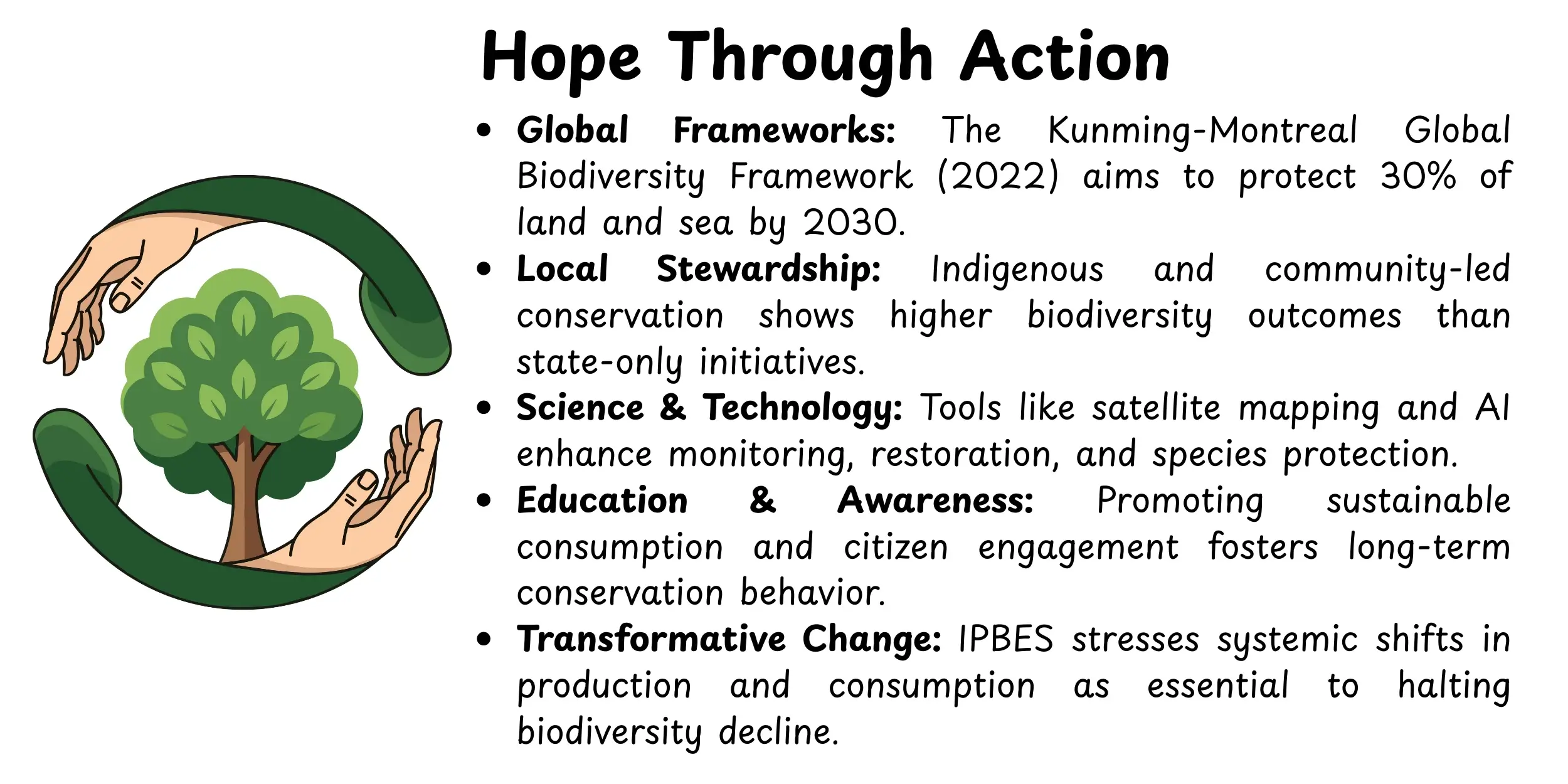
The framework of harmonious action is composed of international accords. To stabilise the situation, there have been goals set by the Kunming-Montreal Global Biodiversity Framework to safeguard thirty percent of both terrestrial and marine ecosystems by the year 2030. The United Nations 2025 Biodiversity Progress Report has indicated that over one hundred sovereign states have already set off on a path towards matching their national strategies with these aspirations. Such frameworks pre-empt accountability, funding and inclusiveness, thus setting conservation into the global governance institutions.
Community Involvement
Conservation programs are often dependent on the local populations. Empirical research shows that territories managed by the indigenous people yield more biodiversity in comparison with the territories managed by states. Conservation outcomes become better by giving the local community the ability to manage the same through participatory governance, sustainable livelihoods, and recognising indigenous rights. Such local involvement, as the examples of the Joint Forest Managementprogrammes in India, shows how community-based projects are capable of recovering the lost ecosystems through preserving the traditions of the locals.
Technology, Innovation, and Science
Technological innovation and scientific inquiry are the key guides. Advances in genetic sequencing, ecological surveillance and artificial intelligence enable better monitoring of species and habitats. Biodiversity mapping, e.g. through satellite, has been used to identify stakeholder conservation areas where hot spots have been determined. The World Economic Forum (2025) points out that, with the application of technology to conservation, its implementation can also speed up the process of restoration, and minimise it in terms of costs, which makes it possible to implement substantial measures.
Education
Long-term conservation requires a change in human behaviour. Awareness about the environment helps to create awareness, and sustainable consumption helps to reduce the strain on the environment. Awareness campaigns with the message of plant-based meals, decreased use of plastics, and ethical consumerism also have a measurable effect on biodiversity. The 2025 IPBES report makes it clear that the transformative change in the consumption and production patterns is crucial to stop biodiversity decline, and thus, citizens play a pivotal role in conservation.
Conclusion
The modern extinction crisis highlights the inseparable realization of the ordeal of the nexus between biodiversity and human progress. Every specieshas unique ecological functions, cultural heritage, and hidden scientific knowledge, which makes the loss of the species an elaborate tragedy. The loss of the biological forms eradicates the integrity of ecosystems, decreases the ability to be innovative, and weakens cultural and spiritual identity. Nevertheless, the way out of destruction that includes international mechanisms, domestic management, scientific breakthroughs, and lifestyle modification, offershope. Protecting biodiversity is not only a duty towards the environment, but it is a moral and civilizational duty. Through maintaining the living repository of the earth, humanity ensures ecological well-being, cultural continuity, and prospects of new discoveries necessary to achieve sustainable development and collective survival.