|
Key highlights
- 10 Years of the Paris Agreement
- Its Drawbacks
- Voluntary commitment of NDC
- US Withdrawal
- Regional and National Initiatives
- Future Governance
|
The article evaluates the achievements and failures of the Agreement on the 10th anniversary of its adoption. It explores the shift towards sovereign country actions. It further questions the climate action metamorphosis through the lens of how states are redefining the nature of climate policy that transcends collective loyalty to localized and practical modalities of action, and the future direction of the global agenda. 10 years after its adoption, the Paris Agreement presents a mix of promise in galvanising global climate action and the clean energy transition, and paradox in that its goals are significantly off-track, and key issues like finance and equity remain unresolved.
|
Tips for Aspirants
The article is an invaluable addition to UPSC CSE and State PSC Exams because it contributes to the understanding of climate governance, international diplomacy, equity, and policy developments, which are fundamental units in the environmental and international relations course.
|
|
Relevant Suggestions for UPSC and State PCS Exam
- Paris Agreement (2015): The agreement is a widely praised document aimed at limiting global warming to less than 2°C.
- A free commitment of Nationally Determined Contributions (NDCs) without enforcement is a major weakness.
- Ambition Gap: It is being diminished by the existing contribution of a warmer world at 2100 with 2.4-2.6 °C, significantly higher than the promises set.
- Finance Problems: The promised annual climate finance of $100 billion dollars has not been realised, and adaptation financing has not been adequately done.
- Regional Waypoints: The EU Green Deal, the renewable growth of China, the climate-friendly development of India, or the U.S. sub-national initiatives are examples of different ways to manage them.
- Enhanced accountability, equitable financing, and technology transfer, coupled with inclusive models of governance, are much needed in the future.
|
In 2015, it was a historic process, and the Paris Agreement brought about a collective framework to curb global warming to below 2˚C and even an aspirational 1.5˚C. It was imagined as a consensus-based agreement, which foresaw the amount of contributions by nations (nationally determined contributions, NDCs), openness, and fairness, and thus it established itself as a cornerstone of multilateral climate diplomacy. With the day of the tenth anniversary of the Agreement, November 2025, the efficacy and legitimacy of the Agreement are put to an increasing number of questions. Ratification backed up by the U.S. withdrawal, along with the imbalanced development of signatories, has revealed the weakness of the structural nature of the pact’s voluntary and non-binding framework.
Also, different priorities of nations, economic limitations, and geopolitical strains have influenced a range of countries to implement an independent course of action, frequently favouring national strength and energy shifts to the united partnership. This change is an indication of a change in climate narrative: of a coherent world-system becoming disaggregated, of localized responses to globalization, which reveal the crisis of development in maintaining a balance between developmental needs and those of environmental protection. The resulting discourse presents essential issues about the future of the international control of climate, the suitability of existing systems, and the future of establishing a more responsible, fair, and realistic framework of handling the growing warming problem.
What is the Paris Agreement?
The Paris Agreement is a legally binding international treaty on the climate change, made in the year 2015 by 195 countries, aiming to limit global warming to well below 2°C, preferably to 1.5°C, compared to pre-industrial levels, by decreasing greenhouse gas (GHG) emissions and increasing climate resilience through cooperative, national commitments (Nationally Determined Contributions) that become more ambitious over time. It also focuses on climate finance, adaptation, and transparency, requiring countries to report on their progress and align financial flows with climate goals.
How many countries signed the Paris Agreement?
The total of 196 countries and the European Union adopted the Paris Agreement in the year 2015, and as of late 2020, 193 countries and the EU had signed, with 189 becoming formal "Parties" by ratification, making it a nearly universal commitment to tackle climate change. The agreement aims to limit global warming to well below 2°C, ideally 1.5°C, above pre-industrial levels.
Paris Agreement at 10 Years
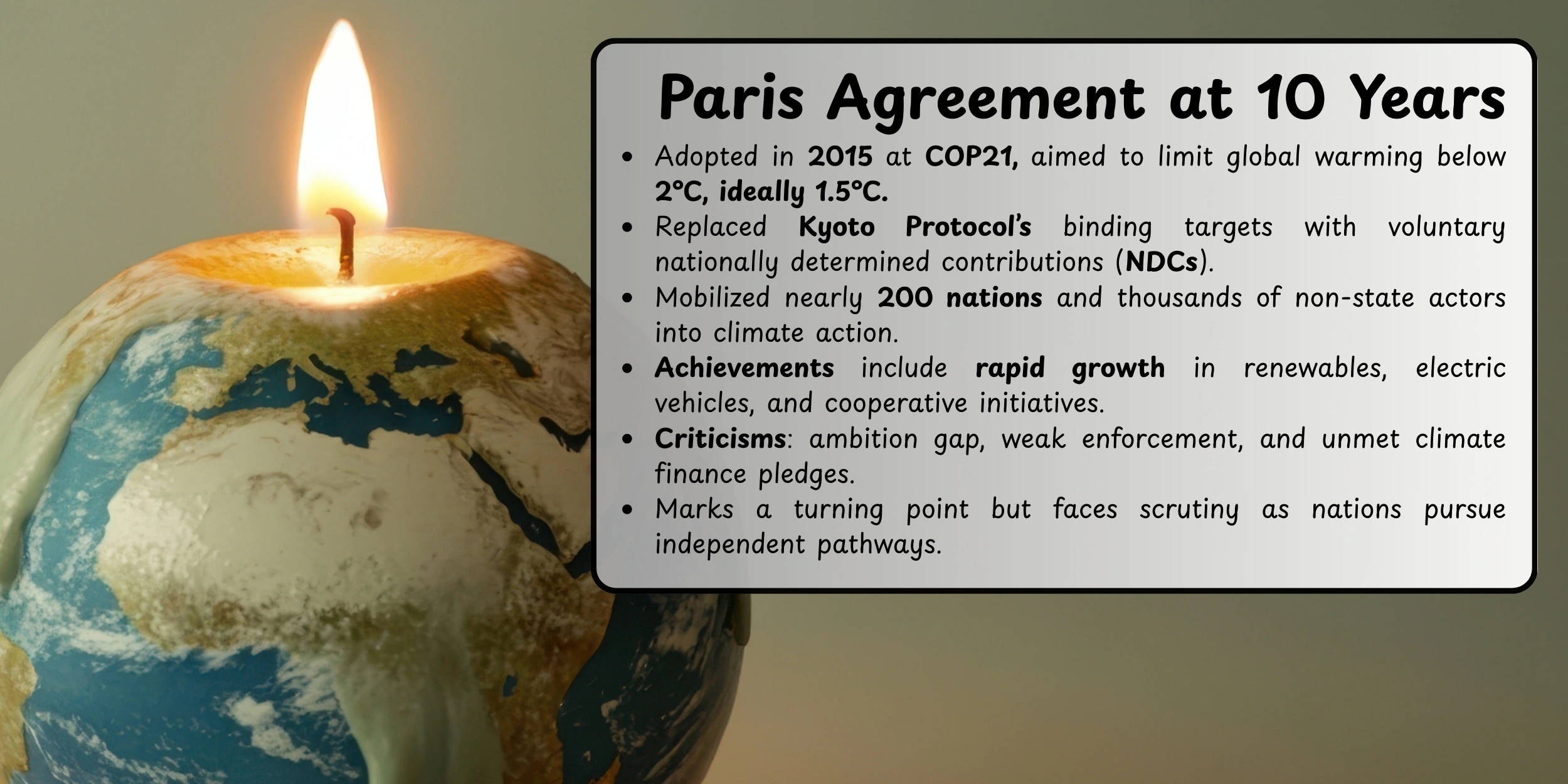
The Paris Agreement, adopted in December 2015 at the UN Climate Change Conference (COP21) in Paris, is a landmark, legally binding international treaty to combat climate change by limiting global warming to well below 2°C (preferably 1.5°C) above pre-industrial levels, requiring countries to submit progressively ambitious emissions reduction plans (Nationally Determined Contributions) and providing frameworks for adaptation and climate finance. The Paris Agreement entered into force in 2016 and aims to achieve a climate-neutral world by mid-century through collective national efforts and transparent review processes.
The historical background-
The Paris Agreement is a global agreement that is based on the premise of the bottom-up framework. As one of the outcomes of the 2015 COP21 summit, replacing the Kyoto Protocol was initially a prescriptive agreement, and its goals proved overly ambitious to succeed; it was replaced by the Paris Agreement. Its major goal has been to limit the temperature increase of the world to much less than 2˚C, ideally, 1.5˚C, and at the same time focus on equity and accountability. Unlike antecedent treaties, the Agreement pre-empted voluntary commitments and thus demonstrated a wider inclusivity.
Progress and Achievements-
The Agreement has triggered a new level of engagement in the last ten years. The Council on Energy, Environment and Water (CEEW) has reported over 475 voluntary climate programs that have been initiated in over 40,000 businesses, investors, and local governments. The Yearbook of Global Climate Action 2025, prepared by the United Nations Framework Convention on Climate Change (UNFCCC), highlights the fact that the non-state actors, which are cities, civil societies, and corporations, are now crucial agents of action, specifically in the rapid deployment of renewable energy and resilience measures. Such developments affirm the mainstreaming perspective of the Agreement on the taking of action on climate outside national governments.
Challenges and Criticisms
Although these gains are witnessed, structural gaps are evident. Organisation for Economic Co-operation and Development (OECD) 2025 review comments that voluntary commitments often are not enforceable, hence making the development uneven within different regions. The withdrawal of the United States, along with the differing national agendas, has diluted the unity. The world continues to increase its emissions. According to the United Nations, the existing NDCs are putting the world on a course toward 2.4 to 2.6 °C warming by 2100, a trajectory that is far higher than the Paris target. The disparity between the goals and the action, therefore, created doubts in the viability of the Agreement.
Shifting Narrative
Ten years hence have passed, and the environmental story is shifting to jointly-made commitments to local, more practical approaches. The European Union and green deal, the Chinese build-up of renewable energy sources, and Indian climate-friendly developmental initiatives are some of the examples where countries are working in independent directions. Although such efforts reflect the national priorities, they also create uncertainty regarding the future of governance on the international level. Researchers argue that the next stage should strengthen accountability, finance structures, and transfer of technology to ensure equity as well as effectiveness.
Problems and Objections of Paris Agreement
Although the Paris Agreement was feted as a breakthrough in climate diplomacy, it has lately received criticisms with regard to its design and action. Its restrictions are increasingly gaining ground in the global discourse.
Non-Engagement in Compliance
The first and most important critique is in terms of the voluntariness of nationally determined contributions (NDCs). Unlike the legally binding targets under the Kyoto Protocol, the Paris framework is based on self-proclaimed pledges, which are not allowed to undergo the legally binding mechanisms. Such an organizational characteristic has contributed to high levels of unequal ambition and real delivery. According to the OECD findings, according to its report on the Paris Agreement at 10 Years, over 60 percent of surveyed policymakers note weak accountability as one of the key obstacles to successful climate action.
Aspiration Disparity and Growing Emissions
Despite the widespread participation in the Agreement, the Agreement has not successfully bridged the gap in terms of emissions. According to the evaluation of the United Nations Environment Programme (2025), the present commitments put the world on a path of 2.4-2.6°C of global warming by 2100, which is much higher than the 1.5˚C mark. Such incorporation highlights the inadequacy of voluntary commitments to cope with the urgency expressed in terms of modern climate science. Sceptics argue that the Agreement is prone to be more symbolic than transformative if ambition is not substantially escalated.
Geopolitics and Retreat
The withdrawal of the U.S. in 2020 gave a symbolic strike against the credibility of the pact. Being the second-largest emitter in the world, the Paris Agreement U.S. withdrawal weakened the overall momentum and increased doubt in other countries. In spite of the fact that many countries renewed their commitments, the episode demonstrated the frailty of consensus-based climate governance, as well as expressed doubts about the strength of the Agreement in changing political contexts.
Equity and Finance Concerns
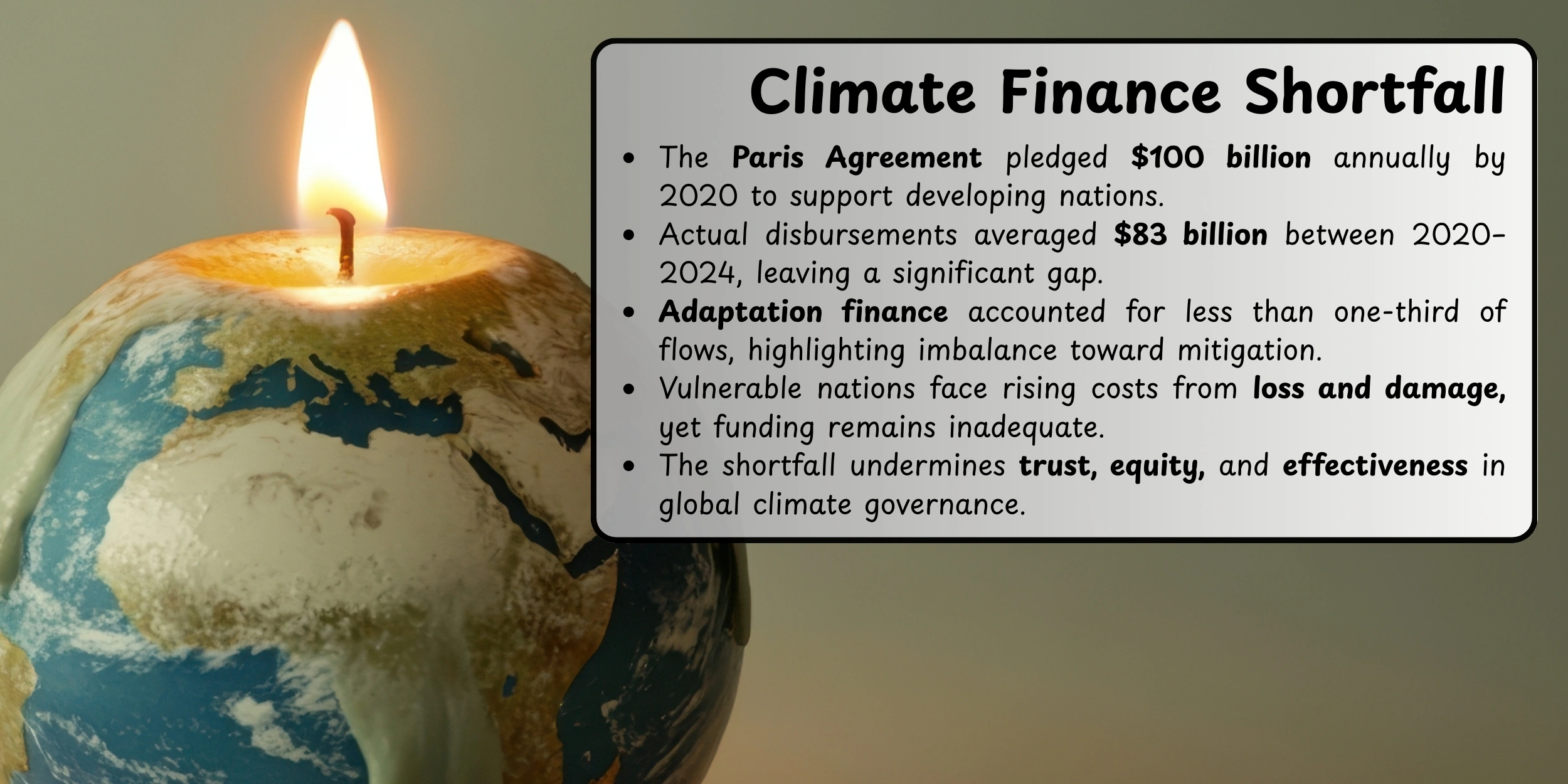
There is a lack of progress on climate finance and equity in the Paris framework that has been criticized by the developing countries. Despite the promise made by the Agreement to provide climate finance in the amount of $100 billion every year by the year 2020, there have been irregularities in the delivery. It is reported that the actual flows have been lower than the targets, and the adaptation finance is especially underfinanced. This has actually strengthened the perception of the imbalance, whereby the more developed countries reduce the impact and less developed countries deal with adjustment and loss and damage expenses.
New National and Regional Trajectories of Paris Agreement
The tenth anniversary of the Paris Agreement highlights a remarkable shift in the climate governance models, whereby most sovereign states have increasingly embarked on independent and region-specific approaches. Such strategies entail varying priorities, resource distributions, and political settings that combine forces to influence the course of climatic action in the world.
European Union
The Green Deal in the European Union has put the organization in the top role in climate activities, with a goal to achieve net-zero emissions by 2050. The Emissions Trading System has been extended to cover more fields, and renewable energy currently makes up 23 percent of the total EU consumption (2024). The example of regional cooperation among member states shows how the systems of collective interaction can strengthen international agreements and enhance responsibility and innovativeness.
China
As the largest emitter in the world, China has put in place a two-pronged government approach to balancing climate responsibilities and economic growth. A total of more than 430 GW of solar is installed in the country, with almost one-third of the total installed capacity worldwide. The initiatives of concurrent investments in electric vehicles, as well as green hydrogen, represent an example of a stream in which the industrial policy can be coupled with climate goals, thus transforming the global energy markets via domestic policy decisions.
India
The route of India focuses on resolving the development needs and climate resilience. The country has committed to achieving non-fossil-based electricity production of 50 percent by 2030. Events like the International Solar Alliance reflect the Indian dominance in promoting South-South cooperation. Climate action is entrenched in broader development priorities, as seen in regional adaptation programmes that aim to develop agricultural and water resilience in regions as well as mitigate disaster impacts.
United States and Fragmented Leadership
The United States withdrew from the Paris Agreement, but still controls the action on climate via subnational movements. Some states, like California, have put in place ambitious renewable goals, and federal policies, including the Inflation Reduction Act (2022), include a commitment of $369billion of clean-energy and climate programmes. This piecemeal process demonstrates that even without an integrated world system, 21st century politics in the domestic sphere influence climate patterns.
Future of Climate Governance
Climate governance is now at a sensitive crossroads for the future. Towards the end of the second-decade of the Paris Agreement, a scholarly discourse is picking up with an increased debate about accountability, equity, and the need to have more robust institutional mechanisms.
Strengthening Accountability –
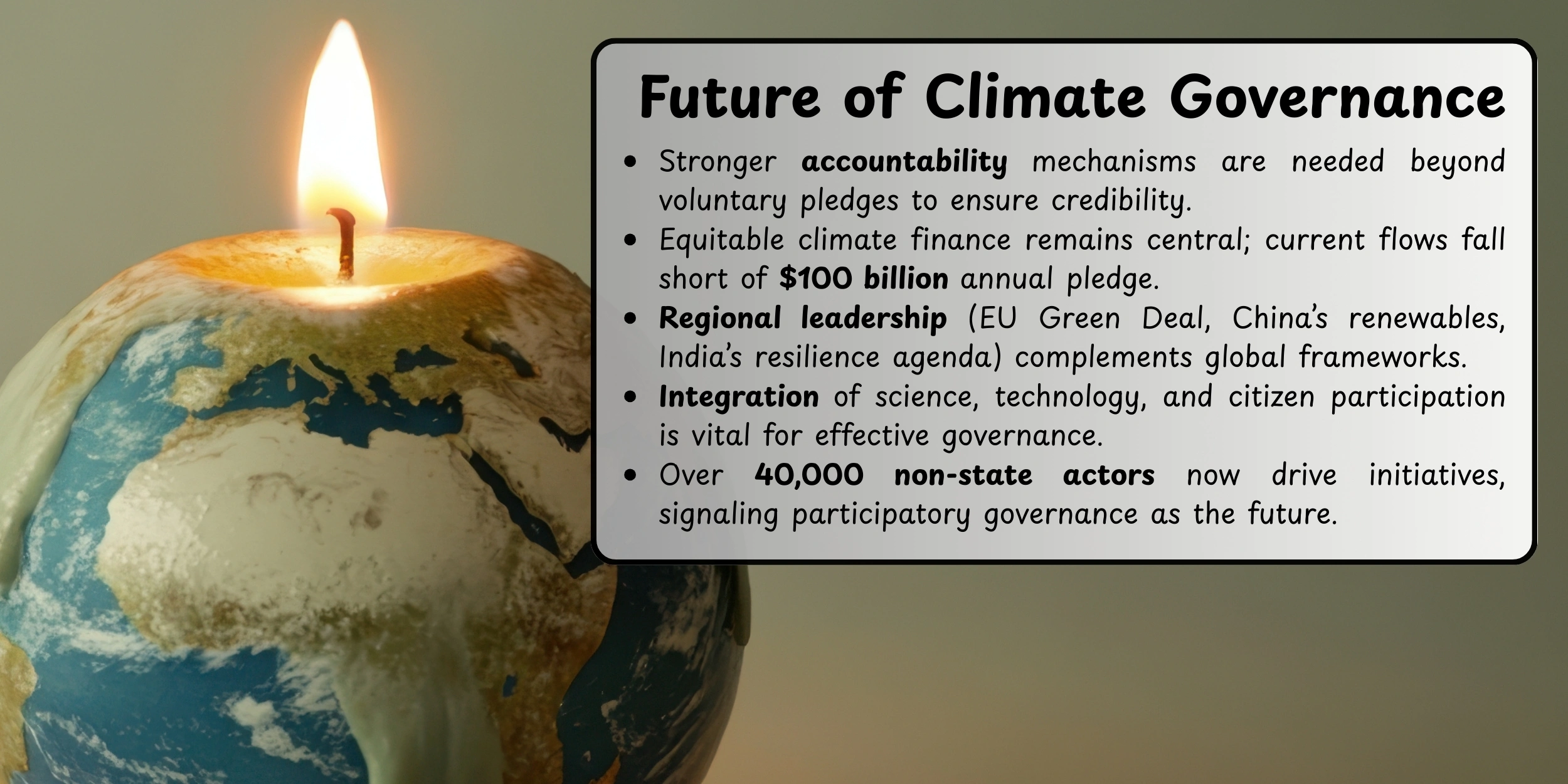
There is an urgent issue of the lack of enforceable provisions when it comes to the Paris framework. Researchers argue that future administrative setups need to have strict compliance procedures to maintain credibility. A review of OECD is carried out in 2025; it points to the finding that more than 70 percent of the interrogated policymakers find voluntary commitments insufficient in attaining the worldwide targets. The introduction of non-governmental supervision organizations and imposing penalties for violations are among the proposed solutions, which might increase the level of trust and effectiveness.
Funding Climate Action and Equity-
Prospective governance forms are marked by equitable finance. A report released by the UNFCCC on Climate Finance Delivery (2025) shows that despite the pledged amount of the US$100 billion/annum by developed countries, the real amount was only an averaged $83 billion during 2020-24. In addition, adaptation finance was lower than a third of total flows, thus subjecting vulnerable countries. The next generation of frameworks should then focus on foreseeable finance, loss and damage processes, and transfer of technology to balance the mitigation and adaptation needs.
Models of Leadership-
The climate pathways diversification points to an alternative form of governance, which is more based on regional blocs and national institutions. The case of the European Union and its Green Deal, China and its renewable growth, and India and its climate-resilient development plans are good examples of how local levels enhance the position of international agreements. The International Energy Agency (IEA) attributes the production of renewables to 30% in 2024, mainly due to national policy. Therefore, it is possible that in the future, the global governance will become a hybrid one, global coordination supported by regional leadership.
Combining Technology, Public Participation, and Science-
The future governments should also be willing to incorporate scientific findings, technological advancements, and participatory citizens. Advancements in artificial intelligence, carbon capture, and green hydrogen transform the opportunities in decarbonisation. At the same time, civil society and the public movements require increased accountability. In 2025, according to the UN Global Climate Action Yearbook, 40,000 non-state actors are now involved in climate projects, revealing the relevance of participatory governance.
Conclusion
The Paris Agreement has become a landmark and a controversial system of global climate regulation ten years after its approval. Although the pact has been effective in motivating an unparalleled gathering of stakeholder involvement to mobilisation together with incorporation of climate agendas with fundamental policy, its voluntary construction, uneven allocation, and minimal monetary pledges have demonstrated structural laxity. The alternative conceptualisation of climate action based on practical strategies is defined by the rise of national and regional paths, as associated with domestic concerns.
Therefore, the future of climate governance should be able to balance between world ambition and binding responsibility, fair finance, and technical improvement. International cooperation can only remain credible and resilient through such reforms to aim at dealing with the rising climate crisis.