Prime Minister Modi's maritime policy has evolved into MAHASAGAR (Mutual and Holistic Advancement for Security and Growth Across Regions), becoming a symbol of India's growing global footprint.The maritime policy of India has been the focus of academic research recently, especially with the display of the Indian marine heritage made by the Indian Navy at the World Book Fair 2026 in New Delhi; the exhibition focused on the historical development of the Indian maritime relations, the priorities leading the contemporary decision-making, and the perspectives on the future, especially under the lights of the ever-increasing risks of the Indo-Pacific and Indian ocean arenas.
|
Key highlights
- Indian maritime policy
- Historical Foundations
- Contemporary Developments
- Challenges Ahead
- Future Trajectory
|
The Indian maritime policy has become one of the defining aspects of the overall national strategy and is shaped by historical legacies, geographical needs, and dynamic relations with the world. With its commercial routes and maritime culture dating back to ancient ages, and colonial conquest and a subsequent restructuring of the institutions, the maritime history of the country has been simultaneously unifying and transformational. Over the past few decades, the policy has grown to include agendas beyond the coastal defence to include economic development, regional security and Indo-Pacific partnership. The modern plans like SAGAR or port modernisation convey what India likes to be a net security provider in the Indian Ocean. This article is an analysis of how the maritime policy of India has been developing and the future strategic path of the country.
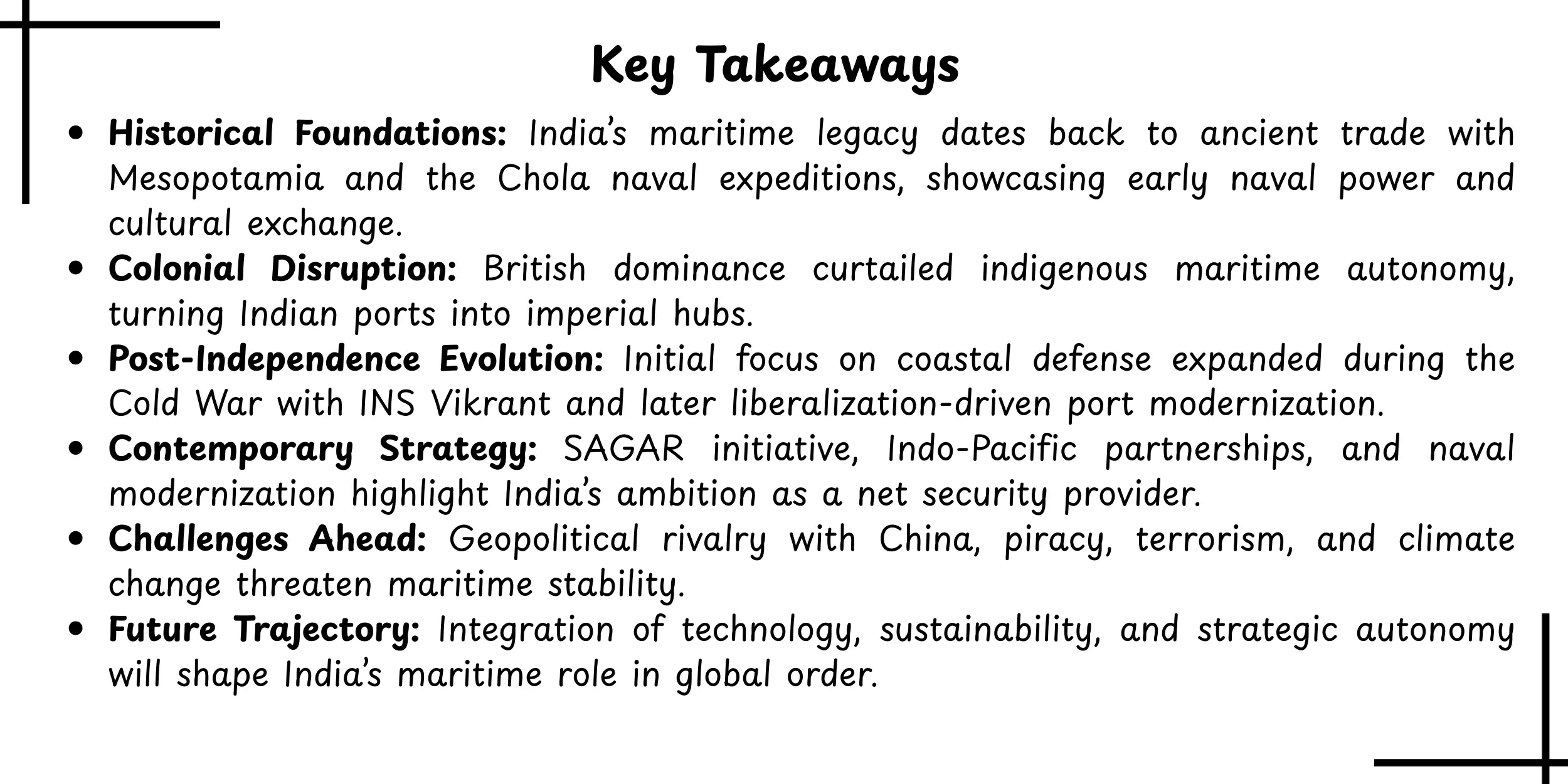
Historical Foundations of India's Maritime Policy
The maritime roots of India date back to ancient times and were formed by the combination of trade and cultural interaction with the presence of the naval force, which helped to form and shape the strategic identity of India over the centuries.
Maritime Traditions in Ancient Times
The geography of the coastline of India developed strong trade connections with Mesopotamia, Egypt and Southeast Asia as early as the third millennium BCE. Advanced methods of shipbuilding and highly developed practices of port management are also discerned in the archaeological evidence found at the dockyard at Lothal, creating more evidence of the sea-sophistication of India during the early era.
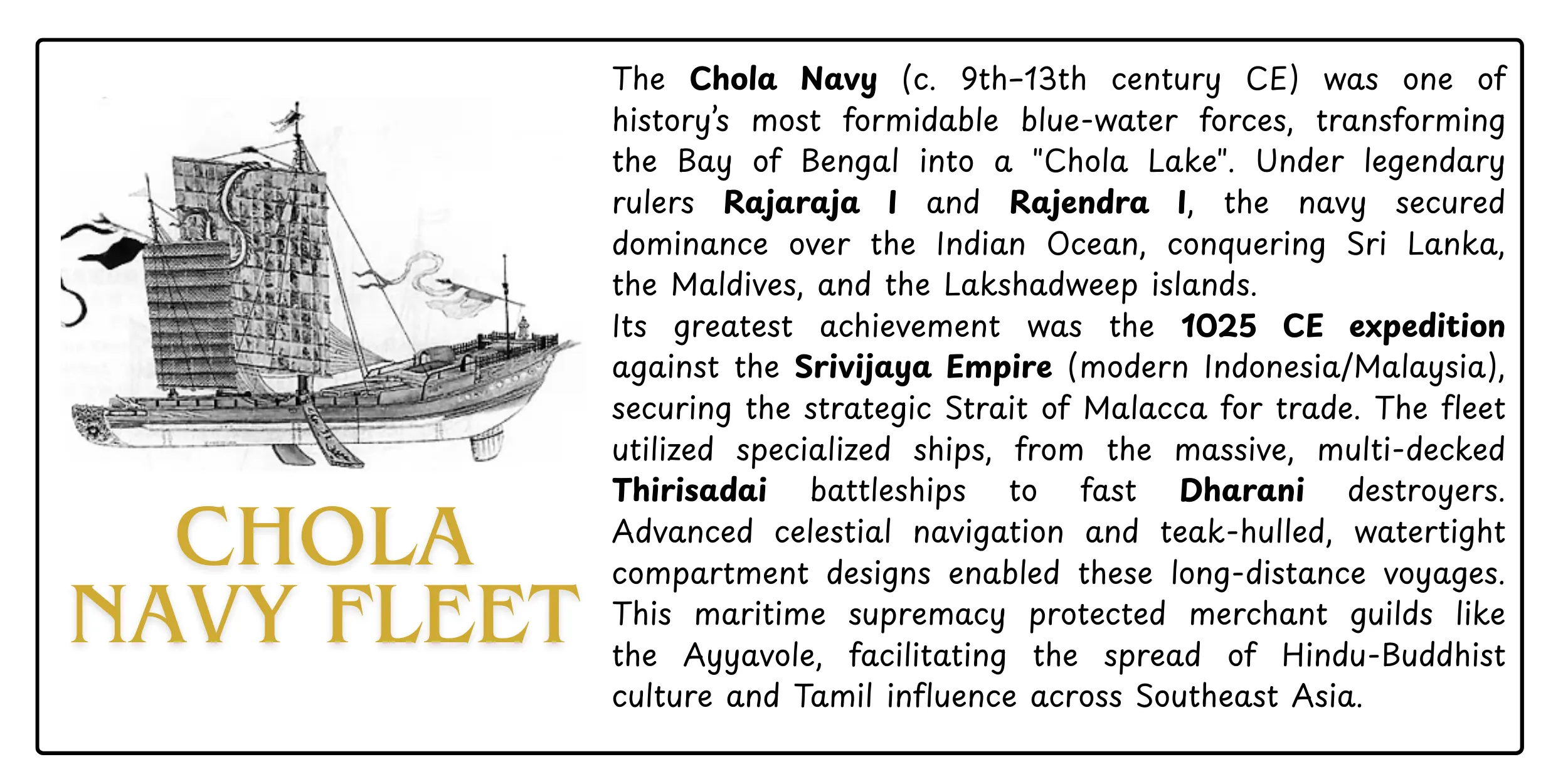
Chola Naval Power
A good example of Indian naval superiority was the Chola dynasty (9th-13th centuries CE). The expedition to Sri Lanka and Southeast Asia is recorded in the historical records, and the Chola influence along the Bay of Bengal is projected. The Chola navy helped with trade campaigns, military and the spread of cultures, therefore making India to become the maritime superpower of the time.
Colonial Disruption
The British supremacy reversed the Indian maritime environment to favour it at the expense of the indigenous traditions of a navy. Imperial ports like Bombay and Calcutta emerged; still, Indian independence in maritime matters was restricted until the post-colonial era.
Early Years of Independence
During the immediate post-1947 period, the maritime interest in India was very much limited to the protection of the Indian coastline. The key work by K.M. Panikkar highlighted the significance of the Indian Ocean in terms of strategy and the need to enhance the naval power of policymakers.
Cold war and Strategic realignment
In the Cold War, India balanced between the Soviet and Western involvement. The military advancement also involved the commissioning of naval aircraft carriers like INS Vikrant (1961), which represented the desire by India to assert power in areas beyond the littoral waters.
Economic Integration and Liberalisation
Economic reforms which followed the year 1991 helped boost maritime trade, which led to the modernisation of ports and a focus on the blue economy. The maritime doctrine of India during the 2000s emphasised regional security and economic connectivity.
India’s Contemporary Development Policy
India's contemporary maritime policy focuses on becoming a global maritime power through Maritime India Vision 2030, emphasizing infrastructure (Sagarmala), green shipping, digitization, and shipbuilding, alongside the SAGAR (Security and Growth for All in the Region) vision for a secure Indo-Pacific, incorporating enhanced naval cooperation, Blue Economy initiatives (fisheries, deep-sea mining), and stronger regional connectivity, all while countering China's influence and integrating traditional maritime security. The recent developments, like the SAGAR (2015) and the new Indian Maritime doctrine (2025), reiterate the importance of India contributing to the security of the Indian Ocean as a net provider of security.
Strategic Frameworks & Doctrines (MAHASAGAR)
The new MAHASAGAR doctrine builds on the previous SAGAR vision, whereby the country is envisioned as a country of choice in the region of maritime security in the world. Such a policy is a prediction of a holistic, comprehensive model of security that is not limited to the Indian Ocean but is taken on a global perspective.
- Collaboration is the key principle of the plan, and in this case, special interest wason the involvement of the Global South, which can contribute to making India a first responder in humanitarian aid and disaster management.
- This is complemented by the 2025 doctrine of the Navy, which includes emerging technologies like artificial intelligence to efficiently combat the multi-domain grey-zone security threat.
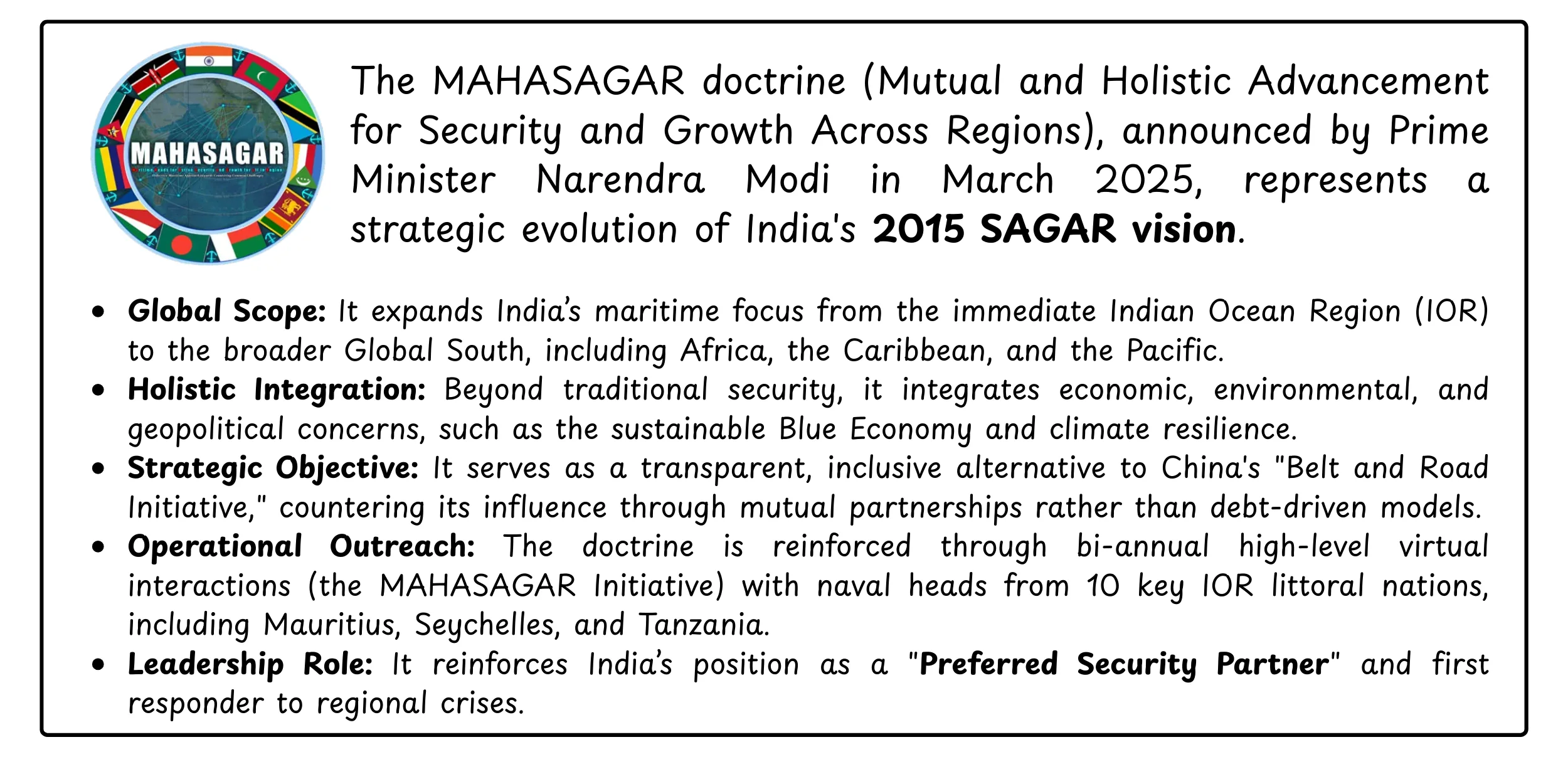
What is MAHASAGAR policy?
India's MAHASAGAR policy is an Indian strategic vision for the Global South, expanding on the SAGAR doctrine, meaning "Mutual and Holistic Advancement for Security and Growth Across Regions," focusing on maritime security, economic integration, capacity building, and technology sharing for sustainable development and regional leadership in the global ocean, especially for developing nations.
Landmark Legislative reforms
The government passed five landmark bills in late 2025, which updated the legislative framework of the Blue Economy in India; therefore, replenishing century-old and colonial-era maritime laws. These reforms make governance lean, and operational efficiency is greatly improved, and logistical costs are greatly cut. Some of the most important bills encompass:
- The Indian Ports Bill, 2025, which also centralizes the port planning;
- The Merchant Shipping Bill, 2025, which establishes new levels of seafarer welfare and safety; and
- TheCoastal Shipping Bill, which considerably reduces the spending on national logistics through the optimization of domestic coastal traffic and the increase of freight capacity.
Economic Targets and Infrastructure (Vision 2047)
The long termMaritime Amrit Kaal Vision 2047 estimates that it will invest about 80 lakh crore Indian rupees to become among the top five economies in the world in ship-building.
- This is an ambitious roadmap that has given more attention to developing an internationally acclaimed infrastructure and advancing green/sustainable shipping technologies.
- Other projects include the building of major deep-sea ports at Vadhavan and Vizhinjam, which are designed to harbour the largest mega-vessel in the world.
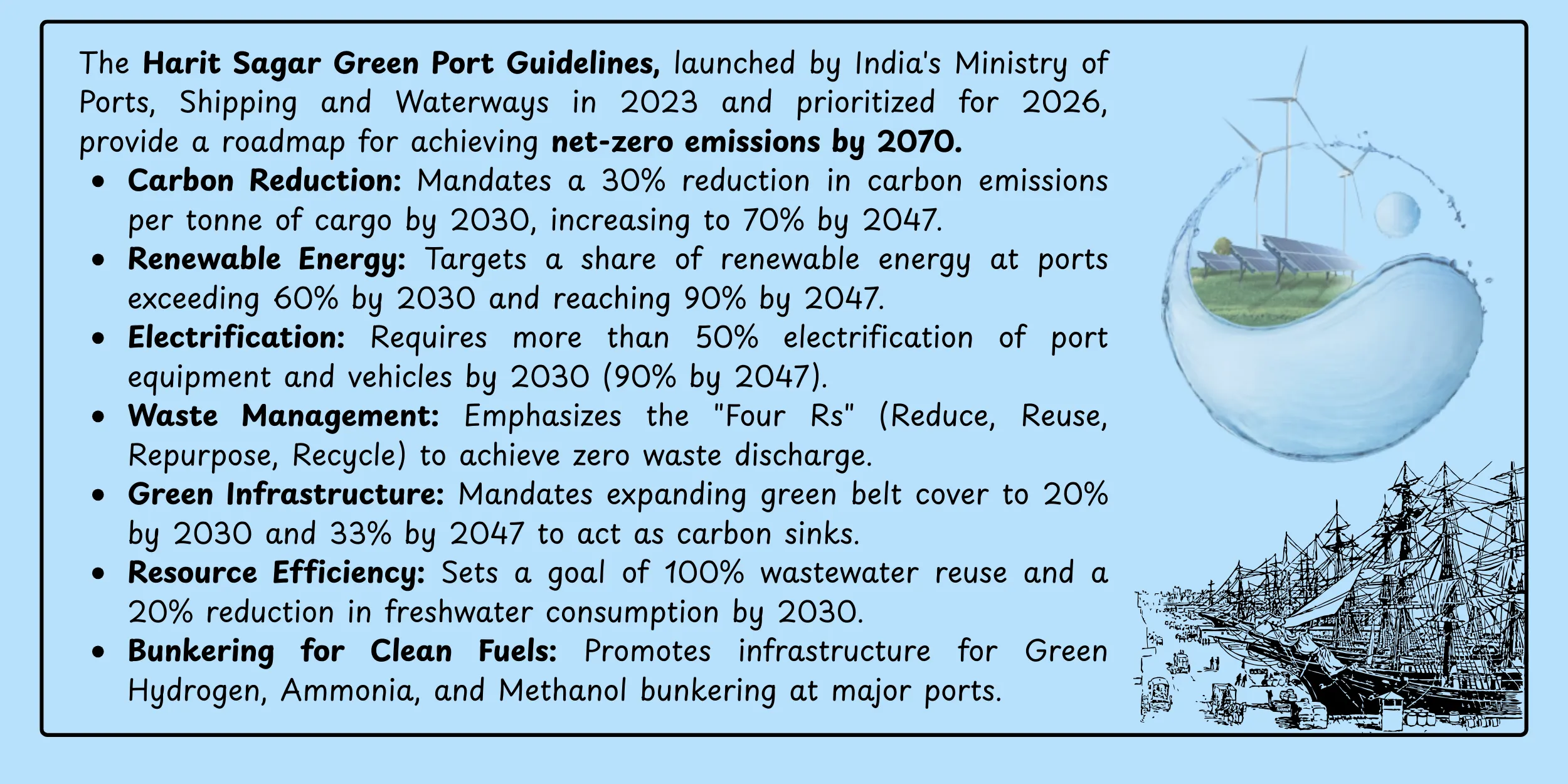
- “Harit Sagar” guidelines are the drivers of the green transition, which promotes the creation of electrified ports and future green hydrogen bunkering hubs.
Geopolitics and Regional Cooperation
India is capitalizing on its geographical location in a bid to alleviate regional threats, especially increased influence of external powers in the Indian Ocean Region.
- As of 2026, India continued its lead positions in the Indian Ocean Rim Association, as well as the Naval Symposium.
- The Quad and Indo-Pacific Oceans Initiativesare strengthening strategic partnerships to ensure the protection of the free and open region.
- Additionally, an Information Fusion Centre in Gurugram gives the ability to monitor maritime threats in real time, and today it has over 22 partner countries, providing awareness of the maritime domain in the region.
Geopolitical and Security Challenges
The maritime policy of India is facing complexities that require it to be strategically foresighted, technologically innovative, and cooperation between the region to safeguard national interests with regard to the Indian Ocean and the Indo-Pacific.
Geopolitical Pressures
India already has to contend with the growing Chinese naval force and infrastructure projects under the Belt and Road Initiative. According to recent studies, the major part of the trade in India, which is more than 80 percent, flows through the sea path, which depicts the significance of maritime security.
Piracy and Non-Traditional Threats
The problem of piracy in the Arabian Sea and the maritime-focused terrorists still remains an issue. According to a study 2025, the 7516km coastline of India needs increased surveillance and domain awareness against asymmetric threats.
Environmental Risks and Climate Change
Ecological and economic problems are related to rising sea levels, cyclones, and the lack of resources. Study by IMPRI (2025) highlights that climate change has a direct effect on port infrastructure and fisheries of India, undermining the blue economy.
Strategic Autonomy
Striking a balance between partnerships in the Quad and Indo-Pacific and maintaining the ability to make independent policy decisions will be a challenge to the diplomatic nimbleness of India. Strategic independence during alliances is vital to maritime stability in the long run.
Navigating India's Future Trajectory
The maritime policy of India is geared towards opening up its strategic and economic perspectives, thus portraying the desires of consolidating its position as a net security provider in the Indian Ocean and Indo-Pacific domains.
Strategic Expansion
The future outlook of India highlights a process of accelerating the ideas of Security and Growth for All in the Region (SAGAR) vision that is already transitioning to Maritime Awareness of Security and Growth (MAHASAGAR). Empirical evidence shows that the Indian Ocean is preceding about two-thirds of all world oil shipments and half of all container movements, thus increasing India's responsibility in maintaining security in such maritime routes.
Technological Modernization
The naval modernization projects, such as the locally built aircraft carriers and complex surveillance platforms, are expected to improve the awareness of the maritime domain in India. The Indo-Pacific Regional Dialogue of 2025 noted the efforts to create a collective security system, as well as capacity-building in the area, and has expressed that India is dedicated to these endeavours.
Sustainability and Blue Economy
It is expected that future policy systems will be able to incorporate climate resilience and sustainable management of resources. The Indian maritime vision aims to develop ecological stewardship in line with the economic development goals, with close to 40 percent of the global population living along the Indian Ocean littoral.
Conclusion
The maritime policy of India is one of the examples of the vibrant process of interaction between historical heritage, strategic demands, and future visions. Due to its historical developments, tracing its roots to ancient trade pathways, colonial perturbations, and post-independence reorganizations, the policy path is characterized by stability and accommodation. The new trends, which include SAGAR initiative and naval modernisation schemes, are hence enhancing the ambitions the India to serve as the key security power in the Indian Ocean. In the future, geopolitical tension, technological advancement, and environmentally friendly practices will determine the task of India to play a role in the sea to determine regional and global order.
Frequently asked questionsFrequently asked questions
Historical Foundations of India's Maritime Policy?
The maritime roots of India date back to ancient times and were formed by the combination of trade and cultural interaction with the presence of the naval force, which helped to form and shape the strategic identity of India over the centuries.
India’s Contemporary Development Policy?
India's contemporary maritime policy focuses on becoming a global maritime power through Maritime India Vision 2030, emphasizing infrastructure (Sagarmala), green shipping, digitization, and shipbuilding, alongside the SAGAR (Security and Growth for All in the Region) vision for a secure Indo-Pacific, incorporating enhanced naval cooperation, Blue Economy initiatives (fisheries, deep-sea mining), and stronger regional connectivity, all while countering China's influence and integrating traditional maritime security. The recent developments, like the SAGAR (2015) and the new Indian Maritime doctrine (2025), reiterate the importance of India contributing to the security of the Indian Ocean as a net provider of security.
Geopolitical and Security Challenges?
The maritime policy of India is facing complexities that require it to be strategically foresighted, technologically innovative, and cooperation between the region to safeguard national interests with regard to the Indian Ocean and the Indo-Pacific.
Navigating India's Future Trajectory?
The maritime policy of India is geared towards opening up its strategic and economic perspectives, thus portraying the desires of consolidating its position as a net security provider in the Indian Ocean and Indo-Pacific domains.