|
Key highlights
- Russian Nuclear Pitch
- India-Russia Nuclear Collaboration
- Towards attaining energy security
- 100GW Nuclear Capacity by 2047
- Supporting Make in India
- Strategic Autonomy
|
President Vladimir Putin is about to bring a large nuclear industry delegation with him during his visit to India. In this context, Rosatom offered small modular reactors (SMRs) in terms of the necessity to provide flexible power provision and sophisticated large reactors designed to ensure grid-scale power supply. Also, Russia offered serial production joint ventures in Indian land, which is hopeful of extending nuclear collaboration, and India considers the option of technology transfer, financing options, and energy security.
Vladimir Putin's nuclear agenda and broader energy strategy are reshaping India's energy landscape by reinforcing energy security through diversified and discounted crude oil supplies and the potential for expanded civilian nuclear cooperation, particularly in small modular reactors (SMRs).
|
Tips for Aspirants
The article is very relevant to the UPSC Civil Services Examination and State Public Service Commission examinations as it relates to energy policy, emerging technologies, and geopolitical considerations, which are the core aspects of governance, international relations, and sustainable development.
|
|
Relevant Suggestions for UPSC and State PCS Exam
- The Russian nuclear offer to India consists of Small Modular Reactors (SMRs), next-generation large reactors and plans of serial production.
- The SMRs are compact, safer and can work in a variety of locations; thus, they are compatible with remote areas and industrial groups.
- The Akademik Lomonosov floating SMR in Russia is one such structure that reflects the aspirations of Russia.
- A huge reactor is proposed for the grid-scale base-load, and it is also provided with a sophisticated safety system; the Kudankulam facility forms a precedent of Indo-Russian cooperation.
- India plans to attain a nuclear capacity of 100 GW by the year 2047, which means that nuclear growth is associated with the goal of climate targets and net-zero targets by the year 2070.
- The localisation initiative of Russia is a contributor to the Make in India agenda, enhancing local production, employment, and a supply chain that is resilient.
- Geopolitically, India must counter its collaboration with Russia against nuclear partnership diversification to ensure strategic independence.
|
The upcoming visit of the Russian President Vladimir Putin to India is also going to highlight the strategic profundity of Indo-Russian partnership in the sphere of nuclear energy. The fact that a significant number of representatives of the Russian nuclear industry can be seen is an indication that Moscow intends to increase its technological and industrial presence in the Indian energy sector. The main aspects of this engagement involve the support of small modular reactors (SMRs), next-generation large nuclear reactors, and serial production proposals in India. These services are being packaged in such a way that they are not only presented as technological exports but also as tools of a long-term partnership that will appeal to the increasing need of India to access clean, reliable, and scalable forms of energy. Climate commitments and energy security are the two competing demands that are increasingly shaping the energy policy of India. In this discussion, nuclear power to its ability to provide low-carbon base-load power holds a key role. The high-level nuclear bid of Russia thus cuts across the strategic interests of India, which include advanced technology transfer, funding, and involvement of the Indian industries. Simultaneously, these suggestions have geopolitical undertones to them, as Russia is competing more globally in the nuclear market, and India is trying to gain strategic independence. This article discusses the outlines of the nuclear hard sell of Russia, the technological solutions of SMRs and advanced reactors, and the policy options facing India in this changing relationship.
The Nuclear Pitching of Russia in India
The recent revival of the nuclear relations between Russia and India can be viewed as being of saliency, as President Vladimir Putin is expected to visit the country soon. Through its state-owned company, Rosatom, Moscow is marketing a list of nuclear project opportunities that includes small modular reactors (SMRs), next-generation large reactors, and serial manufacturing alliances. These projects are meant to control the salient position of Russia in the growing civil nuclear sector in India.
"The Nuclear Pitching of Russia in India" refers to Russia's recent push to expand civil and military nuclear cooperation with India, highlighted by President Vladimir Putin's visit in early December 2025 and new proposals for Small Modular Reactors (SMRs).
Nuclear Engagement
The nuclear pitch that Russia has made is not just a technological product but is far more than that. The introduction of SMRs and advanced reactor design will help Moscow to prove the longevity of the cooperation with India in the policy of energy security. The Kudankulam Nuclear Power Plant, which is already under construction with Russian help, can be regarded as one of the tangible precursors of increased cooperation. The freshly circulated offers thus reinforce the mission of Russia to remain the most reliable nuclear partner of India, especially at a time when the world is evolving into a place where the nuclear export competition is growing fast.
S.M.R. as a Versatile Solution
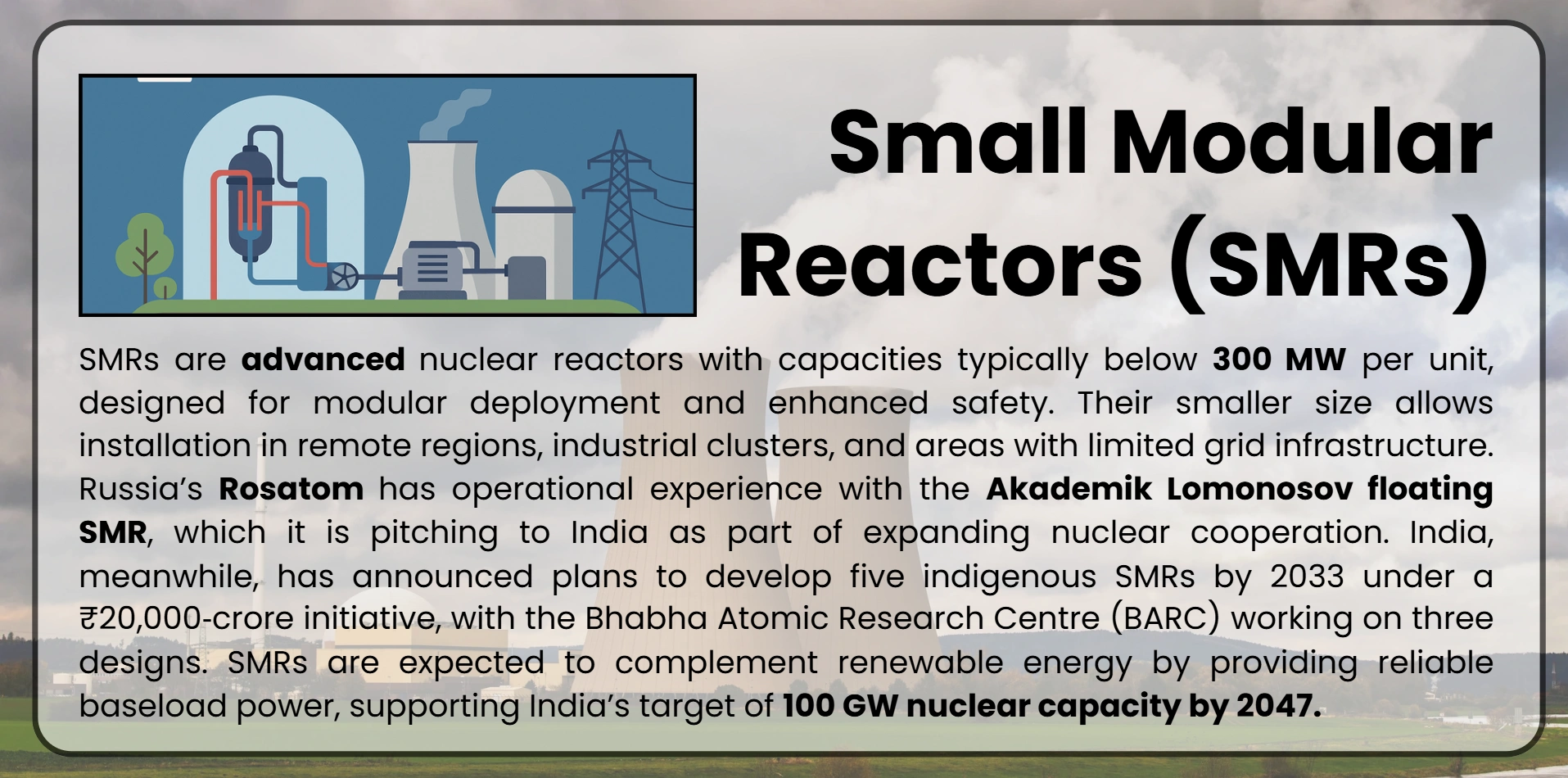
The center of the present pitch of Russia is SMRs. These reactors are designed to be small size, demonstrate superior safety, and diversity to other energy needs, including isolated locations and industrial complexes. The Russian experience of implementing works like the Akademik Lomonosov floating power unit is considered to be evidence of feasibility. In the case of India, SMRs can be employed to supplement renewable energy, as well as provide a consistent base-load, and at the same time work in conjunction with its climate commitments, and future nuclear capacity expansion to 100 GW by 2070.
Next-generation Large Reactors
Along with SMRs, Russia is also promoting the large next-generation reactors, which are loaded with advanced safety features. These are reactors that have been placed as being too vital to fulfil the grid-scale electricity needs of India. Additionally, Moscow is making an offer of serial production co-operations inside India, and it makes it possible to manufacture reactor parts in India. These forms of cooperation would moderate costs, encourage domestic talent, and enhance the nuclear infrastructure of India. This industrial aspect indicates how Russia is willing to incorporate India as part of its global supply chain and, in the process, intensify strategic freedom.
Policy Decisions and Geopolitics
Receptivity to the nuclear pitch of Russia in India will be preconditioned by a complex of factors: the mode of finance, the system of transfer of technologies, and the necessity to counterbalance nuclear development with the renewable energy goals. Russia will speed up the nuclear ambitions of India once the proposal is accepted, but will at the same time increase its reliance on Moscow in a time when the geopolitical trends are changing. Thus, the proposals have effects that are not only energetic, but they also cross the entire spectrum of foreign-policy calculations in India, and the independence of strategic choice in the framework of world nuclear policy.
SMRs and Next-Gen Reactors Technology
SMRs (Small Modular Reactors) and Next-Gen Reactors are advanced nuclear technologies using factory-built, smaller designs (under 300 MW) for lower costs, faster deployment, and enhanced safety via passive systems, aiming for grid flexibility, remote power, and hydrogen production. The nuclear activity between Russia and India is becoming more focused on high technologies, namely such as small modular reactors (SMRs) and next-generation large reactors. These are innovations that are being positioned to address the growing energy demand in India and climate commitments.
Small Modular Reactors: Design and Flexibility
SMRs are a major breakthrough compared to traditional nuclear power stations. They are small in size, allowing them to be used in remote locations, industrial clusters, and limited grid infrastructure areas. Rosatom of Russia has work experience in using the Akademik Lomonosov floating SMR, which is being offered as an example to India. SMRs have increased safety due to passive cooling, reduced construction schedules and modularity.
Next-Generation Large Reactors: Size and Safety
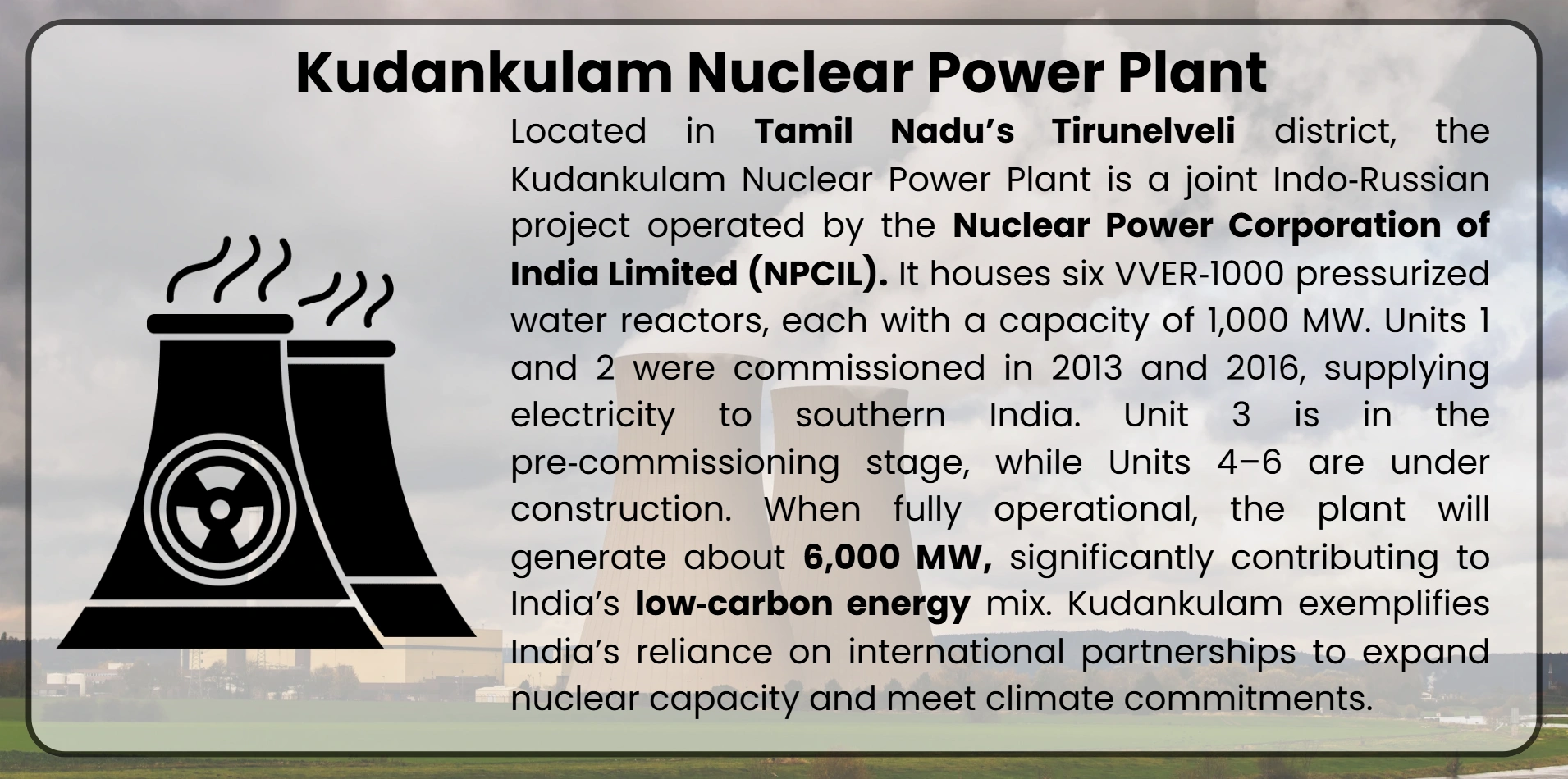
In addition to SMRs, Russia also provides new-generation large reactors with enhanced safety measures, specifically better containment systems and fuel, which are accident-tolerant. These reactors should meet grid-scale power demand in India, meaning a steady amount of power to the urban and industrial centres. An example of such cooperation is the Kudankulam Nuclear Power Plant, currently under construction with Russian support. Through the deployment of next-gen reactors, India is able to hasten its nuclear capacity increase to its 100 GW goal by 2070, and as well as meet international climate commitments.
Serial Production and Localisation
The peculiarity of the proposition of Russia is the offer of serial production collaborations in India. This would mean that components of the reactor will be produced locally and thereby lowering costs and creating local expertise. Localisation is consistent with the Make in India, but it is also effective to strengthen supply-chain resiliency. This level of industrial collaboration would make India a beneficiary of nuclear technology to also be a co-producer of nuclear products, and this would increase India's strategic independence as well as generate skilled jobs.
Strategic Implications
The SMRs and next-gen reactors' technological promise should be judged against a policy. Funding, laws and community acceptance are also matters of concern. Additionally, India has to weigh between nuclear development and renewable energy development in an attempt to have a diversified energy mix. The propositions created by Russia, however, provide a way forward in enhancing bilateral cooperation and also making India a regional leader in advanced nuclear technology.
Dynamic Strategic Options and India's Energy Requirement
The energy path of India is based on the twin demands of maintaining economic growth and being able to deliver on climate obligations. The rise in demand and the demand to have reliable and cleaner energy are making India develop strategic decisions in all aspects of nuclear, renewable and fossil energy.
India's energy strategy balances massive, growing demand with ambitious clean energy goals (500 GW renewables by 2030, net-zero by 2070), focusing on dynamic options like rapidly scaling solar/wind, green hydrogen, energy efficiency, and diversifying imports, while managing coal's current dominance and leveraging hydropower, all while navigating rising fossil fuel needs and geopolitical factors to secure energy access for development.
Diversifying Demand and Development Requirement
The electricity consumption level of India is expected to spike with the growth of industries, townships, and population. Energy reliability has been pre-empted by the government as one of the pillars of Viksit Bharat (Developed India). Nuclear energy, which can be used as a low-carbon base-load source of power, is increasingly viewed as a central part of this change. This was strengthened by the 2025-26 Budget, which declared an ambition to have 100 GW of nuclear capacity by 2047, and thus nuclear has been at the centre of the Indian energy mix in the long run.
Solar and Nuclear Energy Compromise
Although nuclear energy offers stability in operations, renewable energy, particularly solar and wind, is still crucial to the climate targets of India. India has undertaken to achieve net-zero emissions by the year 2070, and this task requires an energy mix. Nuclear energy has the potential to coexist with renewables to reduce intermittency, provide stability to the grid and reduce dependence on coal. Studies have revealed that next-generation nuclear technologies will potentially be able to provide nearly 28 percent of electricity needs in India by 2050, and this is important in terms of its strategic value.
Financing, Technology Transfer and Industrial Policy
The strategic choices made by India do not only involve the adoption of technology but also funding and participation in industry. The nuclear projects are capital-intensive and have long gestation cycles. The partnership with other countries like Russia that offer serial production and transfer of technology may reduce cost and eventually develop in-country competencies. Coordination of nuclear growth with the Make in India program would enhance the resilience of nuclear supply chains, produce skilled jobs, and increase energy-governance autonomy of India.
Strategic Autonomy
The geopolitics of the energy policy of India is also important. The dependency on foreign suppliers of nuclear technology should be balanced with a distance. The collaboration with Russia, the United States, and France gives alternatives to India and strengthens its role in international nuclear regulation. Finally, the energy policy of India has to balance between the economic growth, the environmental accountability and political autonomy of the country and, as such, make sure that the energy security is aligned with the national agenda toward development.
Great Power Interplay and Geopolitical Analysis
The offer that Russia makes to India concerning nuclear partnership that mostly concerns small modular reactors (SMRs), next-generation large reactors, and a scalable series of production crosses the boundary of energy partnership. It has some geopolitical and industrial implications that have consequences and shape the strategic sovereignty of India as well as the future of Indian modernisation in terms of industrialisation.
Great power interplay is the dynamic interaction between powerful states vying for global or regional influence, analyzed through the lens of geopolitical analysis, which studies power dynamics, strategic competition, and territorial control.
Nuclear Diplomacy
The nuclear deal involving Russia is a broader geopolitical initiative to consolidate its power as far as South Asia is concerned. Moscow tries to counter the competition in the nuclear export market in the West by positioning itself as the most reliable nuclear partner that India has ever had. The promoted usage of SMRs and enhanced reactor types works as both technological projects and diplomatic tools, thus strengthening the role of Russia in the infrastructure of Indian energy security. Such an activity also strengthens bilateral interactions in a global energy environment that is increasingly becoming polarised.
Industrial Localization and Transfer of technology
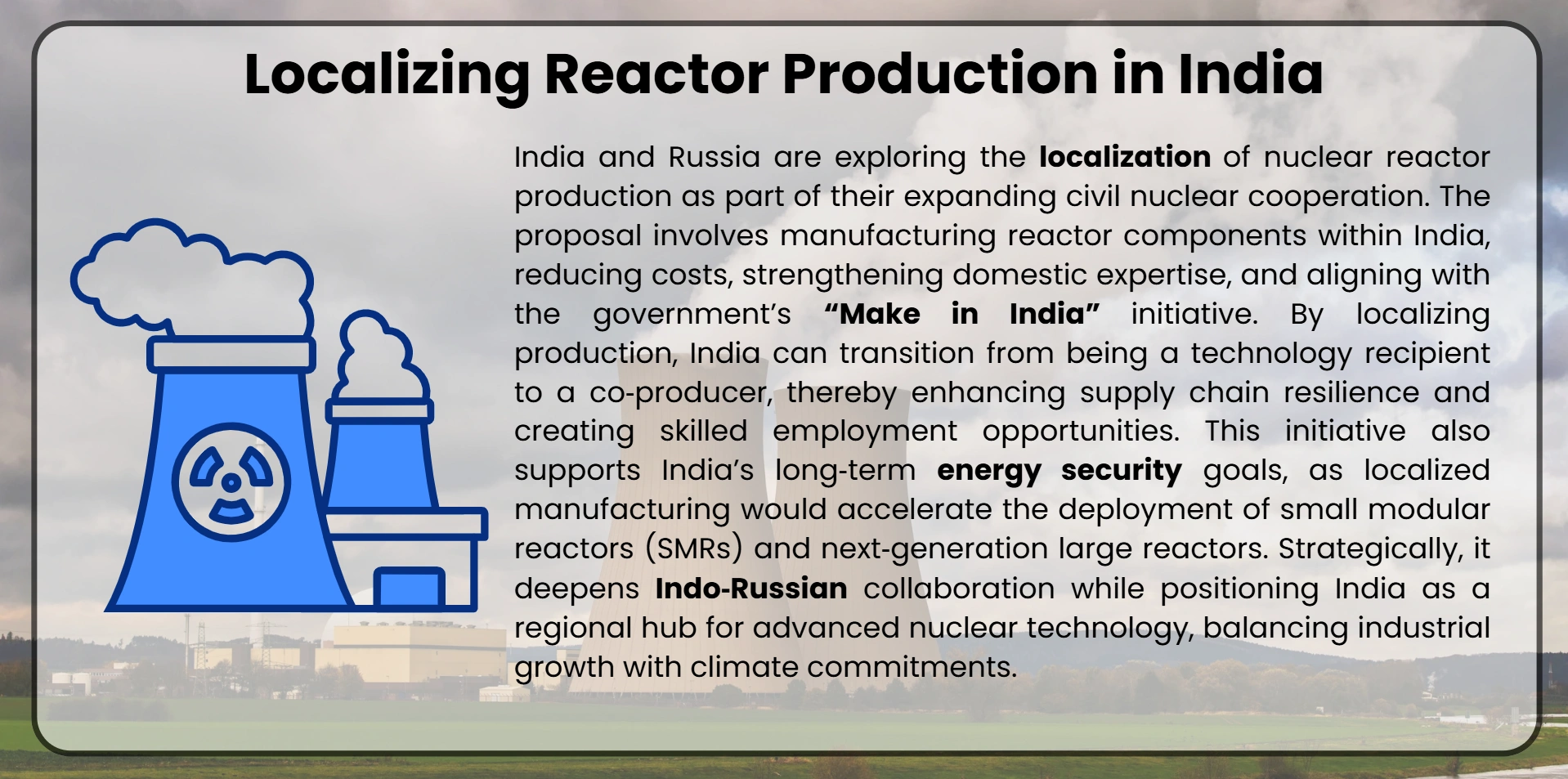
One of the most important aspects of the offer by Russia would be the adoption of the localisation of reactor manufacture in India. The discussions that take place between Rosatom and the Indian Department of Atomic Energy focus on local production of the elements of the reactors, thus limiting expenses and developing industrial capabilities. This partnership will be agreeable to the Indian program of Make in India, which will help to transform the country from a passive technology receiver to a co-producer. It is expected that industrial localisation would create skilled jobs and strengthen the resilience of the supply chain, making India a regional centre of nuclear technology.
The Strategic Independence and Energy Security of India
Even though the suggestions by Russia provide irrefutable economic benefits, they simultaneously create an impression of elements connected to the strategic independence of India. Dependence on Russian technology requires the creation of a prudent equilibrium between diversification of deals, including the United States, France, and other nuclear sellers. The energy security policy of India should thus be balanced so as to utilise the Russian skills without the overdependence factor. Geopolitical stakes are higher because nuclear cooperation is confounded with other foreign-policy agendas, including involvement in climate-related governance by the Indian government, and its capacity to achieve net-zero emissions by 2070.
Local and International Implications
The nuclear proposal of Russia has not just industrial and geopolitical implications, but it is also not limited to India. An alliance, which is a success, can change the future of energy in South Asia and leave India with the role of being a leading player in advanced nuclear capabilities. Globally, this effort indicates the determination of Russia to remain competitive in the nuclear sales against the Western sanctions and technology rivalry. In the case of India, embracing such propositions could make India stronger and more robust in terms of its industrial backbone and its climate pledges; however, such actions to be taken will have reverberating effects within the sphere of regional geopolitics or even the entire landscape of global energy politics.
Conclusion
The nuclear overtures that the Russian Federation has been making towards India, including small modular reactors, next-generation large reactors, and production in series, put into focus the convergence of high-tech technology, energy security, and the concept of geopolitics. In the case of the Republic of India, these proposals offer it a way to diversify its energy base, increase its capacities in industry and enhance its climate agenda. However, they require a precise fine-tuning of strategic independence, economic processes and sustained policy directions. The emerging Indo-Russian nuclear relation thus represents both an opportunity and a challenge, reflecting the overall changes in the energy regulation in the world. The consequences of India's adoption decisions are whether this cooperation will find its basis as a pillar of sustainable development or a limitation to its strategic autonomy.