|
Key highlights
- Electoral Trusts
- Supreme Court’s Verdict
- How these are Governed
- Laws related to it
- Funding and Sources
- Post Electoral Bonds
|
Electoral trusts are non-profit organizations whose operations are governed by the Election Commission and which receive donations made by corporate bodies and individuals to the political parties. Their importance increased after, following the annulment of electoral bonds by the Supreme Court in February 2024, they were set up to improve transparency and become relevant again after such a ruling. The rise of a new tendency to use trusts as a means of financing political projects by firms, which started their increasing popularity in the 2024-25 fiscal year, can be explained by the benefits of legal clarity, strict disclosure requirements, and reduced anonymity, which substantially reforms the party-finance ecosystem of India.
|
Tips for Aspirants
The article is significant in terms of preparations on polity, governance, and current affairs because it explains electoral trusts, funding transparency, and post-bond reforms as major areas of concern in the UPSC CSE and the State PSC exams.
|
|
Relevant Suggestions for UPSC and State PCS Exam
- Electoral trusts are non-profit-making organisations whose duties are to direct the contributions towards political parties and are controlled by the Election Commission of India (ECI).
- The Central Board of Direct Taxes (CBDT) introduced it under the Electoral Trusts Scheme, 2013, to bring greater honesty in the field of political finance.
- Under the direction of the Income Tax Act, 1961, any form of donation through trusts qualifies for tax exemptions as provided by Sections 80 GGB and 80 GGC.
- Trusts receive contributions by corporations and individuals, and partially redeem them among registered political parties under Section 29A of the Representation of the People Act, 1951.
- Funding Sources are mainly corporate contributions, supplemented by personal contributions.
- Names of donors, amounts, and benefits to be disclosed to the ECI on a mandatory basis for better transparency.
- When the use of electoral bonds was abolished by the Supreme Court in 2024, the new corporate method of donation, trusts, got popular.
- It enhances accountability, diminishes anonymity, and transforms the nature of how democracy is funded in India.
|
Electoral funding is a critical aspect of democratic rule, as it affects the autonomy of the political parties and the transparency of the representative organizations. The regulatory framework under political contributions in India has undergone significant development over the last decade, among other things, with the creation of electoral trusts in 2013 in accordance with the guidelines that were given by the Election Commission of India (ECI). These trusts are non-profit-making organizations formed to serve the role of mediators between donors, mostly corporate entities and individuals, and political parties. They are charged with the role of simplifying the reception of donations, compliance with the requirements of disclosure in the law, and enhancing accountability within the funding process. The issue of electoral trusts has escalated since the historic decision of the Supreme Court of February 2024 that struck down the electoral bonds scheme, citing the issues of transparency and constitutional inefficiency. Following that decision, electoral trusts have become the leading choice of corporate donation in the 2024-25 fiscal year, which offers a legally approved and rather transparent channel of political finance. This transformation reflects the dynamically changing nature of party-funding systems in India, where there is tension between the interests of the donors, the control of the regulations, and democracy. The discussion of the organizational structure, those who fund, and the consequences of the electoral trusts provides a major clue to the future development of the political finance reform in the country.
Historical Background- What are electoral trusts Scheme and why were they introduced
Electoral trusts are non-profit entities that serve as intermediaries for transparent political funding in India. Following the Supreme Court's abolition of the anonymous electoral bonds scheme in February 2024, electoral trusts have become the primary channel for corporate and individual political donations. Electoral trusts in India are an attempt by the state to address the requirements of democratic transparency and the political finance realities that are in place. Until decades ago, opaque mechanisms had dominated the process of party financing, something being consistently denounced, encouraging hidden corporate payments as well as passage of dirty money. Subsequently, the Government of India has already implemented a scheme, the Electoral Trusts Scheme, which was carried out by the Central Board of Direct Taxes (CBDT) in 2013. The plan allows the corporations to set up non-profit trusts whose sole aim is to be offered donations voluntarily by individuals and corporate entities and then give such monies to registered political parties.
The main aspect of this project involved the mandatory regulation by the Election Commission of India (ECI), which should control compliance and is empowered to demand annual reports of trusts indicating contributions and beneficiaries. This was a great deviation as compared to the previous practices, and accountability and traceability were being the requisite part of the donation process.
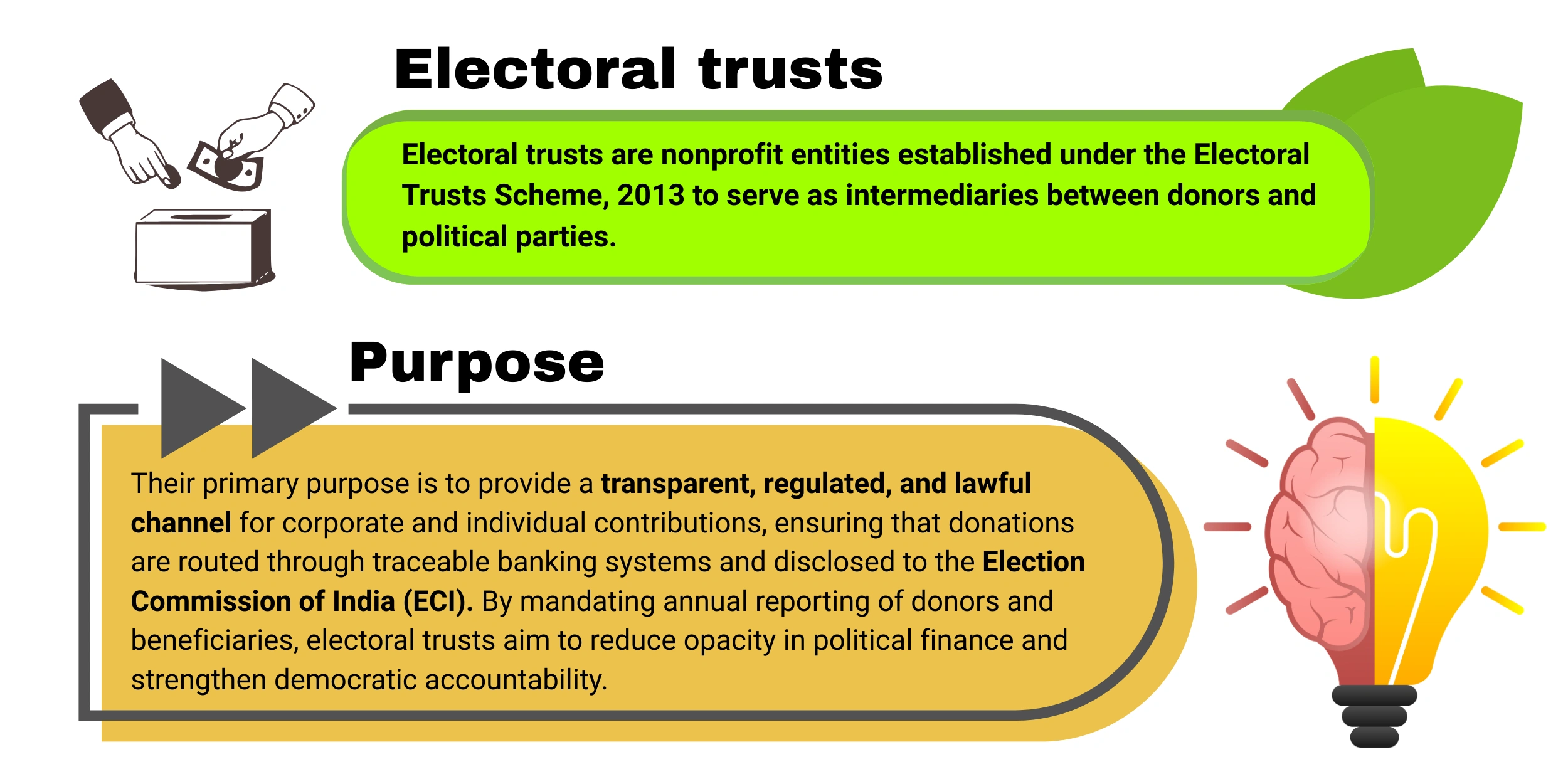
The scheme was also secured by the provisions of the Income Tax Act that provided tax exemptions to encourage legitimate funds in order to encourage financial invincibility of the trusts. In the long run, the electoral trusts became institutionalised and a way of directing corporate donations; however, their popularity was a side role until the 2024 decision of the Supreme Court to abrogate electoral bonds. This ruling gave them back their centrality, making electoral trusts the key channel of political financing in the post bond era.
What are its Legal Aspects?
The legal framework governing the electoral trusts is based on the idea that electoral transparency and accountability should be institutionalised in the political finance sector. Legal aspects refer to the laws, rules, and regulations governing any activity, process, or entity, ensuring lawful operation, protecting stakeholder rights (customers, employees, investors), managing risks, and facilitating fair commerce, covering areas like contracts, IP, labor, tax, environment, and corporate governance, to avoid penalties and build trust. Understanding these legalities is crucial for compliance, risk management, and smooth functioning, preventing fines and reputational damage.
Non-Profit Entities
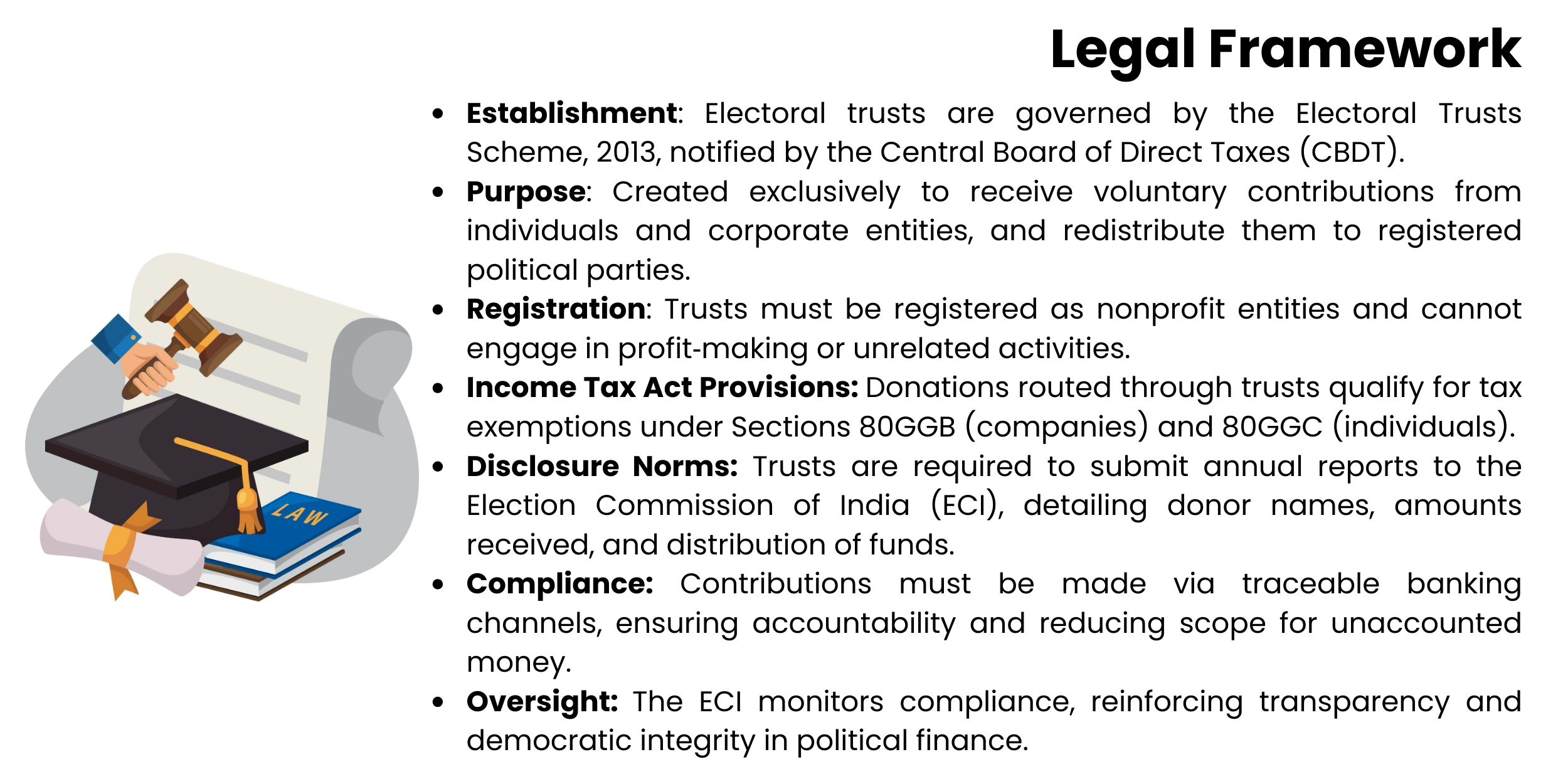
Electoral trusts are registered as non-profit-making entities under the Electoral Trusts Scheme, 2013, which has been promulgated by the Central Board of Direct Taxes (CBDT). According to it, they can only be formed with the sole purpose of accepting voluntary contributions by individuals and corporate entities and dispensing such funds to registered political parties, and they are not allowed to hold excess profits or conduct activities other than funding political parties.
Tax Rebates
The contributions to such trusts are tax-free under the Income Tax Act, 1961, which motivates people to comply. The Trusts are obligated to provide annual reports to the Election Commission of India (ECI) that would indicate the identities and monetary inflows of donors and how the funds are allocated among the political parties. The Supreme Court ruling in 2024 that allows the nullification of electoral bonds has highlighted the crucial nature of such a regulatory regime, making electoral trusts the major means of corporate donations. This leads to the legal structure that integrates financial incentives and a regulatory system to protect the integrity of democracy.
How Trusts Function?
In India, Electoral trusts are formed as non-profit organizations which are incorporated by the Electoral Trusts Scheme, 2013, and regulated by the Central Board of Direct Taxes (CBDT). This is because their constitution expressly states that they should purely be formed as a channel through which voluntary contributions are directed to political parties.
- The structure of the operations of these trusts is highly regulated. The funds are submitted to a trust by the donors, who are mainly corporate bodies and individual donors, who then release funds to political parties recognized under Section 29A of the Representation of the People Act, 1951.
- Surplus profits cannot be kept in Trusts and they cannot be involved in any form of activity other than what political funding is supposed to be.
- They must submit to the Election Commission of India (ECI) annual reports that show the name of donors, the amount received, and how the money was distributed.
- The given disclosure mechanism is supposed to increase the level of transparency and decrease the level of obscurity that has dominated previous donation practices.
The contribution made through trusts is entitled to benefits provided by the Income Tax Act, 1961, which offers an extra incentive to legally contribute to political finance. As a well-organized and responsible system of corporate and personal donations in the Indian democratic system, electoral trusts are the integration of fiscal incentives and disclosure into a mandatory action.
Funding Sources
The Electoral trusts in India depend on their own resources to a great extent, which implies the voluntary contributions of corporations and individual donors.
Donors
The Electoral Trust Scheme of 2013 allows parties registered under the Companies Act and individuals to contribute to the non-profit-making middle organizations that, in turn, dispense the money to the registered political parties. The highest element is made up of corporate donations, where the firms often submit the political contributions via trusts so as to get the benefits of the deductions that Section 80GGB provides under the Income Tax Act of 1961. Similarly, personal donations passed through trusts enable claimants to claim deductions under Section80GGC, so as to encourage the legal involvement in financing political affairs.
Form of Donation
The rules prohibit trusts holding profits from being able to distribute the money to the registered political parties or using the money in any other way other than distribution to parties. The contributions should be made through account payee cheques, demand drafts, or electronic transfer, and this should be done in a manner that is traceable and reduces the chances of unaccounted money. By identifying the names of donors, donor amounts, and how they will be used, annual reports should be submitted to the Election Commission of India (ECI), making transparency a part of the process.
Things that change Post‑Electoral Bonds
The landmark case observed in the political finance sector in regulation in February 2024, when the Supreme Court of India struck down the electoral bonds program, was a watershed case. The Court found that the scheme interfered with the constitutional underpinnings of transparency and the right to information of the citizen since the scheme allowed anonymous corporate donations without sufficient disclosure. The votes of the trust were re-employed, in the very short run, as the main legitimate method of political donation.
More Donations
In the fiscal year 2024-25, firms also increased their use of electoral trusts as a substitute for direct donations due to the legal predictability and adherence to the requirements mandated by the Election Commission of India (ECI). The trusts provide benefits by making year-end reporting of contributions and beneficiaries, as opposed to the anonymity of electoral bonds, thus instilling a sense of accountability in the system. This trend also represented a company preference for a mechanism that balances fiscal incentives under the Income Tax Act with reputational protection within a post-bond atmosphere. The motion augurs an enhanced, more traditional reconstruction of the system through which political activity is financed in India, with transparency and regulatory restraints playing the leading roles. Having initially been side-lined, electoral trusts are currently at the centre of the corporate fund distribution to politics and, hence, reflect the changing basics of democratic finances in the country.
Trust in the Institution
With the example of the 2024 decision of the Supreme Court of India, which struck down the scheme of electoral bonds, corporate donors in India are starting to favour electoral trusts as their source of political donations. The appeal of the trusts is in its duality, where the legal protection and also a financial incentive under the Income Tax Act, 1961, are undermined. By giving donations through trusts, companies are entitled to deductions in Section 80GGB, which ultimately lowers their tax payable obligations as they abide by the statutory norms.
Inclusiveness
Electoral trusts, unlike the electoral bonds that allowed the ability to remain anonymous and were criticised as threatening to transparency, disclose the identity of donors, the amount donated, and how the money was distributed among the political parties. This is the requirement that is overseen by the Election Commission of India (ECI), and the companies can safeguard their reputational interests by showing that they are performing within the framework of legal and open businesses. Moreover, the funds should be channelled through the traceable banking system, which reduces the risk of untraceable cash.
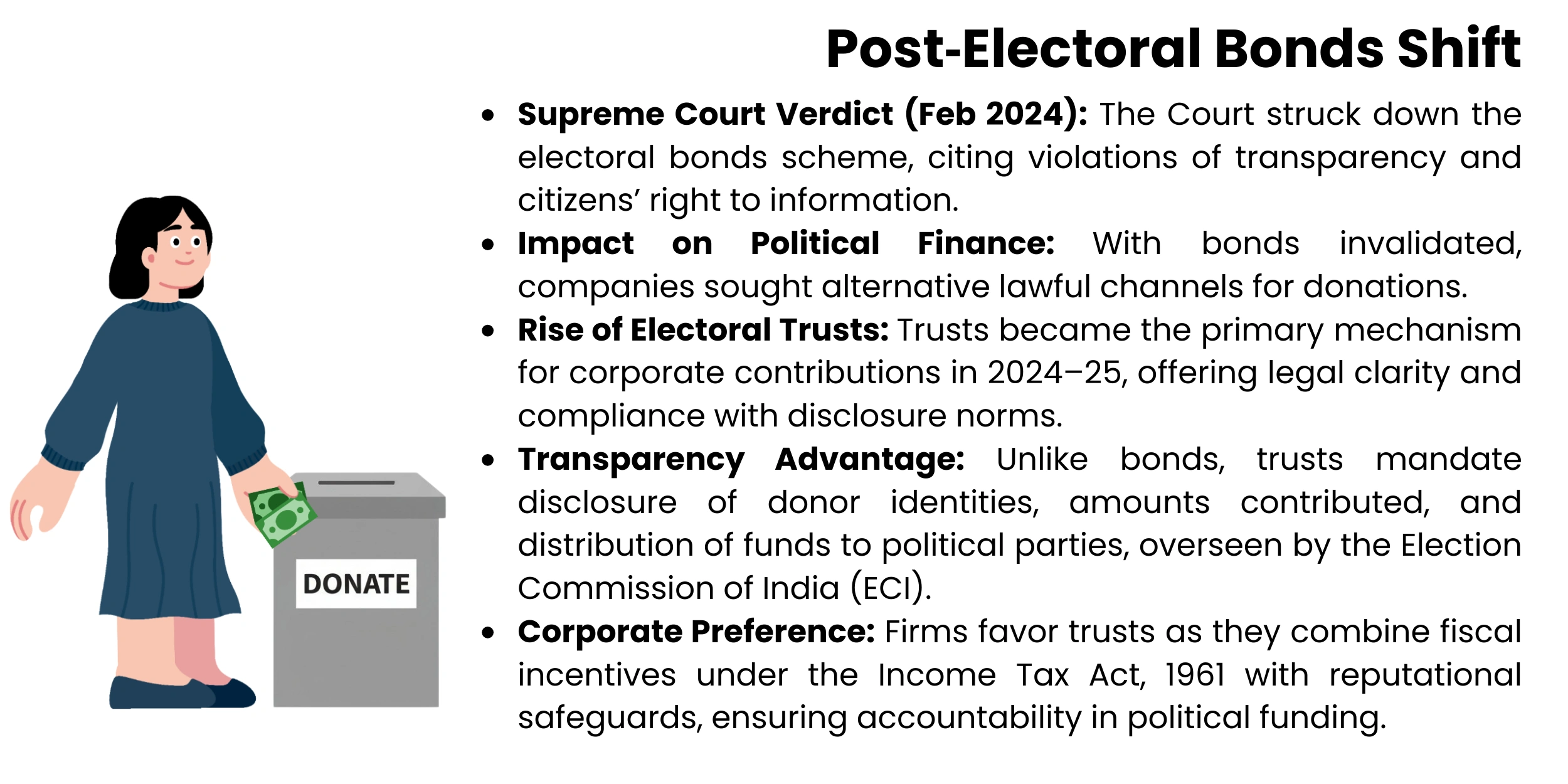
As a result, the post-bond environment has shifted the electoral trusts from a secondary channel to a primary channel of political finance of the corporations. Their organised nature, regulatory superiority, and financial advantage make them quite appealing to companies that would need to not only have a sense of legitimacy but also accountability within their interactions with the democratic processes.
Accountability and Transparency
The main pillars of the electoral mechanism of trust in India are transparency and accountability.
Transparency
Unlike the old-fashioned method of political giving, where such giving often remained secret, the electoral trusts have to operate under the rigorous disclosure requirements provided by the Electoral Trusts Scheme, 2013. These non-profit-making organizations are required to provide yearly reports to the Election Commission of India (ECI), including the identity of the donors, the amount of money donated, and how the funds were distributed among the political parties. This is meant to guard the democratic process since the citizens and the control bodies are able to check the inflow of money into the political arena through such disclosures.
Accountability
Fiscal regulations are also helpful to support accountability. Donations should be directed via verifiable banking mechanisms, hence reducing the chances of compromise of anonymous or illegal money into the political system. Profits retained by trusts are not allowed to be used to finance other activities other than funding politics, meaning that their activities are highly restricted to legal donation activities. In addition, the scheme being compliant with the provisions of the Income Tax Act, 1961, is incentives to comply with the scheme since both corporate and individual donors only get benefits from tax deductions when their donations are routed through transparent channels.
Conclusion
Electoral trusts have also become an important part of an ever-changing political finance sector in India, especially after the Supreme Court verdict in 2024 that electoral bonds had been invalidated. Trusts are bringing a balance between the interests of the donors and this democratic accountability by enacting a disclosure, improving traceability, and providing fiscal incentives. The transparency of their intermediary channels is more transparent than the previous opaque channels due to their structural design and external control by the Election Commission of India. Still, it is difficult to provide even distribution and avoid excessive corporate impact. Any discussion about a future India will be riddled with electoral trusts as it will influence reforms funding, the integrity of the democratic process, and seek a more transparent electoral process.