|
Key Highlights
- The Draft ISI Bill
- Related Issues
- Opposition by Stakeholders
- Governments rationale
- Protests all over the Country
- Effects on revenue generation
|
The draft Indian Statistical Institute (ISI) Bill, 2025, a Bill introduced by the Ministry of Statistics and Programme Implementation (MoSPI), suggests replacing the ISI Act of 1959 as well as the conversion of the ISI into a statutory corporate body. It raises concerns amongst students and scholars that such a change can lead to the lack of academic autonomy, centralisation of governance under governmental control and diminish sources of revenue, which could cause the global independence and status of the ISI.
|
Tips for Aspirants
The article is important to the aspirants of the Union Public Service Commission (UPSC) Civil Services Examination (CSE) and State Public Service Commission (PSC), as the article examines governance, institutional autonomy, public policy reform, and protest politics, which are also present in the spheres of polity, education, and current affairs.
|
|
Relevant Suggestions for UPSC and State PCS Exam
- Bankim Chandra Chattopadhyay wrote Vande Mataram in his work Anandamath (1882), which denotes devotion to the motherland.
- It was a call to nationalism, and a song they sang in Congress sessions and demonstrations during the battle for freedom.
- The Congress view incorporated the song as a historic one, though only the first two stanzas were used, so that there was no controversy about it being a religious song.
- Congress has made Vande Mataram the national song and has made Jana Gana Mana the national anthem to ensure inclusiveness.
- The reservations brought out by the Muslim League focused on the objections to goddess representations, which were considered to be isolating and against pluralism.
- The controversy has emphasized the conflicts between cultural heritage and a secular representation in nation-building.
- The compromise depicts the pluralist spirit in India, between tradition and inclusiveness in national symbols.
|
To a great extent, the issuance of the Draft Indian Statistical Institute (ISI) Bill, 2025, by the MoSPI has sparked a constructive postulate among scholars and policymakers. The proposed statute seeks to repeal the historic Indian Statistical Institute Act of 1959 so that the ISI can be reconstituted as a statutory corporate entity, and so as to supposedly modernise structures of governance and to harmonise the operations of the institution with the current paradigms of administrative governance. However, a great apprehension among students, faculty members and even researchers has been raised since the Bill is seen as a possible threatto the independence and academic freedom of one of the most reputed research institutes in India. The Indian Statistical Institute was founded in 1931 and recognised as a statutory institution in 1959, and has long been recognised as an international centre of statistical research, pedagogy and consultancy. Its unique structure of governance, which includes academic self-governance, has enabled harmonious solutions of academic activities to both the scholarly activities and the financial generating activities in terms of industrial partnerships and professional training courses. The measures of the draft Bill that predict centralised regulation and updated financial tactics are seen as a threat to this delicate balance. As a result, strong demonstrations have been vocalised through the ISI campuses that are driven by concern on bureaucratic intrusion, downtrodden academic freedoms and restrictions in terms of revenue production. The follow-up controversy can therefore be seen to be symbolic of greater strains in institutional and state-based reform in higher education governance.
Background and Rationale behind the Bill
The Draft Indian Statistical Institute (ISI),Bill 2025, which is promulgated by the Ministry of Statistics and Programme Implementation (MoSPI), is a relevant legislation initiative directed at transforming the governance of the Indian Statistical Institute.
Historical Context
At its founding in 1931 by P.C.Mahalanobis, the Indian Statistical Institute was given statutory status by the ISI Act 1959, which granted it an officially recognised designation of an “Institution of National Importance. This legal identity gave ISI the authority to be a registered society with significant freedom to govern its own academic, administrative and financial operations. The unique model of governance over the decades has facilitated ISI to balance research with consultancy and training, and therefore, making its own significant contribution to the formulation of national policy and global scholarship.
The Indian Statistical Institute (ISI) Bill, 2025 faces significant resistance because it proposes to transform the institute from a highly autonomous, academic-led society into a central government-dominated statutory body, raising fears of eroded academic freedom and increased political interference.
The Objectives
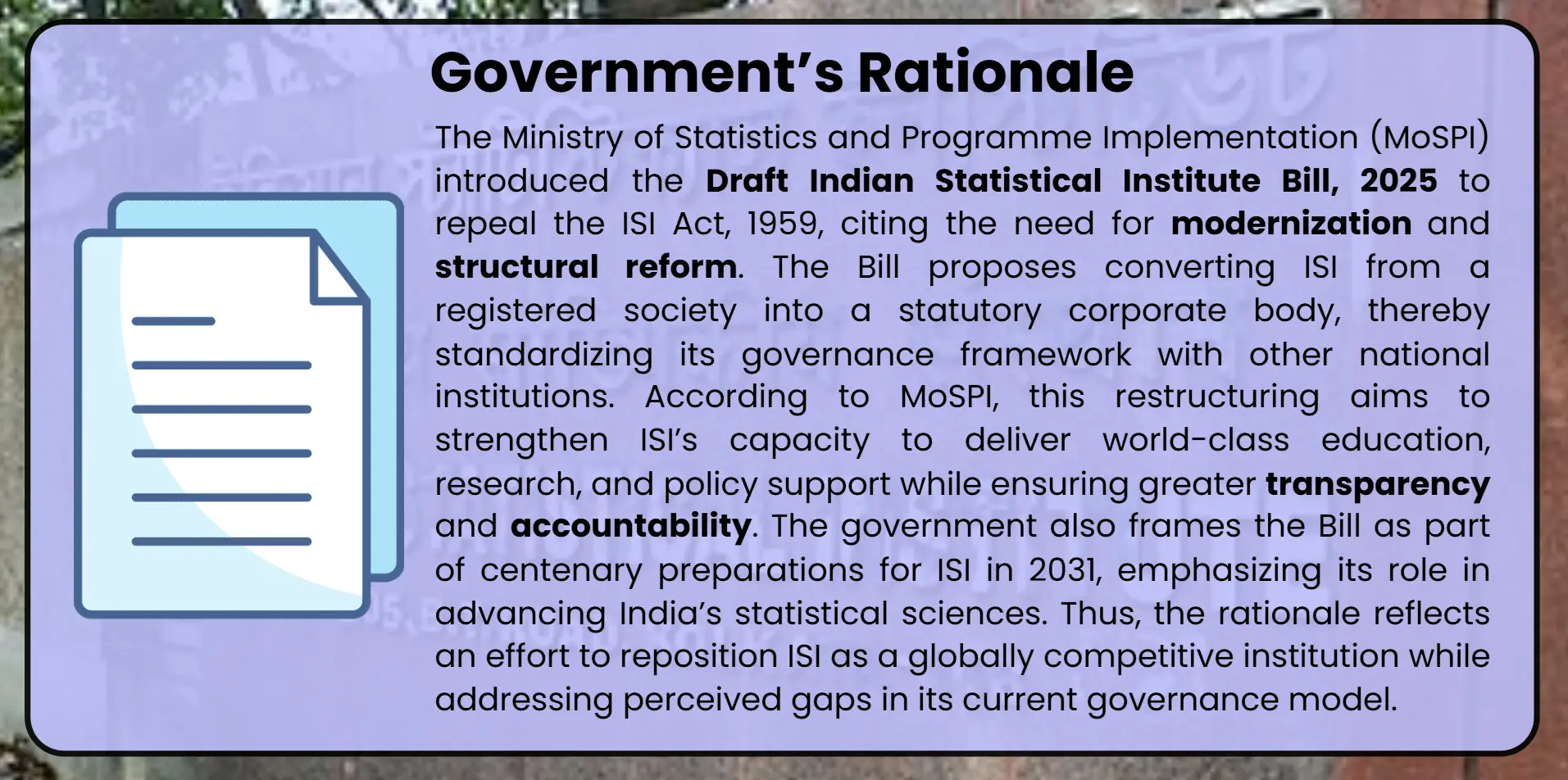
MoSPI argues that the 1959 Act has grown to be out-dated in the world of modern-day governance demands. The proposed Bill will seek to reorganise ISI into a statutory corporate entity, and will put it at the same level as the other Institutions of National Importance. The given reason foreshadows modernisation, increased responsibility, and the necessity to strengthen the ability of ISI to provide education, research, and policy advice at a world level, especially to mark its centenary in 2031.
Proposed Structural Reforms
The Bill projects significant changes in the governance framework of ISI, such as restructuring its governing council and increasing the role of government members. The aim of these changes is to increase transparency and to provide assurance that the operations of ISI would not be in conflict with the national priorities in the development. Demonstration of the shift of a registered society into a corporate one is to bring a more homogenous institutional management paradigm consistent with the statutory bodies. The reforms are reported to be invaluable to fighting the financial difficulties of fiscal sustainability and strengthening global competitiveness.
Rationales and Concerns
Even as the advocates look towards modernisation and accountability, opponents opine that the alleged reasoning covers some other underlying issues with respect to institutional autonomy. Scholars and learners worry that the Bill provisions can lead to a concentration of power, reduce the freedom of ISI to raise revenue and eliminate its autonomy when it comes to choosing research priorities. As a result, the controversy represents one of the general controversies between state-initiated reform and scholarly self-government that sheds light on the convoluted rhetoric of the necessary manner in which centres of national concern ought to attune themselves to the autonomy-accountability question in the face of swiftly shifting policy environments.
Issues Concerned by Stakeholders
The draft bill of the Indian Statistical Institute (ISI), 2025, has generated a lot of controversy among the students, faculty, staff, and policy researchers. Stakeholders argue that the amendments offered put ISI at risk of losing the independence of operations, financial zone, and long academic history.The shift from autonomy to oversight involves stakeholders balancing agency (autonomy) with control (oversight), raising concerns about accountability gaps, conflicting priorities (profit vs. ethics/environment), information asymmetry, power imbalances, and ensuring mechanisms like transparency, fairness, and genuine participation truly serve broader interests beyond just management or shareholders, often requiring new governance models for complex systems like AI or public agencies.
Autonomy and Academic Freedom
One issue that has been addressed is that of the supposedly eroded academic autonomy. The Bill suggests the reorganization of the governance of ISI, introducing a statutory corporate model that would increase government regulation. Scholars are concerned that this will weaken the traditional ISI self-regulation processes, whereby decisions regarding the priorities of research and curriculum decisions have a long history of being internally made. The threat of bureaucracy creates a fear of limited freedom in the designing of the curriculum, seeking independent research, and maintaining the worldwide reputation of ISI as a center of statistical innovation.
Government and Centralization
The dangers of centralized governance are also highlighted by the stakeholders. The restoration of the council of ISI, which would have more members appointed by the government, is seen as a system that can transfer the decision-making power out of the schools of scholars and researchers. Opponents claim this amounts to centralization, which weakens the ethos of participation in the institution, and instead of academic deliberation time, it is substituted with administrative control. This issue is also particularly close to faculty, who stress that the success of ISI in the past relied on its decentralized and collegial form of governance.
Finance and Revenue Systems
One more serious problem is related to ISI being financially independent. Currently, the institute maintains sustainability through the consultancy projects, training programmes, and by industrial and international organisations. However, the draft Bill proposes measures that are likely to limit the ability of ISI to make money, thus obstructing its ability to acquire the means of initiating independent studies. Students and faculty are concerned that decreased financial independence would make ISI over-dependent on government funding, undermining its capacity to be innovative and operate on an international level.
Demonstrations
The suggested developments have resulted in protests all over campuses, especially in Kolkata. According to students, the Bill compromises the academic climate by putting administrative control over academics. Faculty members have made statements publicly, held demonstrations, and said the reforms would undermine the position of ISI as an Institution of National Importance. These demonstrations can be seen to mirror additional concerns regarding the future of higher-education management in India, the place where autonomy and accountability often clash.
Student and Academician Unrests
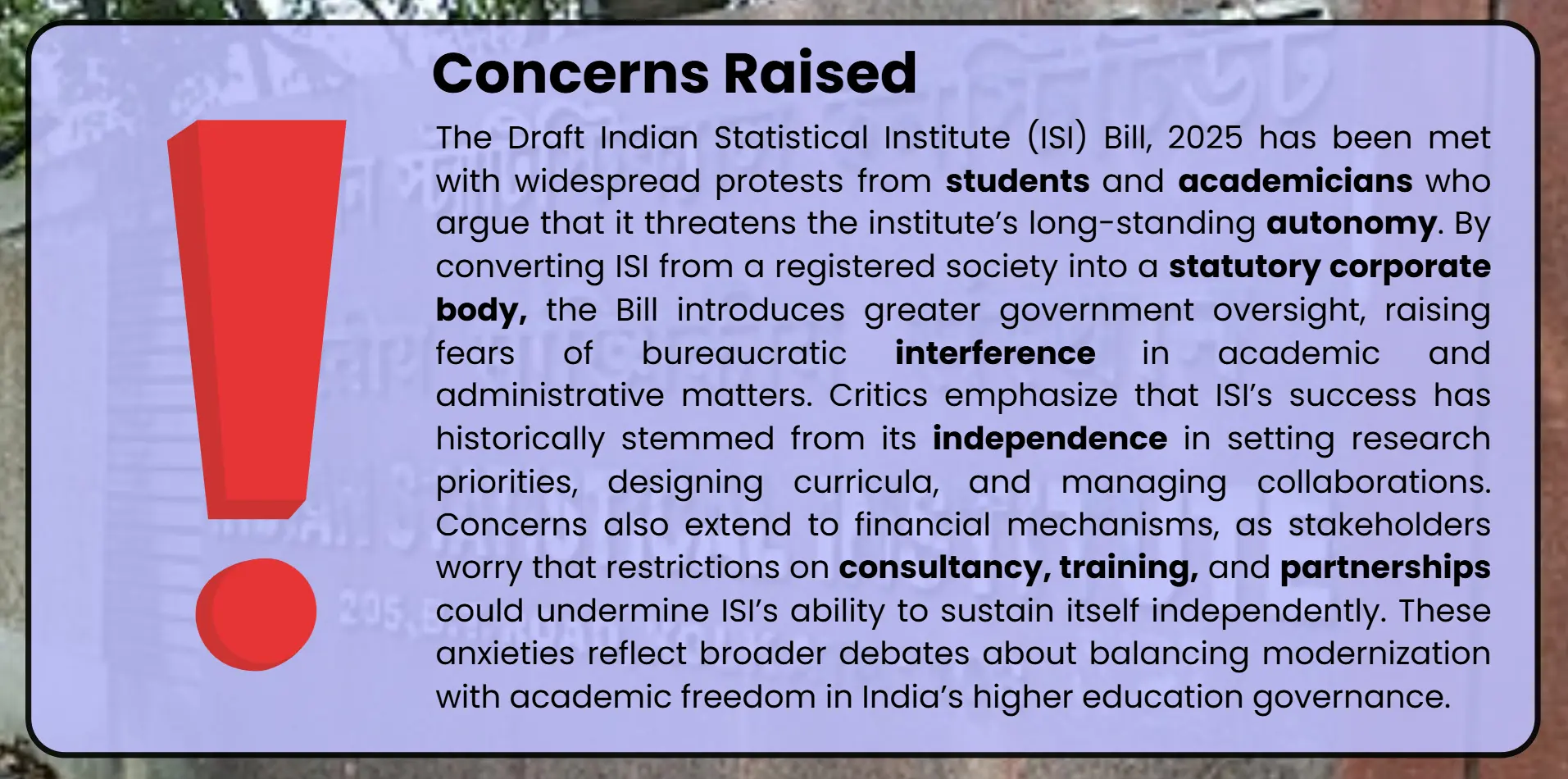
The statute of the Draft Indian Statistical Institute Bill of 2025 has received significant resistance among the ISI campuses. According to students and academicians, the proposed legislation will threaten the institution-level of authority, academic freedom, and the history of the institute. From Autonomy to Oversight Student and Academician Unrests" describes the global trend where the traditional autonomy of higher education institutions and academic freedom are being challenged by increased external oversight, leading to significant unrest among students and faculty.
Student Mobilisation
Students of ISI, especially in Kolkata, have held demonstrations, sit-ins, as well as public campaigns opposing the Bill. The sacrifice of academic freedom is the primary focus of their concern, and concerns that government-led reforms would value administrations at the expense of academic activities. Committees also underscore the fact that the quality of ISI as one of the internationally recognized research institutions lies in its ability to be independent in determining curricula, research priorities, and in establishing partnership work. These demonstrations represent a fear of the future of higher-education administration in India on a generational level.
Faculty Resistance
Academicians have not been left behind in rhetorical opposition. The members of the faculty are claiming that the Bill waters down the position of ISI as an Institute of National Importance, as it is put under the inquiry of the bureaucracy. Their points are backed by the fact that historically, ISI was successful due to its collegial governance model, which has enabled scholars to set priorities without outside interference. Senior professors have made public statements that the envisioned changes may hurt the global reputation of ISI and undermine its role in improving statistical research and policy making.
Solidarity and collectivism
It is significant that the protests are collective in nature besides uniting students, faculty, alumni, and even civil society voices. Joint petitions and open letters have also been made; they are demanding that the government revisit the Bill. This unity highlights the unity of opinion that the independence of ISI is its essence and its efficiency. The mobilisation is also indicative of other wider issues within the Indian scholastic world concerning the growing state intervention in the institutions of higher education.
Broader Implications
The demonstrations underscore a tension of greater magnitude between modernization and autonomy. Although the intentions of the government behind the Bill are defined as the reform aimed at the improvement of accountability, the stakeholders believe that the Bill may be considered a threat to academic independence. The protests, therefore, go beyond ISI, which means fighting against policies that can damage the intellectual autonomy of institutions that are deemed national. The demonstrations have gained nationwide attention, causing ISI to be at the heart of the discussions regarding governance and autonomy, as well as the future of research in India.
Effect on Revenue Aggregation
The proposed Indian Statistical Institute (ISI) Bill, 2025, has raised a lot of concerns concerning the financial sustainability of ISI. The stakeholders have argued that the proposed restructuring can destroy the revenue-generating institute mechanisms.Moving from autonomy to oversight in revenue matters generally increases central control, potentially limiting local revenue generation (Own Source Revenue - OSR) by reducing discretion in setting rates/limits, centralizing approvals (budgets, appointments), and creating dependency on central transfers, which strengthens accountability but risks stifling local initiative and efficient resource use, leading to gaps in service delivery if oversight lacks clear.
Existing Revenue Model
Traditionally, ISI has been able to sustain its activities on a diversified platform of revenue generated by a combination of consultancy to government and industry, specialised training programmes, joint research projects, as well as international collaborative ventures. Such mechanisms have provided ISI with some level of financial independence, thus enabling the financing of state-of-the-art research and attracting international project partnerships without necessarily relying on state grants.
Financial Governance Recommendations
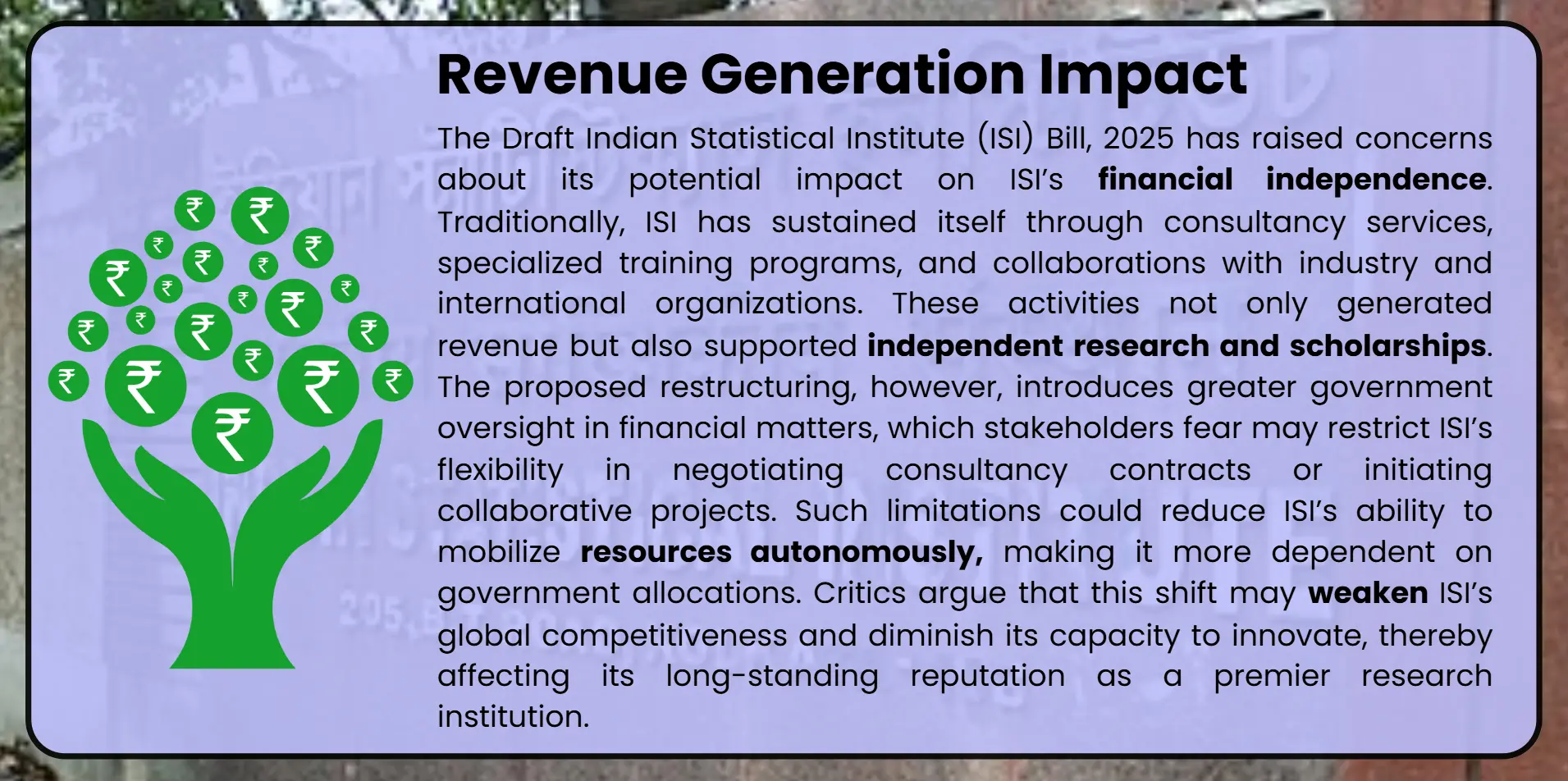
The Bill in question would lead to changing ISI into a statutory corporate organisation as opposed to being a registered society. This restructuring would increase the government's control over financial matters to the extent that ISI may no longer have the freedom to negotiate consultancy contracts or training programmes independently. The critics speculate that such a reorientation can decrease the flexibility of ISI to market demands, and thus, it causes a reduction in its readiness to create revenue through external capabilities.
Threats to Autonomy and Innovation
Financial independence is also one of the key factors influencing the innovative potential of ISI. The institute historically had self-generating revenue and has been autonomous, and supports interdisciplinary ventures. Within the new Bill, though, revenue streams can be placed under the control of bureaucratic sanctioning, and this will limit the ability of ISI to act upon opportunities. This situation would stifle the industry partnerships and discourage the competitiveness of ISI in the international academic environment.
Stakeholder Concerns
Faculty and students argue that the reduction of revenue generation will not only affect the financial health of ISI but will also affect the academic ecosystem. Limited reachability in the mobilisation of resources could trigger a reduction in scholarships, cut-off research funding, and undermine international partnerships. The demonstrations highlight the interconnectedness between ISI as an international leader in the research facility and its ability to maintain independent financial processes.
Conclusion
The Draft Indian Statistical Institute (ISI) Bill, 2025, explains the complicated conflict between new-fangled and independence in the management of higher education establishments. Although the legislation can be viewed as instituting a reform agenda by the Ministry of Statistics and Programme Implementation, intended to promote accountability and the alignment of ISI to modern institutional models, an extensive stakeholder base argues that it will disadvantage scholarship freedom, financial autonomy, and the position of the institute in the global arena. The strikes by students and scholars indicate underlying fears of state intrusion into the research institutions of national significance, thus supporting the necessity of reforms that balance obligations and the protection of intellectual freedom and institutional nature.