The Mahatma Gandhi National Rural Employment Guarantee Act (MGNREGA) has served as a vital safety net, helps to reduce farmer suicides by providing a crucial alternative income and improving rural infrastructure, but its impact has been uneven due to implementation challenges, regional disparities, and its inability to address the deep-seated structural issues of the agrarian crisis.
Key highlights
- 3.9 lakh cases were registered from 1995 to 2023
- Numbers are dominated by Maharashtra and Karnataka
- Major causing factors
- MGNREGS effectiveness
- Crop-insurance schemes and loan waivers
- Long-standing policy gaps
- Climate change resistance and psychological support
The article discusses twenty-eight years of suicide statistics among farmers in India, with Maharashtra and Karnataka being the most impacted states. It examines tendencies of history, the differences in the regions, and the role played by welfare programs like MGNREGS in the same. Lastly, it uncovers credit, insurance, and support systemic gaps to provide lessons and reforms to solve this long-running agrarian crisis. Suicides by farmers in India are among the most chronically challenging and troubling aspects of agrarian distress, and an illustration of agrarian distress and economic vulnerability intertwining with the pressures of the social environment and policy failure. The official statistics during the last twenty-eight years have invariably pointed to Maharashtra and Karnataka as the worst hit states, although periodically there are dips connected to the same welfare schemes like the Mahatma Gandhi National Rural Employment Guarantee Scheme (MGNREGS). The effectiveness of MGNREGS in relieving the distress, even on a short-term basis, is evaluated critically, and systemic gaps that still maintain vulnerability are also evaluated. Finally, the article recommends a holistic strategy involving the engagement of economic, social, and psychological facets in order to deal with farmer suicides as one of the priorities in the country.
What is Mahatma Gandhi National Rural Employment Guarantee Act (MGNREGA)
MGNREGA (Mahatma Gandhi National Rural Employment Guarantee Act) is one of India’s flagship social welfare programmes that provides a statutory guarantee of 100 days of unskilled wage employment per financial year to rural households. The scheme aims to strengthen rural livelihood security by generating employment and creating durable community assets such as roads, ponds, canals and water conservation structures. It emphasizes transparency, women participation, and decentralized, bottom-up planning through local institutions.
Key Features & Objectives of MGNREGA
MGNREGA's core objective is providing 100 days of guaranteed unskilled wage employment to rural households, enhancing livelihood security, while key features include a legal guarantee, demand-driven work, self-targeting for the poor, creation of durable rural assets, empowerment of Gram Panchayats, and mandatory social audits, all fostering rural development and resilience.
Livelihood Security:
The scheme acts as a social safety net by enhancing income stability and food security for vulnerable rural populations, especially during periods of agricultural distress.
Asset Creation:
It prioritizes labour-intensive projects that strengthen rural infrastructure, including water harvesting, flood control measures, land development, and rural connectivity.
Legal Entitlement:
Employment under MGNREGA is a legally enforceable right. If work is not provided within 15 days of application, beneficiaries are entitled to receive an unemployment allowance.
Decentralized Planning:
The planning and selection of works are carried out by Gram Sabhas, ensuring community participation, local relevance, and greater accountability.
Transparency & Accountability:
The programme incorporates strong monitoring mechanisms such as social audits, grievance redressal systems, Ombudsman oversight, and public disclosure of records to ensure effective implementation.
Gender Equality:
MGNREGA promotes women’s empowerment by ensuring equal wages for men and women and encouraging high female participation in the workforce.
Trends and Outline (1995-2023)
The issue of farmer suicide in India has remained a relevant measure of agrarian distress for almost 30 years. The time frame between 1995 and 2023 is a sign of structural weakness, massive differences between regions and policy-related volatility.
Scale of the Crisis
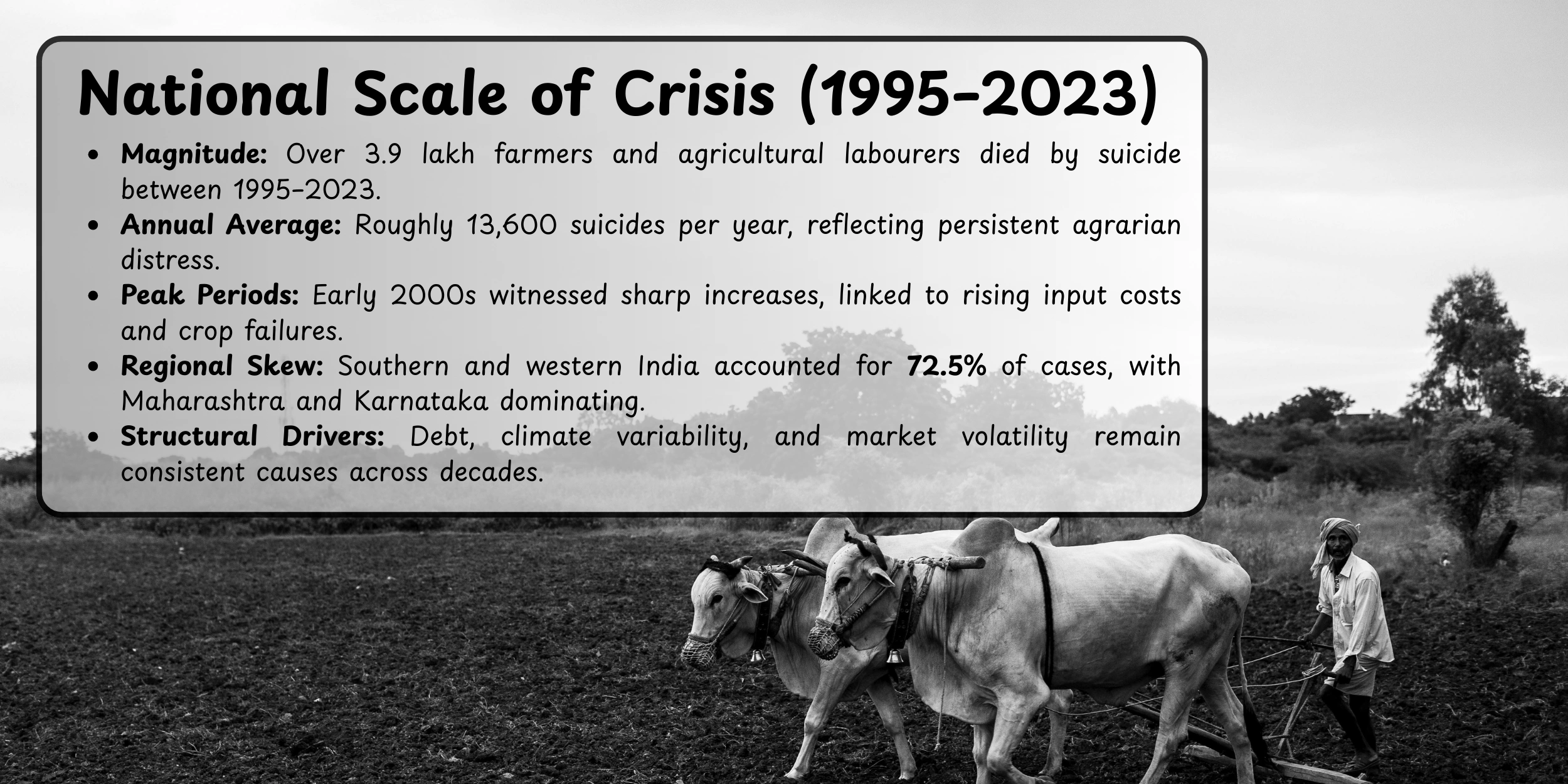
As per the statistics data at the National Crime Records Bureau (NCRB), over 390,000 farmers and agricultural labourers took their own lives in 1995-2023, giving an annual death rate of around 13,600. The crisis reached its peak in the early 2000s, which was the period of rising costs of inputs, frequent crop failures, and the spread of Bt-cotton in drought-prone areas. These empirical observations highlight the biased structural character of distress as opposed to rare happenings.
Regional Concentration
The empirical history is skewed regionally, with Maharashtra and Karnataka significantly larger contributors to farmer suicides (more than sixty percent). Maharashtra recorded the highest percentage of 38.5% of all the cases of farmer suicides, followed by Karnataka at 22.5% in the year 2023 alone. Other states shared extensively as Andhra Pradesh (8.6 percent), Madhya Pradesh (7.2 percent) and Tamil Nadu (5.9 percent), but Maharashtra and Karnataka prevail because the states have structural vices in their cotton and sugarcane cash economy.
Temporality and Policy
Trends observed show the instances of downturn involving the welfare interventions, particularly the Mahatma Gandhi National Rural Employment Guarantee Scheme (MGNREGS). In its initial rollout in the mid-2000s, the suicide rates decreased because rural households could engage in other sources of income. However, the decline was not short-lived since unfair distribution and implementation, weather hits, and unresolved credit dependence remained as sore areas of weakness. The recent case of suicides in 2023 proves the ineffectiveness of temporary relief strategies without the redesign of the entire system.
Structural Drivers
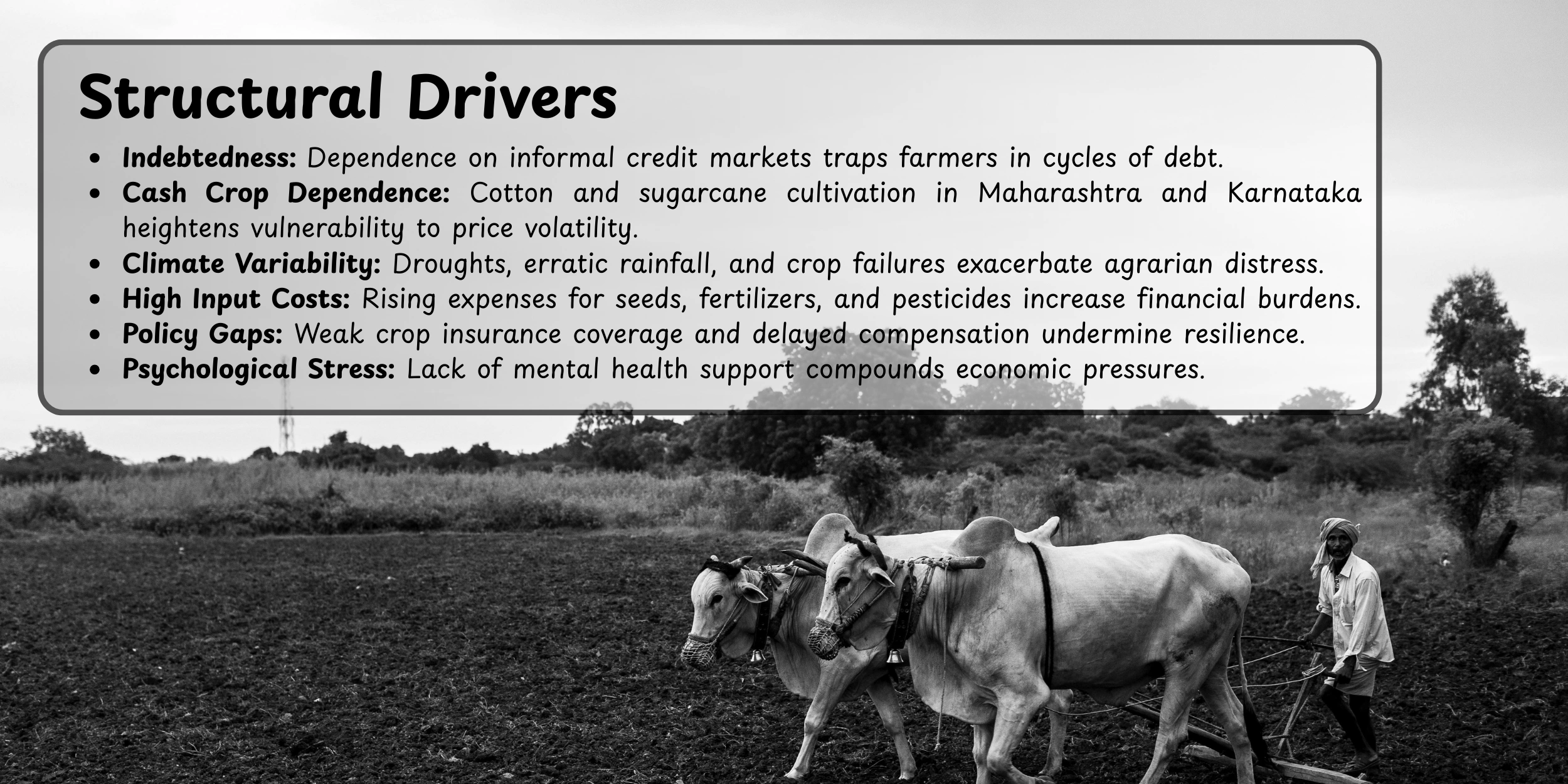
The historical persistence rate of suicides is a reflection of multi-dimensional stresses, which include indebtedness through informal credit, the fluctuation of prices in the agricultural market, insufficient coverage by crop insurance and climatic fluctuations. Vidarbha (Maharashtra) cotton belts and northern Karnataka demonstrate how technological shifts (including the adoption of Bt cotton) in combination with the increase in input costs can increase distress. These structural drivers underline the failure of separate interventions and the need to implement combined interventions, which will focus on both economic and psychological aspects.
What are the reasons for farmers suiciding in India
Farmer suicides in India remain a chronic crisis driven by a complex interaction of economic, social, and environmental factors. In 2023, over 10,700 deaths were reported among individuals connected to the farming sector, highlighting the persistent distress in rural India. Here are the key reasons include:
High Debt and Indebtedness
When farmers fail to access formal credit from banks, they are forced to depend on private moneylenders who charge exorbitant interest rates, often between 24–50 percent annually. In cases of crop failure or low market prices, repayment becomes impossible, pushing farmers into a chronic debt trap.
Crop Failure and Environmental Risks-
A large proportion of Indian agriculture is rain-fed, making it highly vulnerable to climate change–induced uncertainties such as droughts, floods, and unseasonal rainfall. Even a single extreme weather event can destroy an entire year’s crop and financial investment.
Rising Input Costs
The cost of essential agricultural inputs such as quality seeds, fertilizers, pesticides, and farm machinery has risen sharply, often outpacing the prices farmers receive for their produce.
Non-Remunerative Prices
Despite good harvests, farmers frequently fail to recover their costs due to volatile market prices and inadequate storage and marketing infrastructure, forcing distress sales immediately after harvest.
Small Land Holdings
The dominance of small and marginal landholdings limits economies of scale and discourages investment in modern farming technologies, resulting in low productivity and incomes.
Socio-Cultural Pressures-
Social stigma associated with indebtedness, inability to meet family responsibilities, and high expenditures on social obligations such as weddings and medical emergencies significantly increase psychological stress among farmers.
These interconnected economic, environmental, and social factors together create a cycle of financial insecurity and mental distress, making agriculture an increasingly precarious livelihood in India.
Geographical Focus: Maharashtra and Karnataka
The issue of the concentration of cases of farmer suicides in India proves to be highly regional, as Maharashtra and Karnataka have been leading national statistics. The agrarian economies of these states, which have been largely dependent on cash crops, have had a weakness in structure for almost thirty years.
Maharashtra
Since the mid-1990s, 38.5% of farmer suicides have been documented in Maharashtra, the highest rate of suicide in the country. The regions that have been hit most are Vidarbha and Marathwada, which are dominated by cotton cultivation. The problems of rising input prices, dependence on rain-fed farming (rain-fed agriculture), and the uncertainty of cotton prices have made distress worse. With promises of increased yields, the introduction of Bt cotton in the early 2000s made farmers rely more on the use of costly seeds and pesticides, thus implying a worsening indebtedness.
Karnataka
Karnataka is close after it with a 22.5 percent contribution of farmer suicides. Sugarcane and cotton belts in Southern Karnataka have been affected the most, and frequent cases of droughts and random rain showers have worsened the crisis. The use of informal credit markets by the farmers often causes traps of debt in cases of failure of crops. With the welfare systems, the rising suicide rates are predictably double the national figure, which implies there are still amplified structural flaws in rural assistance frameworks.
Analysis and Structural Forces
Together, Maharashtra and Karnataka have more than 60 percent of farmer suicides in the country, a concentration that does not match other states. The states of Andhra Pradesh (8.6%), Madhya Pradesh (7.2%), and Tamil Nadu (5.9%) also have high numbers, but the prevalence of Maharashtra and Karnataka highlights the systemic problems. Key drivers include:
- Cash dependence (cotton, sugarcane), and other crops that can be affected by market fluctuations.
- The variation of climate is typified by the incidence of droughts and rain failure.
- Credit dependency, especially to informal lenders.
- Policy gaps, whereby policies like MGNREGS give one-time relief but are ineffective in structural debt and crop insurance.
Implications for Policy
The suicides in the region are concentrated, which is why state-specific interventions are needed. Maharashtra and Karnataka need specific measures of crop diversification, institutional access to credit, and climate resilience of agriculture. Without systematic change, these states will still be leading in the statistics on suicides, with the result that the stability of the rural areas and national food security will be compromised.
Policy interventions and the effect of the MGNREGS
In India, farmer suicides have been met with enough government policies that are responsive enough to usher in some form of a policy gap, yielding a range of policy responses aimed at alleviating agrarian distress. The Mahatma Gandhi National Rural Employment Guarantee Scheme (MGNREGS) has been one notable tool that has seen the light of day among the interventions, as it does offer supplemental income and is also part of a decrease in vulnerability in rural households.
Credit waivers and loan support
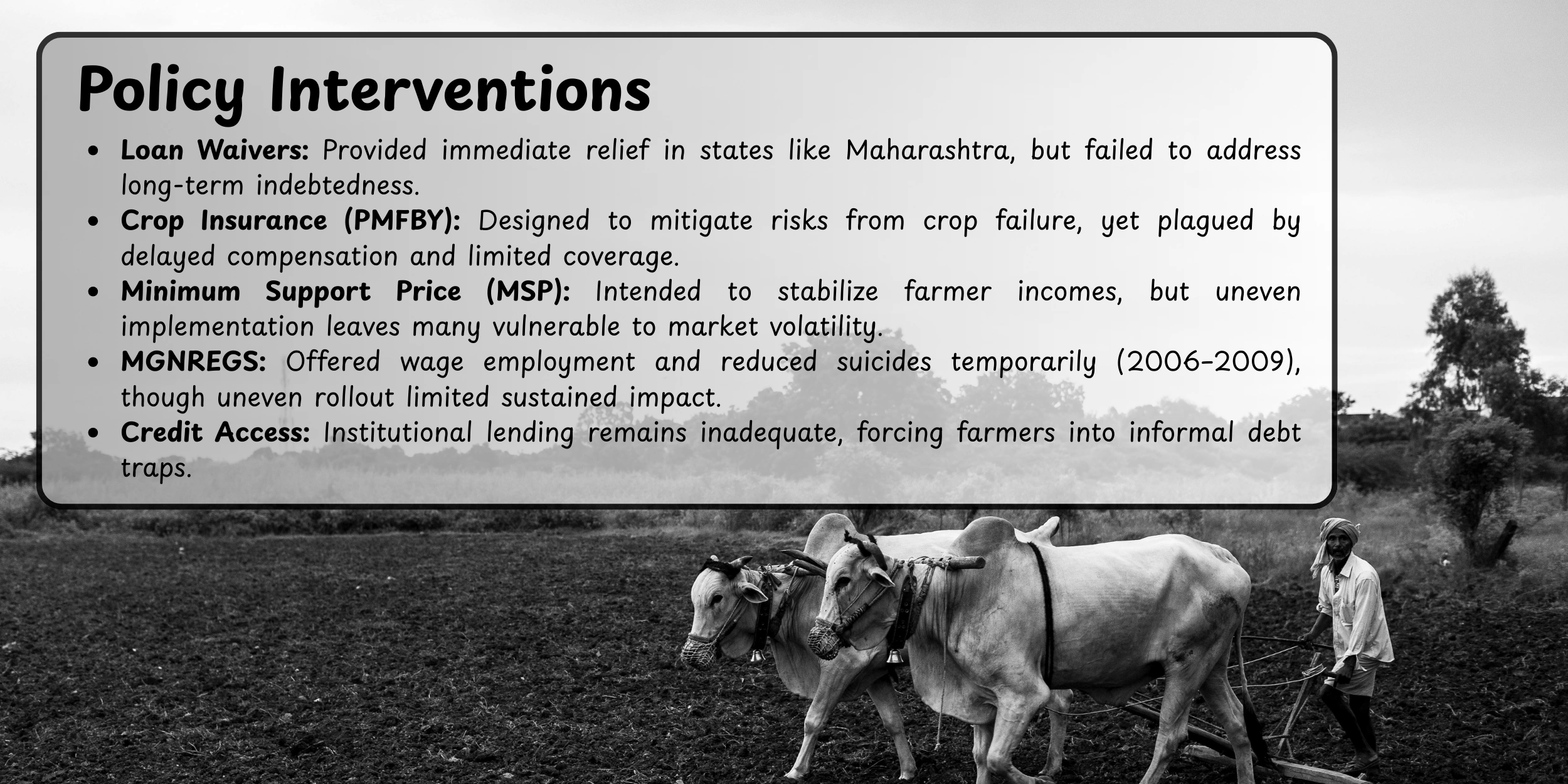
Loan waivers have been put into use on multiple occasions, especially in states like Maharashtra and Karnataka. Although these waivers provide short-term relief, empirical studies have revealed that most of them do not solve structural indebtedness because farmers tend to go back to informal credit markets where institutional access is limited. According to the figures of the National Crime Records Bureau (NCRB), indebtedness has remained a principal antecedent of suicides, and more than half the suicides can be traced to financial stress.
The market reforms and crop insurance
Programs like Pradhan Mantri Fasal Bima Yojana (PMFBY) were designed in order to reduce the risks related to crop failure. However, research has pointed out shortcomings in implementation, delayed compensation, and coverage. In parts with drought, such as Vidarbha and northern Karnataka, farmers are often left out, so this will be ineffective in other areas. Market reforms, such as a change of the minimum support price (MSP), have also failed to stabilize the incomes of farmers, leaving them most vulnerable to market fluctuations.
MGNREGS and Suicide Fall
MGNREGS was instituted in 2005, and it ensures rural households 100 days of wage employment. It has been indicated that, in the early days of its existence, suicide rates did temporarily decline in agrarian states as households obtained alternative sources of income. As an example, NCRB statistics show that suicides declined between 2006 and 2009, and this coincided with the peak of the MGNREGS process. Its long-term effect was, however, limited by an uneven distribution, corruption, and delays in remuneration. The scholars argue that although MGNREGS brought immediate relief, it failed to fundamentally redress them structurally through the debt and crop reciprocity.
Limitations
The effectiveness of the policy interventions is not homogeneous. Loan waivers and insurance schemes provide short-term relief, but do not correct structural weak areas. MGNREGS showed potential for lessening pain but requires strong monitoring, timely payment of wages, and consideration of more inclusive agricultural reforms.
Lessons, Gaps, and Way Forward
The continued rate of cases of farmer suicides in India during almost thirty years highlights the lessons learned during the previous interventions as well as the gaps that still exist. An economic, social, and institutional reform should bring together a prospective approach.
Experiences of Past Interventions
The waivers of loans, crop insurance and Mahatma Gandhi National Rural Employment Guarantee Scheme (MGNREGS) proved that temporary relief can help alleviate distress in the short term. As an example, the records of the National Crime Records Bureau (NCRB) show the decline of suicides during 2006-2009, which is the period when MGNREGS reached its highest implementation level. Likewise, Loan waivers, which were established in Maharashtra, gave temporary relief, but, again, only temporarily. The moral of the story is clear: the interventions should not be limited to short-term relief but should be aimed at structural change.
Gaps in Current Approaches
Systemic gaps still exist even with the various schemes deployed. In the 2023 NCRB report, 10,786 suicides among farmers and agricultural labourers were reported, out of which Maharashtra (38.5%) and Karnataka (22.5%) played a disproportionate role.
Key gaps include:
- Availability of credit: Farmers are always reliant on informal credit providers, and it entraps them in a credit trap.
- Insurance cover: PMFBY is plagued with late compensation and low coverage.
- Mental health support: Mental aspects of agrarian distress are still very little realised.
- Climate resilience: Drought-prone areas do not have proper mechanisms of adaptation, which increases vulnerability.
Towards Sustainable Solutions
Multi-dimensional reforms are essential in order to have a path towards sustainable solutions.
- It is essential to strengthen institutional credit structures and ensure the payment of crop insurance pay-outs punctually.
- The use of agricultural linkages can be expanded to MGNREGS to offer a stable income and productivity.
- Farming practices that are resistant to climatic changes, such as crop diversification and water management, should be given priority.
- It is also essential that mental health services are incorporated into the programmes of rural welfare, thus recognising the psychological burden of agrarian distress.
National Priority and Policy Integration
Farmer suicides are not to be treated as a local issue but as a national issue. The policies should combine the economic, social, and psychological aspects, where the ministries of agriculture, rural development and health are coordinated. The example of Maharashtra and Karnataka underlines the need to provide state-specific strategies, whereas national frameworks should provide equity and sustainability. Unless radial changes are made in the system, the distress cycle will continue, with poor rural stability and food security being compromised.
Conclusion
The trend of suicides among the Indian farmers is something that has been going on within the last twenty eight years, and this clearly highlights the agrarian distress in India that has remained unresolved despite the various policy interventions. Maharashtra and Karnataka have remained on top of the national numbers, thus representing structural weaknesses as reflected in indebtedness, climatic uncertainty, and cash crop dependency. Though programs such as MGNREGS worked to alleviate the problems temporarily, the inaccessibility of credit, along with crop insurance and mental-health assistance, is still unaddressed. To resolve this crisis, interdisciplinary measures (combined with economic brightening, social safeguards, and psychological assistance) are required. Farmer suicides should be taken as a priority on a national level, and multidimensional approaches should be implemented long-term in a bid to protect the livelihood of rural people.