The ISRO PSLV-C62 flight of the Indian Space Research Organisation was of significant media interest, as there was a failure in the third stage on 12 January 2026, complicating the delivery of sixteen satellites, which presents a rare setback in the history of the successful launch vehicle of the country and the future of Indian space ambition.
|
Key highlights
- PSLV-C62 mission of the ISRO
- Failure of ISRO PSLV-C62
- Causes of Failure
- Consequences for the Indian Space Program
- Its Implications
|
The failure ofthe PSLV-C62 mission of the ISRO on 12th January 2026 is a matter that has received an exceptional amount of attention, both scientific and policymaking. Since the Polar Satellite Launch Vehicle has been viewed as a solid workhorse of the space exploration program, the unexpected third-stage data is a rare but substantial setback. The mission carried with it sixteen satellites, including the strategic payloads, and the resulting loss illustrates both the weaknesses in technology and institution-based challenges. This episode, therefore, causes one to critically review the strength of the launch infrastructure in India, the consequences of the situation on national space missions, and the need to improve quality controls and innovation in the field of aerospace engineering.
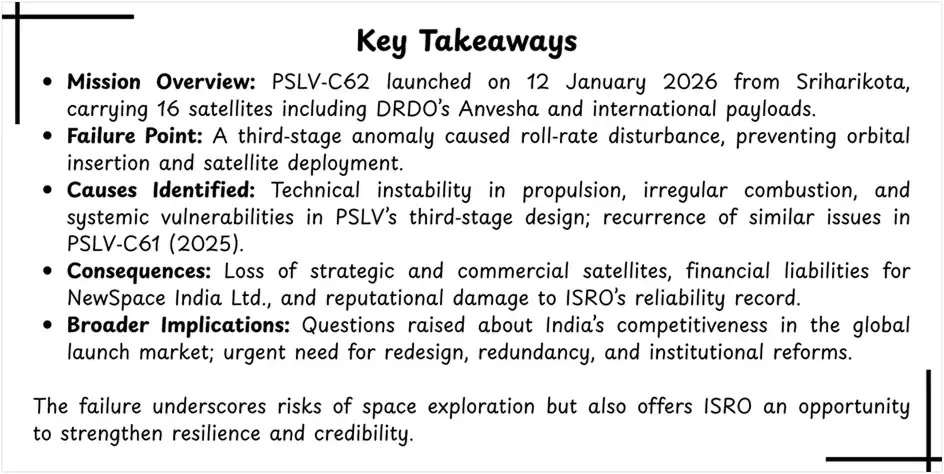
The ISRO PSLV-C62 mission failed due to an anomaly in the third stage that prevented the rocket from achieving orbital velocity. This technical flaw, the second consecutive failure involving the PSLV's third stage, exposed institutional challenges regarding quality control and transparency.
What happened on the Morning of 12th January?
The PSLV-C62 was launched on 12 January 2026 and ended up being unsuccessful due to a severe anomaly in stage three. This rare failure undermined the schedule of the Indian satellite launch and led to questions about the stability of the system.
Initial Launch Performance
PSLV-C62 was launched at 10: 17 AM Indian Standard Time from Satish Dhawan Space Centre. It had an Earth observation satellite EOSN1, and payloads of sixteen satellites, which included DRDOsourced, Nepal-sourced, Spain-sourced, Mauritius-sourced, and Brazil-sourced satellites. Although the first and second stages had been performed nominally with a successful separation, the third phase, the point at which the trajectory was to be redirected, saw errors in the roll rate and propulsion stability.
Technical Deviation on Third Stage
The third stage, according to ISRO chairman, V. N Narayanan, had a roll-rate disturbance, which triggered the loss of control and hindered the orbital insertion. The current anomaly is similar to that of the PSLV-C61, which failed in May 2025, also characterized by a case of instability in its third stage. The observation implies that there exist points of failure in the design or quality assurance procedures relating to PSLV.Historically, PSLV has been seen as the workhorse of India, as it has had sixty-three successful flights, but these consecutive failures are not common.
ISRO PSLV-C62 :What went wrong?
The PSLV-C62 mission crash has raised much criticism about its root causes. Even though the history of the ISRO has been historic in terms of reliability, the fact that the anomalies in the third stage of the rocket happened twice makes a more thorough analysis.
Third-Stage Instability
The instantaneous reason for the failure was the roll rate perturbation in the third stage, which derailed the path of the rocket and made it impossible to insert it into orbit. According to frequency conforming reports by the ISRO Chairman V. Narayan, it was a problem in the propulsion system, which had been previously experienced during the May 2025 PSLV-C61 mission. This highlights an in-flawed design of the PSLV, especially in its third-stage control systems.
Propulsion and Quality Assurance Issue
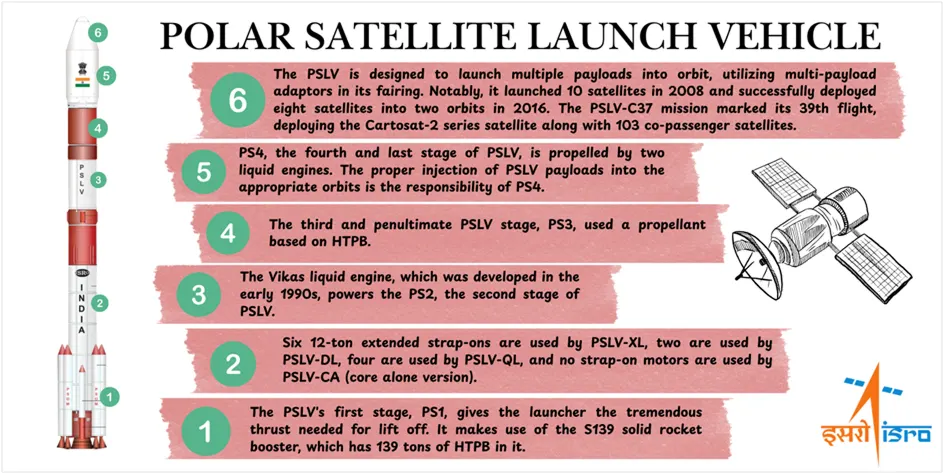
It has been technically investigated that the solid-propellant motor of the third stage could have had the issue of irregular combustion or thrust-vectoring errors. These kinds of failures destroy stability and guidance, hence resulting in mission failure. This has led to the observation by analysts that although there have been 63 successful launches of PSLV, there have been consecutive failure cases that seem to indicate flaws in the quality-assurance and testing-procedures. As a result, it is witnessed that greater redundancy and harsh pre-launch simulations are necessitated.
Institutional and Systemic Factors
In addition to technical deficiency, institutional problems seem to be contributory factors. The rising rate of launches, combined with the commercial obligations undertaken by NewSpace India Ltd. through ISRO, could have been a burden on the resources and management. The negligence of 16 satellites, including the DRDO Anvesha and foreign payloads, clearly shows the dangers involved in putting schedules ahead of exhaustive testing. This accident implies that the project management and engineering controls should be reformed systemically in order to regain trust.
PSLV-C62 cost to India’s Space Program
The breakdown of the PSLV-C62 mission has caused numerous implications on the Indian space mission, including the technological user confidence, capital investments, and partnerships. These results provide an understanding of the general consequences of the repetitive failures in the ISRO launch systems.
Loss of Strategic and Commercial Payloads
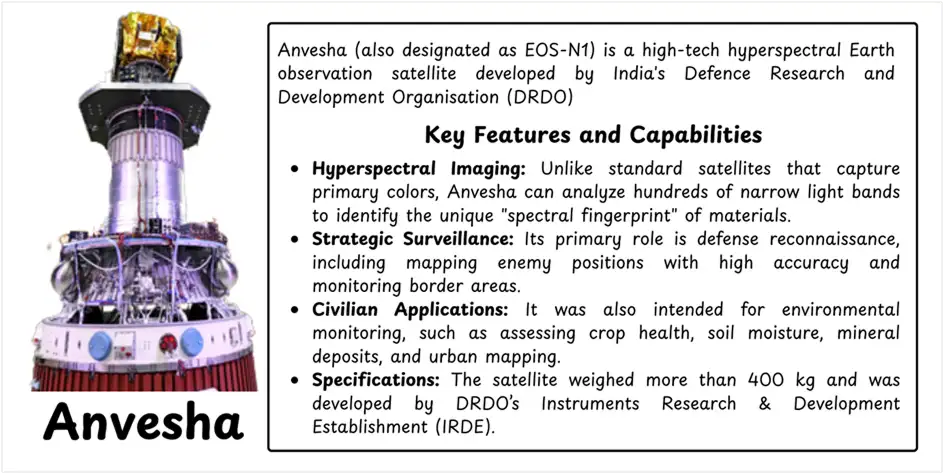
It was followed by the destruction of 16 satellites, and the payloads of DRDO Anvesha and payloads from Nepal, Spain, Mauritius, and Brazil. These satellites were meant to be used in earth observation, communication, and as experimental technologies. The fact that their loss delays vital applications in defense, agriculture, and disaster management and it compromises the reputation of India as a reliable launch provider.DRDO Anvesha (or simply Anvesha) refers to the EOS-N1 hyperspectral Earth observation satellite, which was developed with support from the Defence Research and Development Organisation (DRDO).
Financial and Contractual Setback
NewSpace India Ltd, which is the commercial wing of ISRO, is the contracting party in matters concerning the failures of deploying foreign satellites.According to the estimates given by the analysts, the financial consequences may reach hundreds of crores, considering the insurance claims and compensation accords. The consequence of this failure is also the undermining of India's competitiveness in the international market of launching satellites in space, the reliability of which is a decisive factor.
Reputational Damage and Policy Effects
The PSLV, by marking 63 successful launches, had propelled ISRO to large achievements before falling short of success in 2025 and 2026. Repetitive appearance of third-stage anomalies provokes concerns over the vulnerability of the system and demands its design and quality assurance. The foreign collaborators might be reluctant to leave payloads on PSLV until corrective decisions have been made. In the case of India, this accident highlights the necessity of introducing institutional changes, enhancing the redundancy provisions, and re-investing in next-generation launch vehicles.
PSLV-C62 :Broader Implications
Failure of PSLV-C62 has implications which are not limited to the resulting technical setbacks. It poses pertinent questions related to the dependability that India has in space missions, its stance in the international launch sector, and the institutional changes that might be necessary in order to support the long-term aspirations.
India Launch Systems Reliability
In the past,the PSLV was so far the most reliable Indian launch vehicle, having control over 63 successful launches before the failure of 2025 and 2026. Continued repetition of third-stage anomalies reduces the confidence in the reliability of payloads. In the case of international partners, trustworthiness is one of the key requirements, and recurrent failures can discourage collaborative interactions unless corrective actions are proven to be efficient.
Influence on Global Competitiveness
India has been able to position itself strategically as a low-cost substitute in the world market in launching satellites. However, the fact that 16 satellites, including the foreign ones, were destroyed in the process of PSLV-C62 hinders its competitive edge. Business clients can re-negotiate the contractual commitments, especially in cases where dependability is measured against the costs. This episode highlights the need to speed the process of developing a next-generation aircraft like Small Satellite Launch Vehicle SSLV and GSLV Mk-III that is claimed to be more resilient and have a higher payload capacity.
Institutional and Policy Reforms
The accident points to institutional shortcomings in quality assurance and project management. As the pace of ISRO rises together with launch rates and as it enters the business sector by way of NewSpace India Ltd., restructuring of the institution is essential to strike a balance between innovation and strict testing standards. The reinforcement of the redundancy system, enhancement of propulsion equipment, and investments in sophisticated processes of simulating will also play a significant role in building credibility again.
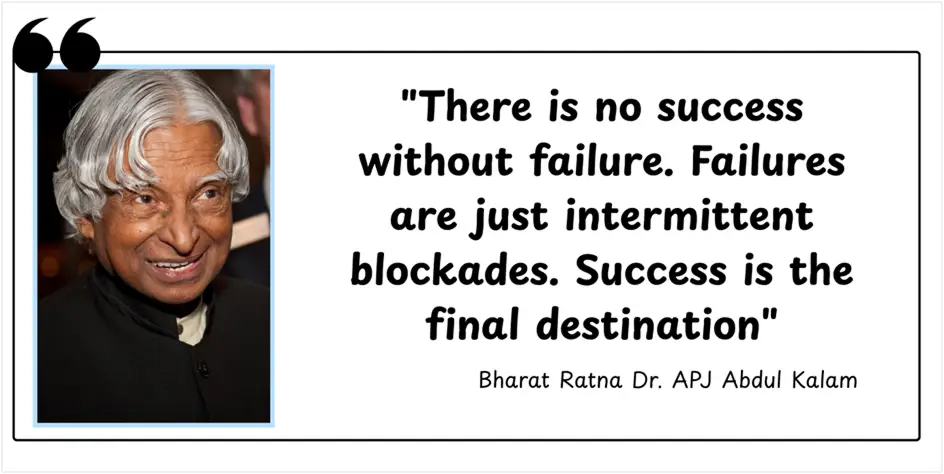
Conclusion
The ISRO PSLV-C62 failure is not a mere technical anomaly, as it forms one of the critical milestones in the Indian space program. The fact that sixteen satellites were lost, in addition to the frequent instability of the third stage, only increases the acuteness of the need for systemic changes that involve design, testing, and institutional control. ISRO is still fairly resilient; however, the incident reflects the negative aspects of space exploration and the need to ensure stability. To maintain its credibility in the long run in space missions, India needs to work on its mistakes.
Frequently asked questionsFrequently asked questions
What happened on the Morning of 12th January?
The PSLV-C62 was launched on 12 January 2026 and ended up being unsuccessful due to a severe anomaly in stage three. This rare failure undermined the schedule of the Indian satellite launch and led to questions about the stability of the system.
ISRO PSLV-C62 :What went wrong?
The PSLV-C62 mission crash has raised much criticism about its root causes. Even though the history of the ISRO has been historic in terms of reliability, the fact that the anomalies in the third stage of the rocket happened twice makes a more thorough analysis.
PSLV-C62 cost to India’s Space Program?
The breakdown of the PSLV-C62 mission has caused numerous implications on the Indian space mission, including the technological user confidence, capital investments, and partnerships. These results provide an understanding of the general consequences of the repetitive failures in the ISRO launch systems.
PSLV-C62 :Broader Implications?
Failure of PSLV-C62 has implications which are not limited to the resulting technical setbacks. It poses pertinent questions related to the dependability that India has in space missions, its stance in the international launch sector, and the institutional changes that might be necessary in order to support the long-term aspirations.