The recent confiscation of a number of Venezuela-linked tankers, as well as its proclamation of endless control over the crude exports of the nation, by the United States, following the overthrow of President Nicolas Maduro, has changed global energy markets as well as increased geopolitical tension in the world.
|
Key highlights
- Oil Reserves of Venezuela
- Interests of US in Venezuela
- Changing Politics in Venezuela
- Impact of US Sanctions on Venezuela
- Shift in Global Oil Market
- Impact on the Energy Transition and Sustainability
|
Venezuela, with the largest proven oil reserves in the world, takes a strategic position in the current energy geopolitics. Its oil prosperity has traditionally been seen as both an economic strength and vulnerability, thus moulding the politics of the country and the diplomatic relationships with other countries. Traditionally, the United States, as a powerful participant in the world oil markets, has had significant influence in the Venezuelan oil industry through the use of sanctions, diplomatic, and corporate actions. This dynamic has very far-reaching implications not only to the sovereignty of Venezuela but also to the stability of the international oil markets. The integration of these changes explains the complexity of interactions between resource nationalism, external control, and changing the world energy dynamics.
Venezuela Oil Reserves
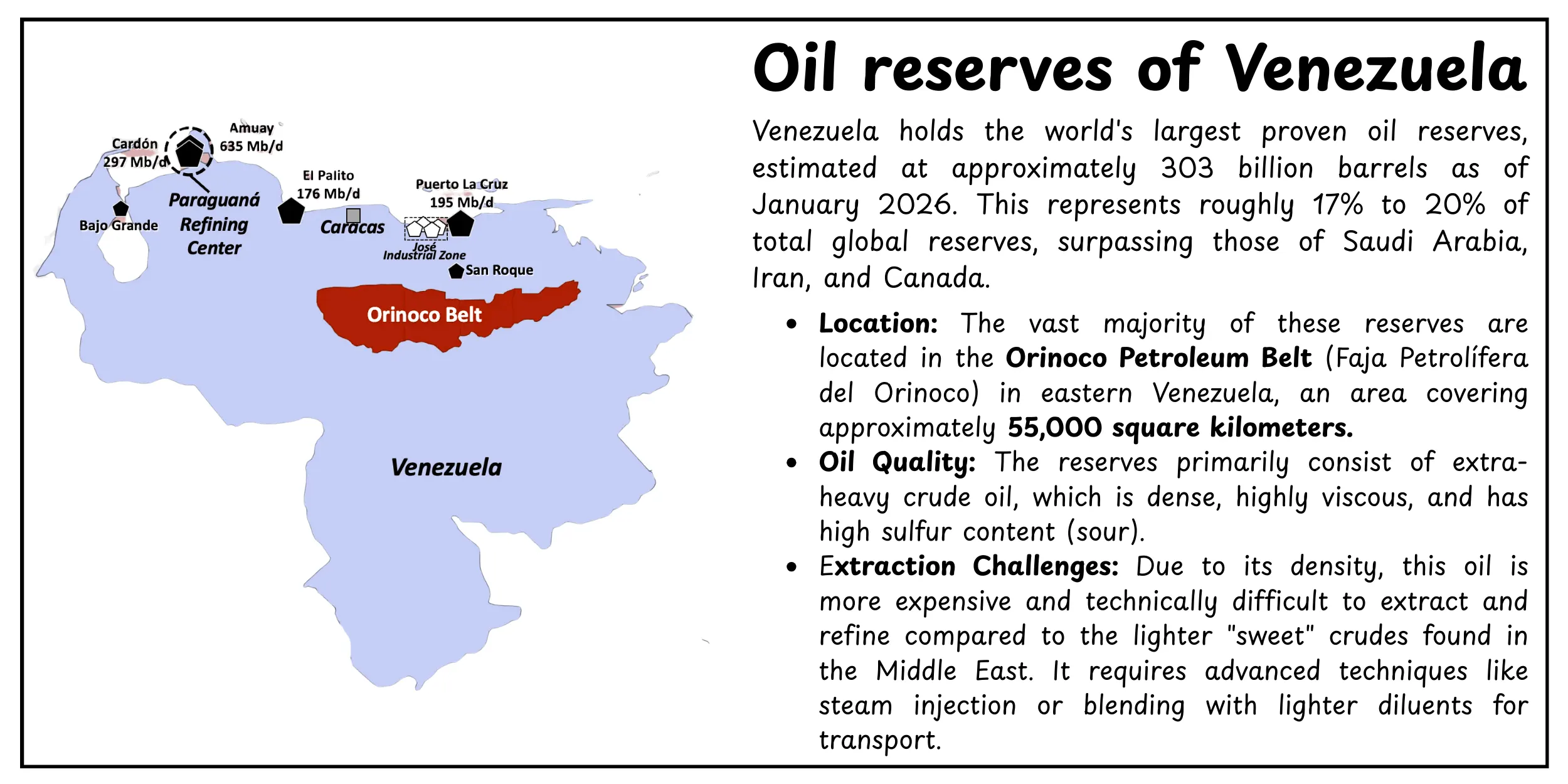
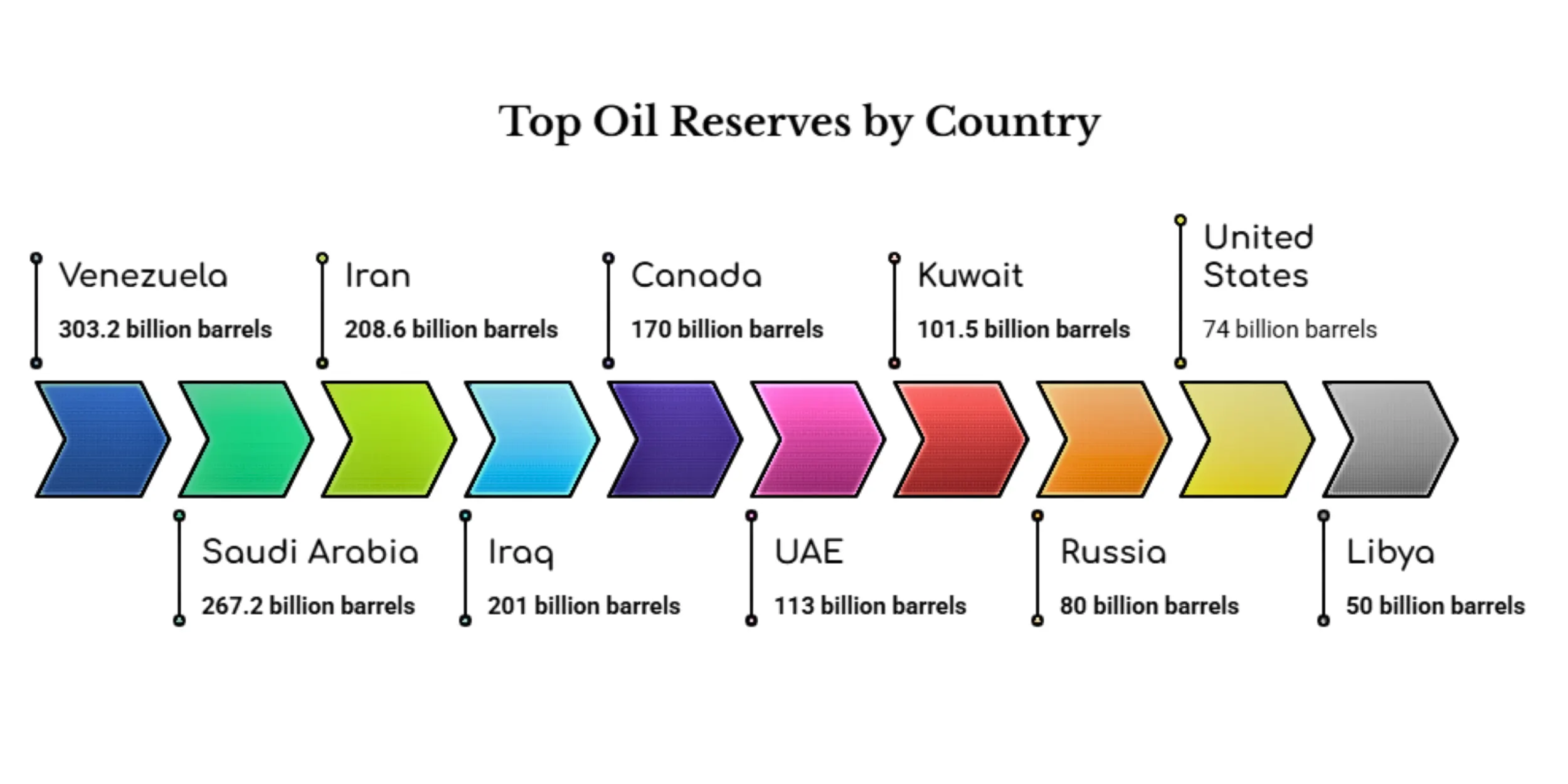
Venezuela holds the world's largest proven oil reserves in January 2026, officially estimated at approximately 303 billion barrels. This represents roughly 17% to 20% of the total global oil stock.Oil reserves that form the largest deposits of oil worldwide in Venezuela influence political discourse in the country as well as global energy markets. Their size, density, and the drawbacks related to them suggest the irony of resource abundance.
Scale and Global Ranking of Venezuela’s Oil Reserves
Venezuela carries an estimated 303 billion barrels of proven oil reserves, which is about 17 percent of all the world's reserves, thus making it the leading reserve keeper over Saudi Arabia and Iran. These reserves are mainly located in the Orinoco Belt, a massive geological structure that takes up almost 55,000 square kilometres, where the extra-heavy crude contents require the use of sophisticated refining technology. This immense reserve base therefore, highlights the strategic value of Venezuela to the world energy geopolitics.
Background and Production of Oil by Venezuela
Although the reserves of Venezuela have been increasingly certified over time, production has been drastically reduced. In February 2025, production of crude oil was 1,098,000 barrels per day- a very sharp drop compared to the almost 3 million barrels per day just in the early 2000s. This decline represents a deterioration of infrastructure, limited investment, and the snowballing impact of sanctions by other countries. The imbalance between reserves and production capacity, therefore, proves the challenges of achieving economic stability using geological abundance.
Strategic Implications for Venezuela
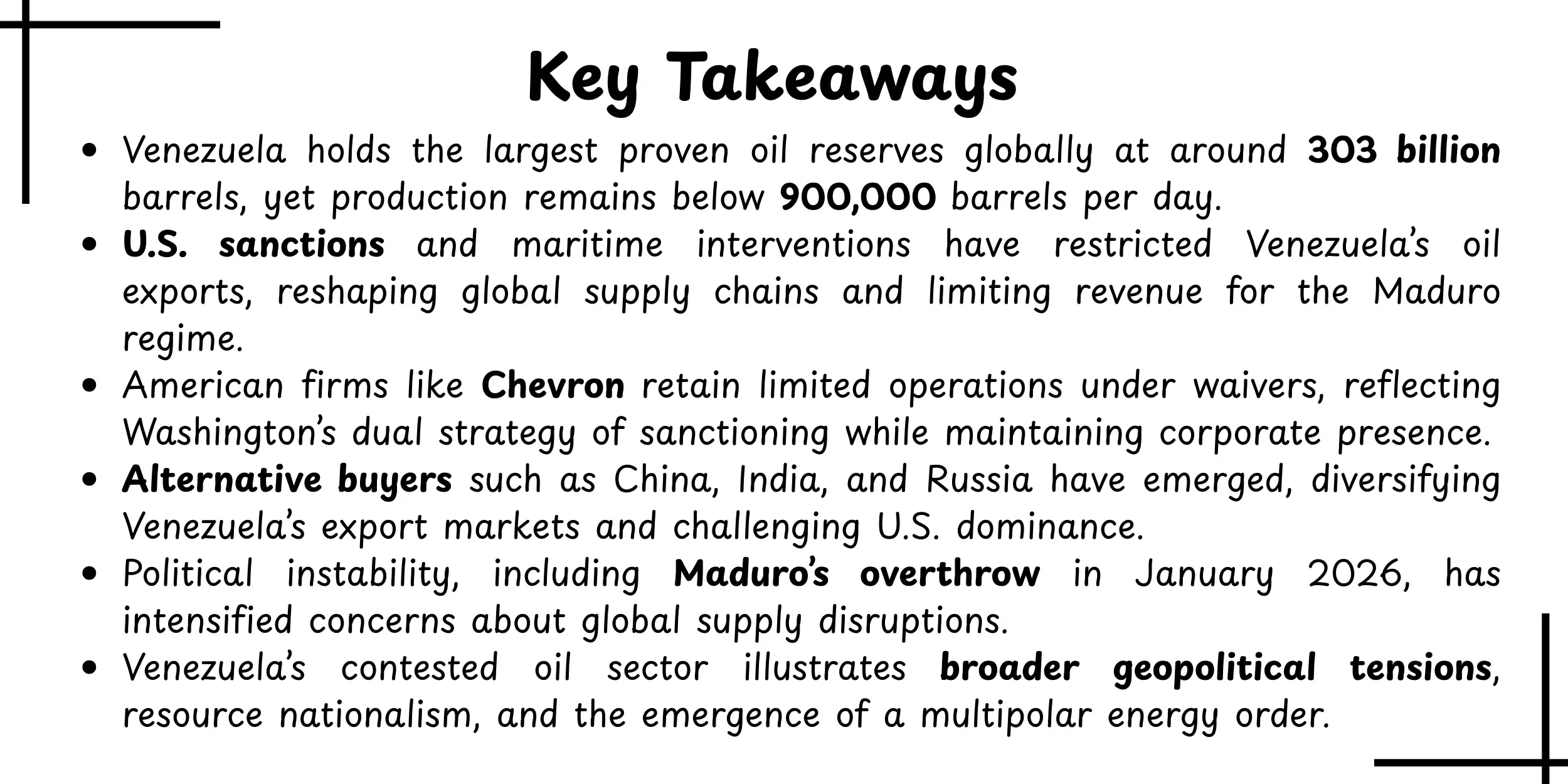
The actual size of the reserves of Venezuela makes it a potential superpower in the energy supplies; however, inefficiencies in operations and geopolitical pressures drag down its actual ability to exercise that position. The extra-heavy extraction creates serious technical difficulties, and the U.S. sanctions restrict international markets. Accordingly, the reserves in Venezuela represent both the unexploited opportunities and disputed sovereignty and, thus, condition the debates of resource nationalism and extreme control.
Which country has the largest oil reserves?
Venezuela holds the world’s largest proven oil reserves, surpassing Saudi Arabia. Most of its reserves lie in the Orinoco Belt, containing heavy crude. Although production has declined due to economic and political challenges, Venezuela’s vast reserves make it a key country in global energy discussions and long-term oil supply potential for future markets and strategic planning worldwide by governments globally.
Interests and Control Mechanisms of the United States
Using its economic, diplomatic, and military tools that strategically influence the oil industry of Venezuela, the United States tries to safeguard its interests in energy matters and prevent the influence of adversarial powers in the global markets.
Strategic Energy Interests of the United States
Venezuela has about 303 billion barrels of proven reserves, which makes about 17 percent of the world's oil reserves. However, this figure dropped to 1 percent in the global production in 2024. To Washington, the need to gain access to such reserves is crucial to stabilizing the energy prices, as well as diminishing reliance on the supply sources based in the Middle East. The fact that U.S. corporate entities like Chevron still exist in the field under special waivers can be seen as a two-pronged approach to the same, i.e., the combination of sanctions across the Maduro administration, yet corporate presence.
Sanctions and Economic Coercion by the United States
Since the year 2019, the United States has put in place a successive set of sanctions on Venezuelan oil companies, shipping companies, and tankers. In December 2025, the Treasury Department imposed sanctions on four Venezuelan oil companies and four tankers, and the purpose of these measures was to isolate the sector and restrict the flow of revenues to Maduro to a minimum. These steps not only limit Venezuela in its export market, but the international chain of supply is also diverted, thus strengthening U.S. bargaining power in the international market of energy.
Maritime and Military Domination of the United States
Other than economic sanctions, Washington has shown maritime supremacy. American forces took over the Venezuelan-linked tanker, the Olina, on the fifth of five seizures carried out as part of Operation Southern Spear in January 2026 in the Caribbean. These moves underline a wider policy of controlling the Venezuelan oil flow channels, thus curbing illegal exportations to other countries like China and Russia.
Global Market Dynamics of Venezuela’s Oil Reserves
Even though Venezuela has vast oil reserves, they are exposed to the dynamics of the global market conditions, where sanctions, alternative purchasers, and realignment of geopolitics transform the position of Venezuela in world energy trade.
Shifting Supply Chains of the Oil Market
Venezuela has limited exports that are affecting the oil markets around the world. Although with 303billion barrels of proven reserves, its output was still less than 900,000 barrels per day in 2025, which still constrained its contribution to the global output to about 1 percent. The sanctions placed on Venezuela by the United States have shifted Venezuelan crude to other buyers like China, India, and Russia, and in the process, altered the traditional supply chains and reduced access to the Western market.
Volatility and Response of Investors to oil crisis
Price fluctuations have been prompted by events in Venezuela. The response to the activities by the U.S. in early 2026 was a slight increase in oil prices instead of prices falling, as it was expected that Venezuelan crude would be able to ease the lack of supply. Investors reacted by adjusting money towards gold and cryptocurrencies, thus echoing increased uncertainty in energy markets. This process demonstrates that the shock felt in the financial systems in Venezuela is triggered by geopolitical shocks and affects both the commodity markets and the safe-haven markets.
Market Potentialities for India
The Reliance Industries of India has sought U.S. assent to import Venezuelan crude as it sees it as an alternative to Russian imports due to geopolitical pressure. The refineries owned by the company can handle Venezuela heavy crude, highlighting the possible opportunities that the emerging economies can get due to the changes in the global energy balance. The analysts estimate that Venezuela may reach 1.3-1.4 million barrels per day in two years, once a political transition occurs, and this would change the LNG and oil supply in the entire region of Latin America.
Geopolitical Implications of the Oil Crisis
Although the oil deposits in Venezuela are vast, the country has become a point of geopolitical rivalry, where sanctions, personal relationships, and political or civil unrest are colliding to reshapethe energy and diplomatic landscape across the world.
Venezuela’s Sovereignty and Resource Nationalism
The amount of proven reserves held by Venezuela, which is 303 billion barrels, makes the country a potential superpower in terms of energy. However, U.S. sanctions and embargoes have limited it to making money out of this fortune, which provokes the issue of sovereignty and resource nationalism. PDVSA, which is state-owned, is still saddled with debts and poor infrastructure that requires billions of foreign funding to fix. This conflict reveals that the ownership of hydrocarbons cannot be easily separated from the autonomy of the nation.
Global Supply Risks and Political Instability in Venezuela
The toppling of Nicolas Maduro shocked the global energy markets, with analysts forecasting a devastating impact on Venezuelan crude production. Since Venezuela is considered to be a supplier of heavy crude used in the feedstock of the refinery, not only is the internal governance of this country in danger, but also the world supply balances. The other producers, in the Middle East and Africa, thus need to redefine their production plan to compensate for the possible Venezuelan deficits.
Multipolar Energy Alignments
The geopolitical repercussion is more than bilateral U.S. relations with Venezuela. The cooperation with Russia and China is not very supportive, but it cannot be as big to restore the infrastructure in Venezuela. This dynamic can be seen as an extension of a larger multipolar order of energy, where even as the world shifts to renewables, hydrocarbons still remain at the core of foreign-policy decisions. The oil industry, which has become the realm of controversy in Venezuela, is therefore an illustration of how energy resources will continue to determine the international provisions and strategic competition.
Conclusion
To conclude, the oil deposits of Venezuela represent at once great possibilities and great weaknesses in the energy system of the world. The U.S sanctions, corporate interests, and maritime interventions exemplify how national sovereignty is limited through the external control mechanisms as national international supply chains are redefined. At the same time, the geopolitical instability and multipolar orientations bring to light the volatility of the resource-based politics. The Venezuelan example has shown that oil wealth does not promise prosperity but rather deepens rivalry between the domestic rule and the markets in the international energy industry, thus affecting the direction of international energy security and international relations.