The Mission is carried out through two closely integrated sub-schemes. Niryat Protsahan highlight financial support and trade finance leader, while Niryat Disha focuses on non-financial measures, including market access expansion and strengthening the wide export ecosystem.
|
Key Highlights
- Architecture of the Export Promotion Mission
- EPM as MSMEs Financial Enablers
- Market Accessing and Non-Financial Support through EPM
- EPM’s Mechanism, Application and Implementation
- Online Niryat Protsahan
- Niryat Disha Interventions Procedures
|
How Niryat Protsahan and Niryat Disha empower MSMEs with export incentives, trade finance support and expanded market access. Learn how these initiatives strengthen India’s export ecosystem and accelerate global trade growth through financial and non-financial policy measures. The Export Promotion Mission (EPM) has come into the limelight of the discourse after the Government of India introduced seven new interventions recently, thereby expanding support to micro, small, and medium enterprises (MSMEs) in areas such as trade finance, compliance, logistics, and access to overseas markets. The value of such an initiative lies in its ability to reduce costs associated with exports, enhance global competitiveness, and promote inclusive and sustainable growth through the possibilities of small enterprises to trade internationally. The Export Promotion Mission (EPM) is a fundamental program by the Government of India meant to support the national export ecosystem by a mission-mode approach. The Mission was approved in November 2025 and integrates two non-financial and financial interventions under two sub-schemes.
Niryat Protsahan and Niryat Disha serve as the two core sub-schemes under India’s Export Promotion Mission (EPM), a comprehensive program approved in November 2025 to strengthen exports, with a special focus on supporting MSMEs. Niryat Protsahan and Niryat Disha, to empower the Micro, Small and Medium Enterprises (MSMEs). Allocating around 25,060 crore outlay over the financial years 2025-26 to 2030-31, the EPM is aimed at reducing fragmentation in the exporter support and providing complete assistance to trade finance, compliance, logistics and access to overseas markets. The convergence of institutional mechanisms and tapping into online platforms will see the Mission boost competitiveness, expand the worldwide presence, and foster inclusive, decentralised, and sustainable growth in exports, hence becoming a potential driver of MSMEs to grow their participation in international trade.
Architecture of the Export Promotion Mission
The Export Promotion Mission (EPM) is visualize as an all-inclusive model of financial and non-financial assistance to the Indian exporters (with special focus on the Micro, Small, and Medium Enterprises {MSMEs}). It uses a "whole-of-government" approach, merging financial and non-financial support into two pillars: Niryat Protsahan (trade finance) and Niryat Disha (logistics, compliance, and market access).
Unified Ecosystem Approach of EPM
The EPM integrates fragmented export-support systems into something that is centrally digitally motivated. Approved in 2025 with an outlay of 25,060 crore for the FY2025-26 to FY2030-31, it integrates trade finance, compliance, logistics, and market access. This whole-of-government approach will guarantee coordinated service delivery, minimise duplication and enhance efficiency among ministries, financial institutions and export councils.
Sub- Schemes: Niryat Protsahan and Niryat Disha
The Mission is run on the basis of two interrelated sub-schemes. Niryat Protsahan focuses on providing financial support, which includes interest subversion, collateral-free credit and export factoring, hence filling liquidity gaps. Niryat Disha also deals with non-financial enablers, such as international standards compliance, lowering logistics costs, and overseas warehousing. The combination of these tools will ensure a comprehensive end-to-end support of the exporter experience.
Stage‑Wise Exporter Support
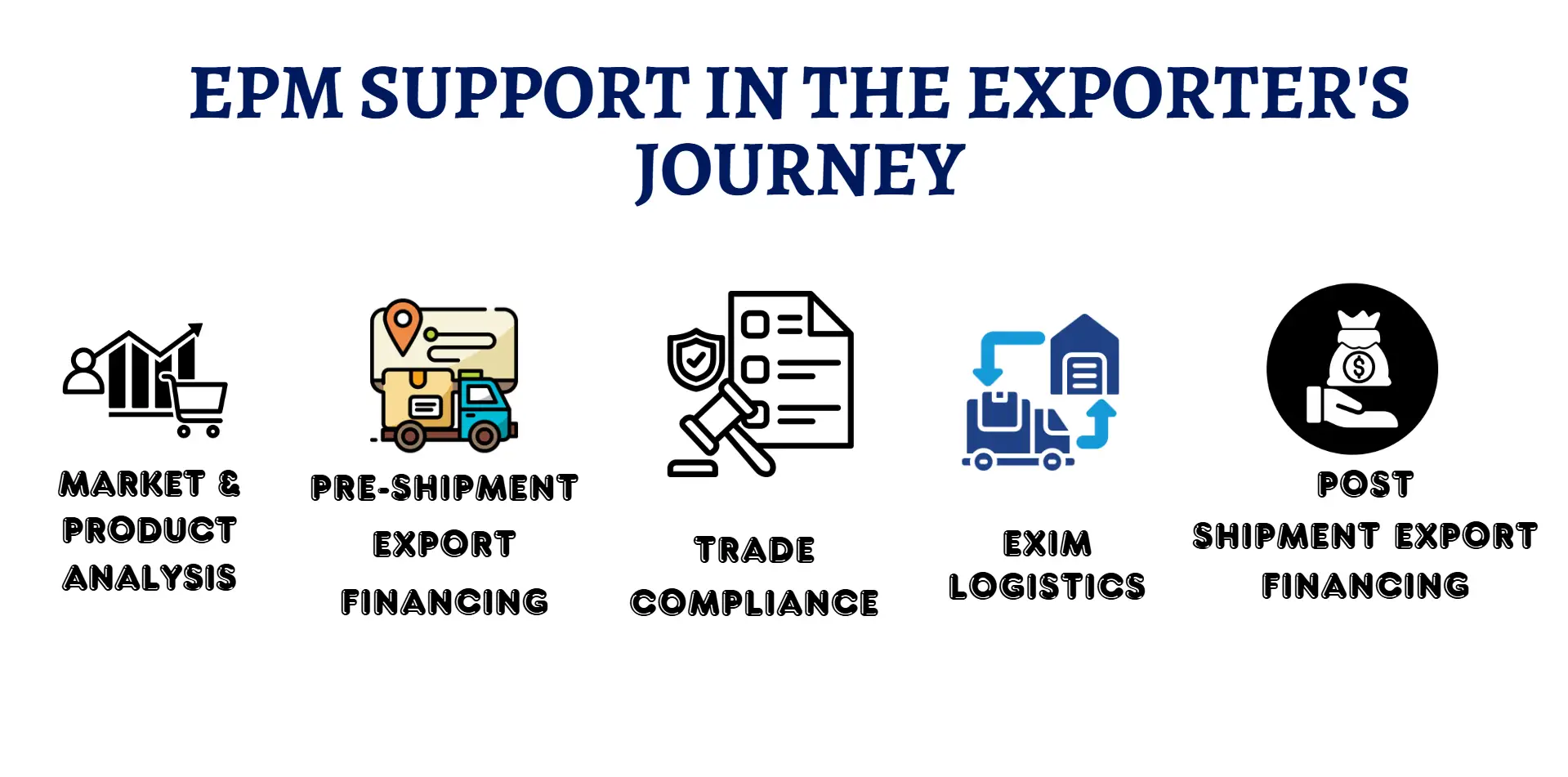
EPM interconnects interventions to different stages of the export process, such as market analysis, pre-shipment and post-shipment financing, trade compliance, logistics, and overseas fulfilment. This step-by-step design is expected to have the effect of providing timely assistance to MSMEs, particularly from initial market searching out to the global connection with buyers. The framework allows exporters to expand in a sustainable environment of international trade by combining financial and ecosystem-wide assistance.
EPM as MSMEs Financial Enablers
The financial instruments incorporated in the Export Promotion Mission (EPM) are designed to lessen the liquidity and financing costs as well as provide risk-sharing instruments to the Micro, Small and Medium Enterprises (MSMEs).
Export Factoring: a Liquidity Tool
Export factoring allows MSMEs to convert receivables into cash on hand, stabilising the cycles of working capital. During the EPM, an interest subvention of 2.75 percent will be registered upon factoring costs and subject to a maximum of 50 lakh per Import Export Code (IEC). Both non-recourse and recourse factoring are supported, and this means that exporters are able to control risks on payment. This is a particularly important intervention in the case of merchandise exporters who have been subject to notified tariff lines.
SMEs' Credit Facilitating Export of E-commerce Merchandise
Considering the expansion of the digital trade, the EPM provides specific credit facilities to MSMEs that are involved in e-commerce exports. Direct E-Commerce Credit Facility is given a facility of up to 90% guarantee with a limit of 50 lakhs, whereas Overseas Inventory Credit Facility is given a 75% guarantee with a limit of 5 crore. They can take an interest subversion of 2.75 % with an annual ceiling of 15 lakh per candidate. Such intervention will be realised with the help of the Export-Import Bank of India (EXIM Bank), hence, a sense of credibility of the institutions.
Interest subversion as well as Collateral Free credit
In order to reduce financing costs, there is a subvention interest of 2.75% on pre- and post-shipment export credit in MSMEs, the limit of which is 50 lakhs per exporter. As well, they are facilitated by 85 percent and 65 percent guarantee cover of micro and small enterprises, respectively, and medium enterprises, subject to a maximum limit of 10 crores that is not backed by collateral. By January 2026, close to 3,000 exporters have already signed to opt to receive interest subsidies, and 60 exporters have already received credit without collateral.
Risk -Sharing for Emerging Markets
EPM also serves exporters into new markets or high-risk markets through shared-risk instruments. Risk sharing is between 10% and 90% of the transaction value, but is exposed to country, exporter, and transaction limits, 15%, 5%, and 1%, respectively. This process occurs in diversification and reducing uncertainties in volatile international markets.
Market Accessing and Non-Financial Support through EPM
The Export Promotion Mission (EPM) offers market access and non-financial support to build institutional readiness, curb trade barriers and expand the geographical reach of Indian MSMEs.
Trade Regulations, Accreditation and Compliance Enablement (TRACE)
There is financial support (TRACE intervention) for foreign certification and conformity needs. Certification at the cost of 60% or 75% shall be available to MSMEs which have a valid IEC and Udyam Registration, or priority certification such as food safety (BRCGS, FSSC 22000) and ethical supply chains (SMETA). It has an annual limit of 25 lakh per exporter, and this affordability improves credibility in global markets.
Logistics Interventions for Freight and Transport (LIFT)
In order to cover connection gaps between inland and other regions, Logistics Interventions for Freight and Transport LIFT provides up to 30% reimbursement of transportation up to a limited 20 lakh/exporter/year. The eligible shipment includes ICDs, CFSs, ports and air cargo complexes. This intervention helps in reducing geographical disadvantages to exporters in the hinterland, hence enhancing the competitiveness of international trade.
Integrated Support for Trade Intelligence and Facilitation (INSIGHT)
INSIGHT Integrated Support for Trade Intelligence and Facilitation enhance institutional performance by funding training and toolkits, analytics and facilitation on a district level. The financial support is made to a maximum of 50 percent of the project costs, whereas government bodies may get 100 percent. The initiative will deal with information asymmetries and prepare exporters and logistics providers with better preparedness.
Facilitating Logistics, Overseas Warehousing and Fulfilment (FLOW)
Facilitating Logistics, Overseas Warehousing and Fulfilment FLOW offers overseas warehousing/ fulfilment/ e-commerce hubs assistance with a limit of 10 crore or 30 percent of the project expenditure. This is supplemented by MAS, which has been funding trade fairs, buyer-seller meetings, and delegations, INR 10 crore per event. By early 2026, over 34 events have already received their approval with support of 45.5 crores.
EPM’s Mechanism, Application and Implementation
An Electrical Power Monitoring System (EPMS) is a specialized, high-speed, and comprehensive solution designed to measure, analyze, and manage electrical power infrastructure. The mechanisms applied and implemented in the Export Promotion Mission (EPM) are aimed at enhancing transparency, digital efficiency and fair access to micro, small and medium enterprises (MSMEs) using standardised norms of procedures and institutional coordination.
Online Niryat Protsahan
As part of financial intervention procedures, exporters will have to fill an Intent-to-Claim (IC) form on the dgft.gov.in site, which will create a Unique Identification Number (UIN). This UIN number is then sold to lending institutions or factoring institutions, which offer either credit or trade finance instruments. Subsequently, these institutions would provide Claim Submissions (CS) to the implementing agencies. The digital-first strategy significantly minimises paper documents and increases responsibility.
Niryat Disha Interventions Procedures
In the case of the TRACE and LIFT programmes, the exporters will submit ICs on trade.gov.in before availing the services, and subsequently submit Reimbursement Claims (RC) after completing their export deals. The FLOW, INSIGHT and MAS efforts are conducted through proposal based approval process, where the applications are reviewed by the EPM Division, suggested by a Sub-Committee and then finalised by the Steering Committee. This stratified procedure means that there is a stringent examination and fair allocation of aid.
Institutional Co-ordination and Inclusiveness through EPM
Its implementation will require the coordination between the Central Ministries, the State authorities, Export Promotion Councils, EXIM Bank, and the Indian Missions abroad. In early 2026, the INR 850 crore of the Interest Equalisation Scheme and INR 118.65 crore of the Market Access Initiative arrears have been cleared, hence showing the institutional efficiency and inclusivity in service delivery.
Conclusion
The Export Promotion Mission (EPM) is a good example of how India has been strategic in strengthening its export ecosystem by ensuring that finance and non-finance interventions are made as part of the mission. The Mission reduces the effects of fragmentation and improves work efficiency through combining trade finance, compliance empowerment, logistics, and access to overseas markets. By putting a large sum of INR 25,060 crore of expenditure in the fiscal years 2025-26 to 2030-31, the EPM has been placed as a transformational frame that champions the MSMEs, inclusion, and sustainable decentralised export-led growth in the global markets.