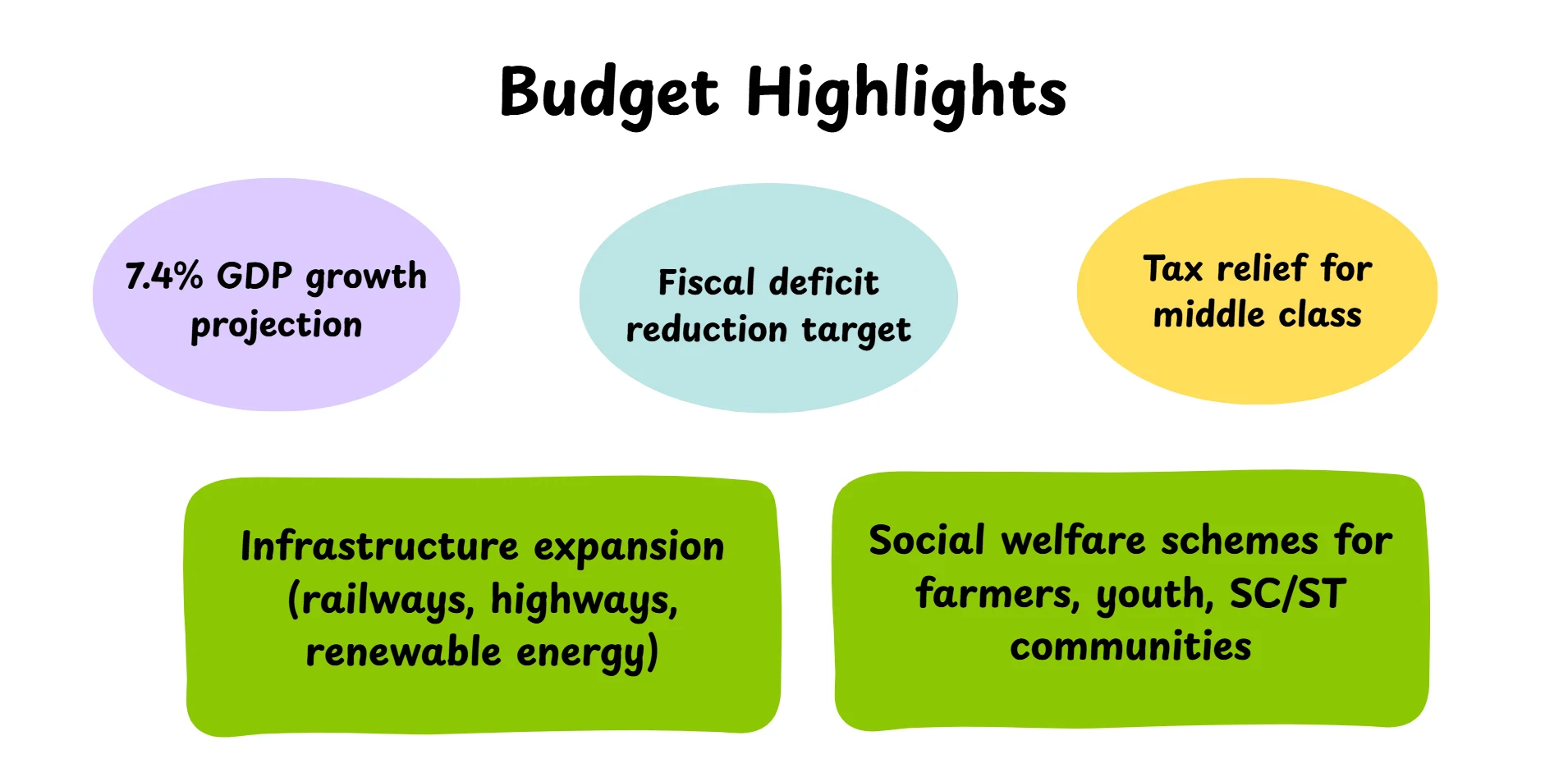
The Union Budget 2026-27 was presented by the Union Finance Minister Nirmala Sitharaman on 1 February 2026. She made history by presenting the 9th consecutive budget in 2026. The budget focuses on tax relief for the middle class, infrastructure growth, and advancement towards the vision of Viksit Bharat 2047, with an estimated GDP growth rate of 7.4%.
|
Key highlights
- Union Budget 2026
- What is the Union Budget?
- India’s Macroeconomic structure and Financial discipline
- Taxation and Revenue Measures by India
- Infrastructure and Development in Union Budget 2026-27
- Social Welfare and Inclusivity in Union Budget 2026-27
|
The 2026-27 Union Budget, presented by Finance Minister Nirmala Sitharaman, highlights India's role in aligning financial sanity with multifaceted growth. Within the general Viksit Bharat 2047 structure, the budget highlights structural changes, infrastructure development, and targeted welfare programs to keep the economy moving. Anticipating 7.4% of GDP growth in FY 2026-27, the budget lays emphasis on rationalizing taxation, digital governance, and social equity. By consolidating the gains of success in the previous years and tackling the new challenges in world trade, energy security, and climate resilience, it will strengthen the course of India towards sustainable development over an extended time period.Union Budget 2026 summarised with key highlights, major policy announcements, tax changes and sector wise impact explained simply. Focuses on sustaining high economic growth of around 7%, scaling manufacturing, and strengthening social infrastructure.
What is the Union Budget?
|
|
The Union Budget is a financial statement of the Government of India, which is presented annually and outlines the estimated revenue and expenditure of the upcoming financial year.Finance Minister Nirmala Sitharaman presented the Union Budget 2026 Detailed Analysis on February 1, 2026, focusing on a vision for "Viksit Bharat 2047". The budget is anchored in three Kartavyas (duties)- accelerating economic growth, fulfilling citizen aspirations, and ensuring inclusive participation. It details how these resources will be levied mainly through tax and other supplementary sources and how the resources will be apportioned later to key sectors such as infrastructure, health, education, and welfare. In addition to the role of marking the fiscal payments, the budget can be seen as one of the key policy tools that summarises the priorities of the administration, macroeconomic planning, and vision of development during the specific year.
|
India’s Macroeconomic structure and Financial discipline
Fiscal consolidation, resilient growth, and stability are highlighted in the Union Budget 2026-27, and it is estimated that the gross domestic product will grow by 7.4 percent and the economic path of the nation will be on the long-term track of Viksit Bharat 2047.
India’s GDP Growth Projection in Union Budget 2026
The Finance Minister noted that India has a strong economic performance and has projected a gross domestic product growth of 7.4 percent by FY 2025-26. The forecast justifies a belief in the domestic demand, investment, and structural changes.
India’s Fiscal Deficit Targets in in Union Budget 2026
Fiscal tightening is still one of the strategic priorities, and the government is determined to narrow the deficit without cutting spending in key sectors. This balance is an indication of dedication to long-term stability without damaging growth momentum.
Tackling Global Problems in Union Budget 2026
In recognition of the wind against the world, e.g., energy volatility and geopolitics, the budget brings into light India's capacity to stay afloat due to diversified trade, renewable energy investment, and local consumption.
Viksit Bharat 2047 Vision of India in in Union Budget 2026
The macroeconomic framework is clearly connected with the vision of Viksit Bharat 2047 that puts India on the path of developing into a developed economy by the 100thanniversary of independence. Growth-oriented policies and fiscal discipline are offered as the two main pillars of this long-term roadmap.
Taxation and Revenue Measures by India
The Union Budget 2026-27 focuses on rationalization of taxes and transparency, relief of the middle classes, simplified compliance, and balanced mobilization of revenue to maintain fiscal discipline, providing reasonable participative of economic participation.
Direct Tax Relief for the Indian Middle Class in Union Budget 2026
The Finance Minister once again assured the government of the intentions to ease the burden on the salaried taxpayers and the middle-class; building upon what had already been done before, the budget expands rationalized slabs and deductions, which in turn will guarantee an increase in disposable income. It is expected that this step will drive consumption and promote social equity.
Enhancement of the Indian tax regime in Union Budget 2026
The continuity of an effort to reduce direct tax to a streamlined system is a salient feature; regulation by means of minimizing complexities and overlaps of regimes, the government aims at improving compliance, reducing litigation, and promoting transparency. The simplification, as well, is in line with the overall goal of digital governance.
Easy Compliance by the Indian Government in Union Budget 2026
The budget anticipates digital filing, faceless evaluation, and streamlined practices to address the grievances of taxpayers; these organizational changes will improve institutional confidence and promote voluntary compliance, expanding the tax base.
Revenue Mobilization and Fiscal Prudence in Union Budget 2026
In the process of alleviating, the government has been very fiscally prudent through increasing efficiency in indirect tax collection, as well as reducing leakages in revenue collection; through the two, fiscal consolidation goals have not been compromised despite inclusivity remaining a primary objective.
Infrastructure and Development in Union Budget 2026-27
Infrastructure growth, green energy enhancement and urban planning have been identified as priorities of the Union Budget 2026-27, and these areas are viewed as drivers of growth, and because of them, sustainability, connectivity, and digital governance are all made to drive the national progress inclusively.
Investments in the Indian Transport Sector
Major investments have been made in the highways and railways as the government feels the need to ensure the road and rail systems are efficient and connected. Completion of expressways, refurbishment of railway routes, and freight infrastructure is likely to lower the cost and competitive nature. These actions also promote regional integration and balanced development.
Push to Sustainability in Union Budget 2026
The budget highlights the desire of India to shift to clean energy with investments in solar, wind and green hydrogen activities. The government will use this by increasing the power of renewable capacities as a way of lowering fossil fuel dependence, as well as developing energy security and fulfilling climate promises through international systems.
Urban Development in Union Budget 2026
One of the main themes is the idea of urbanization, and the new emphasis is set on smart cities, affordable housing programs, and sustainable planning of urban development. These are aimed to meet the increasing urban demand that is increasing and yet, to be inclusive and resilient.
Smart Governance and Digital-Infra in Union Budget 2026
The establishment of digital infrastructure is discussed as one of the foundation-building blocks in the reform of governance. Infrastructure (e-governance and online system of payments and citizen service portal) investment in e-governance, Vita Fintech, and platforms of digital payment will be oriented at enhancing the sense of transparency, efficiency, and accessibility. This digital thrust augments physical infrastructure, which facilitates a complete development structure.
Social Welfare and Inclusivity in Union Budget 2026
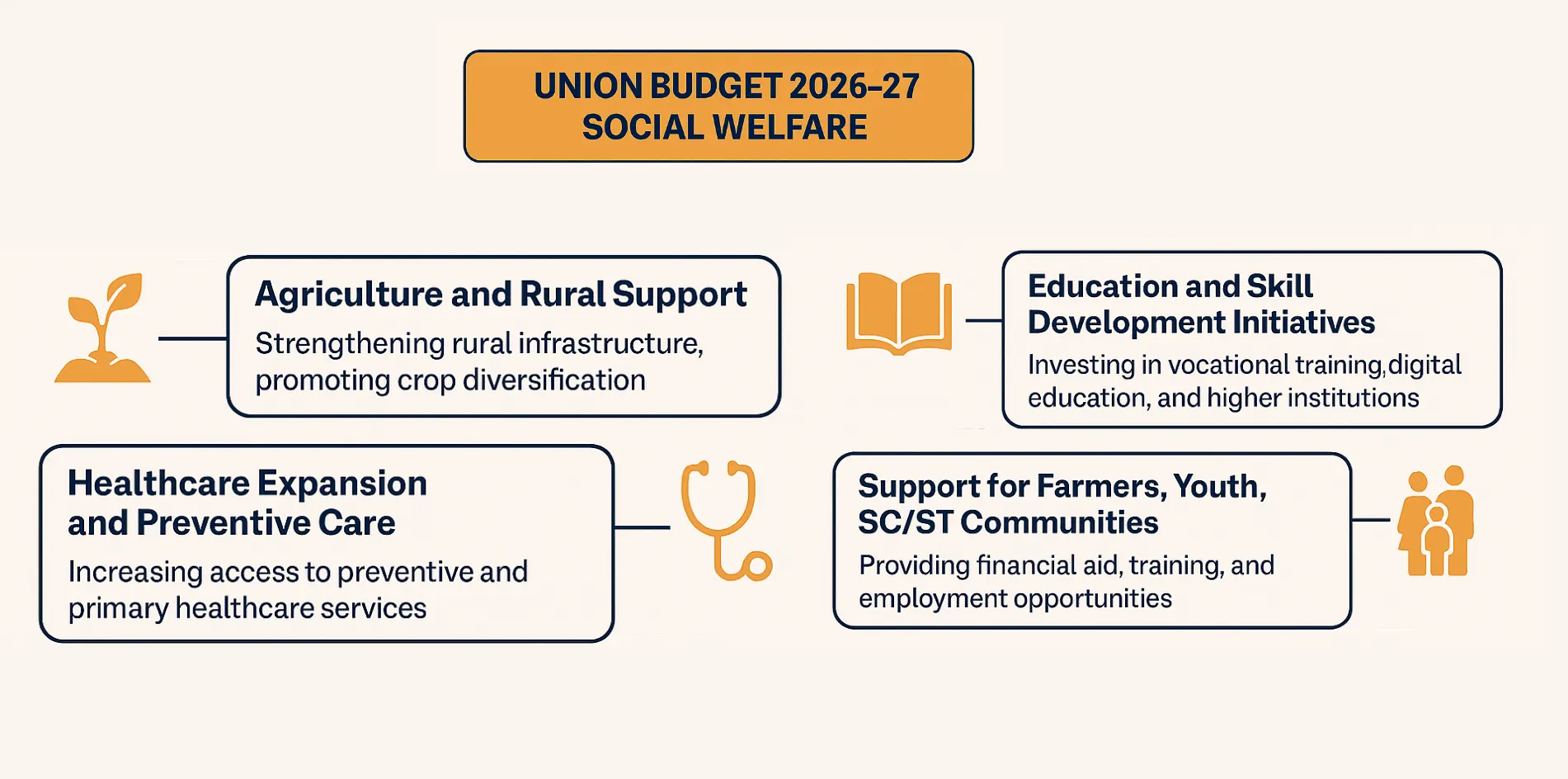
The Union Budget 2026-27 will enhance inclusive growth to increase welfare initiatives in the agricultural sector, in healthcare, and in education, which will make sure the marginalized community, the farmers, and young people can enjoy the development model of India within its boundaries.
Indian Farming and Rural Developmentin Union Budget 2026
The budget places a lot of funds to empower the rural infrastructure, better irrigation facilities and direct support to the farmers. The notion of crop diversification, digital agribusiness initiatives and enhanced credit access seek to stabilize the livelihood and ensure the stabilization of the economy in rural regions.
Indian Healthcare in Union Budget 2026
The focus on public health continues, whereby greater amounts have been allocated to primary healthcare centres, vaccination, and preventive care. The focus on low-cost healthcare facilities is an illustration of the interest of the government in universal health insurance.
Indian Education and Skilling Development in Union Budget 2026
Reforms in education are aimed at skill development in terms of future employment. The investments in vocational training, digital classes and institutions of higher learning are meant to help prepare the young generation in India, as it is globally competitive.
Union Budget 2026 supporting Indian Farmer, Youth, and SC/ST Communities:
Inclusive activities are created with specific programs that adapt to marginalized communities (SC/ST communities and youth in rural areas). The measures are relevant to provide fair access to opportunities, close the social-economic divide, and support social justice.
Sustainable Growth Measures by India in Union Budget 2026
The welfare agenda is put in terms of sustainability, where social equity is combined with environmental resilience. The budget also brings welfare programmes in long term development objectives; hence, growth becomes inclusive and futuristic.
Conclusion
The Union Budget 2026-27 comes out as a very inclusive growth at the same time fiscally disciplined policy document. It maps a sustainable development path by dealing with taxation, infrastructure and welfare in Viksit Bharat 2047. Though implementation issues and international shocks are still there, the budget symbolizes the resolve of India to unify economic benefits and proceed with its centenary plan of becoming a developed country.
Frequently asked questionsFrequently asked questions
India’s Macroeconomic structure and Financial discipline?
Fiscal consolidation, resilient growth, and stability are highlighted in the Union Budget 2026-27, and it is estimated that the gross domestic product will grow by 7.4 percent and the economic path of the nation will be on the long-term track of Viksit Bharat 2047.
Taxation and Revenue Measures by India?
The Union Budget 2026-27 focuses on rationalization of taxes and transparency, relief of the middle classes, simplified compliance, and balanced mobilization of revenue to maintain fiscal discipline, providing reasonable participative of economic participation.
Infrastructure and Development in Union Budget 2026-27?
Infrastructure growth, green energy enhancement and urban planning have been identified as priorities of the Union Budget 2026-27, and these areas are viewed as drivers of growth, and because of them, sustainability, connectivity, and digital governance are all made to drive the national progress inclusively.
Social Welfare and Inclusivity in Union Budget 2026?
The Union Budget 2026-27 will enhance inclusive growth to increase welfare initiatives in the agricultural sector, in healthcare, and in education, which will make sure the marginalized community, the farmers, and young people can enjoy the development model of India within its boundaries.