The Ministry of Food Processing Industries published its Year-End Review 2025 that explains the achievements gained with reference to Pradhan Mantri Kisan Sampada Yojana (PMKSY), Production Linked Incentive (PLI) scheme, and Pradhan Mantri Formalisation of Micro Food Enterprises (PMFME) project. The review also expounds on the growth of infrastructural resources, the introduction of sustainability guidelines, and specific initiatives to increase the income of farmers as well as foreign exchange on processed food commodities.
|
Key highlights
- Year-End Review 2025 of MoFPI
- Key Achievements in 2025
- 1. Pradhan Mantri Kisan Sampada Yojana (PMKSY)
- 2. Pradhan Mantri Formalisation of Micro Food Processing Enterprise Scheme
- 3. Food Processing Industry Production Linked Incentive Scheme (PLISFPI)
- 4. “World Food India‑2025”
- Impacts of these Initiatives
- Future Roadmap
|
The Ministry of Food Processing Industries (MoFPI) has become the centre for the development of the agro-economic sphere in India as a principal consequence of the realisation of value addition, alleviation of post-harvest losses, and increased income of farmers. The Year-End Review 2025 highlights the varied achievements made by the Ministry and includes the structural augmentation to the PMKSY, as well as novel export promotion through the PLI system. Simultaneous programs like the PMFME scheme are examples of inclusive growth and career advancement. A compilation of these acts highlights the strategic role that MoFPI has played in strengthening food security, sustainability, and industrial competitiveness among the global mix of India's development agenda.
Key Achievements in 2025
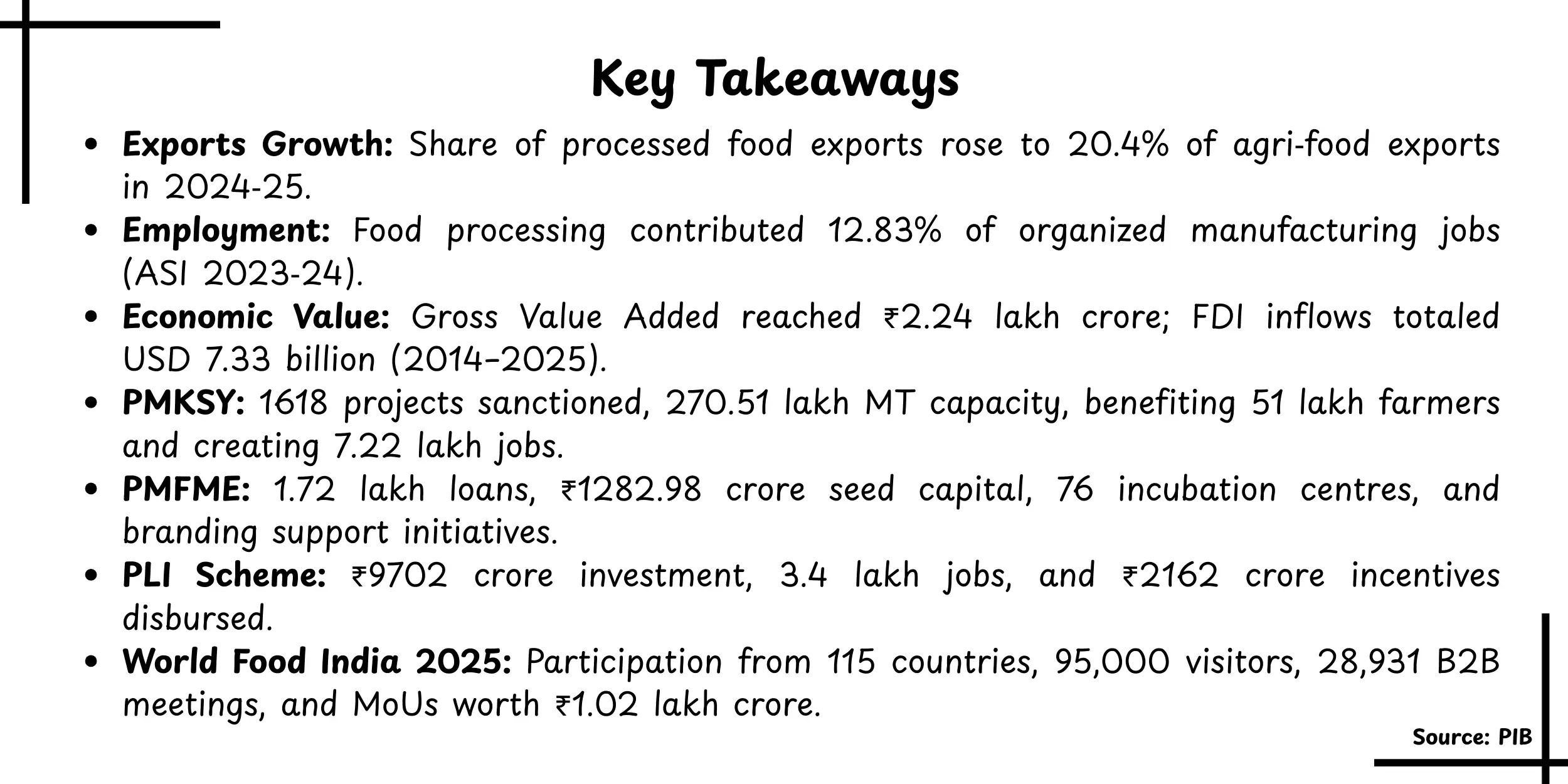
In 2025, the agro-economy of India was advanced by the Ministry of Food Processing Industries by developing cold-chain networks, setting up new food-parks and also agro-processing clusters in the framework of PMKSY. At one end the PLI scheme aided in a boom of exports and local production, whereas on the other end the PMFME program combined the capacities of micro-enterprises. Enhanced research and development, approachable skill advancement and stringent sustainability demonstrated plans put the sector as a driver of farmer wellbeing and industrial improvability.
1. Pradhan Mantri Kisan Sampada Yojana (PMKSY)
The Pradhan Mantri Kisan Sampada Yojana (PMKSYS) is one of the pillars of the food-processing policy in India, which is designed to modernise infrastructure, reduce wastage, and increase the earnings of farmers. The transformative effect of the 2025 review is joined by significant advancements, which are reflected in 2025’s review.
Infrastructure Development
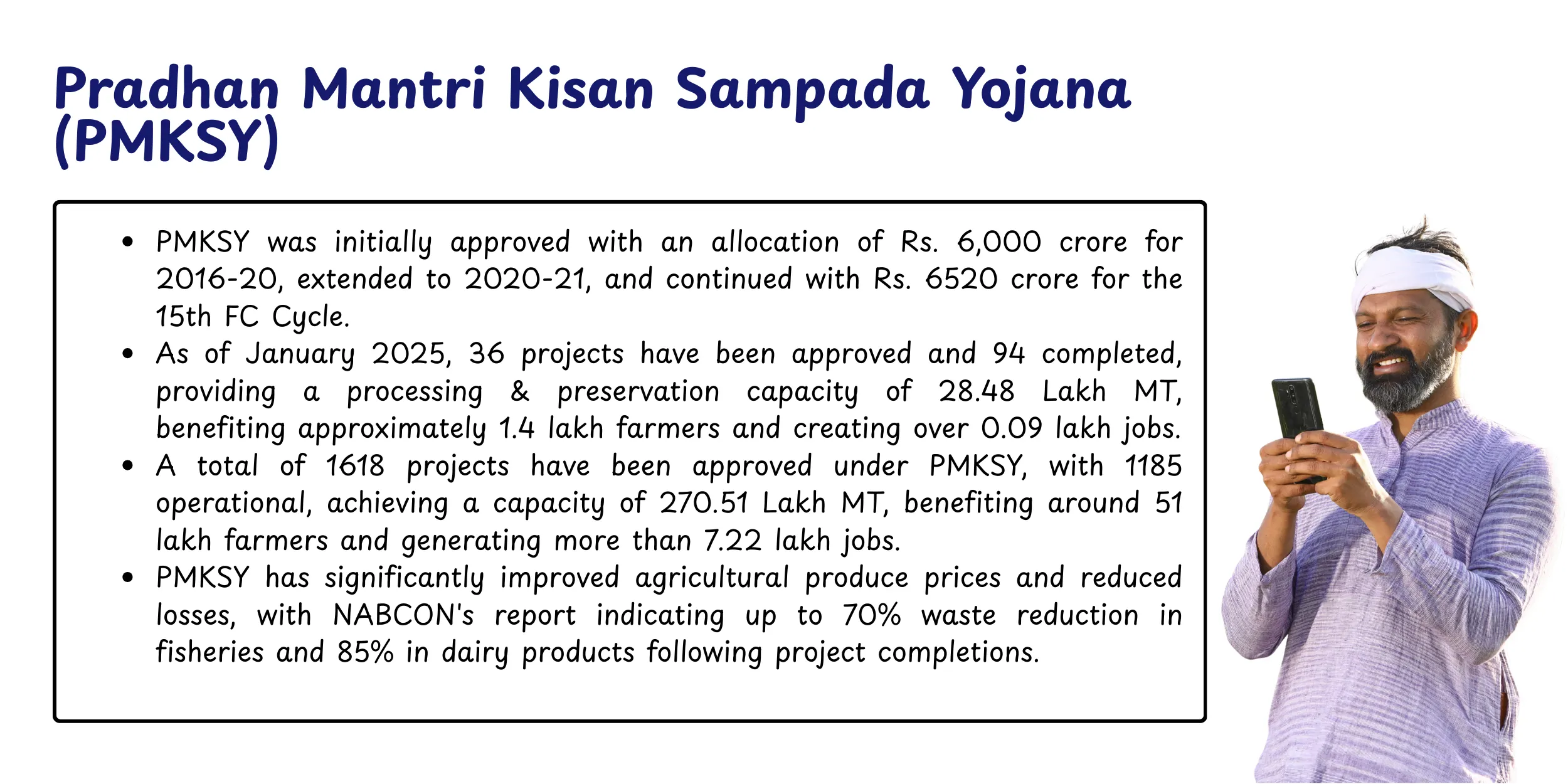
Under the PMKSY, there was significant progress in the development of Mega Food Parks, Integrated Cold Chains and Agro Processing Clusters. There areabout 1618 sanctioned projectsthatoffer modern storage, processing, and distribution facilities. This growth has had a direct benefit of reducing losses that occur after harvesting and enhancing market connections for farmers.
Legislative Measures:
Child marriage is prohibited by the law in the Prohibition of Child Marriage Act, 2006, which provides the legal basis on which such marriages may be regarded as voidable, and offenders should be punished. Further, additional laws such as the Protection of Children from Sexual Offences Act (POCSO),2012, enhance protections.
Employment and Farmer Benefits
The programme has created vast employment opportunities, including direct and indirect opportunities. According to official figures, PMKSY projects have already created 7.22 lakh jobs and have given benefits to close to fifty one lakh farmers. It is through these results that the twin purpose of the scheme, livelihood support and rural economic reinforcement, is portrayed.
Promotion of Value Addition
PMKSY has emphasized on value addition of agricultural produce, and this will compel industrial entities to upgrade the perishable commodities into value products. This has enhanced the competitive environment of India in the international markets, and there is a steady growth in the level of processed-food exports. The scheme is supplemented by Make in Indiathrough alignment with the industrial development initiative thatenhances its role in the industrial development even in greater ways.
2. Pradhan Mantri Formalisation of Micro Food Processing Enterprise Scheme
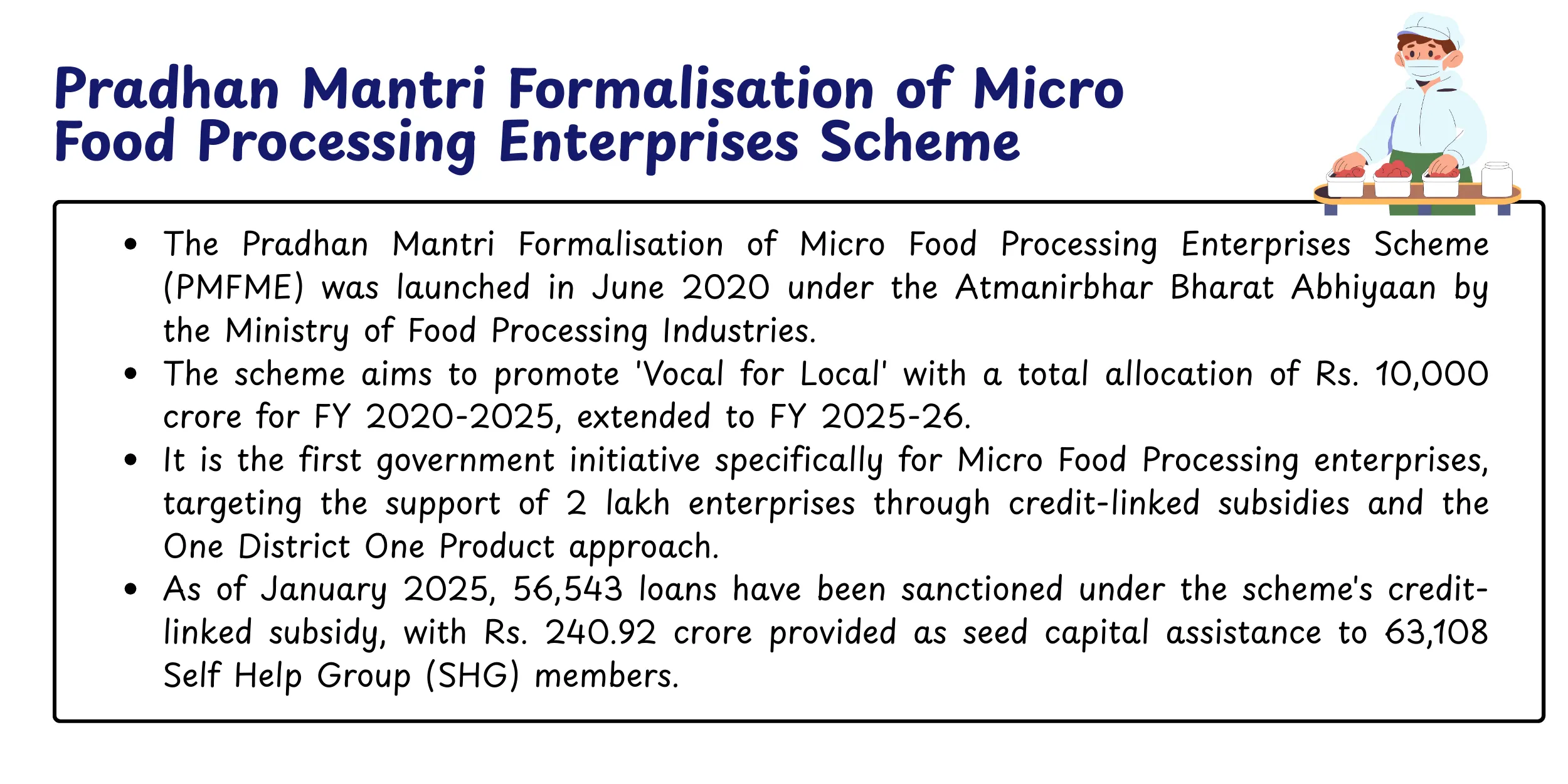
Introduced with the aim of ensuring that India has a well-established, predominantly informal micro food-processing industry, the PMFME Scheme has turned out to be a significant scheme in strengthening the Indian micro-enterprise, value addition augmentation, and inclusive growth.
Providing support to Micro Food Enterprise
In 2025, the PMFME provided grants on credit-associated financing to thousands of micro food units and thus allowed formalisation of their activities. The plan has placed emphasis on cluster strategy with an orientation toward the traditional products like millet-based foodstuffs, pickles, and other local specialities. This intervention made small-scale entrepreneurs competitive and accessible to the market significantly.
Efforts towards Capacity Building and Skill Development
One of the accomplishments of the PMFME is that it has established complete training and skill development programmes that were customised to suit the needs of young and female entrepreneurs. More than 1.50lakh recipients were taking specialised training in food safety, packaging, and branding. These have improved entrepreneurial ability and enhanced the quality standards.
Creating Employment and Inclusion
The scheme has provided a lot of employment opportunities, especially in rural and semi-urban situations. Statistics show that the PMFME initiatives have created over 2,000 jobs, especially for women-based businesses. This kind of inclusivity is characteristic of the alignment of the scheme to bigger national goals of self-reliance and social equity.
Market Relations and Prospects
The PMFME ensured strong market connectivity with the aid of e-commerce trading platforms and branding services so that the micro-enterprises can have access to broader consumer markets. In this prospect, the scheme is expected to intensify its effect by incorporating sustainable behaviour and global competitiveness.
3. Food Processing Industry Production Linked Incentive Scheme (PLISFPI)
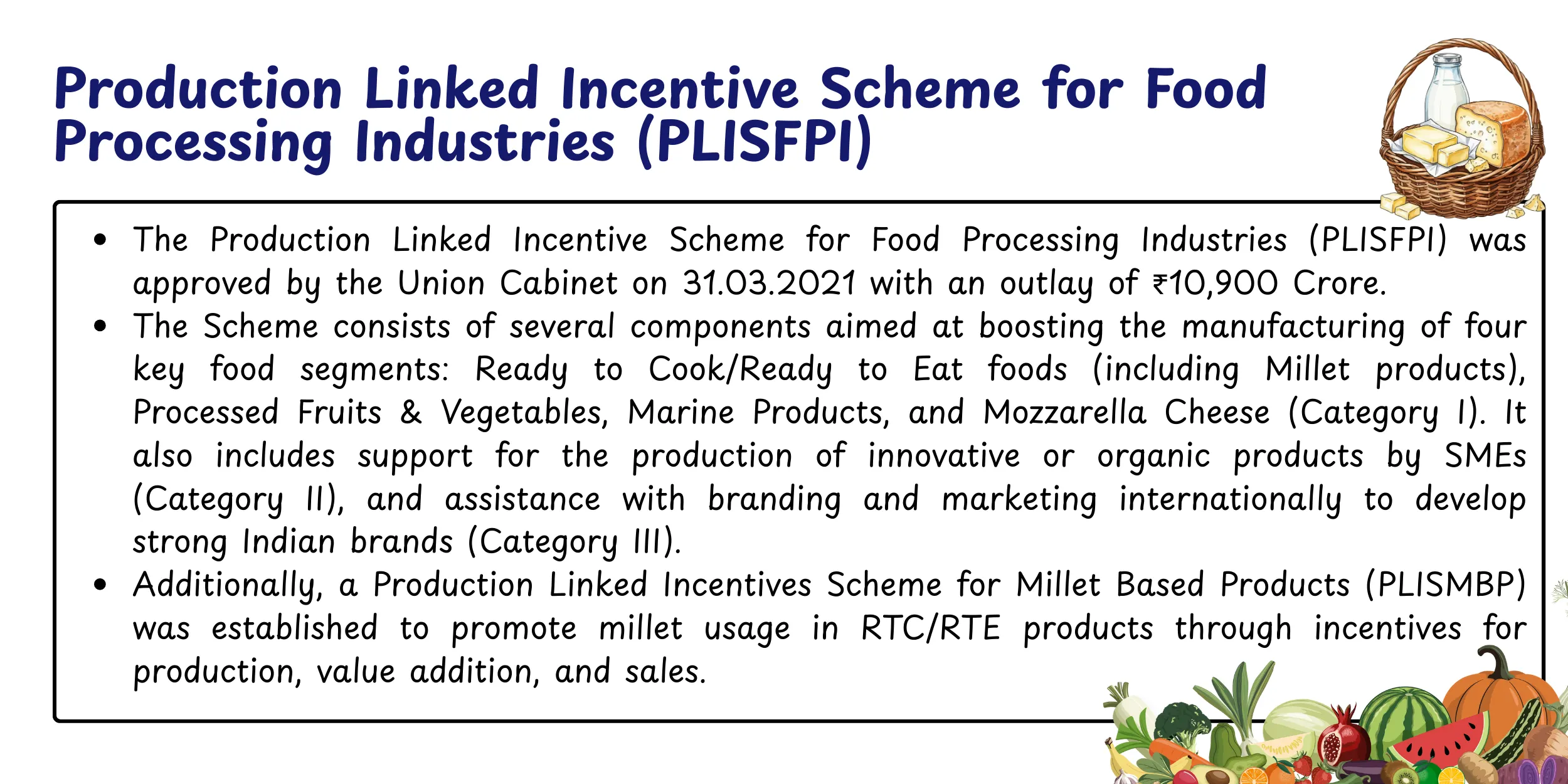
Production Linked Incentives Scheme on Food Processing Industries (PLISFPI) was established to develop the domestic manufacturing, stimulate exports and attract investment in the food-processing industry in India. The achievements of the scheme, as measured under the 2025 review, are below:
Investment and Development of Industry
PLISFPI has been very successful in bringing together significant amounts of capital in the food-processing sector privately. The Union Cabinet approved INR 10,900 crore in 2023 for the scheme, which has to be done in 6 years,to support the base of industry in India, and it will also support the creation of modern processing. This has boosted technology adoption and increased global competitiveness as a result of this capital injection.
Export Promotion
One of the brightest achievements of PLISFPI is the growth in exports of processed foods. Official records depict that the export of ready-to-eat and processed local food products increased by over 25 percent in 2025, and this is an indicator that India is gaining a lot of importance in the foreign markets. The expansion conforms to the objectives of the government, which is to make India a food hub globally.
Employment Generation
The scheme has helped in the creation of employment in the value chain. The projects created by PLI SFPI created more than 3.4 lakh direct and indirect jobs, particularly in the rural and semi-urban areas. This effect on employment highlights the use of the scheme to promote inclusive development.
Value Addition and Innovation
PLISFPI provided incentives to the companies to invest in new product types, fortified foodstuff and healthier food products, thus offering diversification to the food basket in India. The plan was also a proponent of R&D in packaging and a source of sustainability, which makes the sector more resilient in the long run.
4. “World Food India‑2025”
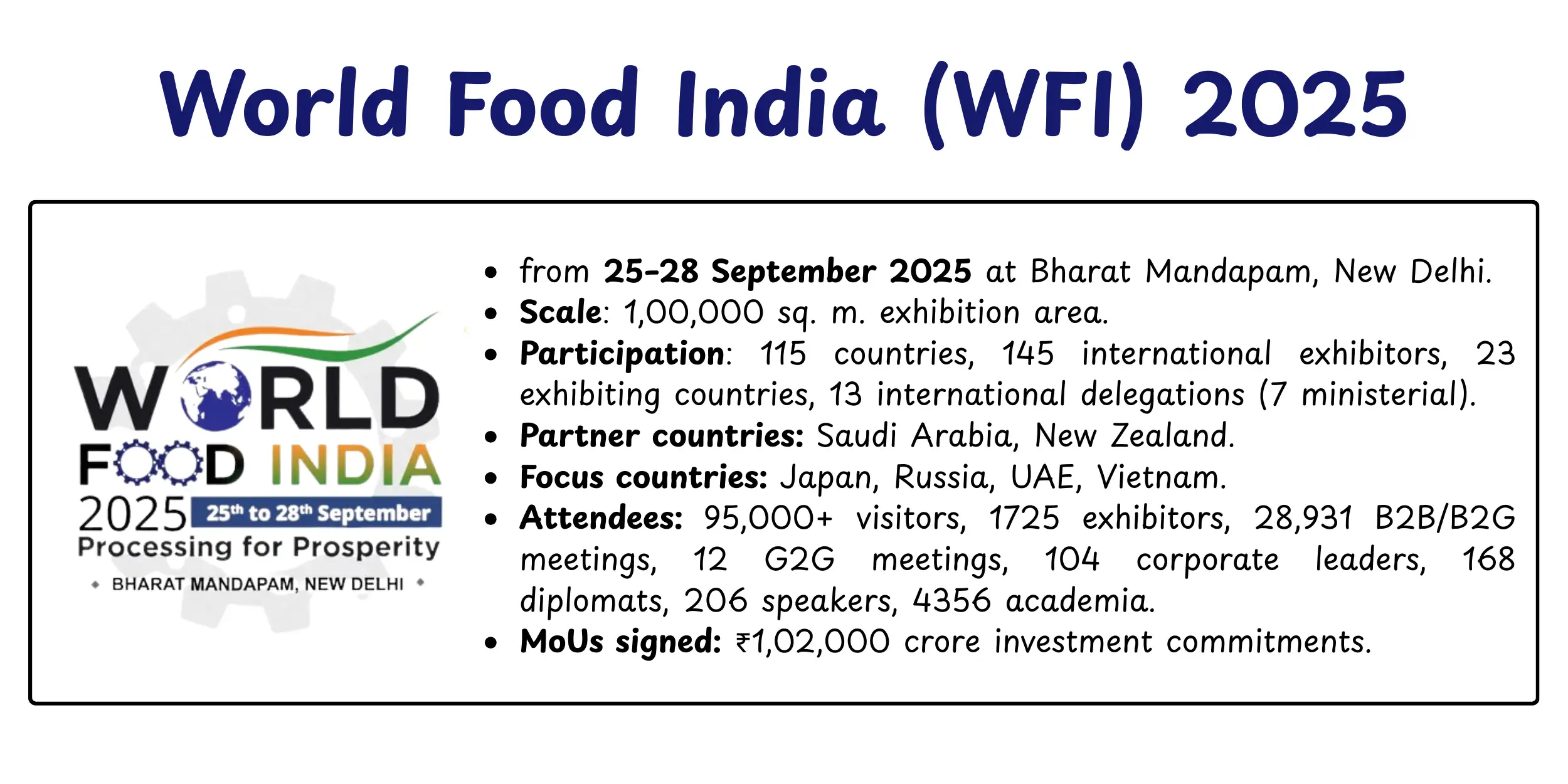
The World Food India (WFI) 2025, organised by the Ministry of Food Processing Industry, served as a platform to promote the Indian food economy, investment, and innovations in food processing and value addition.
International Investment and Operation
More than 115 countries took part in the 2025 edition, including the leading players of the food industry. The company signed Memoranda of Understanding (MoUs) worth INR 102,000 crore, as this was a strong indicator of investor confidence in the food-processing industry of India. The international interaction strengthened the position of India as the future centre of agro-industrial development.
Indian Food Diversity on display
WFI-2025 sparked the Indian ethnic cuisine and the variety of agricultural products. The importance was especially given to the millets and traditional dishes, which are in accordance with the International Year of Millets. Exhibitions and thematic sessions encouraged indigenous products, which enhanced the linkages of the farmers and increased the export potential.
Policy Dialogues and Knowledge Sharing
Policy discussions, industry round tables and academia sessions on sustainability, innovation and food security were hosted during the event. Such considerations have helped in sharing the knowledge between policy makers, business persons and researchers so that the food-processing roadmap of India can be competitive in the global market as well as environmentally conscious.
Impacts of these Initiatives
The joint efforts of 2025 by the Ministry of Food Processing Industries, through PMKSY, PMFME, PLSFPI, along with the “World Food India”, have significantly transformed the agro-industrial system in India, thus supporting the earned income of farmers, employment rates and increased global competitiveness of the country.
Economic Development and Employment
These schemesmobilised over 30,000 crores of rupees of investment and created over 1.5 million jobs, as per the data. They have done so by increasing the food parks, the infrastructure of the cold chain, and also the micro-enterprise support mechanisms, which have resulted in less food wastage and value addition, contributing positively to the gross domestic product.
Farmer welfare and diversity
PMKSY and PMFME have first-hand beneficiaries of more than 5 million farmers, and this guarantees them better prices and wider access to markets. Inclusion through participation in micro-enterprises by women and youth under PMFME also supported the aims of national development of self-reliance and equity.
Global Competitiveness and Sustainability
India's export of processed food has grown by a quarter through PLISFPI and World Food India 2025, and sustainability incorporated eco-friendly packaging and climate-friendly measures. These results support the Indian ambition of becoming a world food processing centre.
Future Roadmap
The Ministry of Food Processing Industries further needs an ambitious roadmap, focusing on innovation, sustainability and international market competitiveness in the food processing industry.
Enhancing Infrastructure and Supporting Farmers
The expansion of Mega Food Parks, cold chains and agro-processing clusters should be the focus of future plans, where new projects must be planned to be established so as to minimise wastes and maximise farmer incomes. The digital platform integration can enhance transparency and access to the market.
Innovation, Exports, and Sustainability
There is a need to put more emphasis on research and development on fortified and climate-resilient foods, eco-friendly packages and skill development programmes. It is estimated that exports will increase by 30 percent in the next three years to make India a food hub in the world.
Conclusion
The Year-End Review 2025 of the Ministry of Food Processing Industries can be used to show how the industry positively supports the developmental priorities of India. The Ministry has strengthened infrastructure through programs like PMKSY, PMFME, PLISFPI and the World Food India, increased farmer incomes, stimulated export activity and led the way in innovation. These successes reaffirm the scope of food processing being in tandem with the national aspirations of sustainability, inclusivity and global competitiveness, collectively making the food economy in India an engine of rural growth and industrialisation.