|
Key highlights
- Issue of the Aravalli Hills
- Background of the Issue
- Ecological and Environmental Impact
- Consequences for NCR
- Future Directions
|
The Aravalli Hills dispute portends a very dramatic policy change: although mining is still not allowed, portions neighbouring the National Capital Region (NCR) can now be built. This growth raises issues about ecological degradation, urban sprawl, and the precedent set in ecologically sensitive jurisdictions. The discussion highlights the concerns of governance that lie in competing developmental goals against conservation interests, coupled with concomitant effects related to air quality, biodiversity, and sustainable urban planning in the country.
|
Tips for Aspirants
The article is relevant to the UPSC CSE and State PSC examinations, as it summarises the environmental, governance, legal, and policy aspects, which are the main parts of General Studies, essay writing, and current affairs.
|
|
Relevant Suggestions for UPSC and State PCS Exam
- The Aravalli hills are a group of the oldest mountains of India that act as a natural barrier against desertification and dust storms, which affect the National Capital Region.
- Due to the loss of biodiversity, depletion of groundwater, and illegal mining, the Supreme Court enforced mining restrictions.
- With a heightened sensitivity to reduced protection, the new definition (100 m elevation benchmark) leaves out an order of magnitude of the range that raises further concerns.
- Now Mining is banned, but construction can be approved, which can be a major threat to the environment.
- This can cause air quality degradation, affect groundwater recharge and biodiversity, and lead to the spread of urban sprawl.
- Governance Challenges include the development versus the conservation issue, the danger of the loopholes in the policies compromising ecological science.
- Future directions include needs for combined structures, eco-tourism, green infrastructure, and strict zoning and participatory government.
|
Most of the Aravalli Hills, which are one of the oldest mountain ranges in India, have been famously considered to be an ecological defense of NCR. The Aravalli have an ecological and socio-economic importance in terms of serving as a natural defense against desertification and being a crucial zone in the process of groundwater recharge, which is vital to the ecological and social economy of the area. Judicial intervention in the past decades, including that which arises out of the Supreme Court, has tried to limit the mining activities in the region, citing irreparable destruction of the ecology and increased danger to biodiversity. There is also a new dimension with the new policy discourse; though the Minister of Environment has stated that no leeway will be given to the mining industry in the Aravalli Hills, whereas near the NCR portion of Aravalli, construction work can be done.
This transformation leads to the burning questions on the adequacy of the remaining standards on environmental protection, and the consequences of replacing mining with large-scale urban sprawl. The controversy also highlights the conflict between the developmental demands and environmental sustainability, which places the Aravalli in the intersection between governance and law, and also ecological science and environmental science. It requires a far-reaching analysis of this question, such that it combines both a juridical and an ecological view, but also a more holistic view of how the policy settings of the delicate areas can create precedents that even have an extensive repercussion in conservation and city planning all over India.
What is happening in the Aravalli Hills?
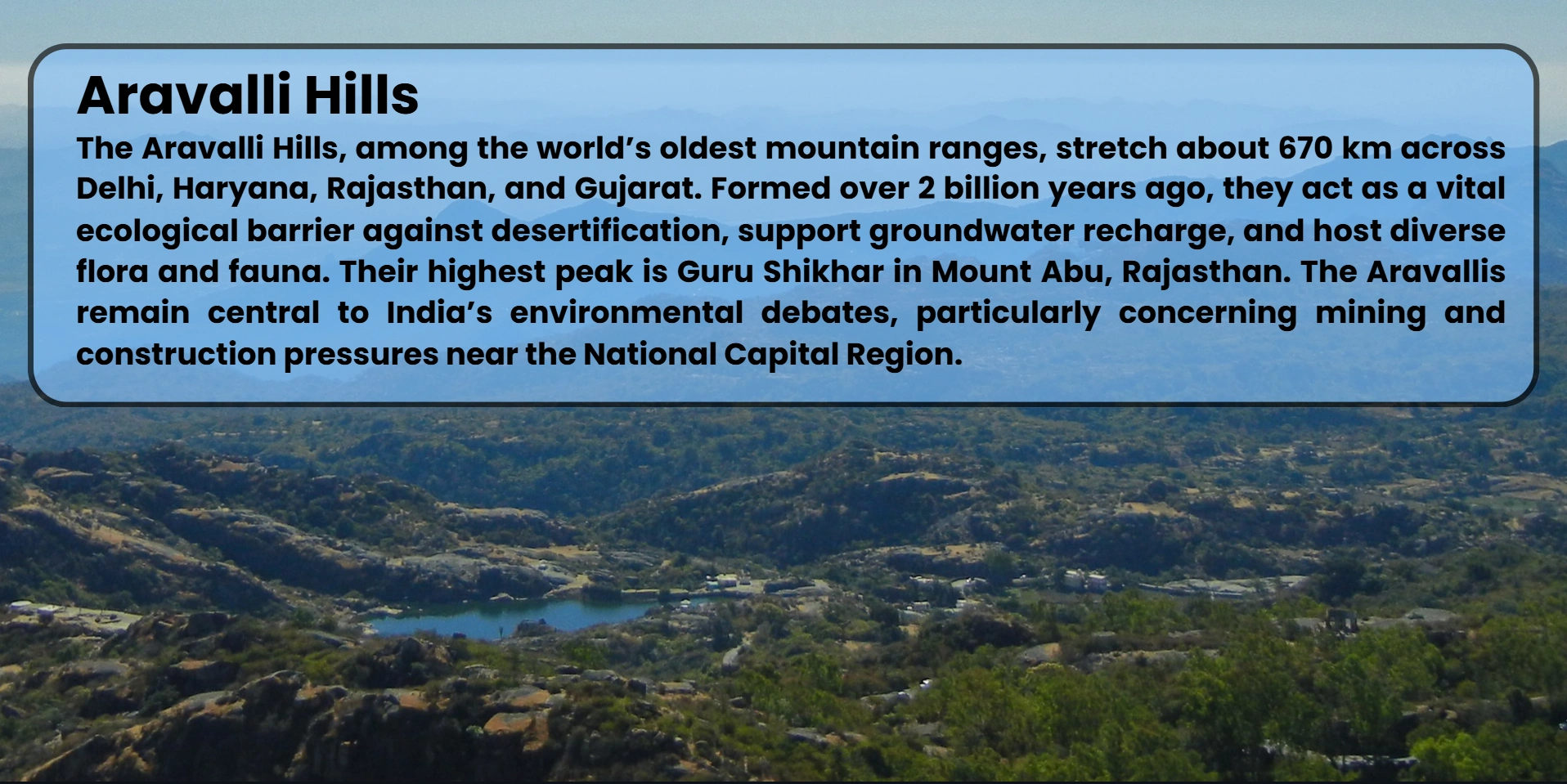
The Aravalli Hills controversy represents the intersection of ecological vulnerability, judicial resolutions, and the redefinition of policies. In recent developments, a new statutory framework governing mining and construction activity in the region has been changed significantly by recent pronouncements of the judiciary, as well as through communications issued by the ministry. Aravalli Hills span the Indian states of Delhi, Haryana, Rajasthan, and Gujarat, and are also one of the oldest mountain chains on the planet. They also control desertification and serve as an important groundwater recharge source. The Supreme Court of India has customarily placed repressive restrictions on the mining activities in recognition of their ecological value, citing the irredeemable environmental pollution issues. Previous decisions provided emphasis on how unsafe unregulated mining is to biodiversity and human health, and thus, exhaustive mining lease bans were required in ecologically sensitive regions.
Now what has changed?
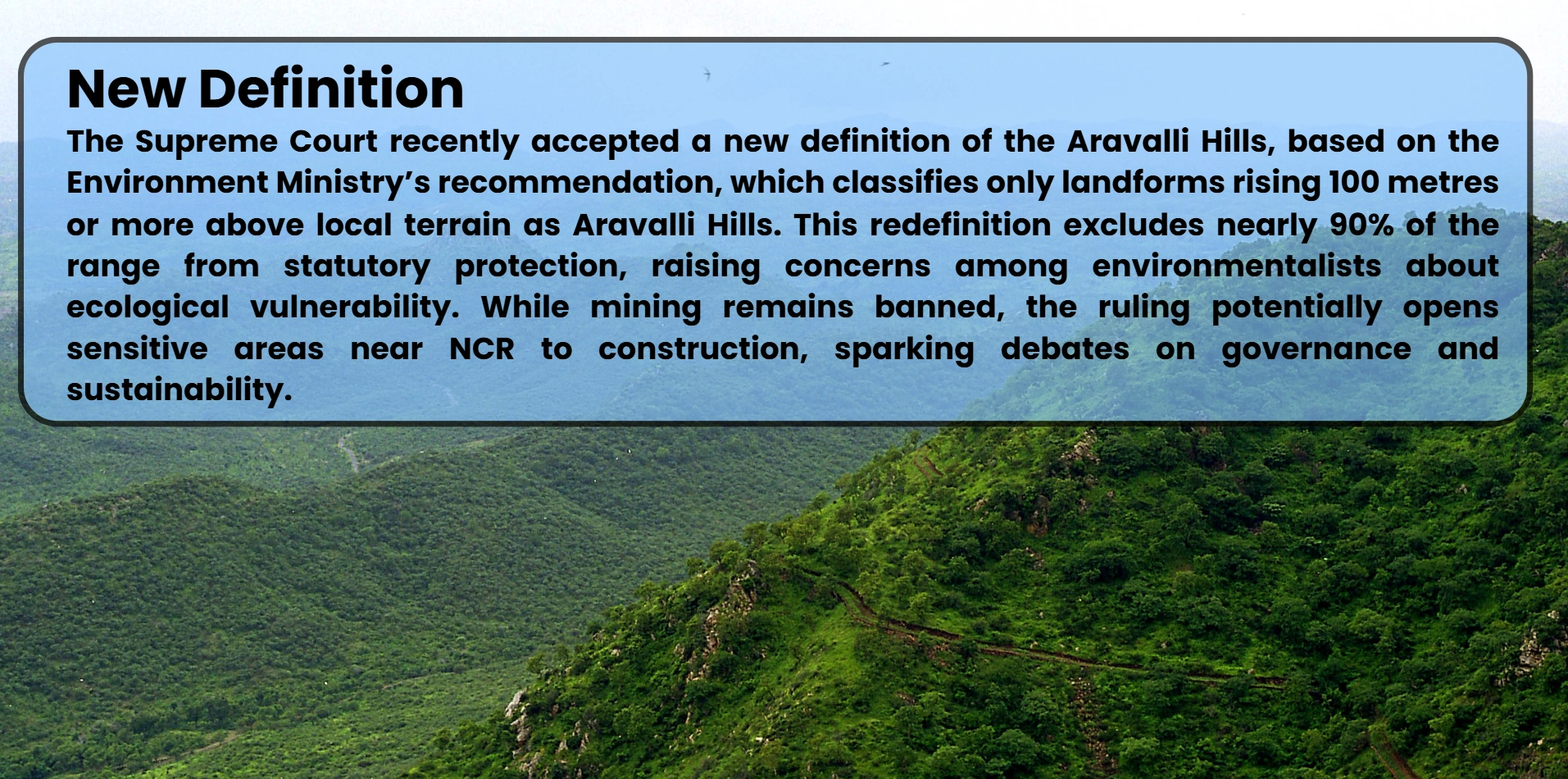
In November 2025, the Supreme Court came up with a new definition of the Aravalli Hills based on the suggestions of the Union Ministry of Environment. According to the new criteria of identifying landforms, the Hills taller than 100 meters, considering the base as local terrain, will be considered as the Aravalli hills. On the one hand, the Court, at the same time, suspended the issuance of new mining leases, but, on the other hand, the technical threshold has provoked alarm among the representatives of environmental activism, as now almost 90 percent of the range may be out of statutory protection. According to legal experts, this narrow definition jeopardizes the elimination of the historical ecological protection of vast regions.
Justifications by the Ministries
The Ministry of Environment has made it clear that the new definition does not give a free pass to mining on the landforms that have a lower altitude than 100 metres, indicating that important slopes and habitat areas are preserved. However, according to the civil-society actors and opposition politicians, the judgment presents gaps of commercial exploitation, especially in construction works that happen to be located near the National Capital Region. Protests held in the campaign under the name “Save Aravalli” stress a general concern that redefinition will pose a threat to the ecological soundness and create a precedent for similar laxity in other at-risk settings.
Concerns it raises
The conflict draws out the general governance challenges and the tension between the requirements of development and the sustainability of the ecosystem. The decision makes economic goals, perhaps sacrificing protection to the highest level, at the cost of environmental science. The controversy is an illustration of how judicial and ministerial standards can revolutionize conservation policy and have consequences on urban growth in the NCR and elsewhere. Finally, the case of Aravalli highlights the need to have an overall legal system to encompass ecological functions instead of using constraining definitions of geomorphology.
The Concerns over mining and construction
The Aravalli Hills issue has shifted its attention not only to the ban on mining activities but also to taking an overall view on the issue of construction licenses, thus casting serious doubts on the concept of ecological sustainability, governance systems, and the overall consequences of relocation of environmental limits in sensitive ecological zones.
Ecological Concerns
Historically, mining in the Aravalli Hills has been viewed as a deplorable activity that has led to deforestation, loss of biodiversity, and degradation of the groundwater resources. Strict prohibitions against mining activities through judicial interventions, especially the Supreme Court, have targeted fragile ecosystems with the aim of protecting them. The bans were based on the factual experience of illegal extraction patterns and irreparable damages caused to the natural landscape, making mining a salient menace to ecological stability.
Construction Issue
According to recent ministerial clarifications, although mining is still forbidden, some parts of the Aravalli range close to the National Capital Region might permit the use of construction in the area. This policy shift changes the focus of the debate since it introduces a legitimate option in construction, that is, real estate development projects and infrastructure projects. However, environmental researchers argue that massive buildings may duplicate or even exceed the ecological footprint of mining, especially due to the required processes, namely the fragmentation of the habitat, an increase in the level of pollution, and urban sprawl.
Ecological Footprints
Mining and construction do part ways in terms of the modalities of their environmental effects, but intersect in their ability to destabilise the ecosystems. Direct mining makes an impact on the topography by the direct removal of resources, thus creating a physical footprint on the terrain, and construction brings fixed structures, which change land use patterns and alter hydrological regimes. Both activities undermine biodiversity and negatively affect groundwater recharge rates, but construction is an activity with an extra risk of developing long-term urban growth. Redefining the Aravalli standards to suit construction, scholars conclude that this will legitimize such operations in the ecologically sensitive areas and, as a result, destroy the conservation agenda.
Global Governance
The controversy is representative of the governance problem wherein the issue of developmental goals and conservation requirements must be struck a balance. Through limiting mining and permitting building works, the policymakers are playing a dangerous game of creating a paradox wherein the preservation of the ecology is undermined by other forms of exploitation. This dichotomy creates more general issues about the concept of precedent: allowing building in the Aravalli Hills could spur similar slackening in other avoidable landscapes. Therefore, good governance should incorporate ecology science in legal tools, and both mining and building should be reviewed in terms of sustainability as opposed to strictly determined technical standards.
How is it going to affect the NCR?
The re-definition of the Aravalli Hills and allowing constructions in the national capital region (NCR) have far-reaching ecological, socio-political, and governance consequences that go beyond the pre-existing mining prohibitions.
Expansion and Air Quality
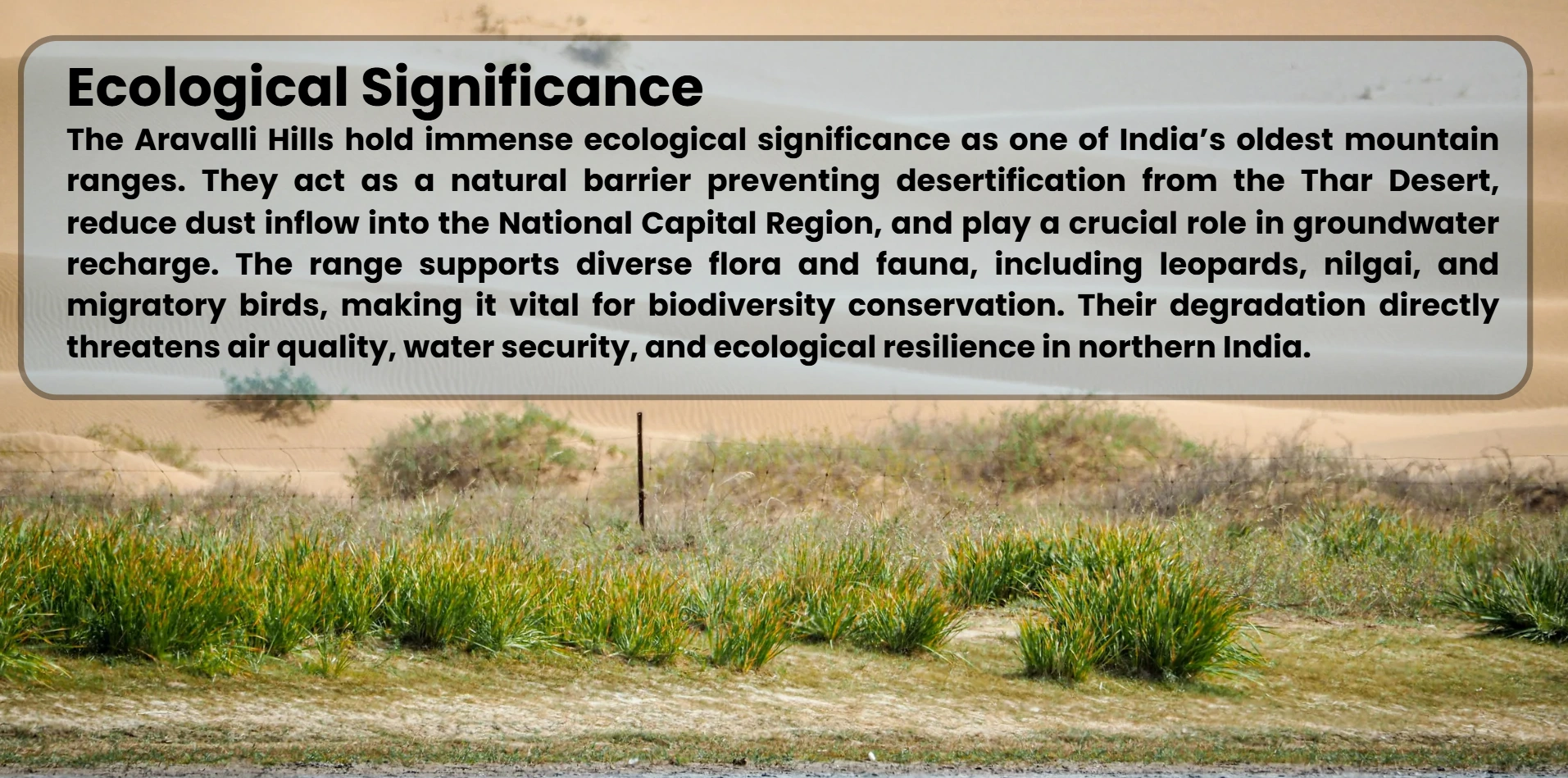
The Aravalli Hills are a natural barrier to wind incursion by the deserts of Rajasthan, and curtailed dust intrusion in the NCR. The extensive construction would presumably worsen the already existing air-quality of the area, since the ecological barrier will be diluted. The problem of urban encroachment in sensitive ecological areas is associated with a potential for increasing the level of particulate matter, which subsequently deteriorates the city's health indicators, and makes the NCR worse than ever due to its high position in the list of the most polluted metropolitan regions of the world.
Groundwater
Aravalli aquifers form a very important source of groundwater recharge in Delhi and other nearby regions. The activity of construction projects, changing land cover, and increasing impermeable areas, poses a threat of disturbing the existing hydrological regimes. Subsequent decrease in recharge potential may make NCR even more seriously chronically short of water, already a situation aggravated by over-pumping and falling water tables. This hydrological mismatch would touch on the urban populations and also the rural agrarian population relying on underground sources as irrigation source.
Ecological and Biodiversity
A diverse form of flora and fauna live in the Aravalli Hills, such as leopards, nilgai, and other migratory avifauna. Construction causes a loss of habitat, which in turn is expected to encourage the process of biodiversity loss, which negatively impacts ecological resilience. More importantly, the restructuring of environmental standards will have precedence; authorizing the construction in the Aravalli hills will have the effect of authorizing similar compliances on other environmentally sensitive areas all over India. It is the long-term existential danger of such normalization of development in fragile ecosystems as an excuse under the technical reclassification that is of great concern to biodiversity conservation.
Policy Ripple Effects
The controversy highlights the issues of the strike of developing needs and conservation goals. The preference for the ban of strict mining but favouring construction poses a risk of developing a paradox where ecological protection becomes subtractive due to other types of utilization. To the NCR, it can be in the form of uncontrolled urban sprawl, whereas at the national level, this would mark the beginning of a jurisprudential transition to a more permissive paradigm of the environment. The controversy, therefore, brings out the pressing need to have comprehensive policy frameworks that emphasize geomorphology limits, ecological functionality, sustainable urban planning, and conservation in India.
Long-term strategies for Policy and Governance
The case on the Aravalli Hills is a clear illustration of the complex interconnection between environmental management and judicial controls, as well as developmental demands, and thus, ecological sustainability is overlooked under pressures of urbanization.
Governance Problems in Sensitive Landscapes
The Aravalli Hills governance is an embodiment of more generalized dilemmas that exist when trying to manage the environmentally sensitive areas. The initial restriction by judicial action against mining was the need to protect biodiversity and groundwater recharge, though there are recent restructuring of benchmarks that has brought about uncertainty. The policymakers can sabotage ecological science by giving preference to technical standards like height to establish exploitable loopholes in the construction industry. This highlights the challenge of having regulation meet the realities of the environment, especially in places filled with high rates of developmental pressures like the National Capital Region (NCR).
Developmental Pressure
The policy paradox that appears in the clarification of the Ministry of Environment that mining is forbidden and construction can be continued can be viewed as an example of it. Allegedly meant to make conservation and urban development coexist, the changes in policy carry the risk of sanctioning exploitation under a different allure. The increase in the real-estate industry within the Aravalli Hills will only serve to worsen the air pollution, water shortage, and degradation of biodiversity, hence leading to serious concerns as to whether the current governance systems are sufficient to forecast the long-term ecological impact of such development. The controversy, therefore, shows how the policy benchmarks may resonate beyond the mining sector to affect the planning and conservation standards in the urban areas of the country.
Need for Sustainable Governance
Moving on, governmental systems should assume comprehensive principles that focus on ecological processes instead of geomorphological categorizations. This will involve strict zoning laws, open environmental impact studies, and involvement of the community in decision making process. Sustainable solutions such as eco-tourism, green infrastructure, and reforestation can provide economic advantages without affecting the ecological integrity. Also, collaboration between the judiciary and the executive should help ensure that the conservation policies are not influenced by political expediency but informed by empirical scientific data.
Global Significance
The Aravalli case sets a precedent for the way India can treat other ecologically sensitive landscapes. In case building in the Aravalli Hills is normalized, similar relaxations may then be projected to the Western Ghats or the Himalayan foothills. The controversy is reverberated at the international scale because of the current discussions on the balance between development and preservation of delicate ecologies. It reminds the necessity of showing the solution to the problem of creating models of governance, combining environmental science, legal protection, and decentralizing mechanisms to achieve sustainability on various levels.
Conclusion
The Aravalli Hills case shows how complex the issues of environmental conservation and developmental needs are. Prohibition of mining in the courts was influenced by the fear of biodiversity loss, depletion of groundwater, and unlawful mining; however, the latest definition of standards and potential permission of mining near the National Capital Area reveal the contradictions in taking actions through regulations. It has not just a local topography impact but also an atmospheric quality, hydrological balance, and biodiversity impact that progress further to set precedents for the delicate ecosystems in other locations. Sustainable governance should be, then, more focused on promoting ecological functions rather than limited technical requirements, which require integration of empirical knowledge, participative decision-making, and dynamic policy processes. Such holistic solutions are the way to ensure that urban growth is reconciled with sustainability in the environment in the long term in India.