During the India AI Impact Summit 2026 on 19 February 2026, French President Emmanuel Macron called on India to join the club of countries introducing social media restrictions for children, aiming to shield young users from digital risks such as cyberbullying, addiction, and exposure to inappropriate content.
|
Key Highlights
- Global Push for Social Media Restrictions According to Age
- The Landmark Legislation in Australia on Age Restrictions
- Global trend on Age Restrictions
- India's Policy Landscape for Age Restrictions
- Dangers of Early Social Media Exposure for Children
- Towards a Holistic Approach to Protect Children on Social Media
|
The French President Emmanuel Macron, has recently advocated for India to participate in global efforts to prohibit social media use among children, following Australia's introduction of a strict 16-year age limit. Europe is shifting in this direction, and this call has resonated in the Economic Survey 2026 of India, where risks of early digital exposure have been raised. Child safety, mental health, and responsible digital governance are all important in relation to the issue. The discussion on the age of access to social media by children has re-emerged with increasing intensity around the world following the historic legislation on children that Australia enacted in the form of establishing a minimum age of 16. French President Emmanuel Macron has urged India in order to move into this emerging international agreement, highlighting the dangers of premature digital exposure.
The Economic Survey 2026, released in India, also expressed certain fears about child safety, mental health, and targeted advertisements, where the recommendations of age-based limitations were highlighted. This national and internationalization of thinking highlights how there is an immediate need to reconsider the digital governance of young users. The matter is not just legal but also concerns the protection of childhood in the context of the globalised world. The India-AI Impact Summit 2026 was a landmark global event held from 16 to 20 February 2026 at Bharat Mandapam, New Delhi.
Global Push for Social Media Restrictions According to Age
Regulating exposure of children to social media has turned out to be an urgent national problem, with the governments progressively considering limitations by age to ensure protection of mental health, privacy, and cyberspace well-being.
The Landmark Legislation in Australia on Age Restrictions
In December 2025, Australia became the first nation to issue a countrywide ban on any children under 16 using social media. Another challenging law related to digital safety was that platforms like TikTok, Instagram, YouTube, and Facebook were made legally obliged to block minors, which is considered one of the most difficult laws connected to online safety in the world. The rationale gave to this action was the growing use of social media, which was causing anxiety, depression, and cyber-bullying in adolescents.
Europe’s Emerging Consensus on Age Restrictions
France followed with an equivalent bill after Australia, and Spain and the UK are in discussions with the aim of doing so as well. It has also been noted that the European Union has been spearheading debate over harmonised digital safety standards, also indicative of a dynamic trend across the continent towards safeguarding children on the internet.
Global trend on Age Restrictions
The studies point out that almost 70 percent of children in OECD nation access social media daily, which is shocking in terms of exposing children to unhealthy content and targeted advertisements. Regulations moved towards a model of parental consent to models of stricter access control and mechanisms of age-assurance on the ecosystem level.
Broader Implications of Age Restrictions
The policies that are emerging are pointing to international convergence into child-centric digital governance. Malaysia, Denmark, and Norway are also looking at bans, and this heightens the need to find some organized international intervention.
India's Policy Landscape for Age Restrictions
In early 2026, India is taking stronger steps to protect children online. The government is talking with social media companies about the possibility of limiting access for users under 16, following a growing global push for stricter child safety rules. Under the Digital Personal Data Protection Bill (DPDP) Rules, 2025, platforms are required to get verified parental consent for anyone below 18, while the legal age of adulthood in India continues to be 18. The control over the access of children to social media in India is developing quickly, being under the influence of international practices and national issues, as it has been pointed out in the latest governmental reports and policy dialogues.
Recommendations on Age Restrictions in Economic Survey 2026
The Economic Survey 2026 clearly suggests the age restrictions on using social media and restrictions on child-directed digital advertisements. The survey underscores the need to have measures put in place by the platforms to ensure age verification and to have age-based defaulting mechanisms, as this would bring India in line with the best practices across the world.
Government Initiative on Age Restrictions
The Ministry of Electronics and Information Technology of India has gone ahead and consulted with key social media players in a bid to discuss age restrictions that can be enforced. The Minister of Information and Technology, Ashwini Vaishnaw, has verified that such debates also include the regulation of deepfakes and child protection as elements in a larger strategy of regulating digital governance to maintain stability.
Proposed Amendments to the IT Rules
It is reported that the government is considering the changes in the 2021 Information Technology Rules in order to add graded restrictions to users below sixteen. India has an opportunity to implement a differentiated system in place of the blanket ban that is used in Australia, and strike a balance between child protection and digital inclusion.
Dangers of Early Social Media Exposure for Children
The rapidly growing use of social media among children has raised a lot of worldwide concerns, and studies have shown that children exposed to it at an early age are exposed to psychological, social, and developmental risks that require decisions to be made immediately by policymakers.
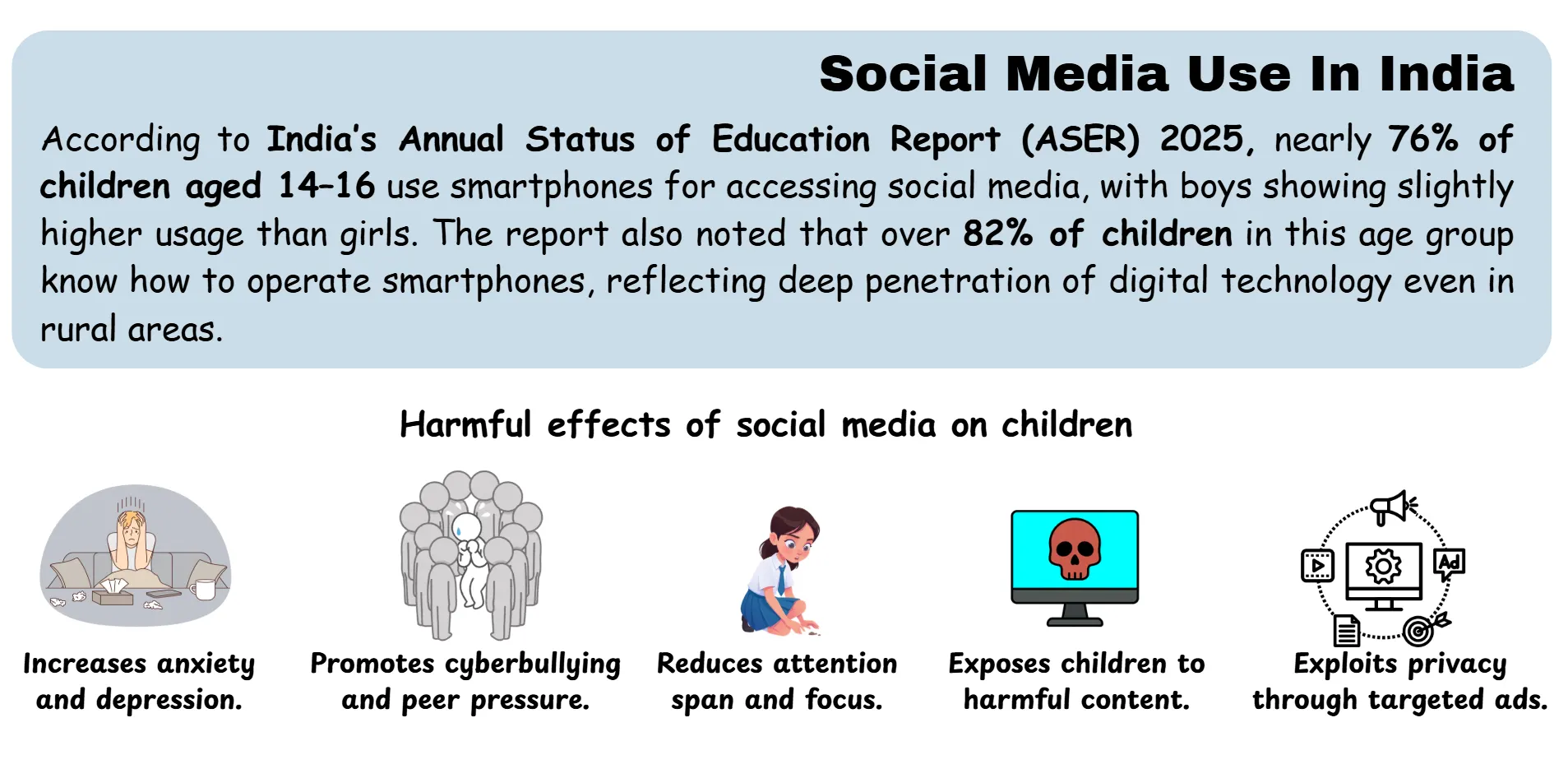
Psychological and Behavioural Impact of Social Media on Children
Research has indicated that too much social media use by children correlates with anxiety, depression, and lack of concentration. In a joint UNICEF India report, it was stated that peer pressure and cyber-bullying on the internet are the principal contributors to increased stress among over 65% of the teenagers who encounter these experiences at the age of 13-15. Surveys performed worldwide have shown that children who are exposed to uncontrolled screen-time have become more aggressive and impatient.
Digital child abuse
Digital child abuse often referred to as online child sexual exploitation and abuse (OCSEA) involves any form of harm inflicted on children through digital platforms such as social media, messaging apps, or online games. This growing crisis has intensified in recent years, with an estimated 300 million children worldwide affected by online sexual abuse and exploitation each year.
Exposure to Harmful Content on Social Media
Children are still subject to indecency, Internet predators, and falsehoods. In a report by the United Nations on Child Online Protection, 77 percent of youth between the ages of 15 and 24 years were active online users in 2023, and this group of the population was left vulnerable to the various, but mostly unsafe, online spaces. This kind of exposure may distort social values and undermine emotional development.
Economic and Privacy Threats to Minors on Social Media
Influencer-based and targeted advertisements take advantage of the impressionability of kids. According to reports, minors are often subjected to manipulative digital advertisements, which is an ethical issue with respect to consumer protection. They are also subjected to risks caused by privacy invasion, such as the unauthorised gathering of data, where children become at risk of prolonged digital exploitation.
Towards a Holistic Approach to Protect Children on Social Media
The reduction of the risks of early exposure to social media requires the establishment of an all-encompassing framework that encompasses educational interventions, parental supervision, technological responsibility, and policy-makers' creativity, thus making child-focused digital governance.
Digital Literacy and Education on Social Media Threats
India must incorporate digital literacy into formal education. As the UNESCO report says, countries with well-organised digital education programmes see the cases of online safety among teenagers decreased by 30 percent (UNESCO). Digital awareness is already promoted by the National Education Policy of India, and those indirect and age-specific courses on responsible online behaviour can be introduced.
Increasing Community Awareness of Social Media
The parents play a central role in the surveillance and control of the online behaviour of the children. According to the survey on adolescents tracked by UNICEF, an adolescent who is exposed to active parental supervision has a reduced likelihood of accessing any harmful content by 40%. In addition, the resilience to digital risks can be strengthened with the help of community-based awareness campaigns.
Moral Responsibility of Social Media Platforms
Social media operators are required to overhaul algorithms in an attempt to reduce the addictive qualities and limit the targeted advertisements that are targeted at minors. The Digital Services Act (2024) in the European Union recommends a stringent process of age-verification and increased transparency in the content-moderation process, and it can serve as a possible template that can be adopted in India.
Conclusion
The global push to restrict children's access to social media is evidence of a growing realisation of its psychological, social, and economic risks. The fact that the French President urged India to be in the club, and Australia has passed the first coordinated digital governance bill, underscores the desperation for joint action in the field. The Economic Survey 2026 gives India an opportune blueprint of matching local policy with international counterparts. India will be able to balance innovation with responsibility by introducing age-based limitations and promoting overall protection so that, on the one hand, such digital ecosystems help to keep childhood safe, and on the other hand, such protection would continue to spur inclusive growth.
Frequently asked questionsFrequently asked questions
Global Push for Social Media Restrictions According to Age?
Regulating exposure of children to social media has turned out to be an urgent national problem, with the governments progressively considering limitations by age to ensure protection of mental health, privacy, and cyberspace well-being.
India's Policy Landscape for Age Restrictions?
In early 2026, India is taking stronger steps to protect children online. The government is talking with social media companies about the possibility of limiting access for users under 16, following a growing global push for stricter child safety rules. Under the Digital Personal Data Protection Bill (DPDP) Rules, 2025, platforms are required to get verified parental consent for anyone below 18, while the legal age of adulthood in India continues to be 18. The control over the access of children to social media in India is developing quickly, being under the influence of international practices and national issues, as it has been pointed out in the latest governmental reports and policy dialogues.
Dangers of Early Social Media Exposure for Children?
The rapidly growing use of social media among children has raised a lot of worldwide concerns, and studies have shown that children exposed to it at an early age are exposed to psychological, social, and developmental risks that require decisions to be made immediately by policymakers.
Towards a Holistic Approach to Protect Children on Social Media?
The reduction of the risks of early exposure to social media requires the establishment of an all-encompassing framework that encompasses educational interventions, parental supervision, technological responsibility, and policy-makers' creativity, thus making child-focused digital governance.