|
Key highlights
- rare-earth permanent magnets
- India’s initiative for domestic production
- 7,280 crore rupees project
- to achieve sustainability and resilience
- lessen dependence on China
- to make a presence in the global supply chain
|
The future of Indian technological evolution is to be determined by the creation of a powerful ecosystem that will focus on the permanent rare-earth magnets. India has a chance to stabilize its energy, defense, and electronics chains of supplies by curbing the reliance on imports, achieving local extraction and production, and emphasizing research and innovation through harmonized national and global efforts. The implementation of sustainable behaviour and development of strategic policies will institutionalize employment, improve competitiveness, and strengthen the international presence of India in comprehensive technologies.
|
Tips for Aspirants
The article is important for UPSC CSE and State PSC examinations because it combines the factors of governance, economic models, environmental issues, and geopolitical policies, thus providing a thorough insight into the technological sovereignty policy and resource-management in India.
|
|
Relevant Suggestions for UPSC and State PCS Exam
- Electric vehicles, wind turbines, defense systems, and electronic devices cannot be operated without rare-earth permanent magnets (REPMs), or they would be vital to the strategically important industries.
- The dependence on Chinese imports imposes supply-chain and geopolitical risks on India.
- The government has come up with a plan of INR 7,280 crore rupees to develop an integrated REPM manufacturing capacity of production of 6,000 metric tons annually.
- The healthy domestic ecosystem requires the presence of the mining-refining-processing infrastructure to fulfil Make in India and the Atmanirbhar Bharat agendas.
- In order to achieve sustainability and resilience, materials science, recycling technologies, and alternative materials research and innovations are necessary.
- Partnerships with the United States, Japan, and Australia provide diversification of supply chains and interest of India in terms of its standing in the world.
- The benefits include job creation, competitiveness in industries, and potential exports.
- An ecological stewardship should be supported by highlighting the sustainable mining processes, the recycling of the materials, and the introduction of the circular economy concept.
|
India's desire to take up hegemony in the world technological market is becoming very dependent on its ability to get access to the needed materials and manufacturing expertise. Herein, rare-earth permanent magnets are in a focal position, due to their essential role in the state-of-the-art consumer devices, renewable power generation, military technology, and vehicles. India is currently highly dependent on the import of rare-earth elements and magnet components, which makes the industrial growth of the country and the areas prioritized by the country susceptible to events in the supply-chain. Therefore, not only an industrial but a national priority is the creation of an indigenous ecosystem used to produce the rare-earth permanent magnets. Such an ecosystem would cover the entire value chain, which includes mining, refining, processing, and developing advanced fabrication, and be supported by sound research and innovation models. Additionally, it would match the Atmanirbhar Bharat and Make in India, and at the same time, contribute to sustainable development with recycling and the elements of the circular economy. India can propel the rare-earth magnet production accordingly by creating a circle of action between government, industry, and academia to become a foundation of its upcoming technological jump and thus guarantee energy security, implantation and geopolitical stability in an era characterized by swift technological shifts.
Strategic significance of Rare Earth Magnets
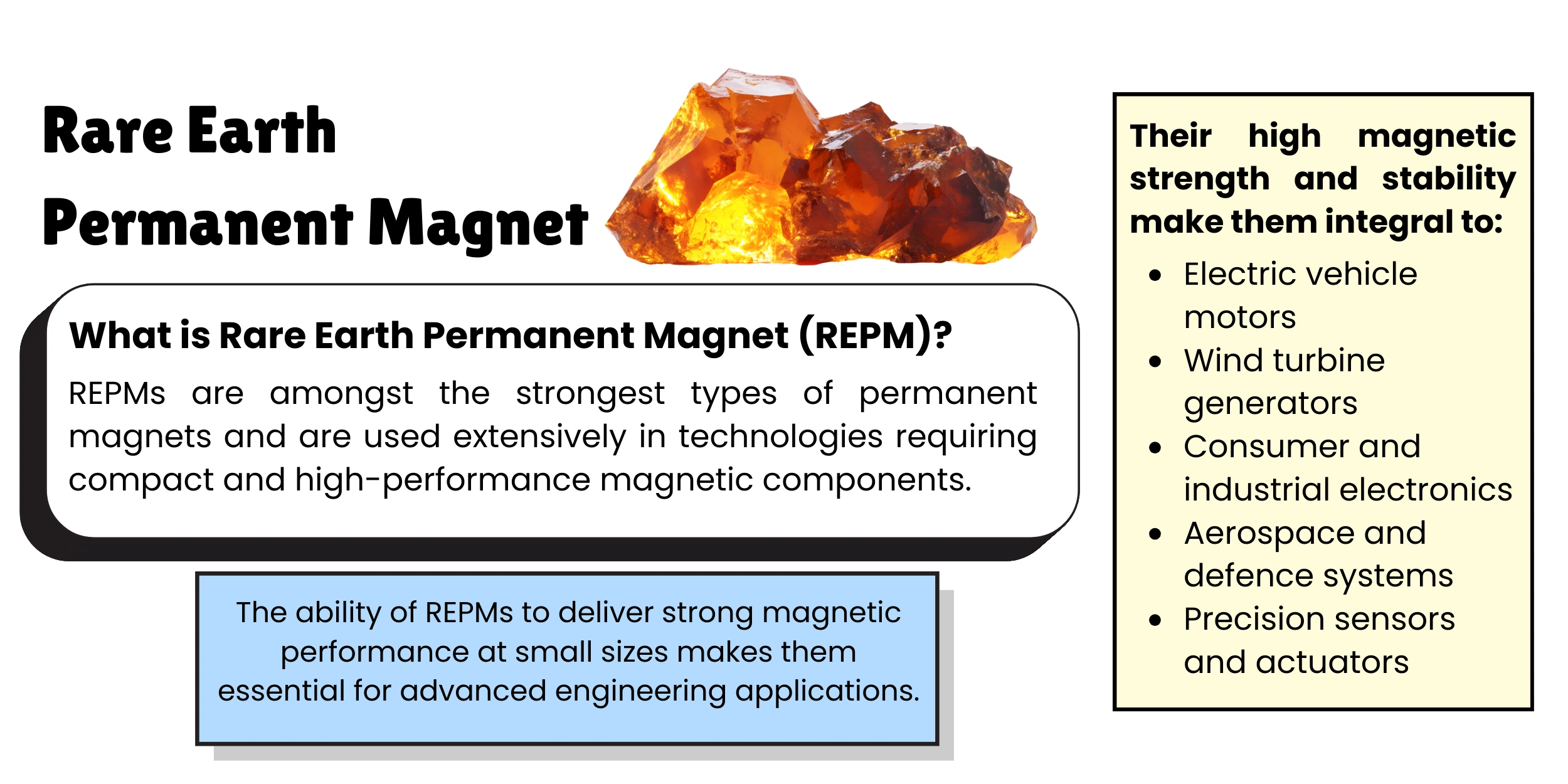
Rare Earth Permanent magnets (REPMs) are invaluable elements of modern-day technology, enabling compact and high-performance applications played out in the fields of energy, mobility, defense, and electronics. They have a strategic relevance in individual competitiveness of industries, defense, and sovereignty in technology. Rare Earth Magnets (REMs) are strategically vital because they power modern high-tech sectors—clean energy (EVs, wind turbines), defense (missiles, sonar), and electronics (phones, computers)—offering superior magnetic strength in small sizes, but their supply chain is heavily concentrated in China, creating geopolitical risks, economic vulnerabilities, and dependency for countries like India and the U.S.
Role in Modern Technologies
Some of the best permanent magnets available are those that use rare earth magnets such as neodymium-iron-boron (NdFeB) magnets. The fact that they have high magnetic strength and thermal stability makes them essential to motors of electric vehicles, wind turbine generating systems, aerospace industries, and consumer electronics. Without such magnets, the Indian dreams of clean energy and a modern manufacturing industry would face considerable limitations.
Unstable Global Supply Chain
India currently relies on importing most of its rare earth magnets, mostly from China, which controls most of the global production. The dependence on imports makes India susceptible to geopolitics, export policy, and price elasticity. The supply chain disruption of the rare-earth this year showed how the external shock could disrupt domestic sectors, particularly the automobile and renewable-energy sectors. It is thus important to build the capacity of the indigenous in order to ensure resilience and counter strategic vulnerabilities.
National Security and Strategic Autonomy
In addition to the industry sector, the rare earth magnets are essential in defense technologies, such as precision-guided missiles, radars, and advanced communication devices. The reliance on such critical supplies on outside suppliers will make India weak in strategic terms. Building a domestic ecosystem is in line with the national agenda, like Atmanirbhar Bharat, where defence preparedness and technological independence are not compromised.
Economic & Geopolitical Importance
The government has given approvals of INR 7,280 crore schemes (about US $820 million) to establish integrated REPM manufacturing capacity with the aim of producing 6,000 metric tonnes every year. This project will not only meet local demand, which is expected to increase twofold by 2030, but will also make India an exporter and a location of the global supply chains. India will have the capacity to establish partnerships with the United States, Japan, and Australia because these allies will help it establish a stronger geopolitical position, as well as diversification of the critical minerals partnerships.
Innovation and Sustainability
Sustainability is also of strategic importance. Rare earth mining and processing are resource-consuming and, therefore, a cause of environmental concern. The focus on the use of recycling e-wastes and the adoption of the circular economy demonstrates two facets of the Indian attitude to technological development and environmental concern. The substitution innovation and other material sciences will increase resilience and minimize ecological footprints.
Creating Localized Manufacturing Eco-system
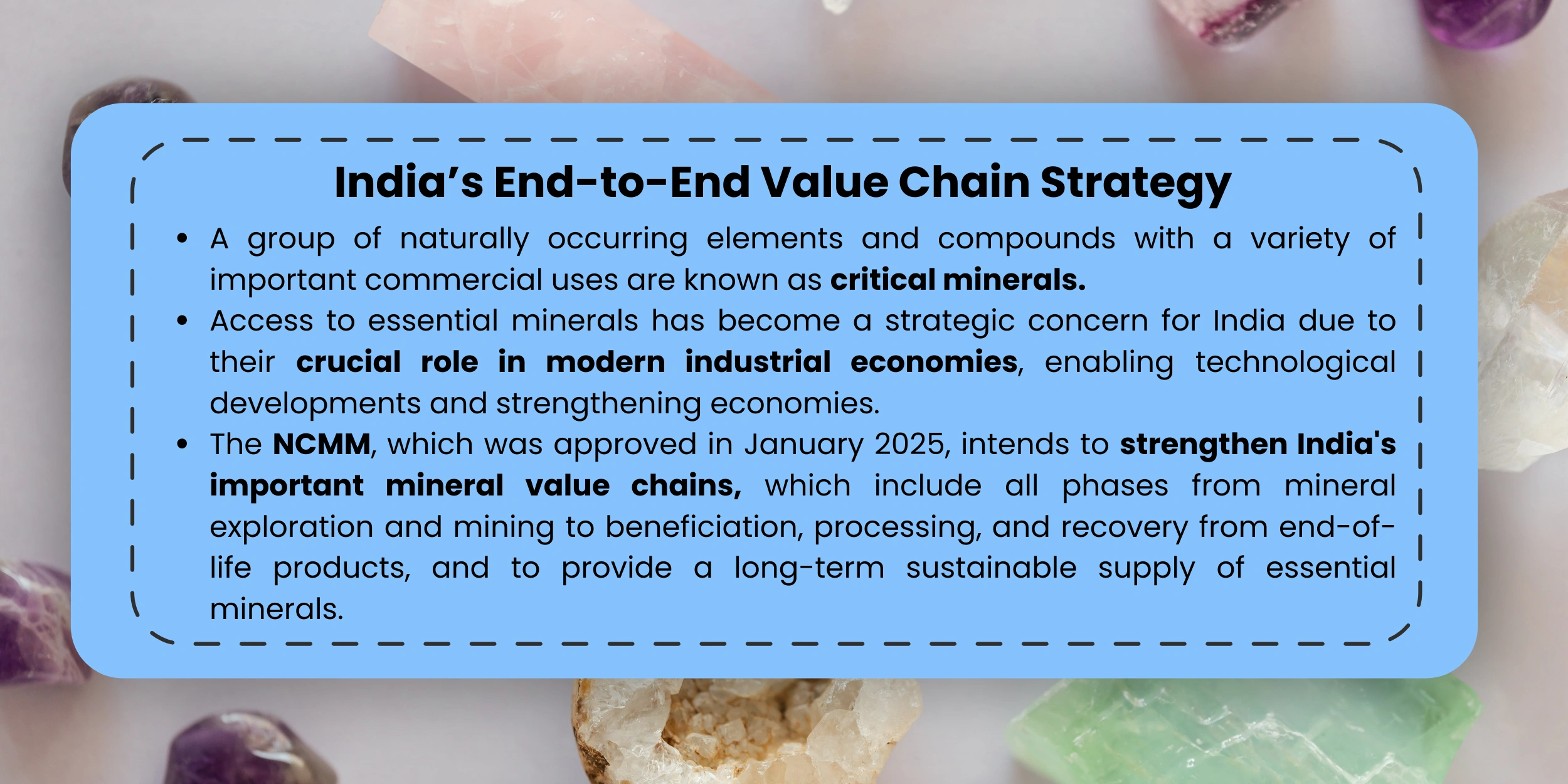
The applied technology in India, which requires technological independence, requires setting up an effective local ecosystem for the production of rare-earth permanent magnets (REPM). Creating a localized manufacturing ecosystem involves building regional, resilient production networks close to consumers, leveraging technology (Industry 4.0, digital twins, automation) for efficiency, securing local supply chains, fostering talent via skilling, and implementing supportive government policies (PLI schemes, 'Make in India'), shifting from centralized models to distributed micro-factories for faster, customized, on-demand production that boosts local economies and reduces import reliance. The mining, refining, processing, and advanced fabrication should be incorporated in this ecosystem to reduce dependence on imports and increase supply-chain resiliency.
Policy Framework and Availability of Resources
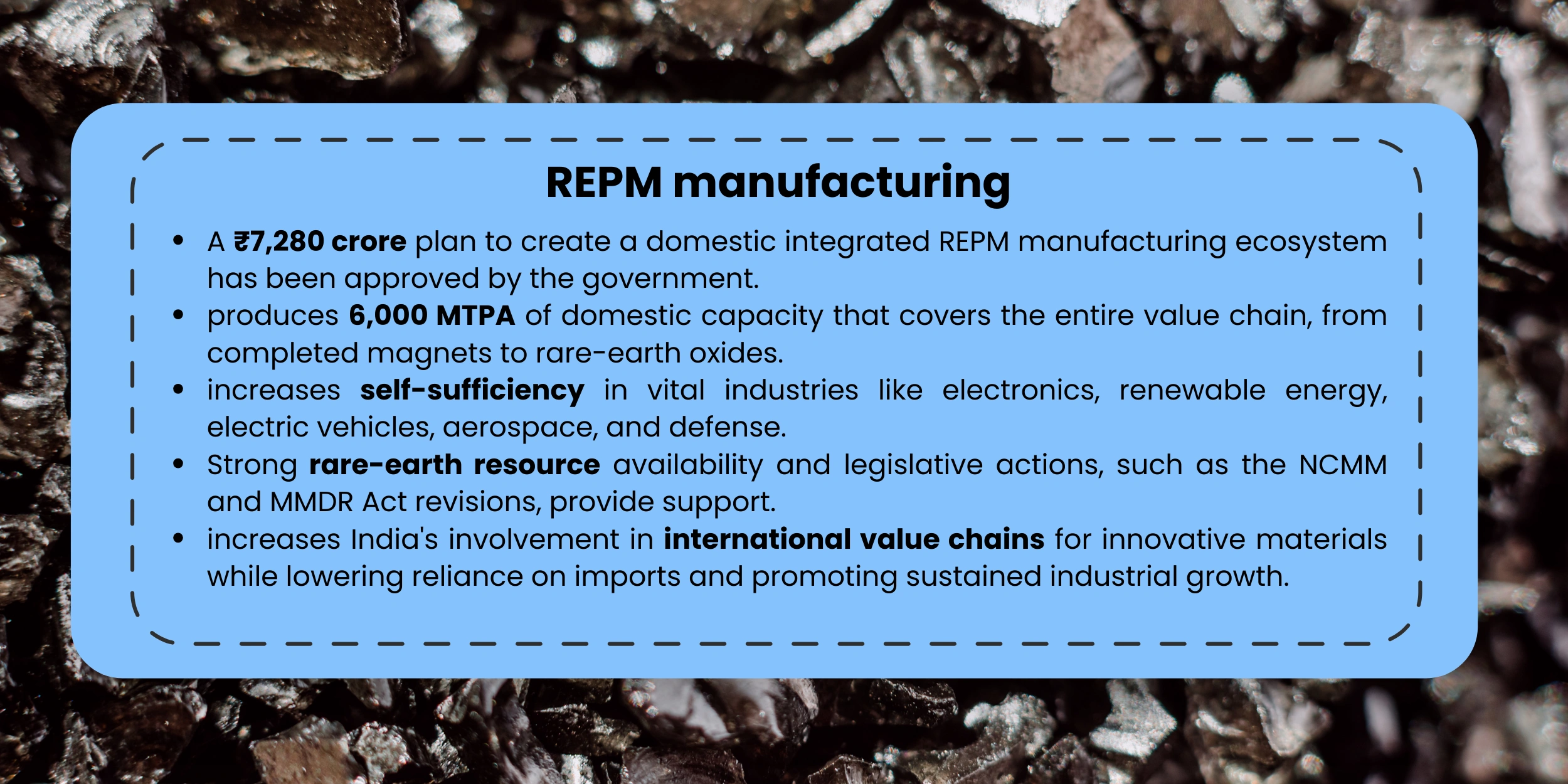
There are significant deposits of rare earths in India, both along the coastal and inland regions, majorly in Andhra Pradesh, Odisha, Tamil Nadu, Kerala, and Gujarat. One recognition of this resource base is the Scheme to encourage the manufacturing of Sintered Rare Earth Permanent Magnets (REPM) of 7,280 crore rupees, which was begun by the government. The project is aimed at building a 6,000 metric tonne per year production capacity, including the whole value chain of the rare-earth oxides to the finished magnets. Moreover, the policy support of exploration and sustainable extraction is ensured by the amendments to the Mines and Minerals (Development and Regulation) Act.
Infrastructure Development and Industrial Integration
A domestic ecosystem can only be developed by developing state-of-the-art refining and processing plants that will produce highly pure rare earth oxides. These oxides are used as feedstock in the downstream magnet-fabrication industries. The national integration with industrial policies like Make in India and Atmanirbhar Bharat will make sure to comply with the priority areas. It would be necessary to establish public-private partnerships, which entail collaboration of the national companies from the private and government sectors and the research structures to have the commercial ability to outdo marketplaces and scale their manufacturing.
Studies, Development, and International Cooperation
The ecosystem that is sustainable requires high-level research work in material science, recycling methods, and substitutes for the critical rare-earth elements. Academic institutions and start-ups are critical to developing novel solutions, and the international joint venture with mineral-rich countries (such as Australia, Argentina, and Zambia) enables the transfer of the technology and diversification of the supply lines. Such a bi-directional strategy, i.e., domestic innovation and international cooperation, makes it more resilient to geopolitical disturbances.
Strategic Impact
The REPM ecosystem in the country is projected to create job opportunities, enhance the competitiveness of the industries, and promote the prospects of export. India can ensure such vital sectors as electric mobility, renewable energy, aerospace, and defense by reducing dependence on imports. In addition, environmentally friendly measures such as e-waste recycling and the e-circular economy framework will reduce environmental hazards and strengthen India's position in the advanced materials chain of supply across the globe.
Innovation, Research, and Global Co-operation
The three pillars of India’s strategy in rare-earth permanent magnet (REPM) are Innovation, Research, and Global Collaboration. All these guarantee technological resilience, sustainable growth, and a stable global supply chain.
Material Science and Innovation
The research facilities and start-ups in India are paying more attention to creating advanced magnetic materials, recycling technology, and the alternative to rare-earth elements. Alternatives like rare-earth-free motor and enhancement of neodymium magnet recycling are investigated to lessen the import-heavy reliance. The 2025 crisis of the supply-chain highlighted the need to invest in indigenous R&D to protect the most important sectors, like electric mobility and renewable energy.
Academia and Industry
A network of universities, national laboratories, and commercial enterprises working together in order to establish a knowledge infrastructure that helps in designing, manufacturing, and testing of magnets. Nanostructured materials and effective processing techniques are developed in academic research, but they are yet to be scaled and commercialised in industry. The Atmanirbhar Bharat model of public-private partnership needs to transform innovation from the laboratories to industries.
Technology Transfer
The rare-earth strategy of India consists of international relations with the United States, Japan, and Australia. Such partnerships make available high-tech technologies, diversified mineral resources, as well as joint research programmes. The new scheme of INR 7,280 crores that has recently been passed to manufacture REPM confirms to the world systems and India has been included in the resilient supply chains, outside the presence of China. This kind of cooperation enhances the geopolitical position of India and minimizes its weaknesses.
Circular Economy Models and Sustainability
New materials are not the only form of innovation, but also sustainable practices. In the long-term strategy of India, recycling e-waste and recovering rare earths in end-of-life products, and the implementation of models around the principles of the circular economy are the key elements. These strategies reduce the environmental hazards that are involved in mining and processing, and also guarantee the efficiency of the resources. Placing sustainability in the context of the innovations will enable India to reconcile between industrialisation and green outcomes.
Economic, Environmental, and Geopolitical Impact
The rare earth permanent magnet (REPM) ecosystem in India can be having far reaching economic, environmental, and geopolitical consequences. The progress of its development will define the competitiveness of the industry, environmental friendliness, and the position of India in the global supply chains. Economic, environmental, and geopolitical factors deeply intertwine, with economic growth often straining resources (increasing emissions), while geopolitical tensions (conflicts, policy uncertainty) disrupt energy markets and trade impacting sustainability.
Economic Impact
The creation of a home-based REPM production ecosystem is an economic gain that will be significant. Electric mobility, renewable energy, and defense industries will contribute to increase the demand for rare earth magnets in India by 2030. An INR 7,280 crore rupees government-sponsored project is designed to create integrated manufacturing capacity, producing 6,000 metric tonnes every year, and thus a cut in the reliance on imports and the emergence of high-skilled jobs. India can turn the rare earth magnets into a source of its high-tech production sector by making them competitive in industries and allowing the country to export them to earn income.
Environmental Impact
Rare earth extraction and processing require a lot of resources, and it is usually associated with radioactive wastes, water pollution, and ecological degradation. The strategy of India focuses on the doctrine of sustainable extraction, recycling, and models of the circular economy to reduce these risks. The recovery of e-waste and equipment at the end of life serves not only to decrease the burden on the environment but also makes the resources more effective. Incorporating sustainability into the REPM system means that industrial development is followed by ecological responsibility control in accordance with global climate regulations in India.
Geopolitical Impact
China now leads in the world with regard to the rare-earth supply chains, producing more than 80% of magnets. India relies on imports, and therefore, it is susceptible to geopolitical, trade-related, and price risks. Diversifying the supply chains and enhancing its strategic independence, India can accomplish this by developing and establishing domestic reserves and partnering with such countries as the United States, Japan, and Australia. This change also boosts the geopolitical position of India, making it an efficient partner in the worldwide technology and energy transformations.
Strategic Integration
Economic, environmental, and geopolitical aspects of rare earth magnets are intertwined. The sustainability practices make India more credible towards global partnerships, and the economy-based competitiveness enhances its bargaining power within the global supply chain. Collectively, the effects of these bring out the strategic importance of establishing a resilient REPM ecosystem in ensuring the future of the Indian technological capability.
Conclusion
Creation of a local rare-earth permanent magnet ecosystem is a critical recurrent move in the technological and strategic growth in India. India may reduce reliance on imports and strengthen the essential supply chains through a harmonized domestic production, research and development, and draw on international collaboration. Meanwhile, by incorporating sustainability in the extraction and recycling of the products, ecological stewardship with respect to industrial growth will be ensured. The geopolitical, environmental, and economic implications of this project highlight its transformative potential, as India is becoming an innovative and powerful player in the field of advanced technology. As a result, rare-earth magnets will also appear as a pillar of the Indian technological breakthrough in the future and the Indian strategic independence.