|
Key highlights
- Headline GDP Growth vs. Reality
- High Frequency Data Divergence
- Unemployment and Informal Economy
- Aggregates of Volatility
- Upcoming New GDP Series
|
The gross domestic product growth rate of India stands at 8.2 percent, yet monthly indicators, such as industrial output, consumption expenditure, and employment figures, show disproportional growth curves. This is often indicated by high-frequency data, denoting moderate and inflationary, rural strains, and sectoral imbalances, but generally, quarterly aggregates smooth variations in the volatility, which masks short-term variations. Upcoming GDP series may better tandem with these high-frequency markers and thus help in elucidating whether the growth is broad-based or concentrated.
|
Tips for Aspirants
The article is an essential source of information for candidates of UPSC CSE and State PSC exams as it provides essential knowledge on macro-economic indicators, important statistical methods, and policy implications, essential in the course of economics, governance, and current affairs.
|
|
Relevant Suggestions for UPSC and State PCS Exam
- Headline GDP Growth vs. Reality: The reported headline GDP growth of 8.2 percent assumes economic resilience in India, but monthly indicators state a different story.
- High Frequency Data Divergence: Moderation has been indicated in the industrial production, automobile sales, rural demand, and in the employment patterns, hence the sectoral imbalances.
- Consumption Trends: The consumer spending of the household is affected by inflationary pressures and weak rural demand, although aggregate consumption growth remains high.
- Employment Issues: The rate of employment is still lower than output growth, especially in the manufacturing and informal sectors, and this increases the issues of inclusivity.
- Statistical Factors: The GDP aggregates of volatility are smoothed with the effects of quarterly GDP, but the base effect and revision of the data distort perception.
- Representation of the Informal Sector: The current GDP series does not fully capture the informal activity, allowing for restricted accuracy.
- New GDP Series: The new series is hoped to bring sectoral weights to the table, consistency with the high-frequency indicators, and present a more believable picture of growth.
- Policy Implications: an accurate GDP is necessary for the establishment of proper policies in all areas, such as rural development and policy on employment.
|
India has reported an 8.2 percent rise in the Headline gross domestic product, and this has caused a lot of discussion among economists, policymakers, and market analysts. This statistic can be reckoned to mean that there is a strong, well-established economy that can maintain high output rates despite the global uncertainties. Nonetheless, the growth rate in the headline is less convincing compared to that of monthly and high-frequency indicators, including industrial production, consumption tendencies, employment information, and the forces of inflation. These are often indicative of uneven momentum, sectoral differences, and low demand, especially in the countryside, hence a visible divide between aggregate GDP figures and reality on the ground level. Such deviation brings up some methodological and interpretive concerns. GDP aggregates in quarters have a tendency to smooth short-term fluctuations and base effects, and data adjustments would increase the apparent growth rates. Additionally, the existing GDP series might fail to adequately capture the dynamics of the informal sector, which continues to be a part and parcel of the Indian economic setup.
India's GDP Growth Mirage- Headline Growth vs. Ground Sentiment
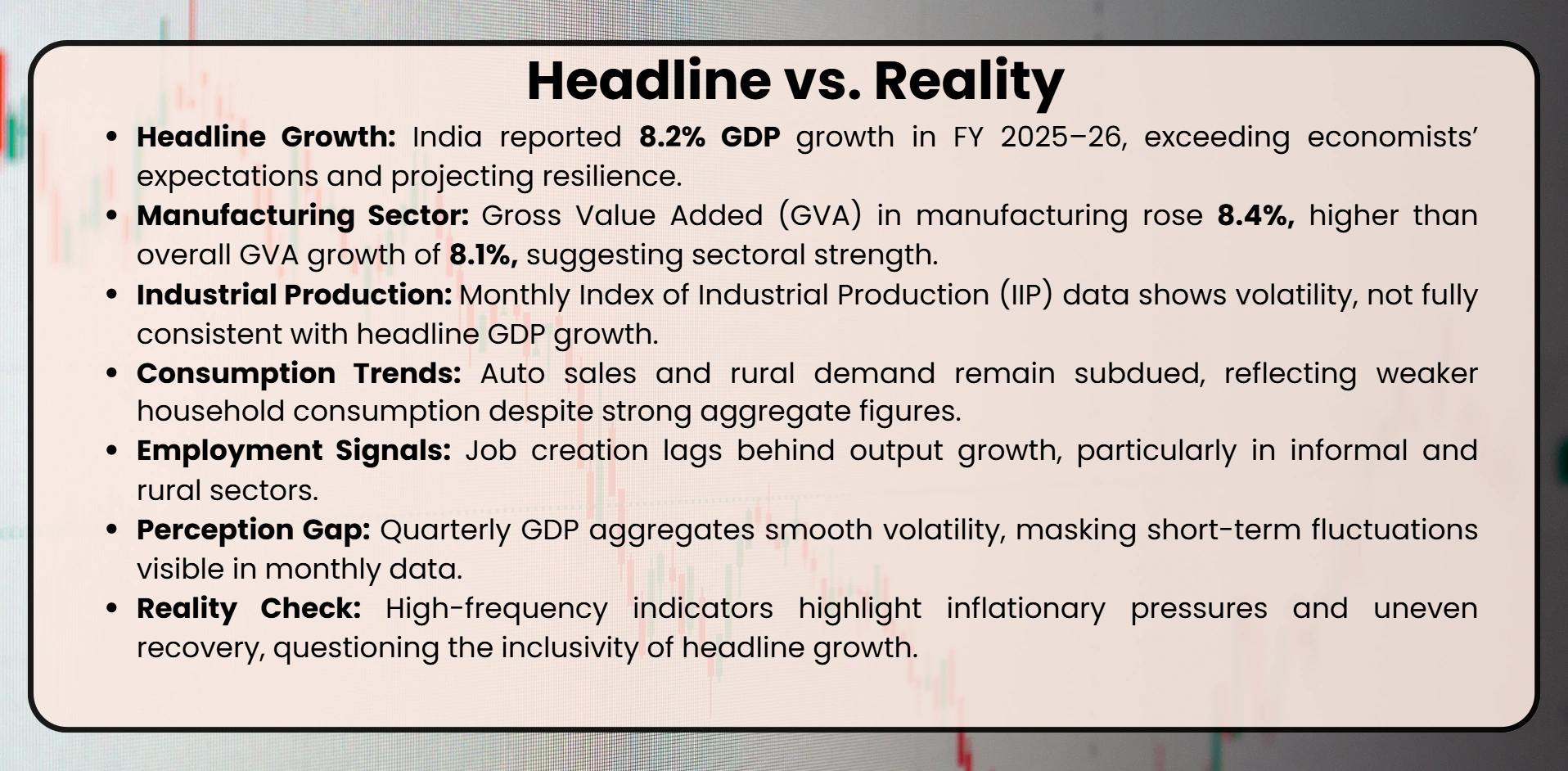
The growth rate of gross domestic product in India in the recent past, which has been listed at 8.2 percent, has been described as an indicator of high macroeconomic activity. However, this overall figure is in contrast with the sentiments that are pulled out of monthly indicators, which are inclined to show a more moderate and heterogeneous rise in economic activity development. The perceived mismatch between a high official GDP growth rate (like 8.2%) and sluggish high-frequency data is primarily due to methodological issues in GDP calculation, particularly the use of an inadequate price deflator and the treatment of statistical discrepancies. These technical factors can make the "real" or inflation-adjusted growth rate appear higher than the actual on-ground economic activity might suggest.
Headline Growth
It states the aggregate expansion across sectors, driven by state capital expenditure, production, and consumerism. International benchmarking, formulation of policies, and the creation of investor confidence cannot do without such data. By framing India as one of the rapidly growing major economies, it sets a narrative of resilience to the world.
Ground -Level Indicators and Divergence
In spite of the optimism of headline expansion, the high-frequency indicators, industrial production, vehicle sales, rural demand, and employment patterns forecast moderation. The celebration of aggregate GDP is diminished by inflationary forces, rural recovery inequity, and disparities within the different sectors. In this instance, for example, whereas services and government-directed investment are robust, the growth of household consumption and employment indicators is fluctuating, arousing a doubt of the depth of growth.
Statistical Aggregation and Perception Gap
The aggregate of quarterly GDP also tends to average the short-term volatility and thus obfuscate the fluctuations in the monthly data, which are clear in the quarterly aggregate. There are also base effects, revisions, and methodological constraints that increase the perceptual divide. The informal sector represents a significant part of the Indian economy that is not well represented in the existing GDP calculations, therefore reducing the headline figures.
Sentiment
The lack of congruence between the increase in headlines and ground sentiment underscores the need to put the methodological mindset into check. The expected changes in the next GDP series should better fit with high-frequency indicators, which may provide a more detailed image of sectoral inputs and informal activity. These corrections can help whatever statistical aggregates are found and checked with realities of life, such that a narrative of growth can be verified as believable and encompassing.
High-Frequency Data Divergence
The headline gross domestic product growth rate of India is reported to be 8.2 percent, indicating a story of strong growth. Nonetheless, the high-frequency indicators such as monthly industrial output, consumption, employment, and inflation later reveal a more heterogeneous and dimmed path, thus creating a discrepancy between headline developments and lived realities.
Industries and Manufacturing
As can be seen in monthly changes in the Index of Industrial Production (IIP), they are rather volatile, and the output of manufacturing fluctuates despite the overall GDP trend being upwardly stable. Although there is robustness in the sectors associated with capital goods and infrastructure, consumer durables, as well as the rural-focused industries, continue to languish in a weak state. This divergence highlights the fact that the headline data in terms of aggregate GDP fails to capture the aspect of sectoral imbalance, whereby growth is largely limited to those sectors that are investment-intensive rather than a general consumption base.
Demand and Consumption Indicators
The less buoyant profile of private consumption, one of the key drivers of GDP, is observed when the data of high frequency is considered. There is moderation reflected in automobile sales and demand for fast-moving consumer goods (FMCG) as well as indicators of rural consumption. Pressures that constitute inflation, particularly in the food sector, have hampered the buying power of households, creating a low level of demand against the aggregate growth rates. This inconsistency highlights the incompatibility of statistical aggregates and sentiments of households at the microeconomic level.
Employment and Labor Market
There are fragmented employment statistics, which point to a small improvement in job creation as compared to headline GDP growth. Starting with the evidence of high-frequency and labor-participation indicators, the development of services and technologically advanced industries is unlikely to drive manufacturing and informal jobs to any other levels. This swamp variance between the set increase and the creation of jobs increases concerns over the encompassment of the Indian economic development.
Rural Distress and Inflation
High-frequency indicators also signal more quickly than quarterly aggregate GDPs in an apparently inflationary shock and rural hardship. Food and fuel price increases have a disproportionately adverse effect on rural households by reducing consumption levels and raising inequality. Although there is overall stability in the production of agriculture, there are localized issues that cannot be fully reflected in the headline GDP. As a result, it creates an impression that improvements are more urban-based and skewed.
Reconciling Divergence
The discrepancy between the high-frequency indicators and the GDP growth highlights the methodological limitations of aggregate statistics. Quarterly measurements of GDP are used to reduce volatility, and monthly data are used to measure short-term changes. With India looking forward to a forthcoming issue in the reissue of a new GDP series, it is hoped that with new approaches, the headline growth and high frequencies will find closer alignment, thus providing a smoother and more believable picture of its pace.
Statistical and Methodological Factors
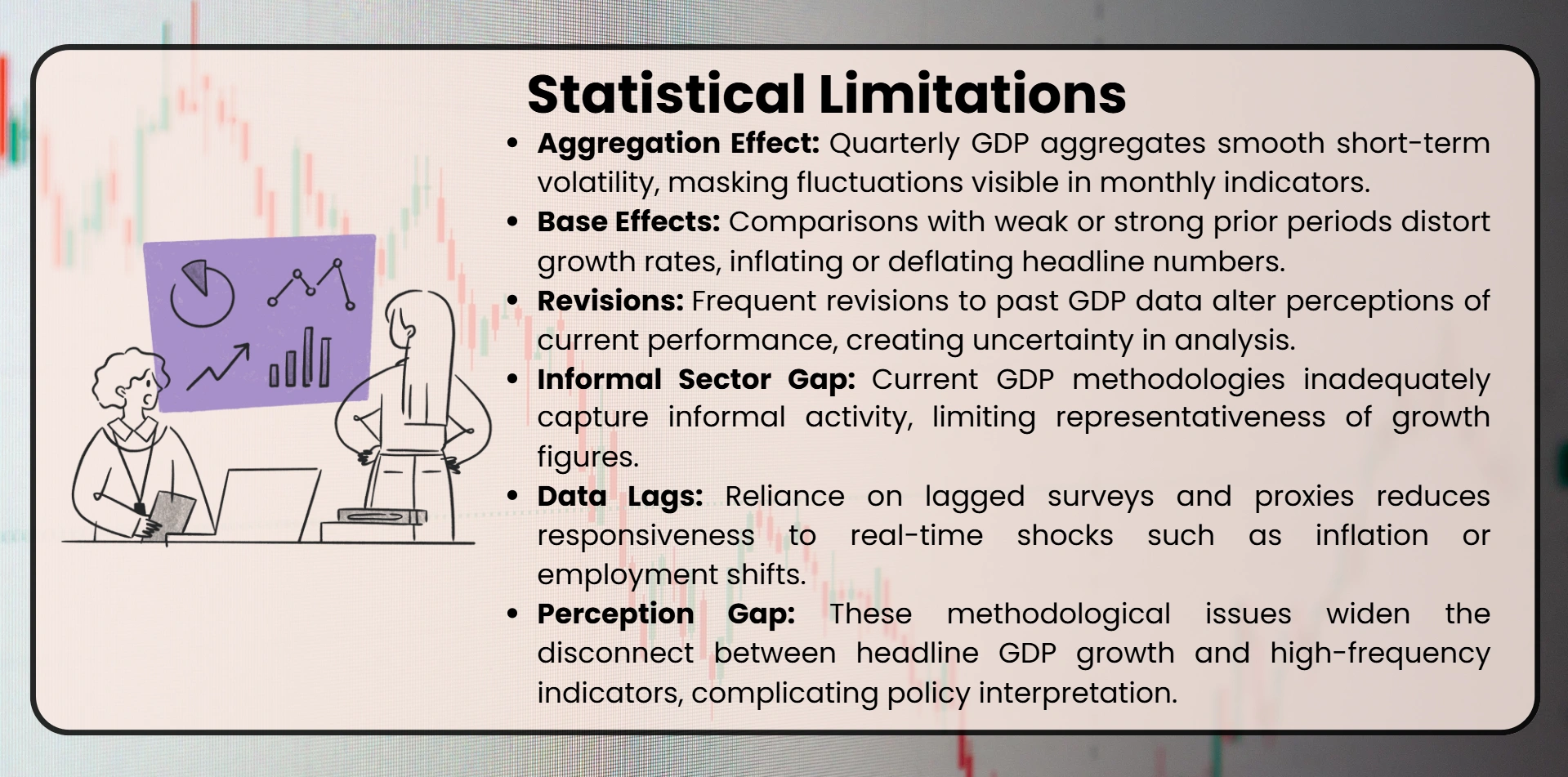
The GDP growth rate of 8.2 percent in India reported has brought about a lot of scholarly debate, not only on the soundness of the economy but also on the statistical and methodological basis of such estimates. Quarterly aggregation has the effect of smoothing the low-frequency variability, but revisions and distortions in the base effects can make the interpretation problematic, creating a dispersion to headline amounts and the reality measured by high-frequency data.
Aggregation Effects and Smoothing Effects
Aggregates of quarterly GDPs capture various outputs of the sectors and, as a result, obscure any short-term trends that are evident in monthly statistics. This type of statistical smoothing creates the impression of continuous growth, where volatility is observed in industrial production or consumption statistics. Though such aggregation is beneficial to long-term policy formation, it limits the ability to identify any imminent economic stress or momentum changes.
Base Effects and Revisions
GDP growth rates are highly base sensitive, so that a comparison between a past era of relatively poor or great performance distorts current estimates. For example, a base, which is low in the preceding year, can cause artificial growth numbers. Furthermore, the changes in historical data, which are common within the national accounting customs, redefine the image of the current performance, which often leads to the gap between the first estimate and subsequent revisions.
Informal Sector
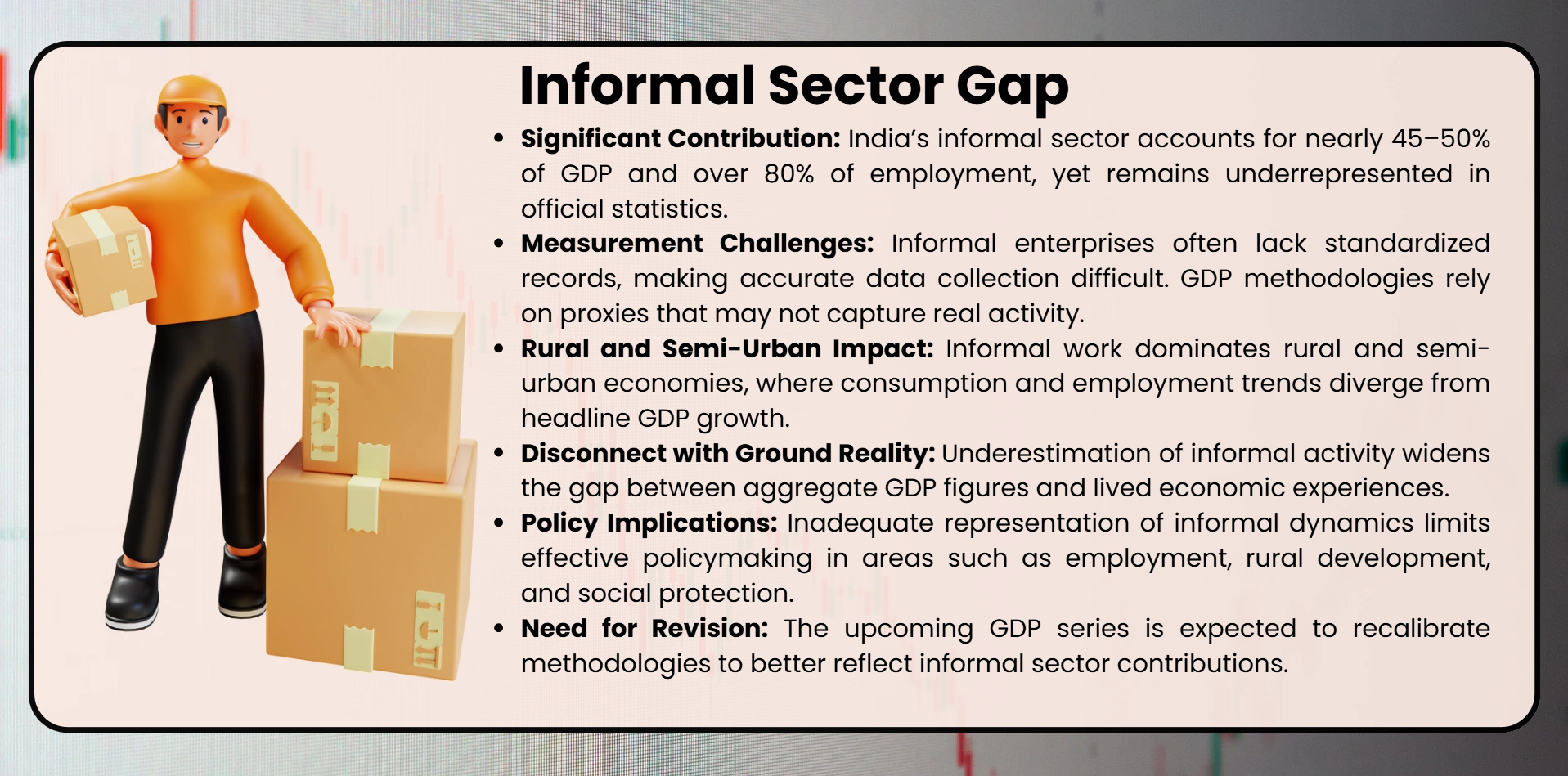
The informal sector has a significant impact on the economy of India; however, the existing GDP approaches have not been able to reflect the dynamics of the informal sector. Informal workers and small-scale businesses are more likely to be undercounted by official statistics, and economic activities in rural regions are often not included. This is a shortcoming of the method that partly accounts for the discrepancy between headline growth and ground-level sentiment, particularly in rural and semi-urban setups.
Data Lags and Reliability
Although the high-frequency indicators could provide more timely information, the GDP estimates rely on lagged and aggregate information. This reliance on proxies, surveys, and late reporting is uncertain and suggests that the GDP could fail to imply current shocks, e.g., inflationary spikes, labor reallocation, or sector-specific recessions. The effect of this lag is, in turn, to dampen the responsiveness of GDP as a pointer to the real-time costs of health of the economy.
New GDP Series: India's GDP Growth Mirage
The headline gross domestic product (GDP) growth of 8.2% in India has created wavering hopes, but in most cases, high-frequency measures tend to tell a different story. As a new revised series of GDP is soon going to be disclosed, the hope has been growing that those methodological adjustments will provide a bridge across the gap between aggregate and monthly data, and hence they will bring to the table more accurate data about the momentum of the economy. India's reported 8.2% GDP growth is questioned because high-frequency data (air traffic, GST, corporate sales, credit) shows slower growth, suggesting a disconnect where large corporate/financial gains aren't reaching the wider economy, possibly due to weak nominal income growth, low inflation, and statistical issues like outdated base years, creating a "mirage" of broad prosperity instead of shared growth.
Expected Methodological Revision
The future GDP series must incorporate updated sectoral weights, improved sources of data, and better estimation methods. The current approaches are more skewed towards informal activity and rural consumption, and create an imbalance between reported growth and lived realities. A reformulated analytic paradigm would prove to be a more suitable way of reflecting the structural changes enforced in the Indian economy, especially where services and digital industries are taking on an increasing central role.
High-Frequency Indicators
One expectation of the new series is a better fit with high-frequency indicators that include industrial output, employment surveys, and consumption statistics. These indicators provide finer details of short-term fluctuations that are often evened out by quarterly aggregates. The new series can potentially decrease the perception-reality gap between the Headline growth and ground-based sentiments by implementing more responsive methodologies.
Overcoming Dynamics of the Informal Sector
The informal sector in India has a central role in the number of people who are employed and its outputs, but it is not duly recognised in the existing GDP estimates. It is expected that the series that will be developed will include stronger proxies and survey data to capture informal activity. Such a change would help strengthen the validity of GDP data to make sure that both formal and informal sectors are represented in the growth stories of the national economy.
The Implications for Policy and the Market
An updated GDP series will have critical implications for policymakers, investors, and analysts. The greater correspondence to high-frequency indicators will make more effective targeting of policies, particularly in such spheres as rural development, job creation, and the regulation of inflation. In the case of financial markets, a better understanding of the performance of sectors would strengthen their faith in the growth trend of India and reduce their uncertainty in making investment decisions.
Conclusion
The headline gross domestic product (GDP) of India at 8.2 percent is a demonstration of macro-economic strength, but a gross deviation from high-frequency indicators highlights structural and methodological complexities. Aggregates on a quarterly basis regularly conceal the volatility of the short-run; and the dynamism of inflationary pressures, disproportionate recovery in the countryside, and the limits on the creation of employment damp down the optimism of headline data. The forthcoming GDP series creates a chance to tune back estimated procedures, incorporate the informal sector impacts, and gain high levels of congruence with the monthly series. These updates are essential to make growth narratives viable, undiscriminating, and indicative of lived realities, thus making policy-making processes and social trust in the future of the Indian economy unquestionable.