India has taken a huge step with the announcement of a world-first farm waste to bio-bitumen commercial production by Union Minister Nitin Gadkari, minimising both pollution and imports. During the ceremony at the Council of Scientific and Industrial Research (CSIR), he projected savings of about 4500 crore rupees, empowerment of the rural population, and how this project will work towards achieving the Viksit Bharat 2047 vision by establishing sustainable and self-reliant infrastructure.
|
Key highlights
- Bio-Bitumen
- Sustainable Infrastructure
- Blending farm waste
- First commercial production
- World leader in green technology
- Viksit Bharat 2047
|
What is Bio‑Bitumen ?
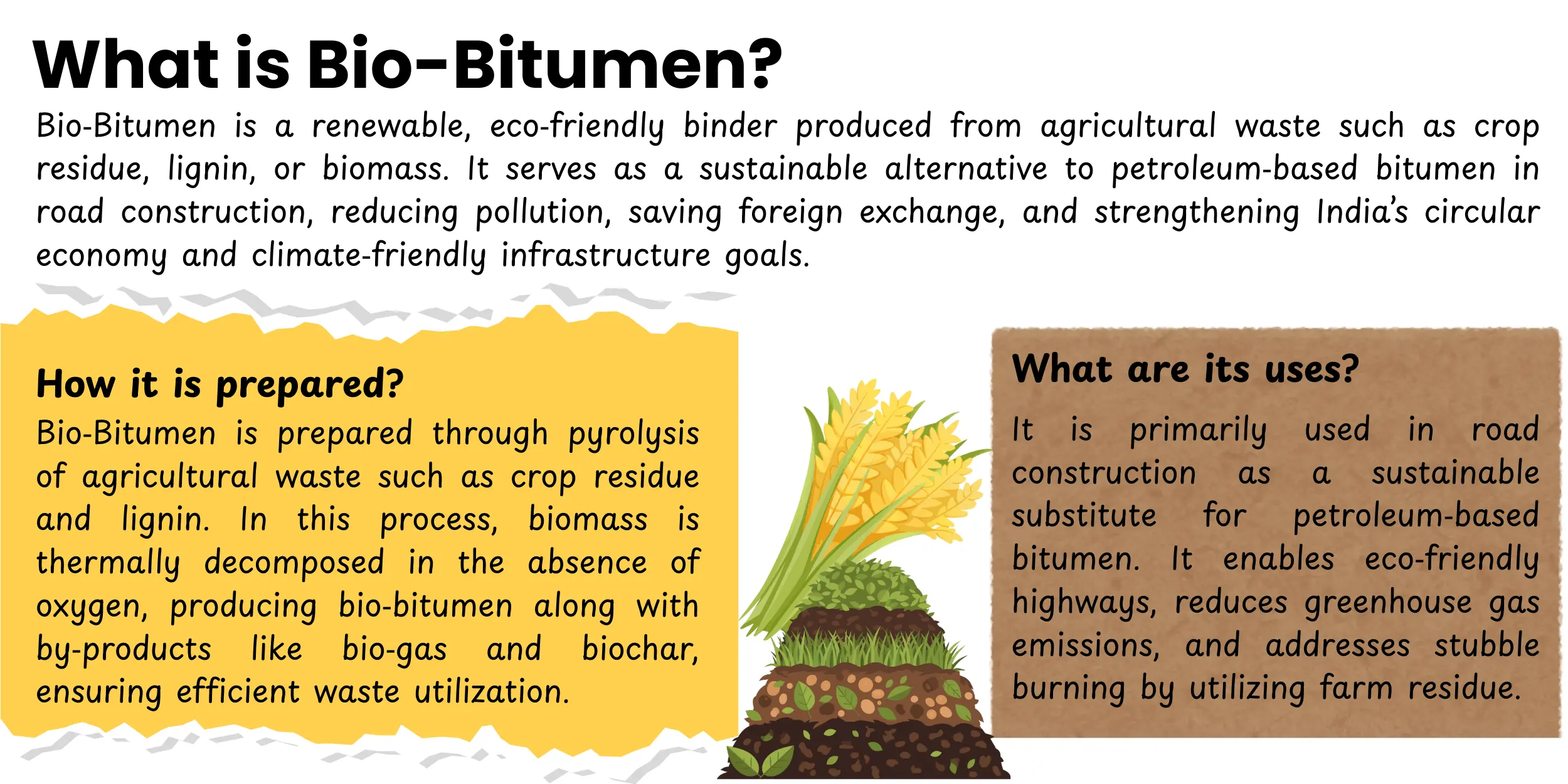
Bio-bitumen is a sustainable, petroleum-free binder for roads and roofing, made from renewable organic materials like vegetable oils, agricultural waste (crop stubble, lignin), or algae, serving as an eco-friendly alternative to traditional bitumen derived from crude oil, reducing pollution and dependence on fossil fuels while maintaining performance.: A Sustainable Revolution in Road Construction.Agricultural waste has been used to make Bio-Bitumen, which is a major milestone of sustainable infrastructure in India and has commercial production. Union Minister Nitin Gadkari highlights such innovation as an innovation in the form of a transition to the vision of Viksit Bharat 2047. Blending farm waste into a marketable national asset, Bio-Bitumen prevents environmental risks, reinforces road construction, and provides a representation of the circular economy principles. This breakthrough makes India a world leader in green technology, one that links governance, climate policy and developmental ambitions into one project.
Agricultural Waste as a Resource
By utilising agro-waste, bio-bitumen reduces pollution caused by crop burning and strengthens the circular economy. Agricultural waste is now seen as one of the strategic national resources that can help achieve sustainability, innovation, and economic growth. The potential of it in making Bio-Bitumen, which can transform crop waste into green infrastructure, has been highlighted by Union Minister Nitin Gadkari. This strategy will help solve environmental challenges to strengthen the Viksit Bharat 2047 vision of India.
Contribution to Circular Economy
Crop residue, which is usually burned, can be used to make Bio-Bitumen, and this will help decrease pollution and increase the effectiveness of resources. Agricultural waste, when viewed as a resource in a circular economy, moves from a linear "take-make-dispose" model to a regenerative system, contributing by generating bioenergy (biogas, syngas), creating value-added products (biofertilizers, bio-based materials), reducing pollution (less landfill, fewer GHG emissions), enhancing soil health, and fostering sustainable resource loops (water, nutrients, energy) through technologies like anaerobic digestion and gasification, ultimately creating economic value and reducing environmental impact
Environmental Impact
Bio-bitumen based on lignin can allow for reducing greenhouse gas emissions by as much as 70% compared to fossil-based bitumen. Agricultural waste, when managed poorly, causes air (methane, smoke), water (nutrient/pesticide runoff), and soil pollution, contributing to climate change and ecosystem harm, but transforming it into resources via methods like composting, anaerobic digestion, or bioenergy production.
Economic Value
The use of agricultural waste will provide jobs in rural places and reduce the reliance on imported petroleum products. Agricultural waste, often seen as a disposal problem, holds significant economic value as a resource for renewable energy (biofuels, biogas), bio-based products (bioplastics, enzymes), animal feed, and organic fertilizers, creating new income streams for farmers, reducing reliance on fossil fuels, lowering pollution, and fostering rural entrepreneurship in a circular bioeconomy
Global Leadership: The industry of commercial production is the first in India, making it the first country globally to introduce Bio-Bitumen.
Bio-Bitumen: An Innovative Idea
A pioneering technology of bio-bitumen is a first of its kind in India in the trend of sustainable infrastructure development, and the country was the first in the world to attain a commercial structure of this eco-friendly substance. It is made of agricultural waste and reduces the use of petroleum-based bitumen, and supports the Viksit Bharat 2047 vision. Union Minister Nitin Gadkari has brought to the limelight how it has transformed the way things are done in terms of reducing pollution, saving money on foreign exchange, and providing jobs to rural people.
- Eco-friendly manufacturing: Bio-Bitumen is made out of lignin and crop residue, which causes a great reduction in greenhouse gas emissions.
- Economic Impact: Government policy will allow as much as a 35% blend with petroleum bitumen that will save an estimated 10,000 crore rupees in foreign exchange each year.
- Energy Efficiency: 1 tonne of paddy straw produces 30-percent bio-bitumen, 350 kg biogas, and 350 kg biochar, thus proving multiple resource efficiency.
- Innovation and adoption: The introduction of green infrastructures through the adoption of sustainable road construction in India is an example of how to develop new infrastructures on a global scale.
Road Infrastructure and Viksit Bharat 2047 Vision
India aspires to become a Viksit Bharat 2047, the centenary of independence. The path to this future will be paved by a road network that connects citizens, markets, ideas, and opportunities. The Indian road infrastructure is an essential part of the Viksit Bharat 2047 vision, in which the concepts of sustainable development and technological advancement are combined to create a modern and resilient state. This is where the use of Bio-bitumen, a product of agricultural waste, can be viewed as a revolution in this direction. Nitin Gadkari is a Union Minister who has highlighted the fact that green roads not only curb carbon emissions but also act as symbolic indicators of India being a country of sustainable development.
Sustainable Roads
The launch of the first national highway in India using Bio-, Bitumen is a testament to the fact that the emission of greenhouse gases by this product is 70% less than the emission of the same gases using conventional fossil bitumen.India's Viksit Bharat 2047 vision for "Sustainable Roads" focuses on massive highway expansion (to ~2.37 lakh km), increased access-controlled expressways (to ~2 lakh km), multimodal connectivity, logistics efficiency, enhanced safety (95% accident reduction goal), and technological integration (AI, IoT) using eco-friendly materials (like recycled concrete) to drive economic growth, reduce logistics costs, and achieve a developed nation status by 2047
Economic Efficiency
The bio-bitumen blend with petroleum bitumen reduces the reliance on imports; hence, this savesvaluable foreign exchange.For Viksit Bharat 2047, road infrastructure is a cornerstone of economic efficiency. It acts as a powerful driver of growth by lowering logistics costs, improving industrial connectivityespecially in regions like eastern Indiastimulating urban development, generating employment, and strengthening self-reliance through smoother freight movement. With modern amenities such as EV charging, robust road networks enhance productivity, boost global competitiveness, and support India’s journey toward becoming a prosperous and developed nation.
Vision Alignment
Green highways Summarize Viksit Bharat 2047 goal of self-reliance, innovation, and environmental responsibility.Aligning road infrastructure with India’s Viksit Bharat 2047 vision means developing world-class, intelligent, and sustainable transport networks—such as access-controlled highways—to drive economic growth, cut logistics costs, improve road safety, and strengthen connectivity. This large-scale expansion and modernization of road infrastructure is vital to India’s ambition of becoming a developed nation by 2047.
Global Pacesetter
The innovative adoption of India places it at a universal forefront on the sustainable infrastructure, which sets standards in other countries.While no single country or entity is universally crowned the "Global Pace setter" in agricultural waste utilization, several nations and organizations are leading the charge by developing innovative and scalable solutions. The transition to a green economy, which emphasizes the optimal use of bioresources, is a key focus globally.
Global Leadership and Future Prospects
The commercial production of the Bio-Bitumen in India is a move that carries an end of the road achievement in terms of sustainable infrastructure across the globe and hence making the nation a leader in terms of eco-innovation. By transforming agricultural waste into a high-value resource, India demonstrates a step toward climate-friendly technology and sets an example for other states. This project not only strengthens the road networks in domestic zones but also opens potential projects of international cooperation, along with export.
- Global First: India is the only country that has managed to produce commercial Bio-Bitumen thus it has become a technological pioneer.
- Export Potential: India has the potential to become a supplier of Bio-Bitumen, given the growing demand for green construction material across the world.
- Economic growth: The use of Bio-Bitumen will have the potential of saving about 10,000 crore Indian rupees worth of foreign exchange in any given year, and in the process, providing rural jobs.
- Future Prospects: Incorporation in the global climate strategies enhances the contribution of India toward the realization of net -zero targets and supports the growth of Viksit Bharat 2047.
Conclusion
The introduction of BioBitumen is one of the most significant moves towards the architecture of sustainable infrastructure in India and the Viksit-Bharat 2047 vision. This innovation can address the environmental condition and reduce the reliance on fossil energy, as well as promote economic stability and sustainability by repurposing agricultural waste to produce a valuable national resource. The fact that India is the first country to commercialize Bio-Bitumen is a plus factor as it is determined to uphold climate-friendly technology and the idea of the circular economy. In addition to the domestic gains, the initiative also creates a global standard and therefore allows opportunities for global cooperation and export prospects. As a result, the Bio-Bitumen is a demonstration of how innovation can be used to align sustainability and national development.
Frequently asked questionsFrequently asked questions
What is Bio‑Bitumen ?
Bio-bitumen is a sustainable, petroleum-free binder for roads and roofing, made from renewable organic materials like vegetable oils, agricultural waste (crop stubble, lignin), or algae, serving as an eco-friendly alternative to traditional bitumen derived from crude oil, reducing pollution and dependence on fossil fuels while maintaining performance.: A Sustainable Revolution in Road Construction.Agricultural waste has been used to make Bio-Bitumen, which is a major milestone of sustainable infrastructure in India and has commercial production. Union Minister Nitin Gadkari highlights such innovation as an innovation in the form of a transition to the vision of Viksit Bharat 2047. Blending farm waste into a marketable national asset, Bio-Bitumen prevents environmental risks, reinforces road construction, and provides a representation of the circular economy principles. This breakthrough makes India a world leader in green technology, one that links governance, climate policy and developmental ambitions into one project.
Agricultural Waste as a Resource?
By utilising agro-waste, bio-bitumen reduces pollution caused by crop burning and strengthens the circular economy. Agricultural waste is now seen as one of the strategic national resources that can help achieve sustainability, innovation, and economic growth. The potential of it in making Bio-Bitumen, which can transform crop waste into green infrastructure, has been highlighted by Union Minister Nitin Gadkari. This strategy will help solve environmental challenges to strengthen the Viksit Bharat 2047 vision of India.
Road Infrastructure and Viksit Bharat 2047 Vision?
India aspires to become a Viksit Bharat 2047, the centenary of independence. The path to this future will be paved by a road network that connects citizens, markets, ideas, and opportunities. The Indian road infrastructure is an essential part of the Viksit Bharat 2047 vision, in which the concepts of sustainable development and technological advancement are combined to create a modern and resilient state. This is where the use of Bio-bitumen, a product of agricultural waste, can be viewed as a revolution in this direction. Nitin Gadkari is a Union Minister who has highlighted the fact that green roads not only curb carbon emissions but also act as symbolic indicators of India being a country of sustainable development.
Global Leadership and Future Prospects?
The commercial production of the Bio-Bitumen in India is a move that carries an end of the road achievement in terms of sustainable infrastructure across the globe and hence making the nation a leader in terms of eco-innovation. By transforming agricultural waste into a high-value resource, India demonstrates a step toward climate-friendly technology and sets an example for other states. This project not only strengthens the road networks in domestic zones but also opens potential projects of international cooperation, along with export.