The Border Roads Organisation recently made news because of its contribution to the nation with the completion of 356 strategic infrastructure projects in the years 2024 and 2025.The government has increased allocations from INR 6,500 crores approved in the Union Budget 2024-25 to 7,146 crores rupees in union budget 2025-26.
|
Key highlights
- Border Roads Organisation
- Evolution of BRO
- Infrastructure Built by BRO
- BRO in Disaster Response
- Regional Connectivity Milestones
- BRO’s future Projects
|
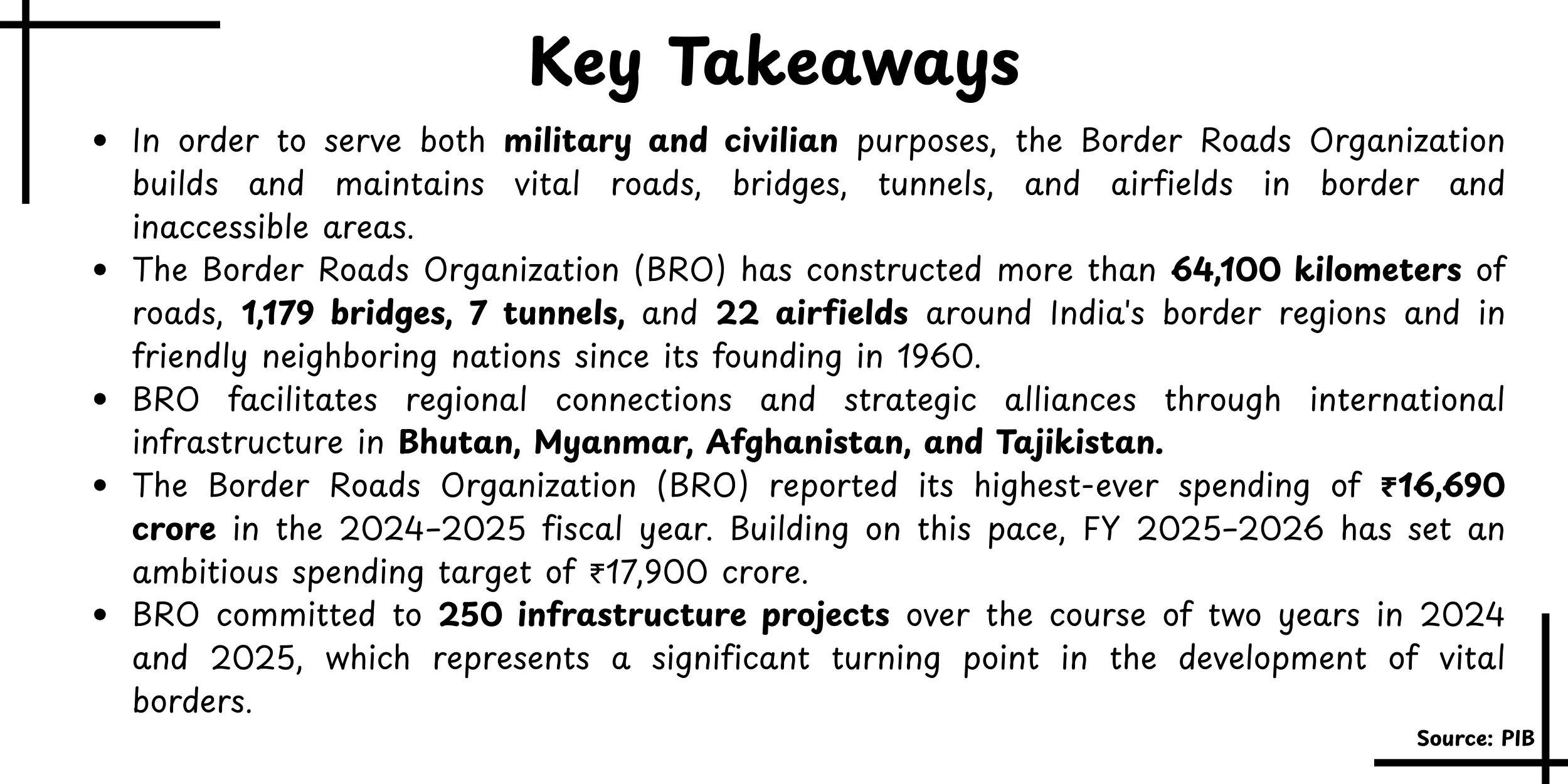
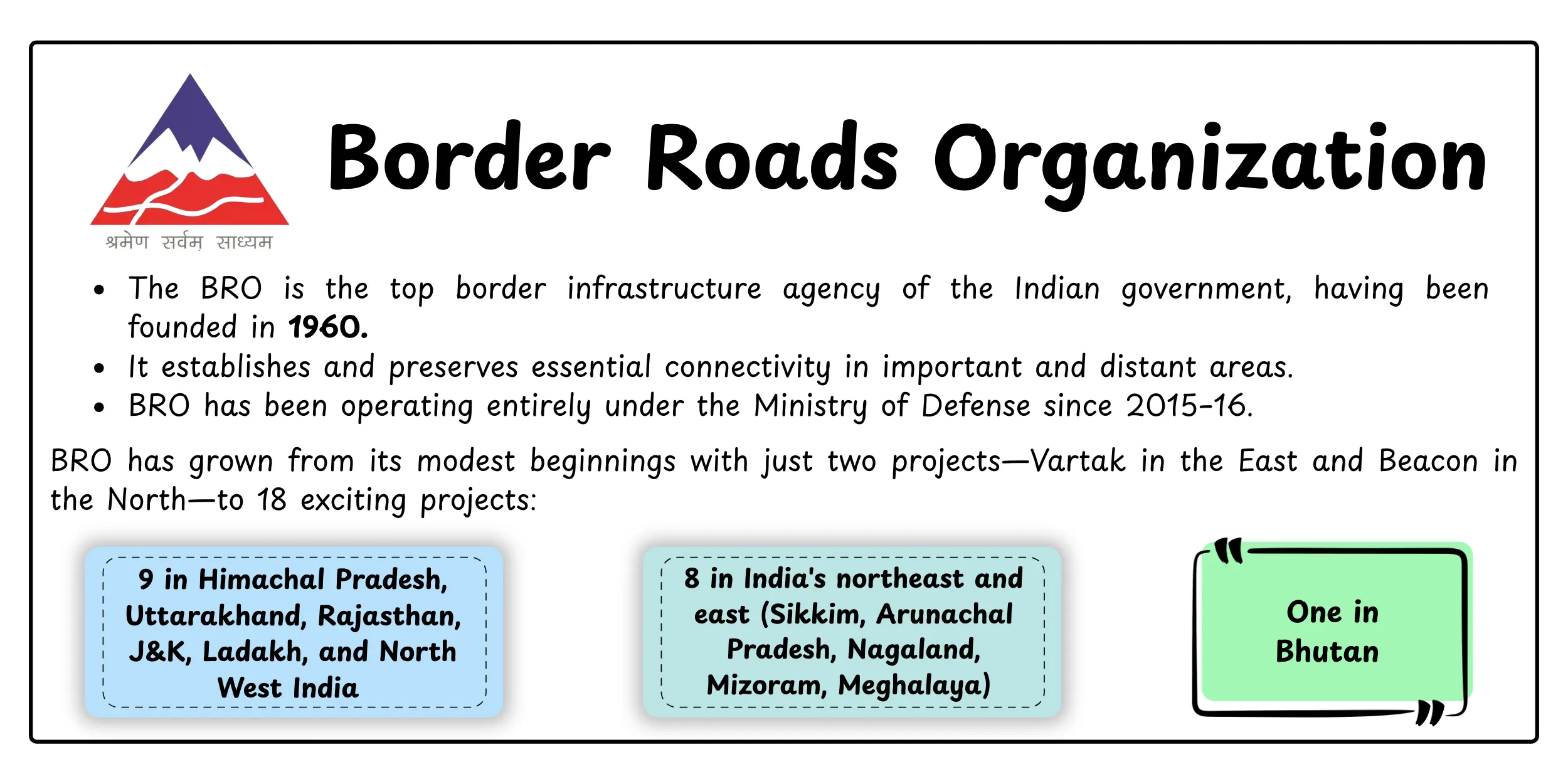
Border Roads Organisation (BRO) is a strategic and developmental institution in India, which was founded in 1960. It functions under the Ministry of Defence, and it builds and maintains vital infrastructure in remote areas and border areas, enhancing national security and the socio-economic integration process. Being successful in almost 64,100 kilometres of roads, 1,179 bridges, 22 airfields, and various high-altitude tunnels, the BRO demonstrates resilience and creativity in the most difficult environments in the world. Its purpose does not solely lie in defence preparedness; however, it is also in defence response and connectivity, which makes it the foundation of developing frontiers and diplomacy of India.
The Border Roads Organisation (BRO) is India's premier agency, under the Ministry of Defence, building strategic roads, tunnels, bridges, and airfields in challenging border terrains, vital for national security, military logistics, and socio-economic development of remote regions, significantly enhancing India's sovereignty and connectivity in harsh conditions like the Himalayas and Northeast, through projects like the Atal Tunnel and recent massive project launches.
Evolution of Border Roads Organisation (BRO)
The Border Roads Organisation (BRO) is one of the oldest institutions within India that started as a small organisation but evolved to become one of the pillars of national security and development. The direction it takes represents necessity in strategy and nation-building.
Foundation and Early Years of BRO
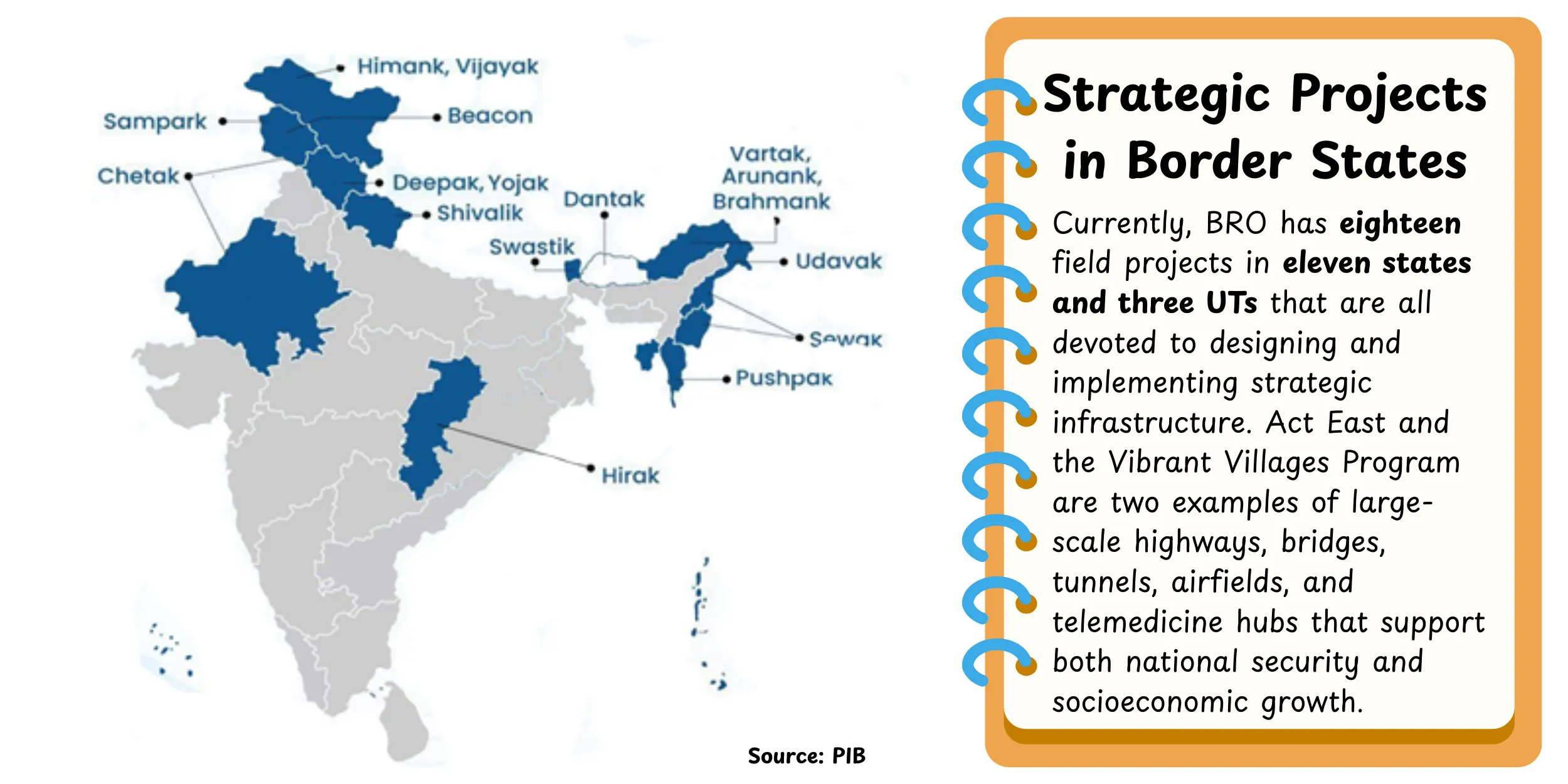
The BRO was inaugurated on 7 May 1960 in two projects, namely Vartak in Arunachal and Beacon in Jammu & Kashmir, to ensure quality connectivity in the frontier areas. Its purpose statement, namely, “Shramena Sarvam Sadhyam” (by hard work, everything is possible), sounded out its mission.
Growth and Organisational Development of BRO
In the 1970s and 1980s, the BRO expanded its activities in the Himalayan states and began Project Dantak in Bhutan (1961), actually symbolising that India was a partner in this region. Its organisation was gradually reorganised to combine the General Reserve Engineer Force (GREF) and Army engineers to combine civilian skills and military accuracy.
Modern Consolidation of BRO
The BRO has been operating as part of the Ministry of Defence since 2015-16, and it manages 18 projects in 3 Union Territories and 11 states. It has built 64,100 km of roads, 1,179 bridges, 22 airfields and 7 tunnels according to the data of PIB.
Strategic Infrastructure built by BRO
The Border Roads Organisation (BRO) has become one of the key institutions in the development of India's frontiers with a combination of engineering novelty and strategic future. Its infrastructure portfolio includes roads, bridges, tunnels, and airfields, all of which have both defence and civilian requirements.
Roads built by BRO
(Lifelines of Defence and Development)
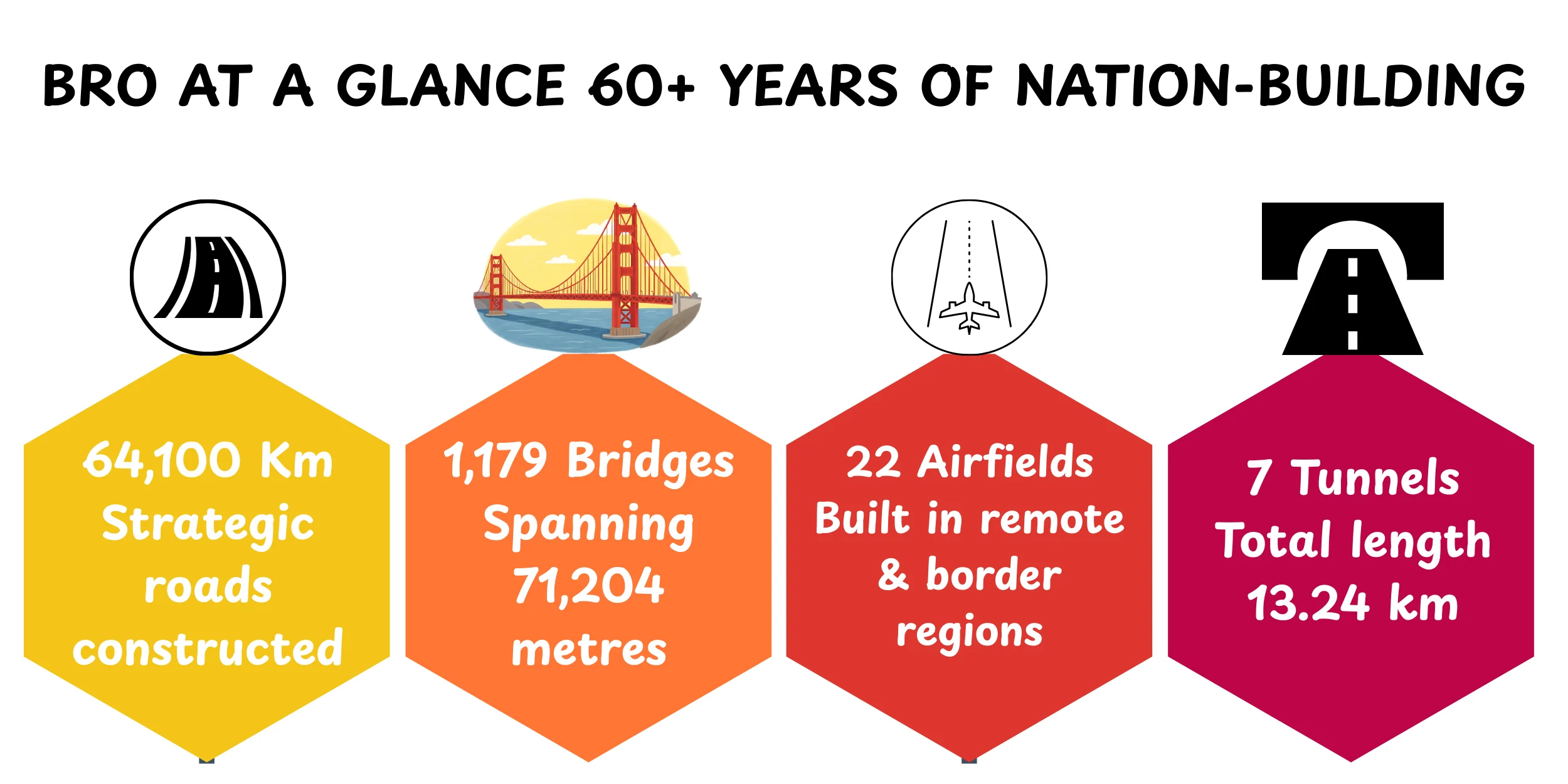
In addition to the border regions of India, BRO has built over 64,100 km of strategic roads. A total of some 4595km of road was constructed during FY 2020-21 and 2024-25 with an allocation of 23,625crore. Examples of all-weather connectivity include the Darbuk-Shyok-DBO Road in Ladakh and the National Highway310A (NH310A) in Sikkim, which support the short-term movement of troops and improve the movement of the civilian population to the remote areas.
Bridges built by BRO
(Enhancing Interconnection in Highland Landscape)
BRO has installed 1,179 bridges with a total cumulative length of 71,204 metres. Special examples are the Siyom and Sisseri Bridges in Arunachal Pradesh that enhance logistics along the Line of Actual Control (LAC). In Ladakh, over 80 bridges have now been built under the Project Vijayak, with the Zoji pass reopened in April 2025, when it was closed in March for 32 days. These facilities are essential in supporting hard-core military transportation and local trade.
Tunnels built by BRO
(Engineering Wonder of all-weather access)
The tunnel projects of BRO represent innovations in engineering at high altitudes. The longest road tunnel in the world is cut through the Rohtang Pass (Atal Tunnel 9.02 km, 2020), and it provides continuous connectivity to the frontiers above 10,000 ft, as well as the Sela Tunnel (at 13,000 ft above sea level) and Nechiphu Tunnel (500 m long) in Arunachal Pradesh. The DS-DBO Road connects with the extreme terrain of Ladakh through the Shyok Tunnel (920 metres long) that ensures all-year-round connectivity and improved operational preparedness.
Airfields built by BRO
(Increased StrategyReach)
BRO has rebuilt 22 airfields, such as Bagdogra and Barrackpore in West Bengal (2023). The Mudh-Nyoma Airbase, which has been revamped with a 2.7km runway at an elevation of 13,700 feet, is among the highest in the whole world, thus facilitating the sustained military operations along the LAC.
BRO in Disaster Response
The Border Roads Organisation (BRO) is a dual-purpose organisation that promotes civil resilience and strengthens the security of the country. Its disaster-response capability highlights engineering capacity, which is consistent with humanitarian aid and quick rehabilitation of lifelines.
Road management by BRO
Zoji, Rohtang and Sela passes are examples of some of the passesBRO works on when they are frequently closed because of snow. These passages are difficult to reopen in winters and it takes a long time to reopen. For example,Zoji La was finally opened 68 days after closure in March 2023, and it was the fastest time to have been recorded.
Emergency Connectivity by BRO
To open up roads damaged by a flood or landslide, BRO has been working with Class70-Bailey bridge and modular spans. A 200-foot Bailey bridge was rebuilt in 26 days in the 2021 Rishiganga floods, which reconnected Reini village in Uttarakhand.
Air Logistics support by BRO
BRO enables the Indian Air Force to transport relief and evacuate civilian victims by means of repairing airstrips and helipads. Coordination with the Army, National Disaster Response Force (NDRF), and state agencies can be used to ensure the use of a holistic approach to disaster management across the vulnerable areas.
BRO’s Regional Connectivity Millstones
Border Roads Organisation (BRO) has not only crossed the boundaries of India but has also influenced the connectivity of the region by ensuring that the destination of their infrastructure projects is situated in the neighbouring countries to strengthen the ties among the countries.
Bhutan: Project DANTAK of BRO
Project DANTAK was the first overseas project initiated by BRO in 1961. The project has developed highways, bridges and airports such as the Paro and Yonphula that came straight to the socioeconomic growth of Bhutan and also represented the long-term friendship between India and Bhutan.
BRO in Myanmar: India-Myanmar Friendship Road
In 2001, BRO built a Friendship Road (160 km) that connects Moreh (India) with Tamu and Kalewa (Myanmar). This corridor has also optimized cross-border flow and regional collaboration in India by promoting integration through its Act East Policy.
BRO in Afghanistan and Tajikistan
BRO designed a 218-kilometre Delaram -Zaranj Road, giving Afghanistan entry into the Iranian Chabahar Port. BRO in Tajikistan also reconstructedFarkhor and Ayni air bases, which strengthenedthe strategic reach of India in Central Asia.
BRO’s Future Projects
The Border Roads Organisation (BRO) is striving to expand its vision in line with its aim to synchronize the infrastructure development with the national security needs, regional integration, and socioeconomic change in the frontier regions. Its future prognosis is based on ambitious planning and strategic vision.
- As part of its long-term perspective plan, BRO will build 470 roads with a length of about 27,300 kilometres along the border territories.
- The Trans-Kashmir Connectivity Project (717 km), which is to be in line with the NHDL standardization.
- The next generation projects include tunnels at Sadhna Pass, P Gali, Z Gali and Razdhan Pass, which would guarantee connectivity in the major mountain passages.
- These programs are intended to alleviate resistance toward isolation during the seasons and enhance troops' mobility in the high-altitude setting.
- The future projects by BRO will strengthen sovereignty, speed up local development in the region and strategies India in an integrated way.
Conclusion
For more than six decades, integrating engineering and nation-building in the frontiers of the countryhas been done bythe Border Roads Organisation (BRO). Its infrastructure successes, which include roads, bridges, tunnels, and airfields, have enhanced defence preparedness and also created socioeconomic integration. The other important thing is that BRO has provided a bridge to the response to the disaster, as well as connected the region and made India develop beyond the national boundaries. As BRO continues to enhance its future plans, it will continue to be a central hub that ensures mobility, resilience and sovereignty, and consolidate Indian security infrastructure and shape of development in hostile environments.