UPSC Current Affairs
Jal Jeevan Mission (JJM): Scheme, Funding and Key Objectives
Jal Jeevan Mission (JJM): Scheme, Funding, ObjectiveJal Jeevan Mission (JJM) also known as Har Ghar Jal is a most important initiative of the Government of India. Jal Jeevan Mission launched on 15 August 2019, with the objective of providing safe and suitable drinking water to every rural household across the country.CONTEXT:Ministry of Jal Shakti is taking up nationwide campaign “Jal Shakti Abhiyan - Catch the Rain”… This Bill must be seen as part of government’s efforts to privatize banks and disinvestment of Public Sector Units.More foreign investment will make the self-reliant programme weak.
VRAuthor Desk
8 min read
Jal Jeevan Mission (JJM): Scheme, Funding, ObjectiveJal Jeevan Mission (JJM) also known as Har Ghar Jal is a most important initiative of the Government of India. Jal Jeevan Mission launched on 15 August 2019, with the objective of providing safe and suitable drinking water to every rural household across the country.CONTEXT:Ministry of Jal Shakti is taking up nationwide campaign “Jal Shakti Abhiyan - Catch the Rain”… This Bill must be seen as part of government’s efforts to privatize banks and disinvestment of Public Sector Units.More foreign investment will make the self-reliant programme weak.
Jal Jeevan Mission (JJM): Scheme, Funding, Objective
Jal Jeevan Mission (JJM) also known as Har Ghar Jal is a most important initiative of the Government of India. Jal Jeevan Mission launched on 15 August 2019, with the objective of providing safe and suitable drinking water to every rural household across the country.
CONTEXT:
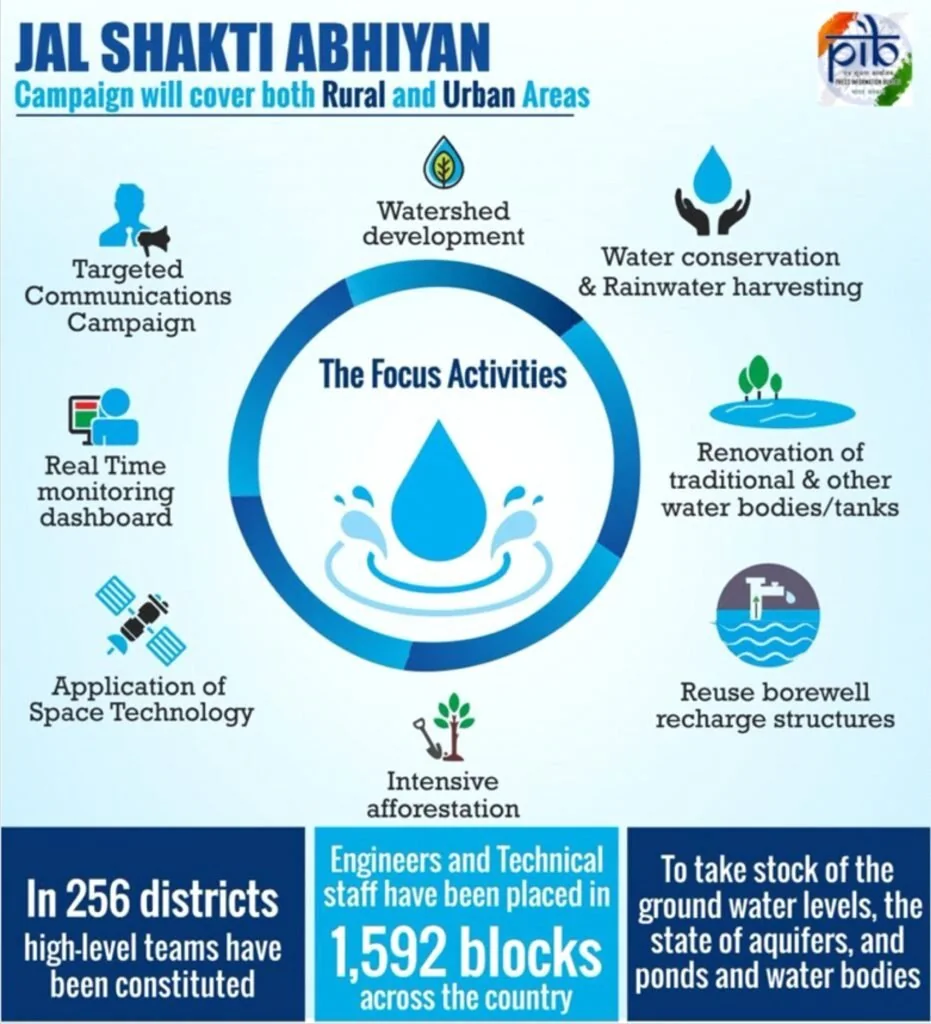
- Ministry of Jal Shakti is taking up nationwide campaign “Jal Shakti Abhiyan - Catch the Rain” focusing on saving and conserving rainwater with the theme “Catch the rain, where it falls, when it falls” from 22 March 2021 to 30 November 2021, in the pre-monsoon and monsoon periods of 2021, covering both urban and rural areas of all the districts in the country.
ABOUT:
- Government of India, in partnership with States, is implementing Jal Jeevan Mission – Har Ghar Jal which aims at providing potable water to every rural household through tap water by 2024 with an estimated outlay of Rs.3.60 lakh crore.
- At the time of announcement of Jal Jeevan Mission on 15th August, 2019, out of 18.93 crore rural households, 3.23 crore rural households were reported to have tap water supply.
- Since then, 3.87 crore rural households have been provided tap water connections.
WATER CRISIS:
- The challenge of the water crisis is increasing equally with India’s development.
- Water is more precious than money but there has been a lack in preserving water resources.
WAY AHEAD:
- Water security and water management is crucial for the future of coming generations.
- India’s development and self-reliance is dependent on water security and water connectivity.
- The government has made water governance a priority in its policies and decisions like Pradhan Mantri Krishi Sinchai Yojna, water campaign to every farm - Har Khet ko Paani, 'Per Drop More Crop' campaign and Namami Gange Mission, Jal Jeevan Mission and Atal Bhujal Yojana.
- Sugarcane can grow through drip irrigation and sprinkles
Insurance Amendment Bill, 2021
CONTEXT:
- Parliament has passed the Insurance (Amendment) Bill, 2021.
ABOUT:
- The Bill seeks to amend the Insurance Act, 1938 which will increase the ceiling limit of foreign investment allowed in Indian insurance companies.
- The Bill provides to increase the foreign direct investment limit from existing 49 percent to 74 percent.
- It also has a provision for removal of restrictions on ownership and control of insurance companies.
- The insurance sector requires a huge and long term investment as it is a capital intensive sector.
- This Bill will also safeguard the interest of 24 lakh employees engaged in the private insurance sector in addition to 17 lakh working in public sector insurance companies.
OPPOSITE VIEWS:
- It is against the interest of small insurance holders.
- Further opening up of certain sectors like insurance will have adverse effects for common people.
- This Bill must be seen as part of government’s efforts to privatize banks and disinvestment of Public Sector Units.
- More foreign investment will make the self-reliant programme weak. Foreign companies will take the money out which will hamper the interest of policy holders.
- More weightage must be given to the Indian companies rather than foreign companies.
National Highways
CONTEXT:
- The Ministry of Road Transport & Highways (MoRTH) has achieved another milestone by constructing 12,205.25 km of National Highways in the current financial year 2020-21 (till 22nd March, 2021), i.e., with construction of 34 kilometres per day.
ABOUT:
- This is almost three times of the rate of construction of highways of about 12 km per day in 2014-15.
- This is also 1,205 km more than the target (11,000 km) fixed for the current fiscal.
- This achievement is significant as the first few months of the current financial year were lost due to nation-wide lockdown in the wake of COVID-19 pandemic. Construction activities were badly affected during the period.
- On 01st March 2021, Union Road Transport & Highways Minister had announced achieving the target of constructing 11,000 km of National Highways, one month ahead of schedule.
- The Ministry, in the last few years, has taken several initiatives to increase the pace of highway construction in the country.
Implementation of MSP
CONTEXT:
- TRIFED and Government of Arunachal Pradesh have entered into a Memorandum of Understanding (MoU) on March 19, 2021 for the implementation of the MSP for MFP Scheme and the Van Dhan Yojana in the state of Arunachal Pradesh.
ABOUT:
- As a part of its mission to improve the livelihoods of the tribals (both forest dwellers and artisans) and work towards tribal empowerment, TRIFED has been carrying out several programmes and initiatives.
- The Rural Development Department in State of Arunachal Pradesh will be the nodal agency for the implementation of this scheme while Arunachal Pradesh State Rural Livelihood Mission (ArSRLM) will be the State Implementation Agency.
- Under this agreement, 100 Van Dhan Vikas Kendras are planned to be set-up in the state this year.
- Conceptualized and implemented by TRIFED in association with State Government Agencies across 21 states of the country, the ‘Mechanism for Marketing of Minor Forest Produce (MFP) through Minimum Support Price (MSP) & Development of Value Chain for MFP’ is a flagship scheme of the Ministry of Tribal Affairs, drawing its strength from The Forest Rights Act of 2005, it aims to provide remunerative and fair prices to tribal gatherers of forest produces, almost three times higher than would be available to them from middle men, trebling their incomes.
- The Van Dhan Yojana (VDY), a programme for value addition, branding & marketing of MFPs by establishing Van Dhan Kendras to facilitate creation of sustainable livelihoods for the forest-based tribes is a component of the same scheme.
Ken-Betwa Link Project
CONTEXT:
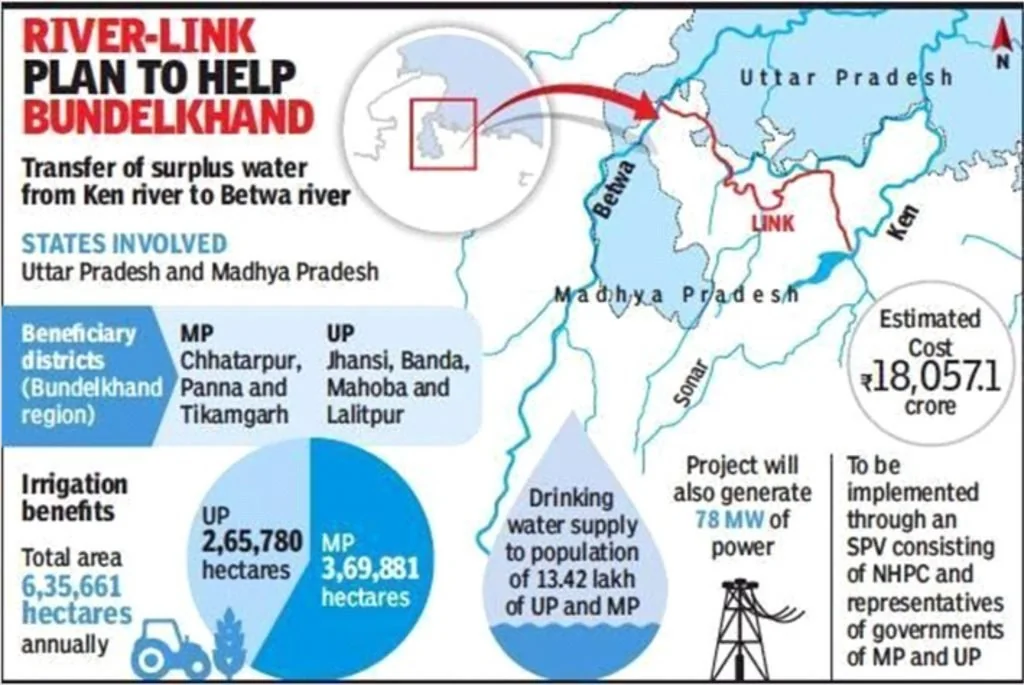
- On the occasion of World Water Day, a memorandum of agreement was signed between Union Minister of Jal Shakti and the chief ministers of Madhya Pradesh and Uttar Pradesh to implement the Ken-Betwa Link Project (KBLP).
What is the Ken Betwa Link Project?
- The Ken-Betwa Link Project is the first project under the National Perspective Plan for interlinking of rivers.
- Under this project, water from the Ken river will be transferred to the Betwa river. Both these rivers are tributaries of river Yamuna.
Two phases of Project:
- Under Phase-I, one of the components — Daudhan dam complex and its appurtenances like Low Level Tunnel, High Level Tunnel, Ken-Betwa link canal and Power houses — will be completed.
- While in the Phase-II, three components — Lower Orr dam, Bina complex project and Kotha barrage — will be constructed.
- According to the Union Jal Shakti Ministry, the project is expected to provide annual irrigation of 10.62 lakh hectares, drinking water supply to about 62 lakh people and also generate 103 MW of hydropower.
What is the estimated cost of the KBLP?
- According to the Comprehensive Detailed Project Report, the cost of Ken-Betwa Link Project is estimated at Rs 35,111.24 crore at 2017-18 prices.
Which region will get the benefits of the KBLP?
- The Ken-Betwa Link Project lies in Bundelkhand, a drought-prone region, which spreads across 13 districts of Uttar Pradesh and Madhya Pradesh.
- According to the Jal Shakti Ministry, the project will be of immense benefit to the water-starved region of Bundelkhand, especially in the districts of Panna, Tikamgarh, Chhatarpur, Sagar, Damoh, Datia, Vidisha, Shivpuri and Raisen of Madhya Pradesh and Banda, Mahoba, Jhansi and Lalitpur of Uttar Pradesh.
- It will pave the way for more interlinking of river projects to ensure that scarcity of water does not become an inhibitor for development in the country.
Will the project affect the Panna tiger reserve?
- Out of the 6,017 ha of forest area coming under submergence of Daudhan dam of Ken Betwa Link Project, 4,206 ha of area lies within the core tiger habitat of Panna Tiger Reserve.
Are there previous examples of river-linking in India?
- In the past, several river linking projects have been taken up. For instance, under the Periyar Project, transfer of water from Periyar basin to Vaigai basin was envisaged.
- It was commissioned in 1895. Similarly, other projects such as Parambikulam Aliyar, Kurnool Cudappah Canal, Telugu Ganga Project, and Ravi-Beas-Sutlej were undertaken.
Recent developments on interlinking of rivers in India
- In the 1970s, the idea of transferring surplus water from a river to water-deficit area was mooted by the then Union Irrigation Minister (earlier the Jal Shakti Ministry was known as Ministry of Irrigation).
- He suggested construction of a National Water Grid for transferring water from water-rich areas to water-deficit areas.
- Similarly, Captain Dinshaw J Dastur proposed the Garland Canal to redistribute water from one area to another.
- However, the government did not pursue these two ideas further. It was in August, 1980 that the Ministry of Irrigation prepared a National Perspective Plan (NNP) for water resources development envisaging inter basin water transfer in the country.
- The NPP comprised two components: (i) Himalayan Rivers Development; and (ii) Peninsular Rivers Development.
- Based on the NPP, the National Water Development Agency (NWDA) identified 30 river links—16 under Peninsular component and 14 under Himalayan Component.
- Later, the river linking idea was revived under the then Atal Bihari Vajpayee Government. Ken Betwa Link Project is one of the 16 river linking projects under the Peninsular component.
Which are the clearances required for a river-linking project?
- Generally, 4-5 types of clearances are required for the interlinking of river projects. These are: Techno-economic (given by the Central Water Commission); Forest Clearance and Environmental clearance (Ministry of Environment & Forests); Resettlement and Rehabilitation (R&R) Plan of Tribal Population (Ministry of Tribal Affairs) and Wildlife clearance (Central Empowered Committee).
- Prelims: Key facts, institutions, locations and terminology in the article.
- Mains: Connect the topic with Environment, Economy, International Relations.
- Revision: Use the article headings to prepare concise notes and answer-writing points.
Test your understanding
Questions from this article
Prelims practiceWith reference to Jal Jeevan Mission (JJM): Scheme, Funding and Key Objectives, consider the following statements:
- Ministry of Jal Shakti is taking up nationwide campaign “Jal Shakti Abhiyan - Catch the Rain” focusing on saving and conserving rainwater with the theme “Catch the rain, where it falls, when it falls” from 22 March 2021…
- Government of India, in partnership with States, is implementing Jal Jeevan Mission – Har Ghar Jal which aims at providing potable water to every rural household through tap water by 2024 with an estimated outlay of…
- At the time of announcement of Jal Jeevan Mission on 15th August, 2019, out of 18.93 crore rural households, 3.23 crore rural households were reported to have tap water supply.
Which of the statements given above are correct?
- 1 and 2 only
- 2 and 3 only
- 1 and 3 only
- 1, 2 and 3
View answer
Answer: (d) 1, 2 and 3. All three statements are drawn from the article.
Mains practiceDiscuss the background, key issues and significance of Jal Jeevan Mission (JJM): Scheme, Funding and Key Objectives for India.
Answer in 250 words.
View answer approach
- Background and context
- Key facts and institutional framework
- Significance and way forward
Frequently asked questionsFrequently asked questions
Why is Jal Jeevan Mission (Jjm): Scheme, Funding And Key Objectives in the news?
Jal Jeevan Mission (JJM): Scheme, Funding, ObjectiveJal Jeevan Mission (JJM) also known as Har Ghar Jal is a most important initiative of the Government of India. Jal Jeevan Mission launched on 15 August 2019, with the objective of providing safe and suitable drinking water to every rural household across the country.CONTEXT:Ministry of Jal Shakti is taking up nationwide campaign “Jal Shakti Abhiyan - Catch the Rain”…
What are the key facts about Jal Jeevan Mission (Jjm): Scheme, Funding And Key Objectives?
This Bill must be seen as part of government’s efforts to privatize banks and disinvestment of Public Sector Units.More foreign investment will make the self-reliant programme weak. Foreign companies will take the money out which will hamper the interest of policy holders.More weightage must be given to the Indian companies rather than foreign companies. National HighwaysCONTEXT:The Ministry of Road Transport & Highways (MoRTH) has achieved another milestone by constructing 12,205.25 km of National Highways in the current financial year 2020-21 (till 22nd March, 2021), i.e., with construction of 34 kilometres…
Why is Jal Jeevan Mission (Jjm): Scheme, Funding And Key Objectives important for UPSC preparation?
The topic connects current developments with Environment, Economy, International Relations and is relevant for both objective revision and analytical answer writing.